
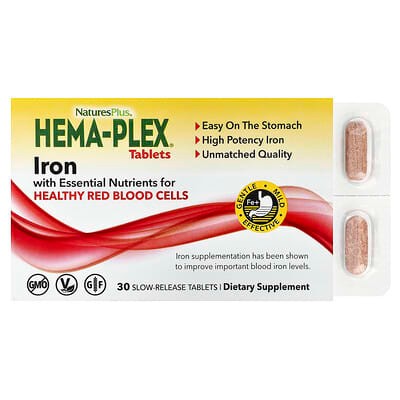

$12.54 $0.41 per serving


Product analysis
Hema-Plex Tablets combines iron with several vitamins and minerals for broader nutritional coverage. The undisclosed components of its added blend make that part of the formula harder to judge.
AI assessment of the formula, label and price. How scoring works
Nutrient Quality61
Natural-form vitamin E and methylfolate are useful distinctions among the named vitamin sources. Quality is less clear for the unidentified blend and several other contributions.
Ingredient Transparency77
The listed amounts and most forms are disclosed. The proprietary complex still does not identify its full components.
Value For Money50
Several vitamin and mineral contributions offer favorable value. Niacin, vitamin B5 and cysteine are less compelling at the same serving cost.
Customer Satisfaction97
Buyer ratings are very positive. The extensive number of ratings gives a broad picture of satisfaction.
Product Focus15
The formula spreads its attention across many nutrients and intended uses. Unknown blend components also prevent a complete account of the active composition.
- Format
Tablet - Container
- 30 Tablet(s)
- Per serving
- $0.41
- Customer rating
- 4.9 · 92,919 ratings
Goals

Impact
High effect
Vitamin B5 · 25 mgRiboflavin · 25 mgThiamin · 25 mgVitamin B12 · 500 mcgIron · 85 mg
Iron, folate and several B vitamins can help reduce fatigue when their intake is deficient, while vitamin C can address deficiency-related tiredness. These roles do not establish an additional energy boost in adequately nourished adults. The high declared iron amount does not establish more benefit above nutritional adequacy. Botanical mass does not supply a confirmed caffeine amount or prove an acute alertness effect.
How this product is rated for Energy
Ingredient fit72
Iron contributes a relevant declared amount, with formula focus and serving quantity shaping the ingredient finding.
Goal fit
Relevant ingredients sit within a broader formula containing ingredients aimed at other goals.
Dose adequacy
The serving provides a partial match to the saved amount comparisons, which are not clinical benefit percentages.
Pathways0
No energy pathway receives coverage. A nutrient contribution for deficiency-related fatigue remains separate from a stimulant effect or extra energy in adequate adults.
Depth
No energy pathway receives coverage; the nutrient contribution remains distinct from an alertness or general fatigue-relief effect.
Breadth
No energy area reaches the saved coverage target, so broad energy effects are not established.
Evidence98
Iron leads the saved evidence finding. The supplied context limits expectations according to nutrient status, preparation and the population studied.
Evidence strength
Iron provides the leading evidence contribution; its nutritional-status, population and preparation limits still determine the benefit that can be described.
Studied preparation
The included ingredients match the saved preparation comparisons; this does not establish a tested whole-product fatigue regimen.
Formulation logic100
The included ingredients meet the saved minimum amount comparisons, with no missing partner or configured conflict. These findings do not establish a combined benefit or overall safety.
Partner coverage
No missing required partner limits the included ingredients; this does not establish added benefit from combining them.
Conflicts
No configured ingredient conflict was identified; this does not establish overall safety or cover every possible interaction.
Effective doses
The included ingredients meet the saved minimum amount comparison, which is not proof of a clinically effective personal fatigue dose.
Vitamin B5 Not classified
No linked studies yet.

Impact
High effect
Zinc · 5 mgIron · 85 mgVitamin C · 300 mg
Iron can matter when iron deficiency contributes to diffuse shedding, but its amount here remains unresolved. Vitamin C supports normal collagen formation and iron absorption, while copper supports pigmentation and connective-tissue biology. These functions and the formula’s B vitamins do not establish independent regrowth; zinc and selenium fall below the saved inclusion criteria.
How this product is rated for Hair Health
Ingredient fit64
Relevant ingredients and their declared amounts shape this finding. The recognized amounts provide partial coverage of the supplied comparison anchors; unresolved amounts contribute nothing to this finding.
Goal fit
Relevant nutritional ingredients are present alongside a broader formula.
Dose adequacy
The recognized amounts provide partial coverage of the supplied comparison anchors; unresolved amounts contribute nothing to this finding.
Pathways44
The strongest recorded coverage concerns follicle antioxidant protection, rather than a demonstrated clinical hair outcome.
Depth
The strongest recorded coverage concerns follicle antioxidant protection, rather than a demonstrated clinical hair outcome.
Breadth
One named pathway reaches the supplied coverage criterion; broader coverage is limited.
Evidence78
Vitamin B12 provides the strongest recognized evidence contribution, subject to its specific hair-benefit limitations.
Evidence strength
Vitamin B12 provides the strongest recognized evidence contribution, subject to its specific hair-benefit limitations.
Studied preparation
The recognized preparations match those accepted in the saved comparison; that alone does not prove hair regrowth.
Formulation logic96
The saved findings identify no missing required partners or configured conflicts. The supplied amount criterion was not met for Iron.
Partner coverage
No missing required partner reduced the recognized ingredients’ contributions.
Conflicts
No configured ingredient conflict was recorded; this is not a general safety assessment.
Effective doses
The supplied amount criterion was not met for Iron.

Impact
Moderate effect
Iron · 85 mgVitamin B12 · 500 mcgVitamin B12 · 500 mcgVitamin B6 · 25 mgZinc · 5 mg
B6, B12 and folate provide the clearest relevant support through normal nutrient functions; correcting a shortfall may help fatigue or concentration. The iron amount is unresolved, and the small zinc amount adds little in the saved findings. Green tea's presence does not supply a quantified caffeine contribution.
How this product is rated for Productivity Boost
Ingredient fit50
The formula has a broad purpose, with only part of its ingredient mix directly relevant to this goal. The relevant amounts provide partial support, with smaller or unresolved amounts limiting the assessment.
Goal fit
The formula has a broad purpose, with only part of its ingredient mix directly relevant to this goal.
Dose adequacy
The relevant amounts provide partial support, with smaller or unresolved amounts limiting the assessment.
Pathways0
The saved findings identify nutritional support without a distinct alertness, memory or stress-fatigue route. The findings do not show broad support across several distinct aspects of productivity.
Depth
The saved findings identify nutritional support without a distinct alertness, memory or stress-fatigue route.
Breadth
The findings do not show broad support across several distinct aspects of productivity.
Evidence70
Vitamin B12 provides the strongest evidence contribution in the saved findings, with the scope and limitations of its supplied evidence retained. The saved findings recognize the relevant preparations at the assessed amounts.
Evidence strength
Vitamin B12 provides the strongest evidence contribution in the saved findings, with the scope and limitations of its supplied evidence retained.
Studied preparation
The saved findings recognize the relevant preparations at the assessed amounts.
Formulation logic94
No listed formulation conflict was matched in the saved findings. Some amounts limit the finding; Iron falls short or has an unresolved amount.
Partner coverage
The relevant ingredients can contribute without a missing required partner.
Conflicts
No listed formulation conflict was matched in the saved findings.
Effective doses
Some amounts limit the finding; Iron falls short or has an unresolved amount.

Impact
High effect
Niacin · 50 mgVitamin B12 · 500 mcgRiboflavin · 25 mgThiamin · 25 mgVitamin B5 · 25 mgVitamin B6 · 25 mgZinc · 5 mg
B vitamins help the body use carbohydrate, fat and protein through their normal cofactor roles. Those functions do not establish that extra vitamins raise energy expenditure when intake is adequate. Iron can matter when iron-deficiency anaemia lowers thyroid hormone and heat production, but its usable amount here is unknown. Green-tea presence and amount remain unresolved because the source declaration lacks matching imported facts, so no catechin or caffeine contribution can be inferred.
How this product is rated for Metabolism Support
Ingredient fit70
The ingredients receive recognition for their connection and amounts in the saved findings. Normal nutrient functions and comparison amounts do not establish a metabolic-rate increase.
Goal fit
Recognised ingredients share this formula with other actives, giving it a broader focus than metabolic rate alone.
Dose adequacy
Iron has no usable amount for comparison, while the other counted ingredients have substantial reference amounts.
Pathways0
No evaluated route to increased calorie expenditure receives recorded ingredient coverage.
Depth
No evaluated route to increased calorie expenditure receives recorded ingredient coverage.
Breadth
None of the evaluated routes has substantial recorded coverage, so broad support for increased energy expenditure is absent.
Evidence100
Vitamin B1 (Thiamin) leads the recorded evidence finding, but its normal metabolic role or other study outcomes do not establish thermogenesis.
Evidence strength
Vitamin B1 (Thiamin) leads the recorded evidence finding, but its normal metabolic role or other study outcomes do not establish thermogenesis.
Studied preparation
The counted ingredients receive preparation recognition in the saved finding, without establishing a direct energy-expenditure effect.
Formulation logic96
The counted ingredients have no missing required partners or identified conflicts among those evaluated. An unresolved amount limits that finding.
Partner coverage
No required ingredient partner is missing for the counted ingredients.
Conflicts
None of the evaluated conflicts was identified; the finding does not cover every possible interaction.
Effective doses
Iron has an unresolved usable amount and does not meet the minimum amount comparison.
Ingredients
| Ingredient | Amount per serving | Score |
|---|---|---|
Vitamin C (Proprietary Esterified Complex) | 300 mg | |
Vitamin E (D-Alpha-Tocopheryl Acetate) | 30 IU | |
Thiamine (Thiamine Hydrochloride) | 25 mg | |
Riboflavin | 25 mg | |
Niacin (Niacinamide) | 50 mg | |
Vitamin B6 (Pyridoxine Hydrochloride) | 25 mg | |
Folate (Calcium L-5-Methyltetrahydrofolate) | 400 mcg | |
Vitamin B12 (Methylcobalamin) | 500 mcg | |
Pantothenic Acid (Calcium Pantothenate) | 25 mg | |
Calcium Complex (Calcium Amino Acid Chelate) | 25 mg | |
Iron Complex (Iron Amino Acid Chelate) | 85 mg | |
Zinc (Zinc Monomethionine) | 5 mg | |
Selenium (Selenium Amino Acid Chelate) | 10 mcg | |
Copper (Copper Amino Acid Chelate) | 2 mg | |
Manganese Complex (Manganese Amino Acid Chelate) | 5 mg | |
L-Cysteine | 50 mg | |
Proanthoplex (Proprietary Proanthocyanidin/Bioflavonoid Complex) | 25 mg | |
Beet | 15 mg | |
Bioperine (1-Piperoylpiperidine) | 2.5 mg |
Manganese (Manganese Amino Acid Chelate) · 5 mg OverallScore84
Each serving lists 5 mg of manganese as manganese amino acid chelate. The saved facts identify an amino acid chelate but do not specify which one.
How this ingredient is rated
Active Ingredient Quality & Bioavailability70
The source is an amino acid chelate; the particular chelate is not specified in the saved facts.
Manganese Chemical Form
Manganese amino acid chelate is the identified source. The saved facts identify an amino acid chelate but do not specify which one.
Dose, Safety & Label Transparency100
Each serving lists 5 mg of manganese and identifies its source.
Manganese Dosage Efficacy & Safety
Each serving provides 5 mg of manganese.
Elemental Weight Disclosure
The saved facts identify 5 mg as manganese and specify its source.
Value80
A whole-product serving costs about $0.42.
Price per Serving vs. Median
A whole-product serving costs about $0.42.
Folate (Calcium L-5-Methyltetrahydrofolate) · 400 mcg OverallScore92
A serving lists 400 mcg of folate at a moderate cost per serving. It uses L-5-methyltetrahydrofolate calcium. The L form bypasses the MTHFR conversion step.
How this ingredient is rated
Active Ingredient Quality & Bioavailability91
The folate uses L-5-methyltetrahydrofolate calcium. It is an active form that bypasses the MTHFR conversion step.
Folate Form Hierarchy
It is an active form that bypasses the MTHFR conversion step.
Patented Sources & Isomeric Purity
The L designation indicates the active isomer; no named branded source is identified.
Dose, Safety & Label Transparency100
The serving declares 400 mcg of folate.
Folate Dosage by Declared Basis
The serving declares 400 mcg of folate.
Value80
The cost per serving is moderate.
Price per Bioavailable Serving
The cost per serving is moderate.
Copper (Copper Amino Acid Chelate) · 2 mg OverallScore67
A serving supplies 2 mg of copper as copper amino acid chelate. A serving also supplies 5 mg of zinc.
How this ingredient is rated
Active Ingredient Quality & Bioavailability58
The saved facts name copper amino acid chelate without establishing a more specific chemical identity. The saved facts give the elemental copper amount and name a source on the copper row.
Copper Form Bioavailability
The saved facts name copper amino acid chelate without establishing a more specific chemical identity.
Elemental Copper Labeling Clarity
The saved facts give the elemental copper amount and name a source on the copper row.
Dose, Safety & Label Transparency85
A serving supplies 2 mg of copper. A serving also supplies 5 mg zinc; its ratio to copper falls below the balance favored in the evaluation.
Copper Dosage Safety & Efficacy
A serving supplies 2 mg of copper.
Zinc-to-Copper Balance
A serving also supplies 5 mg zinc; its ratio to copper falls below the balance favored in the evaluation.
Value50
A whole-product serving costs about $0.42 and provides the stated copper amount.
Price Per Serving Efficiency
A whole-product serving costs about $0.42 and provides the stated copper amount.
Alternative products
Report alternatives
Sources
Published studies used for the product analysis and the top-ranked studies for each ingredient and goal.
- Large-dose intravenous ferric carboxymaltose injection for iron deficiency anemia in heavy uterine bleeding: a randomized, controlled trial.
- The Effect of Parenteral or Oral Iron Supplementation on Fatigue, Sleep, Quality of Life and Restless Legs Syndrome in Iron-Deficient Blood Donors: A Secondary Analysis of the IronWoMan RCT.
- Ferric carboxymaltose vs. oral iron in the treatment of pregnant women with iron deficiency anemia: an international, open-label, randomized controlled trial (FER-ASAP).
- Effect of iron therapy on fatigue symptoms in non-anaemic iron deficient women of reproductive age- A Randomized Controlled Trial.
- Intravenous iron isomaltoside treatment of women suffering from severe fatigue after postpartum hemorrhage.
- Physicochemical properties of and volatile compounds in riboflavin fortified cloudy apple juice; study of its effect on job fatigue among Egyptian construction workers.
- Vitamin B status in patients with chronic fatigue syndrome.
- B-vitamins, related vitamers, and metabolites in patients with quiescent inflammatory bowel disease and chronic fatigue treated with high dose oral thiamine.
- Metabolic features of chronic fatigue syndrome.
- Effectiveness of Riboflavin in Inherited Metabolic Diseases: A Systematic Review
- Influence of thiamin supplementation on the health and general well-being of an elderly Irish population with marginal thiamin deficiency.
- Randomised clinical trial: high-dose oral thiamine versus placebo for chronic fatigue in patients with quiescent inflammatory bowel disease.
- Dietary reference values for thiamin.
- Effects of thiamine supplementation on exercise-induced fatigue.
- Long-term maintenance treatment with 300 mg thiamine for fatigue in patients with inflammatory bowel disease: results from an open-label extension of the TARIF study.
- A new perspective on vitamin B12 deficiency in rheumatology: a case-based review.
- Effects of Vitamin B12 Supplementation on Cognitive Function, Depressive Symptoms, and Fatigue: A Systematic Review, Meta-Analysis, and Meta-Regression.
- Patients' experiences with methylcobalamin injections in amyotrophic lateral sclerosis.
- Cobalamin deficiency: clinical picture and radiological findings.
- Vitamin B12 Deficiency: Common Questions and Answers.