
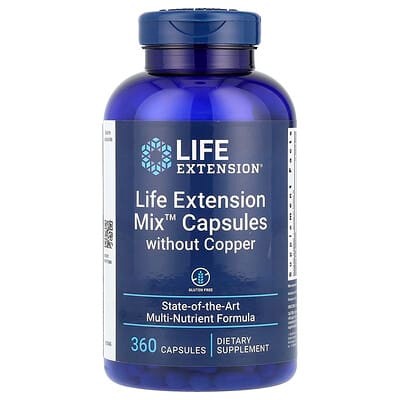
Life Extension Mix Capsules without Copper

Goals
$58.50 $1.95 per serving


Product analysis
Life Extension Mix Capsules without Copper provides broad nutritional support for normal immune and metabolic functions when dietary intake is low. Its very complex mixture and missing component breakdowns make individual contributions difficult to judge.
AI assessment of the formula, label and price. How scoring works
Nutrient Quality40
Several B vitamins, iodine and zinc have favorable or clearly described forms. Magnesium and selenium mix higher and lower quality forms without proportions, while many other preparations remain uncertain.
Ingredient Transparency71
All listed amounts and most ingredient forms are stated. Fifteen mixtures lack component breakdowns, leaving the share of each form unclear.
Value For Money33
Many vitamins, minerals and plant ingredients are relatively costly within the full serving. Moderate value for some B vitamins does not establish good value for the complete mixture.
Customer Satisfaction75
Customers are very positive about their purchases. Several hundred ratings offer a useful view of satisfaction, without showing whether the supplement works.
Product Focus0
The formula mainly supports normal nutrient functions when intake is inadequate. Its very broad ingredient list dilutes a targeted purpose, and the high B6 amount raises a suitability concern.
- Format
Capsule - Container
- 360 Capsule(s)
- Per serving
- $1.95
- Customer rating
- 4.8 · 167 ratings
Goals

Impact
Highest effect
Folate · 400 mcg DFEVitamin B12 · 600 mcgVitamin B6 · 105 mgMolybdenum · 125 mcgSelenium · 200 mcgMagnesium · 420 mgVitamin E · 60 mgZinc · 35 mgVitamin C · 970 mgTaurine · 200 mgRiboflavin · 50 mg
Folate supports methyl-group metabolism; low folate can impair elimination of arsenic in exposed adults, but the supplied findings do not establish routine toxin removal in adequately nourished people. Selenium has limited mercury-related findings in low-selenium or exposed groups. NAC’s glutathione-precursor role does not establish general toxin clearance from routine supplementation.
How this product is rated for Liver & Detox
Ingredient fit57
The formula includes nutrients counted for this goal alongside many ingredients serving broader purposes. Serving amounts provide differing matches to the supplied reference amounts; these comparisons do not identify proven routine toxin-clearance doses.
Goal fit
The formula includes nutrients counted for this goal alongside many ingredients serving broader purposes.
Dose adequacy
Serving amounts provide differing matches to the supplied reference amounts; these comparisons do not identify proven routine toxin-clearance doses.
Pathways100
The strongest represented area is glutathione and conjugation, reflecting ingredient roles rather than demonstrated toxin clearance.
Depth
The strongest represented area is glutathione and conjugation, reflecting ingredient roles rather than demonstrated toxin clearance.
Breadth
The represented coverage includes liver cell integrity and fat export, glutathione and conjugation, methyl-group supply, detox-enzyme induction. This does not establish removal of unspecified toxins.
Evidence98
Vitamin B9 (Folate) leads the saved evidence comparison; the supplied findings remain limited to their nutritional or disease-specific contexts.
Evidence strength
Vitamin B9 (Folate) leads the saved evidence comparison; the supplied findings remain limited to their nutritional or disease-specific contexts.
Studied preparation
Preparation matching is incomplete for Molybdenum, Vitamin B2 (Riboflavin), Vitamin B6.
Formulation logic100
The counted ingredients meet the saved minimum amount check, which is not evidence of a clinically effective routine detoxification dose.
Partner coverage
No required partner is missing among the counted ingredients; this does not establish added detoxification benefit from their combination.
Conflicts
No configured ingredient conflict was identified from the supplied facts.
Effective doses
The counted ingredients meet the saved minimum amount check, which is not evidence of a clinically effective routine detoxification dose.
Riboflavin Not classified
No linked studies yet.
Vitamin B6 Not classified
No linked studies yet.

Impact
High effect
Magnesium · 420 mgVitamin B12 · 600 mcgVitamin B6 · 105 mgTaurine · 200 mgGreen Tea · 325 mgFolate · 400 mcg DFEVitamin D · 50 mcg
Magnesium contributes to vascular tone, although blood-pressure effects are small and inconsistent. Thiamin and selenium can fill dietary gaps relevant to deficiency-related heart problems, without established added benefit when intake is adequate. B vitamins support homocysteine handling rather than proven event prevention. Green-tea lipid findings are preparation-specific; low taurine and grape-seed amounts and an unresolved quercetin amount limit their contribution.
How this product is rated for Heart Health
Ingredient fit52
Several recognized ingredients sit within a broad formula linked to many purposes. Most recognized amounts contribute, but the unresolved quercetin amount limits support and several vascular ingredients are too small to count.
Goal fit
Several recognized ingredients sit within a broad formula linked to many purposes.
Dose adequacy
Most recognized amounts contribute, but the unresolved quercetin amount limits support and several vascular ingredients are too small to count.
Pathways100
Homocysteine handling is the strongest saved finding, alongside vascular function and electrolyte balance. These distinct measurements do not establish fewer heart events.
Depth
Homocysteine handling is the strongest saved finding, alongside vascular function and electrolyte balance.
Breadth
Vascular function, electrolyte balance and homocysteine handling each meet the saved coverage criterion.
Evidence92
Green tea leads the saved evidence finding, but lipid findings depend on a specific preparation and do not establish routine cardiovascular prevention.
Evidence strength
Green tea leads the saved evidence finding, but lipid findings depend on a specific preparation and do not establish routine cardiovascular prevention.
Studied preparation
The saved result recognizes the preparations of the ingredients retained for this check; that recognition does not broaden their demonstrated benefits.
Formulation logic98
The recognized ingredients do not lack a required partner, and no configured conflict was matched. Quercetin's unresolved amount limits the amount check.
Partner coverage
The recognized ingredients can contribute alone or have their required partner; no missing-partner limitation was found.
Conflicts
No configured ingredient conflict was matched in the supplied facts; this check does not establish general safety.
Effective doses
The other recognized ingredients meet the amount criterion; quercetin's unresolved amount does not.

Impact
Highest effect
Magnesium · 420 mgVitamin C · 970 mgZinc · 35 mgVitamin A · 1500 mcg RAEVitamin D · 50 mcgSelenium · 200 mcg
Vitamin A supports normal protective barriers, while zinc, vitamin D and selenium contribute to normal immune function. Folate, B6 and B12 can help maintain immune-cell function when intake is low. Vitamin C adds cautiously bounded support for shorter colds with regular use. Vitamin E, magnesium and green tea receive saved contributions, but their supplied context does not establish routine additional immune benefits or preparation equivalence.
How this product is rated for Immunity
Ingredient fit62
The selected serving makes a partial contribution against the comparison amounts, with differences between ingredients and any unresolved quantities retained.
Goal fit
The immune-related ingredients share the formula with other actives, so the formula is less concentrated on this goal.
Dose adequacy
The selected serving makes a partial contribution against the comparison amounts, with differences between ingredients and any unresolved quantities retained.
Pathways100
The most represented area is barrier and antimicrobial defense.
Depth
The most represented area is barrier and antimicrobial defense.
Breadth
The more substantially represented areas are barrier and antimicrobial defense, innate immune cell activity, lymphocyte function and immune regulation, oxidative and inflammatory balance.
Evidence99
Vitamin C supplies the strongest recognized basis here; the supplied context limits which clinical immune benefits can be claimed.
Evidence strength
Vitamin C supplies the strongest recognized basis here; the supplied context limits which clinical immune benefits can be claimed.
Studied preparation
Green tea is not recognized as a studied preparation; the other recognized ingredients meet the saved preparation check.
Formulation logic100
No defined ingredient-conflict condition was triggered by the supplied facts.
Partner coverage
The recognized ingredients can contribute independently or have required partners present; no additional combined benefit is established.
Conflicts
No defined ingredient-conflict condition was triggered by the supplied facts.
Effective doses
All recognized ingredients meet the minimum amount check; this is not a proven treatment threshold.

Impact
Highest effect
Folate · 400 mcg DFEVitamin B12 · 600 mcgVitamin D · 50 mcgMagnesium · 420 mgBoron · 3 mgSelenium · 200 mcgTaurine · 200 mgAshwagandha · 125 mgZinc · 35 mgVitamin C · 970 mg
B vitamins support normal metabolism, while folate and B12 contribute to blood formation. Magnesium and vitamin D contribute to mineral nutrition, and vitamin C, zinc and selenium support normal antioxidant and immune functions when intake is low. These nutritional contributions do not establish added benefits above adequate intake. Calcium did not qualify for contribution, and the serving's 105 mg of vitamin B6 triggers a high-amount concern in the saved findings.
How this product is rated for Everyday Health
Ingredient fit68
The formula contains many relevant nutrients but also numerous other actives. Most credited nutrient amounts are substantial.
Goal fit
Relevant nutrients share the formula with many other actives, reducing focus on this goal.
Dose adequacy
Most credited amounts are substantial; calcium and several botanical or other actives fall below the saved contribution threshold.
Pathways100
Nutrients span metabolism, blood formation, mineral nutrition and antioxidant or immune functions.
Depth
Combined coverage is strongest in normal energy metabolism.
Breadth
Four nutritional areas have substantial coverage.
Evidence86
Magnesium leads the saved evidence finding, chiefly for filling an intake gap. Credited preparations meet the saved criteria.
Evidence strength
Magnesium provides the strongest saved support, limited to its supported nutritional role.
Studied preparation
Credited preparations meet the saved criteria, without establishing particular forms as superior.
Formulation logic93
Credited nutrients clear the amount threshold and have no missing required partners. High vitamin B6 raises a formulation concern.
Partner coverage
Every credited nutrient works alone or has its relevant partner.
Conflicts
Vitamin B6 at 105 mg per serving triggers the saved high-amount concern.
Effective doses
All credited nutrients clear the saved minimum amount threshold.

Impact
High effect
Vitamin D · 50 mcgVitamin E · 60 mgTaurine · 200 mgVitamin C · 970 mgGreen Tea · 325 mg
Vitamins C and E and selenium contribute antioxidant functions, while magnesium and zinc may help address inflammation associated with low nutrient status. Vitamin C's inflammation-marker signal was limited to elevated baseline CRP, and vitamin D findings were transient rather than consistent. These nutrient roles do not establish added anti-inflammatory benefit when intake is adequate. Green tea adds a limited biomarker connection, with most inflammatory markers unchanged in the supplied trial.
How this product is rated for Inflammation
Ingredient fit52
The relevant contribution comes from the vitamins and minerals. The broad formula and varied nutrient amounts limit its focus on this goal.
Goal fit
Several relevant nutrients sit within a broad formula containing many ingredients directed toward other goals.
Dose adequacy
The contributing nutrients have mixed amount comparisons; some reach the saved reference range while others contribute less.
Pathways80
The main connection involves oxidative stress and inflammatory gene signalling. Two types of mechanisms are represented.
Depth
The strongest connection is to oxidative stress and inflammatory gene signalling; this describes the supplied mechanism findings rather than a proven clinical outcome.
Breadth
The findings cover oxidative stress and inflammatory gene signalling, while fatty-acid mediator and enzyme-inhibition pathways are not covered.
Evidence96
Vitamin E leads the saved evidence finding, but antioxidant function alone does not establish routine clinical anti-inflammatory benefit.
Evidence strength
Vitamin E leads the saved evidence finding, but antioxidant function alone does not establish routine clinical anti-inflammatory benefit.
Studied preparation
The saved finding accepts the contributing preparation comparison; this does not remove the population and clinical-outcome limitations.
Formulation logic100
The contributing ingredients have no unmet partner requirement or identified conflict, and meet the retained amount threshold.
Partner coverage
The contributing ingredients have no unmet partner requirement in the supplied findings.
Conflicts
No ingredient conflict was identified in the supplied calculation.
Effective doses
All retained contributors meet the saved amount threshold; lower-amount ingredients do not add further contributions.
Luteolin Not classified
No linked studies yet.

Impact
High effect
Biotin · 3000 mcgNiacin · 190 mg NEVitamin B12 · 600 mcgRiboflavin · 50 mgThiamin · 125 mgVitamin B5 · 600 mgVitamin B6 · 105 mgVitamin D · 50 mcgZinc · 35 mgMagnesium · 420 mgGreen Tea · 325 mg
Iodine supports thyroid hormone production when intake is deficient; additional iodine does not establish a faster metabolic rate when intake is adequate. Green tea catechin preparations have limited, mixed evidence for a small short-term rise in energy expenditure. Extract mass alone does not establish the studied catechin and caffeine exposure.
How this product is rated for Metabolism Support
Ingredient fit64
The saved findings count relevant ingredient amounts within a broader formula aimed at several needs.
Goal fit
The saved findings count relevant ingredient amounts within a broader formula aimed at several needs.
Dose adequacy
The declared serving amounts receive substantial consideration; this compares amounts with supplied reference ranges, without proving a metabolism-related effect.
Pathways42
The strongest saved connection is to adrenergic drive, based on the counted ingredients; this does not itself demonstrate increased energy expenditure. One metabolism-related-related area reaches the saved coverage threshold, leaving the other areas less represented.
Depth
The strongest saved connection is to adrenergic drive, based on the counted ingredients; this does not itself demonstrate increased energy expenditure.
Breadth
One metabolism-related-related area reaches the saved coverage threshold, leaving the other areas less represented.
Evidence100
Vitamin B1 (Thiamin) provides the strongest saved evidence contribution here; its population and outcome limitations still apply.
Evidence strength
Vitamin B1 (Thiamin) provides the strongest saved evidence contribution here; its population and outcome limitations still apply.
Studied preparation
The counted ingredients meet the saved preparation criteria; this does not make all labelled forms interchangeable with every clinical trial.
Formulation logic100
All counted ingredients meet the saved minimum amount criterion; this does not establish proven thermogenic doses.
Partner coverage
The counted ingredients require no missing partner under the supplied findings; this does not imply an added benefit from combining them.
Conflicts
No listed ingredient conflict was matched in the supplied findings; this does not establish medication compatibility.
Effective doses
All counted ingredients meet the saved minimum amount criterion; this does not establish proven thermogenic doses.
Ashwagandha Not classified
No linked studies yet.
Ingredients
| Ingredient | Amount per serving | Score |
|---|---|---|
Vitamin A (Beta-Carotene, Vitamin A Acetate) | 1500 mcg RAE | |
Vitamin C (Acerola Extract, Ascorbic Acid, Ascorbyl Palmitate, Calcium Ascorbate, Magnesium Ascorbate, Niacinamide Ascorbate) | 970 mg | |
Vitamin D3 (Cholecalciferol) | 50 mcg | |
Vitamin E (D-Alpha-Tocopherol, D-Alpha-Tocopheryl Succinate) | 67 mg | |
Thiamine (Thiamine Hydrochloride) | 125 mg | |
Riboflavin (Riboflavin 5-Phosphate) | 50 mg | |
Niacin (Niacinamide, Niacinamide Ascorbate) | 190 mg NE | |
Vitamin B6 | 105 mg | |
Folate (L-5-Methyltetrahydrofolate, Calcium Salt) | 400 mcg DFE | |
Vitamin B12 (Methylcobalamin) | 600 mcg | |
Biotin | 3000 mcg | |
Pantothenic Acid (D-Calcium Pantothenate) | 600 mg | |
Calcium (Calcium Ascorbate, Calcium D-Glucarate, Calcium D-Pantothenate, Dicalcium Phosphate) | 140 mg | |
Iodine (Potassium Iodide) | 150 mcg | |
Magnesium (Magnesium Arginate, Magnesium Ascorbate, Magnesium Citrate, Magnesium Glycinate, Magnesium Oxide, Magnesium Taurinate) | 420 mg | |
Zinc (L-OptiZinc Zinc Mono-L-Methionine Sulfate, Zinc Citrate) | 35 mg | |
Selenium (Se-Methyl L-Selenocysteine, SelenoExcell High Selenium Yeast, Sodium Selenite) | 200 mcg | |
Manganese (Manganese Citrate, Manganese Gluconate) | 1 mg | |
Chromium (Crominex 3+ Chromium) | 500 mcg | |
Molybdenum (Molybdenum Amino Acid Chelate) | 125 mcg | |
Potassium (Potassium Citrate) | 35 mg | |
Broccoli Concentrate Blend | 725 mg | |
N-Acetyl-L-Cysteine | 600 mg | |
decaffeinated Green Tea extract (Epigallocatechin Gallate) | 325 mg | |
Acerola extract | 300 mg | |
Inositol | 250 mg | |
Bitter Orange Citrus Bioflavonoids (Hesperidin) | 200 mg | |
Fruit/Berry Proprietary Blend | 200 mg | |
Taurine | 200 mg | |
Wild Blueberry Anthocyanin extract | 150 mg | |
Sensoril Ashwagandha extract (Glycoside Conjugates, Oligosaccharides) | 125 mg | |
Silymarin (Milk Thistle extract) | 100 mg | |
Trimethylglycine (Betaine Anhydrous) | 100 mg | |
CherryPure Sour Cherry (Tart Cherry) Proanthocyanidin extract | 85 mg | |
Pomella Pomegranate extract (Punicalagins) | 85 mg | |
natural Mixed Tocopherols (Alpha-Tocopherol, Beta-Tocopherol, Delta Tocopherol, Gamma-Tocopherol) | 60 mg | |
MirtoSelect Bilberry extract | 30 mg | |
BioVin Grape Proanthocyanidin extract | 25 mg | |
Leucoselect Grape seed Proanthocyanidin extract | 25 mg | |
Bio-Quercetin Phytosome | 15 mg | |
Bromelain (Pineapple) | 15 mg | |
Lutein (Marigold extract) | 15 mg | |
Olive extract (Hydroxytyrosol, Oleuropein, Polyphenols, Tyrosol) | 12.5 mg | |
Sesame seed Lignan extract | 10 mg | |
Luteolin (Orange extract) | 8 mg | |
Apigenin | 5 mg | |
Boron (Boron Amino Acid Chelate) | 3 mg | |
Lycopene (LycoBeads natural Tomato extract) | 3 mg | |
Delphinidins (Delphinol Maqui berry (Aristotelia chilensis) extract) | 2 mg | |
Cyanidin-3-Glucoside (Black Currant extract) | 1.25 mg |
Iodine (Potassium Iodide) · 150 mcg OverallScore84
Chromium (Crominex 3+ Chromium) · 500 mcg OverallScore48
Alternative products
Report alternatives
Sources
Published studies used for the product analysis and the top-ranked studies for each ingredient and goal.
- [Comparative study of the urinary excretion of boron, calcium, magnesium and phosphorus in postmenopausal women with and without osteoporosis].
- Effect of dietary boron on mineral, estrogen, and testosterone metabolism in postmenopausal women.
- The relationship between boron and magnesium status and bone mineral density in the human: a review.
- Effects of boron supplementation on bone mineral density and dietary, blood, and urinary calcium, phosphorus, magnesium, and boron in female athletes.
- Metabolic responses of postmenopausal women to supplemental dietary boron and aluminum during usual and low magnesium intake: boron, calcium, and magnesium absorption and retention and blood mineral concentrations
- What is the impact of daily oral supplementation of vitamin D3 (cholecalciferol) plus calcium on the incidence of hip fracture in older people? A systematic review and meta-analysis.
- Calcium supplementation prevents seasonal bone loss and changes in biochemical markers of bone turnover in elderly New England women: a randomized placebo-controlled trial.
- The effects of calcium supplementation (milk powder or tablets) and exercise on bone density in postmenopausal women.
- The efficacy of calcium supplementation alone in elderly Thai women over a 2-year period: a randomized controlled trial.
- Calcium-enriched foods and bone mass growth in prepubertal girls: a randomized, double-blind, placebo-controlled trial.
- Association between RBC folate and lumbar bone mineral density in postmenopausal women, a cross-sectional study from NHANES 2009-2018.
- Genetic variants modify the associations of concentrations of methylmalonic acid, vitamin B-12, vitamin B-6, and folate with bone mineral density.
- Adequate Intake and Supplementation of B Vitamins, in Particular Folic Acid, can Play a Protective Role in Bone Health.
- Relation of homocysteine, folate, and vitamin B12 to bone mineral density of postmenopausal women.
- Dietary intake of folate, but not vitamin B2 or B12, is associated with increased bone mineral density 5 years after the menopause: results from a 10-year follow-up study in early postmenopausal women.
- Association between Serum Magnesium and Fractures: A Systematic Review and Meta-Analysis of Observational Studies.
- Bioabsorbable Magnesium-Based Materials Potential and Safety in Bone Surgery: A Systematic Review.
- Vascularized bone grafting fixed by biodegradable magnesium screw for treating osteonecrosis of the femoral head.
- An update on magnesium and bone health.
- Sex-specific differences in the association of magnesium intake with femoral neck bone mineral density among older adults.