
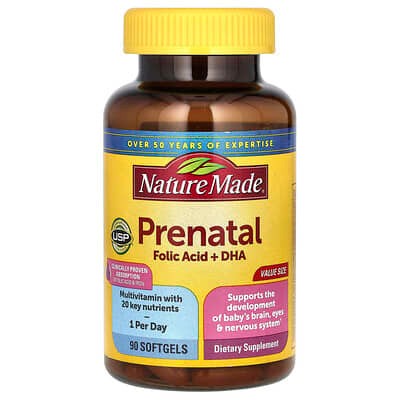

$23.89 $0.26 per serving


Product analysis
Prenatal Multi + DHA offers broad nutritional support, including iron that can help with fatigue when iron levels are low.
AI assessment of the formula, label and price. How scoring works
Nutrient Quality37
Iodine is supplied in a favorable named form, while many other nutrients cannot be confidently compared for absorption. The fish-oil description does not establish the omega-3 fats’ molecular form, and several vitamin forms are unnamed.
Ingredient Transparency91
The listed nutrition amounts are provided, and most ingredient forms are named. Several forms are missing, while the magnesium amount remains unresolved for judging its contribution.
Value For Money47
The iron and iodine contributions offer favorable value, and omega-3 value appears moderate. Value for most of the other nutrients remains uncertain without usable comparisons.
Customer Satisfaction83
Customer ratings are positive across a large review base. No specific experiences are described, so the feedback cannot explain which features buyers found helpful.
Product Focus43
The formula provides broad nutritional support, with iron and B vitamins most relevant to energy when a shortfall is present. The modest calcium contribution and unresolved magnesium amount mean it should not be assumed to cover all bone-related nutritional needs.
- Format
Softgel - Container
- 90 Softgel(s)
- Per serving
- $0.26
- Also available
 Prenatal Multi + DHA 200mg$20.24
- Customer rating
- 4.5 · 3,377 ratings
Goals

Impact
Moderate effect
Iodine · 150 mcgVitamin D · 25 mcgVitamin B5 · 6 mgMagnesium · 45 mgRiboflavin · 1.4 mgThiamin · 1.4 mgVitamin B12 · 5.2 mcgIron · 27 mg
Iron at 27 mg supports oxygen transport and can matter for fatigue when low iron status is corrected. B vitamins, folate and vitamin C add energy-related nutritional support. Magnesium has an unresolved amount, and additional energy is not assumed for someone with adequate nutrient status.
How this product is rated for Energy
Ingredient fit68
Several assessed ingredients support energy-related nutritional needs. The amounts provide partial alignment with the saved exposure comparison.
Goal fit
Several assessed ingredients support energy-related nutritional needs.
Dose adequacy
The amounts provide partial alignment with the saved exposure comparison.
Pathways0
No specific energy mechanism has meaningful coverage in the saved findings. The findings do not show broad coverage of the assessed energy mechanisms.
Depth
No specific energy mechanism has meaningful coverage in the saved findings.
Breadth
The findings do not show broad coverage of the assessed energy mechanisms.
Evidence97
Iron provides the strongest assessed evidence contribution at its amount. Most preparations match the saved criteria, with Iodine remaining unmatched to a studied preparation.
Evidence strength
Iron provides the strongest assessed evidence contribution at its amount.
Studied preparation
Most preparations match the saved criteria, with Iodine remaining unmatched to a studied preparation.
Formulation logic98
10 assessed ingredients meet the saved minimum amount comparison; Magnesium has an unresolved amount or falls below it. No assessed conflict was identified.
Partner coverage
The assessed ingredients can contribute independently or have their required partner.
Conflicts
No conflict was identified by the supplied ingredient checks.
Effective doses
10 assessed ingredients meet the saved minimum amount comparison; Magnesium has an unresolved amount or falls below it.
Vitamin B5 Not classified
No linked studies yet.

Impact
Moderate effect
Biotin · 30 mcgVitamin D · 25 mcgZinc · 11 mgIron · 27 mgVitamin C · 85 mg
Iron may help with diffuse shedding when a shortage of iron is behind it. The amount on a label can't tell you whether your iron stores are low or which replacement regimen you need. Taking iron when you already have enough isn't expected to produce extra hair regrowth. Zinc offers a similar deficiency-related connection to shedding.
How this product is rated for Hair Health
Ingredient fit64
Zinc is most relevant to shedding associated with low zinc intake.
Goal fit
Zinc is most relevant to shedding associated with low zinc intake.
Dose adequacy
Thiamin (B1): 1.4 mg; Riboflavin (B2): 1.4 mg; Pantothenic acid (B5): 6 mg. These are amounts per selected label serving, not instructions for daily use.
Pathways0
No specific hair-related pathway is identified. A nutrient role alone does not imply hair regrowth.
Depth
No specific hair-related pathway is identified for these ingredients.
Breadth
The ingredients do not demonstrate broad action across the named hair-related processes.
Evidence97
Zinc is most relevant to shedding associated with low zinc intake.
Evidence strength
Zinc is most relevant to shedding associated with low zinc intake.
Studied preparation
The iodine preparation has uncertain direct benefit for hair loss.
Formulation logic94
No missing ingredient partner or particular conflict is identified. The ingredient amounts do not by themselves guarantee improved hair growth.
Partner coverage
No missing ingredient partner is identified for the ingredients described here.
Conflicts
No particular ingredient conflict is identified.
Effective doses
Some ingredient amounts or identities remain unresolved, which limits a dose-specific interpretation.

Impact
High effect
Vitamin K · 90 mcgMagnesium · 45 mgCalcium · 150 mgVitamin D · 25 mcgZinc · 11 mgVitamin C · 85 mg
Vitamin D supports calcium handling and normal mineralization when vitamin D is insufficient. Calcium supplies a small mineral top-up, but its 150 mg serving falls below the saved inclusion threshold, and the magnesium amount is unresolved. Vitamin C supports collagen formation when intake is deficient; its amount also falls below that threshold. K1 does not inherit the supplied MK-7-specific bone-density findings.
How this product is rated for Bone Health
Ingredient fit57
Several bone-related nutrients sit within a broad multivitamin formula, so its focus extends well beyond bone health.
Goal fit
Several bone-related nutrients sit within a broad multivitamin formula, so its focus extends well beyond bone health.
Dose adequacy
Amounts are uneven, and unresolved magnesium and omega-3 quantities limit the saved dose finding.
Pathways80
The strongest saved finding concerns bone-matrix formation, including zinc and other nutrient cofactors. Calcium regulation and matrix formation are represented; mineral supply and bone-protein activation remain more limited.
Depth
The strongest saved finding concerns bone-matrix formation, including zinc and other nutrient cofactors.
Breadth
Calcium regulation and matrix formation are represented; mineral supply and bone-protein activation remain more limited.
Evidence98
Zinc leads the saved evidence finding, although its role in bone-forming enzymes does not establish extra bone benefit in adequately nourished adults.
Evidence strength
Zinc leads the saved evidence finding, although its role in bone-forming enzymes does not establish extra bone benefit in adequately nourished adults.
Studied preparation
The counted ingredients match the preparations accepted in the saved comparison; this does not establish fracture prevention.
Formulation logic91
Vitamin D lacks a sufficiently counted calcium partner despite calcium being present.
Partner coverage
Vitamin D lacks a sufficiently counted calcium partner despite calcium being present.
Conflicts
No configured ingredient conflict was identified.
Effective doses
Magnesium and omega-3 lack resolved amounts and do not meet the saved amount threshold; the other counted ingredients do.

Impact
Moderate effect
Iron · 27 mgVitamin B12 · 5.2 mcgVitamin B12 · 5.2 mcgVitamin B6 · 1.9 mgZinc · 11 mgMagnesium · 45 mgOmega-3 · 260 mg
Iron, folate and vitamin B12 support nutritional needs relevant to fatigue and concentration when intake is low. The B vitamins also support normal energy metabolism; the supplied omega-3 evidence gives limited grounds for expecting routine work improvement, and the magnesium amount is unresolved.
How this product is rated for Productivity Boost
Ingredient fit49
The ingredient mix serves broader needs, so only part of it relates directly to this goal. Low or unresolved amounts limit support against the saved targets.
Goal fit
The ingredient mix serves broader needs, so only part of it relates directly to this goal.
Dose adequacy
Low or unresolved amounts limit support against the saved targets.
Pathways13
The saved findings concentrate on brain-cell maintenance, with limited overall coverage.
Depth
The saved findings concentrate on brain-cell maintenance, with limited overall coverage.
Breadth
No area reaches the saved threshold for broad coverage.
Evidence91
Zinc provides the strongest evidence contribution among the counted ingredients. The supplied evidence should not be read as a prediction of improved work output.
Evidence strength
Zinc provides the strongest evidence contribution among the counted ingredients. The supplied evidence should not be read as a prediction of improved work output.
Studied preparation
The saved findings recognize the counted effective preparations as matching the evidence.
Formulation logic94
No listed ingredient conflict was identified in the saved check. Magnesium limits the consistency of the declared amounts.
Partner coverage
The counted ingredients can contribute independently or have the required partner.
Conflicts
The saved check identified no listed ingredient conflict; this is not a general safety assessment.
Effective doses
3 of 4 counted ingredients meet the saved minimum amount threshold; Magnesium falls short or has an unresolved amount.

Impact
High effect
Vitamin K · 90 mcgMagnesium · 45 mgVitamin D · 25 mcgVitamin B12 · 5.2 mcgVitamin B6 · 1.9 mgVitamin E · 15 mgFolate · 1330 mcg DFENiacin · 18 mgVitamin C · 85 mg
DHA provides a limited connection to triglyceride metabolism, though the amount per serving is well below exposures used in the supplied purified-fatty-acid trial. Folate and the B vitamins participate in homocysteine metabolism, but lowering that marker does not establish general cardiovascular-event prevention. Thiamin supports heart function when intake is deficient; extra intake has no established cardiovascular benefit once needs are met.
How this product is rated for Cardiovascular Support
Ingredient fit53
The B vitamins provide a homocysteine-related connection within a broader nutritional formula.
Goal fit
The B vitamins provide a homocysteine-related connection within a broader nutritional formula.
Dose adequacy
The MK-7 amount makes a partial contribution relative to the studied exposure.
Pathways58
Homocysteine metabolism is the strongest route in the saved findings, without establishing a corresponding reduction in cardiovascular events.
Depth
Homocysteine metabolism is the strongest route in the saved findings, without establishing a corresponding reduction in cardiovascular events.
Breadth
Only one route has substantial coverage in the saved findings; broader cardiovascular effects are not established.
Evidence83
The saved findings give the declared fatty acids the strongest evidence standing, chiefly for triglyceride markers.
Evidence strength
The saved findings give the declared fatty acids the strongest evidence standing, chiefly for triglyceride markers.
Studied preparation
The saved findings accept the eligible preparations; this does not transfer every trial outcome to this product.
Formulation logic95
The counted ingredients can contribute alone or have the partner required by the saved findings.
Partner coverage
The counted ingredients can contribute alone or have the partner required by the saved findings.
Conflicts
No evaluated ingredient conflict was found in the supplied facts.
Effective doses
The unresolved magnesium amount does not clear the contribution threshold; the other counted ingredients do.
Ingredients
| Ingredient | Amount per serving | Score |
|---|---|---|
Calories | 5 Calorie(s) | |
Vitamin A (Beta-Carotene) | 770 mcg | |
Vitamin C (Ascorbic Acid) | 85 mg | |
Vitamin D3 (Cholecalciferol) | 25 mcg | |
Vitamin E (DL-Alpha-Tocopheryl Acetate) | 15 mg | |
Vitamin K (Phytonadione) | 90 mcg | |
Thiamine (Thiamine Mononitrate) | 1.4 mg | |
Riboflavin | 1.4 mg | |
Niacin (Niacinamide) | 18 mg | |
Vitamin B6 (Pyridoxine Hydrochloride) | 1.9 mg | |
Folate | 1330 mcg DFE | |
Vitamin B12 (Cyanocobalamin) | 5.2 mcg | |
Biotin | 30 mcg | |
Pantothenic Acid (D-Calcium Pantothenate) | 6 mg | |
Calcium (Calcium Carbonate) | 150 mg | |
Iron (Ferrous Fumarate) | 27 mg | |
Iodine (Potassium Iodide) | 150 mcg | |
Magnesium Oxide | 45 mg | |
Zinc (Zinc Oxide) | 11 mg | |
Omega-3 Fatty Acids (Fish Oil) | 260 mg |
Iodine (Potassium Iodide) · 150 mcg OverallScore96
Each serving provides 150 mcg of iodine as potassium iodide, a form the evaluation views favorably. A whole-product serving costs about $0.27.
How this ingredient is rated
Active Ingredient Quality & Bioavailability100
The identified iodine form is potassium iodide, which the evaluation views favorably. No marine source is identified for the marine-specific check.
Iodine Form & Bioavailability
Potassium iodide is the identified iodine form; the evaluation views it favorably.
Marine Source Purity & Sourcing
No marine source is identified in the saved facts, so the marine-specific check is not applicable; this does not establish purity.
Dose, Safety & Label Transparency100
The label states 150 mcg of elemental iodine per serving. The evaluation does not flag that amount as exceeding its safety limit.
Dosage Efficacy for Daily Support
The 150 mcg of iodine per serving is an amount the evaluation views favorably.
Dosage Safety & Upper Limits
The evaluation does not flag the labeled serving amount as exceeding its safety limit.
Elemental Iodine Transparency
The label specifies 150 mcg of elemental iodine per serving.
Value80
A whole-product serving costs about $0.27.
Price Per Effective Serving
A whole-product serving costs about $0.27.
Iron (Ferrous Fumarate) · 27 mg OverallScore69
Each serving supplies 27 mg of iron as ferrous fumarate, a standard form. Zinc is also present and may compete with iron absorption despite the vitamin C in the formula.
How this ingredient is rated
Active Ingredient Quality & Bioavailability31
Ferrous fumarate is a standard form that may be harder on digestion than some chelated forms. Zinc is also present and may compete with iron absorption.
Iron Chemical Form & Bioavailability
Ferrous fumarate is a standard form that may be harder on digestion than some chelated forms.
Absorption Support & Blocker Avoidance
Zinc is present and may compete with iron absorption, even with vitamin C present.
Dose, Safety & Label Transparency100
The saved facts specify 27 mg of iron per serving. The identified source is Ferrous Fumarate.
Elemental Iron Label Clarity
The saved facts specify 27 mg of iron per serving and identify its source as Ferrous Fumarate.
Dosage Effectiveness & Safety Range
The serving provides 27 mg of iron.
Value80
The whole-product serving costs about $0.27, a relatively low price for the comparison.
Price per Effective Serving
The whole-product serving costs about $0.27, a relatively low price for the comparison.
Vitamin K (Phytonadione) · 90 mcg OverallScore42
The listed vitamin K amount is 90 mcg, with a low cost per serving. It uses vitamin K1 (phytonadione).
How this ingredient is rated
Active Ingredient Quality & Bioavailability11
It uses vitamin K1 (phytonadione). No MK-7 is listed.
Vitamin K Form (MK-7 vs. MK-4 vs. K1)
It uses vitamin K1 (phytonadione).
MK-7 Isomer Disclosure
No MK-7 is listed.
Dose, Safety & Label Transparency44
No MK-7 amount is listed. The amount and named form are stated.
Vitamin K2 (MK-7) Dosage Efficacy
No MK-7 amount is listed.
Form and Subtype Transparency
The amount and named form are stated.
Value100
The cost per serving is low.
Price per Effective MK-7 Serving
The cost per serving is low.
Alternative products
Report alternatives
Sources
Published studies used for the product analysis and the top-ranked studies for each ingredient and goal.
- What is the impact of daily oral supplementation of vitamin D3 (cholecalciferol) plus calcium on the incidence of hip fracture in older people? A systematic review and meta-analysis.
- Calcium supplementation prevents seasonal bone loss and changes in biochemical markers of bone turnover in elderly New England women: a randomized placebo-controlled trial.
- The effects of calcium supplementation (milk powder or tablets) and exercise on bone density in postmenopausal women.
- The efficacy of calcium supplementation alone in elderly Thai women over a 2-year period: a randomized controlled trial.
- Calcium-enriched foods and bone mass growth in prepubertal girls: a randomized, double-blind, placebo-controlled trial.
- Association between RBC folate and lumbar bone mineral density in postmenopausal women, a cross-sectional study from NHANES 2009-2018.
- Genetic variants modify the associations of concentrations of methylmalonic acid, vitamin B-12, vitamin B-6, and folate with bone mineral density.
- Adequate Intake and Supplementation of B Vitamins, in Particular Folic Acid, can Play a Protective Role in Bone Health.
- Relation of homocysteine, folate, and vitamin B12 to bone mineral density of postmenopausal women.
- Dietary intake of folate, but not vitamin B2 or B12, is associated with increased bone mineral density 5 years after the menopause: results from a 10-year follow-up study in early postmenopausal women.
- Association between Serum Magnesium and Fractures: A Systematic Review and Meta-Analysis of Observational Studies.
- Bioabsorbable Magnesium-Based Materials Potential and Safety in Bone Surgery: A Systematic Review.
- Vascularized bone grafting fixed by biodegradable magnesium screw for treating osteonecrosis of the femoral head.
- An update on magnesium and bone health.
- Sex-specific differences in the association of magnesium intake with femoral neck bone mineral density among older adults.
- Habitual use of fish oil supplements, genetic predisposition, and risk of fractures: a large population-based study.
- Perilla seed oil improves bone health by inhibiting bone resorption in healthy Japanese adults: A 12-month, randomized, double-blind, placebo-controlled trial.
- An increase in dietary n-3 fatty acids decreases a marker of bone resorption in humans.
- The Relationship Between Omega-3, Omega-6 and Total Polyunsaturated Fat and Musculoskeletal Health and Functional Status in Adults: A Systematic Review and Meta-analysis of RCTs.
- Dietary intake of fish, n-3 polyunsaturated fatty acids and risk of hip fracture: A systematic review and meta-analysis on observational studies.