
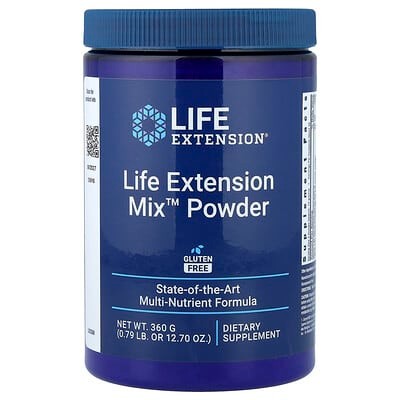

$54.00 $1.80 per serving


Product analysis
Life Extension Mix Powder offers broad nutritional support for normal energy use, immunity and bone maintenance when diet falls short. Unnamed blend components and missing proportions make it harder to judge the contribution of its many extras.
AI assessment of the formula, label and price. How scoring works
Nutrient Quality42
Some vitamins and minerals use favorable forms, including iodine and zinc. Unknown blend proportions and incomplete form details limit a clear judgment of the whole mixture.
Ingredient Transparency71
Ingredient amounts and many forms are stated, helping you identify much of the formula. Missing mixture proportions and unnamed blend components prevent precise comparison.
Value For Money34
The broad formula is relatively costly for many of its individual nutrients. Vitamin B6 is better value within the mix, but several botanical contributions remain difficult to judge.
Customer Satisfaction73
Customer feedback is generally positive across several hundred ratings. That gives a useful picture of satisfaction without showing which ingredients provide a benefit.
Product Focus0
The extensive ingredient list spreads across many health aims rather than one clear purpose. Its strongest practical role is filling nutritional gaps, with uncertain added benefit from many extras.
- Format
Powder - Container
- 360 Gram(s)
- Per serving
- $1.80
- Customer rating
- 4.4 · 733 ratings
Goals

Impact
Moderate effect
Folate · 400 mcg DFEVitamin B12 · 600 mcgVitamin B6 · 105 mgMolybdenum · 125 mcgSelenium · 200 mcgMagnesium · 420 mgVitamin E · 60 mgZinc · 35 mgVitamin C · 970 mgTaurine · 200 mgRiboflavin · 50 mg
Folate, B12 and B6 support methyl-group metabolism, while riboflavin contributes to coenzyme function and selenium supports antioxidant systems. The many other ingredients make the connection to this goal broad and mainly nutritional; NAC and taurine add related mechanisms without establishing routine toxin removal.
How this product is rated for Liver & Detox
Ingredient fit40
8 ingredients relate to this goal, alongside 32 actives aimed at other needs. The relevant amounts provide partial support in the saved comparison; some are modest or unclear.
Goal fit
8 ingredients relate to this goal, alongside 32 actives aimed at other needs.
Dose adequacy
The relevant amounts provide partial support in the saved comparison; some are modest or unclear.
Pathways49
Methyl-group supply is the strongest mechanism in the saved assessment, with substantial coverage. 1 of the three target mechanisms meets the saved coverage level.
Depth
Methyl-group supply is the strongest mechanism in the saved assessment, with substantial coverage.
Breadth
1 of the three target mechanisms meets the saved coverage level.
Evidence91
Magnesium provides the strongest evidence contribution among the assessed amounts. This remains specific to the supplied evidence and its context.
Evidence strength
Magnesium provides the strongest evidence contribution among the assessed amounts. This remains specific to the supplied evidence and its context.
Studied preparation
Most of the assessed contribution matches preparations recognized in the saved assessment; Molybdenum, Vitamin B2 (Riboflavin), Vitamin B6 does not.
Formulation logic100
All 8 assessed ingredients meet the saved amount threshold. No conflict was recorded by the supplied checks.
Partner coverage
The assessed ingredients can work alone or have their required partners present.
Conflicts
No conflict was recorded by the supplied checks.
Effective doses
All 8 assessed ingredients meet the saved amount threshold.
Riboflavin Not classified
No linked studies yet.
Vitamin B6 Not classified
No linked studies yet.

Impact
High effect
Folate · 400 mcg DFEVitamin B12 · 600 mcgVitamin D · 50 mcgMagnesium · 420 mgBoron · 3 mgSelenium · 200 mcgTaurine · 200 mgAshwagandha · 125 mgZinc · 35 mgVitamin C · 970 mg
B vitamins contribute nutrients used in normal energy metabolism; folate and B12 contribute to blood formation and one-carbon metabolism. Magnesium contributes to normal energy and mineral metabolism. Vitamin D contributes to normal bone and mineral metabolism. Vitamin C, Zinc and Selenium provide nutrients involved in normal antioxidant or immune functions. Iodine contributes to thyroid nutrient needs when intake is low. These nutritional contributions matter most when intake falls short; extra benefit with adequate intake is not established.
How this product is rated for Everyday Health
Ingredient fit52
The main relevant ingredients are Vitamin B1 (Thiamin), Vitamin B2 (Riboflavin), Vitamin B3 (Niacin), Vitamin B5 (Pantothenic Acid), Magnesium, Vitamin B9 (Folate), Vitamin B12, Vitamin B6, Vitamin D, Vitamin C, Zinc, Selenium and Iodine. Their value is nutritional, rather than a demonstrated broad health improvement.
Goal fit
The nutrient core fits several routine nutritional needs, while additional actives and links to other goals make the formula less focused.
Dose adequacy
The selected serving provides several meaningful nutrient amounts, although contributions vary across ingredients.
Pathways100
The main areas represented are energy metabolism cofactors, one-carbon metabolism and blood formation, antioxidant and immune defence.
Depth
The strongest supported area is energy metabolism cofactors, through the relevant nutrients.
Breadth
The main areas represented are energy metabolism cofactors, one-carbon metabolism and blood formation, antioxidant and immune defence.
Evidence86
Magnesium supports a nutritional role, chiefly when intake is low; this does not establish extra benefit with adequate intake.
Evidence strength
Magnesium supports a nutritional role, chiefly when intake is low; this does not establish extra benefit with adequate intake.
Studied preparation
The relevant nutrient preparations were accepted in the saved comparison; no superior form or delivery benefit is established.
Formulation logic100
The relevant ingredients can contribute independently or have their required partner; their combination does not establish added benefit. No conflict was identified by the evaluated checks.
Partner coverage
The relevant ingredients can contribute independently or have their required partner; their combination does not establish added benefit.
Conflicts
No conflict was identified by the evaluated checks.
Effective doses
The counted ingredients reach the comparison’s minimum amount criterion; this is not proof of a clinical benefit.

Impact
Moderate effect
Magnesium · 420 mgVitamin B12 · 600 mcgVitamin B6 · 105 mgTaurine · 200 mgGreen Tea · 325 mgFolate · 400 mcg DFEVitamin D · 50 mcg
Folate, vitamin B6 and vitamin B12 support normal homocysteine metabolism, but changes in this marker do not reliably predict fewer heart events. Thiamin and selenium mainly contribute by helping meet nutritional needs, with little reason to expect added heart benefit once needs are met.
Magnesium at 140 mg adds limited blood-vessel support. Taurine and grape-seed extract are present at small amounts relative to the supplied trial exposures, and green-tea findings depend on the specific preparation.
How this product is rated for Heart Health
Ingredient fit40
Heart-related ingredients sit alongside ingredients aimed at other health goals. The assessed amounts provide partial and uneven coverage of the saved comparison references.
Goal fit
Heart-related ingredients sit alongside ingredients aimed at other health goals.
Dose adequacy
The assessed amounts provide partial and uneven coverage of the saved comparison references.
Pathways60
The strongest assessed connection is to homocysteine metabolism, a marker-related function rather than a demonstrated reduction in heart events. One heart-related process has meaningful coverage, with limited coverage elsewhere.
Depth
The strongest assessed connection is to homocysteine metabolism, a marker-related function rather than a demonstrated reduction in heart events.
Breadth
One heart-related process has meaningful coverage, with limited coverage elsewhere.
Evidence89
Magnesium provides the strongest evidence contribution among the assessed ingredients, within the supplied evidence's limits. The assessed ingredients match the preparation categories used in the saved review.
Evidence strength
Magnesium provides the strongest evidence contribution among the assessed ingredients, within the supplied evidence's limits.
Studied preparation
The assessed ingredients match the preparation categories used in the saved review.
Formulation logic96
The assessed ingredients can contribute individually or have their required companion present. No configured ingredient conflict was identified in the supplied assessment. Quercetin falls below the saved minimum amount threshold.
Partner coverage
The assessed ingredients can contribute individually or have their required companion present.
Conflicts
No configured ingredient conflict was identified in the supplied assessment.
Effective doses
Quercetin falls below the saved minimum amount threshold.

Impact
Moderate effect
Vitamin D · 50 mcgVitamin E · 60 mgTaurine · 200 mgVitamin C · 970 mgGreen Tea · 325 mg
Getting enough zinc or magnesium may help when low nutrient levels contribute to low-grade inflammation. That conditional benefit does not imply that extra amounts reduce inflammation when you already get enough. Normal nutrient functions and changes in blood markers are also different from relief of symptoms or treatment of an inflammatory condition.
How this product is rated for Inflammation
Ingredient fit31
Getting enough zinc or magnesium may help when low nutrient levels contribute to low-grade inflammation.
Goal fit
Getting enough zinc or magnesium may help when low nutrient levels contribute to low-grade inflammation.
Dose adequacy
Quercetin: 5 mg per serving. An amount alone does not predict an increase in inflammatory symptom relief.
Pathways18
Getting enough zinc or magnesium may help when low nutrient levels contribute to low-grade inflammation.
Depth
Getting enough zinc or magnesium may help when low nutrient levels contribute to low-grade inflammation.
Breadth
Changes in inflammatory blood markers do not necessarily mean symptom relief or a broad health benefit.
Evidence93
Getting enough zinc or magnesium may help when low nutrient levels contribute to low-grade inflammation.
Evidence strength
Getting enough zinc or magnesium may help when low nutrient levels contribute to low-grade inflammation.
Studied preparation
The preparation matters: different forms and extracts cannot automatically share the same anti-inflammatory effects.
Formulation logic100
No particular ingredient conflict or missing required partner is identified.
Partner coverage
No missing required ingredient partner is identified.
Conflicts
No particular ingredient conflict is identified.
Effective doses
Quercetin: 5 mg per serving. This is a label-serving amount, not an inferred daily intake.
Luteolin Not classified
No linked studies yet.

Impact
High effect
Magnesium · 420 mgVitamin C · 970 mgZinc · 35 mgVitamin A · 1500 mcg RAEVitamin D · 50 mcgSelenium · 200 mcg
Zinc supports immune-cell function, while vitamin A helps maintain normal barriers. B vitamins and copper can help restore immune function when intake is deficient, and selenium supports antioxidant systems when intake is insufficient. These nutrient roles do not establish additional infection prevention when nutrition is adequate. Vitamin C also has limited regular-use cold-duration evidence; the unresolved elder declaration adds no confirmed contribution.
How this product is rated for Immunity
Ingredient fit41
Relevant nutrient amounts contribute, while the formula’s focus and serving quantities determine the saved ingredient finding.
Goal fit
Relevant ingredients sit within a broader formula containing ingredients directed at other goals.
Dose adequacy
The declared serving makes a partial contribution against the saved amount comparisons, which are not clinical benefit thresholds.
Pathways70
The strongest assigned area is oxidative and inflammatory balance. These ingredient associations do not establish how much infection risk changes.
Depth
The saved findings emphasize oxidative and inflammatory balance; this describes the assigned ingredient roles rather than proven protection against infection.
Breadth
Coverage is concentrated in two immune areas, with less support across the remaining areas.
Evidence100
The evidence supports bounded nutrient functions or preparation-specific findings, rather than a general promise of infection prevention.
Evidence strength
Vitamin C leads the saved evidence finding; its supported role does not establish general infection prevention.
Studied preparation
The saved preparation finding is complete for the included ingredients; it does not establish that this whole product reproduces a clinical regimen.
Formulation logic100
The included ingredients have no missing required partners or configured conflicts. Meeting the saved amount comparisons does not prove a combined clinical benefit.
Partner coverage
No missing required partner limits the included ingredients in the saved findings; this does not demonstrate an added benefit from combining them.
Conflicts
No configured ingredient conflict was identified. This finding does not establish overall safety or cover every possible interaction.
Effective doses
The included ingredients reach the saved minimum amount threshold; this threshold is not proof of a clinically effective immune dose.

Impact
Moderate effect
Iodine · 150 mcgVitamin D · 50 mcgVitamin B5 · 600 mgMagnesium · 420 mgRiboflavin · 50 mgThiamin · 125 mgVitamin B12 · 600 mcgPotassium · 35 mg
B vitamins support normal energy metabolism, while folate, B12 and vitamin C may help with tiredness when a dietary shortfall is involved. Larger amounts do not by themselves provide extra energy once nutritional needs are met. Magnesium adds nutritional support, while the small ashwagandha amount has uncertain relevance to fatigue.
How this product is rated for Energy
Ingredient fit47
11 assessed ingredients relate to energy alongside 32 other active ingredients, giving the formula a broader focus. The assessed amounts meet part of the saved dose benchmarks.
Goal fit
11 assessed ingredients relate to energy alongside 32 other active ingredients, giving the formula a broader focus.
Dose adequacy
The assessed amounts meet part of the saved dose benchmarks.
Pathways0
The saved findings identify no coverage of the assessed alertness, muscle-energy, mitochondrial, stress-fatigue or circulation mechanisms. None of the three target areas reaches the saved threshold for substantial coverage.
Depth
The saved findings identify no coverage of the assessed alertness, muscle-energy, mitochondrial, stress-fatigue or circulation mechanisms.
Breadth
None of the three target areas reaches the saved threshold for substantial coverage.
Evidence95
Vitamin D provides the strongest saved evidence among ingredients meeting the amount benchmark. That finding does not establish extra energy from the whole formula. Preparation matching is incomplete for Iodine, limiting direct transfer of results from specific preparations.
Evidence strength
Vitamin D provides the strongest saved evidence among ingredients meeting the amount benchmark. That finding does not establish extra energy from the whole formula.
Studied preparation
Preparation matching is incomplete for Iodine, limiting direct transfer of results from specific preparations.
Formulation logic100
The assessed ingredients can act independently or have their required partner present. No configured ingredient conflicts were identified in the saved findings. 11 of 11 assessed ingredients meet the saved minimum amount benchmark.
Partner coverage
The assessed ingredients can act independently or have their required partner present.
Conflicts
No configured ingredient conflicts were identified in the saved findings.
Effective doses
11 of 11 assessed ingredients meet the saved minimum amount benchmark.
Vitamin B5 Not classified
No linked studies yet.
Ingredients
| Ingredient | Amount per serving | Score |
|---|---|---|
Vitamin A (Beta-Carotene, Vitamin A Acetate) | 1500 mcg RAE | |
Vitamin C (Acerola Extract, Ascorbic Acid, Ascorbyl Palmitate, Calcium Ascorbate, Magnesium Ascorbate, Niacinamide Ascorbate) | 970 mg | |
Vitamin D3 (Cholecalciferol) | 50 mcg | |
Vitamin E (D-Alpha-Tocopherol, D-Alpha-Tocopheryl Succinate) | 67 mg | |
Thiamine (Thiamine Hydrochloride) | 125 mg | |
Riboflavin (Riboflavin 5-Phosphate) | 50 mg | |
Niacin (Niacinamide, Niacinamide Ascorbate) | 190 mg NE | |
Vitamin B6 | 105 mg | |
Folate (L-5-Methyltetrahydrofolate, Calcium Salt) | 400 mcg DFE | |
Vitamin B12 (Methylcobalamin) | 600 mcg | |
Biotin | 3000 mcg | |
Pantothenic Acid (D-Calcium Pantothenate) | 600 mg | |
Calcium (Calcium Ascorbate, Calcium D-Glucarate, Calcium D-Pantothenate, Dicalcium Phosphate) | 140 mg | |
Iodine (Potassium Iodide) | 150 mcg | |
Magnesium (Magnesium Arginate, Magnesium Ascorbate, Magnesium Citrate, Magnesium Glycinate, Magnesium Oxide, Magnesium Taurinate) | 420 mg | |
Zinc (L-OptiZinc Zinc Mono-L-Methionine Sulfate, Zinc Citrate) | 35 mg | |
Selenium (Se-Methyl L-Selenocysteine, SelenoExcell High Selenium Yeast, Sodium Selenite) | 200 mcg | |
Copper (Copper Bisglycinate Chelate) | 1 mg | |
Manganese (Manganese Citrate, Manganese Gluconate) | 1 mg | |
Chromium (Crominex 3+ Chromium) | 500 mcg | |
Molybdenum (Molybdenum Amino Acid Chelate) | 125 mcg | |
Potassium (Potassium Citrate) | 35 mg | |
Broccoli concentrate blend (Broccoli powder, extract, Calcium D-Glucarate) | 725 mg | |
N-Acetyl-L-Cysteine | 600 mg | |
decaffeinated Green Tea extract (Epigallocatechin Gallate) | 325 mg | |
Acerola extract | 300 mg | |
Inositol | 250 mg | |
Bitter Orange Citrus Bioflavonoids (Hesperidin) | 200 mg | |
Fruit/Berry Proprietary Blend | 200 mg | |
Taurine | 200 mg | |
Wild Blueberry Anthocyanin extract | 150 mg | |
Sensoril Ashwagandha extract (Glycoside Conjugates, Oligosaccharides) | 125 mg | |
Silymarin (Milk Thistle extract) | 100 mg | |
Trimethylglycine (Betaine Anhydrous) | 100 mg | |
CherryPure Sour Cherry (Tart Cherry) Proanthocyanidin powder | 85 mg | |
Pomella Pomegranate extract (Punicalagins) | 85 mg | |
natural Mixed Tocopherols (Alpha-Tocopherol, Beta-Tocopherol, Delta Tocopherol, Gamma-Tocopherol) | 60 mg | |
MirtoSelect Bilberry extract | 30 mg | |
BioVin Grape Proanthocyanidin extract | 25 mg | |
Leucoselect Grape seed Proanthocyanidin extract | 25 mg | |
Bio-Quercetin Phytosome | 15 mg | |
Bromelain (Pineapple) | 15 mg | |
Lutein (Marigold extract) | 15 mg | |
Olive extract (Hydroxytyrosol, Oleuropein, Polyphenols, Tyrosol) | 12.5 mg | |
Sesame seed Lignan extract | 10 mg | |
Luteolin (Japanese Sophora) | 8 mg | |
Apigenin | 5 mg | |
Boron (Boron Amino Acid Chelate) | 3 mg | |
Lycopene (LycoBeads natural Tomato extract) | 3 mg | |
Delphinidins (Delphinol Maqui berry (Aristotelia chilensis) extract) | 2 mg | |
Cyanidin-3-Glucoside (Black Currant extract) | 1.25 mg |
Iodine (Potassium Iodide) · 150 mcg OverallScore84
Each serving provides a substantial 35 mg of zinc alongside 1 mg of copper, giving a zinc-heavy balance in the saved evaluation. The citrate and L-monomethionine sulfate sources are identified, but their individual proportions remain unknown.
How this ingredient is rated
Active Ingredient Quality & Bioavailability84
Zinc citrate and zinc L-monomethionine sulfate are favorable form choices, but their actual proportions are unknown. The blend cannot be treated as an equal split.
Zinc Form Bioavailability
Both zinc sources are identified, but their actual shares are undisclosed, limiting how precisely the combination can be compared.
Dose, Safety & Label Transparency79
The zinc and copper amounts are both known, but their balance is zinc-heavy in the supplied assessment.
Elemental Dose Transparency
The label clearly identifies 35 mg elemental zinc per serving and names its sources.
Zinc Dosage Safety & Effectiveness
35 mg per serving provides a substantial zinc amount with a favorable amount assessment.
Zinc-to-Copper Mineral Balance
35 mg zinc and 1 mg copper give a 35:1 ratio, a zinc-heavy balance in the supplied assessment.
Value30
The whole-product serving costs about $1.80. The price is high in the supplied comparison.
Price Per Serving Efficiency
About $1.80 per whole-product serving. The price covers the complete formula, not zinc alone.
Chromium (Crominex 3+ Chromium) · 500 mcg OverallScore54
Alternative products
Report alternatives
Sources
Published studies used for the product analysis and the top-ranked studies for each ingredient and goal.
- [Comparative study of the urinary excretion of boron, calcium, magnesium and phosphorus in postmenopausal women with and without osteoporosis].
- Effect of dietary boron on mineral, estrogen, and testosterone metabolism in postmenopausal women.
- The relationship between boron and magnesium status and bone mineral density in the human: a review.
- Effects of boron supplementation on bone mineral density and dietary, blood, and urinary calcium, phosphorus, magnesium, and boron in female athletes.
- Metabolic responses of postmenopausal women to supplemental dietary boron and aluminum during usual and low magnesium intake: boron, calcium, and magnesium absorption and retention and blood mineral concentrations
- What is the impact of daily oral supplementation of vitamin D3 (cholecalciferol) plus calcium on the incidence of hip fracture in older people? A systematic review and meta-analysis.
- Calcium supplementation prevents seasonal bone loss and changes in biochemical markers of bone turnover in elderly New England women: a randomized placebo-controlled trial.
- The effects of calcium supplementation (milk powder or tablets) and exercise on bone density in postmenopausal women.
- The efficacy of calcium supplementation alone in elderly Thai women over a 2-year period: a randomized controlled trial.
- Calcium-enriched foods and bone mass growth in prepubertal girls: a randomized, double-blind, placebo-controlled trial.
- The Association between Dietary and Circulating Copper Levels and Osteoporosis: a Scoping Review.
- Association between dietary copper, iron, zinc, selenium intake and osteopenia or osteoporosis in elderly hypertensive patients: a retrospective cohort study.
- Associations of dietary copper intake with total bone mineral density and lumbar spine bone mineral density in American adults.
- The association between dietary mineral intake and bone mineral density: a cross-sectional study.
- Association between dietary copper intake and bone mineral density in children and adolescents aged 8-19 years: A cross-sectional study.
- Association between RBC folate and lumbar bone mineral density in postmenopausal women, a cross-sectional study from NHANES 2009-2018.
- Genetic variants modify the associations of concentrations of methylmalonic acid, vitamin B-12, vitamin B-6, and folate with bone mineral density.
- Adequate Intake and Supplementation of B Vitamins, in Particular Folic Acid, can Play a Protective Role in Bone Health.
- Relation of homocysteine, folate, and vitamin B12 to bone mineral density of postmenopausal women.
- Dietary intake of folate, but not vitamin B2 or B12, is associated with increased bone mineral density 5 years after the menopause: results from a 10-year follow-up study in early postmenopausal women.