
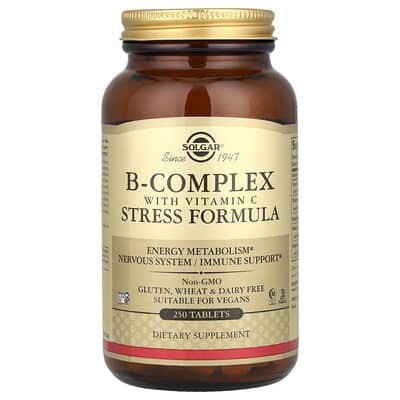
B-Complex with Vitamin C Stress Formula

Goals
$22.40 $0.17 per serving


Product analysis
B-Complex with Vitamin C Stress Formula helps supply nutrients used in normal metabolism and may help when dietary intake is low. Extra energy when nutrient needs are already met is not established.
AI assessment of the formula, label and price. How scoring works
Nutrient Quality51
Several forms are clearly identified, with favorable choices for thiamin and B5. Other form advantages remain uncertain, and the plain riboflavin form offers less of a form-related advantage.
Ingredient Transparency73
Amounts are disclosed, and most forms are named. The remaining missing forms and unexplained mixed ingredients limit a complete comparison.
Value For Money48
Riboflavin compares favorably on cost, while B5 and choline are less economical. Several other value comparisons remain uncertain, leaving the formula with mixed value.
Customer Satisfaction89
Customer feedback is generally favorable. A substantial number of ratings supports that impression, without proving effectiveness or safety.
Product Focus33
The formula mainly supplies B vitamins and vitamin C for normal nutritional needs. Its broad ingredient list and additional proposed benefits make it less focused on a single outcome.
- Format
Tablet - Container
- 250 Tablet(s)
- Per serving
- $0.17
- Also available
 B-Complex with Vitamin C Stress Formula$11.02
- Customer rating
- 4.7 · 5,564 ratings
Goals

Impact
High effect
Vitamin C · 500 mg
Vitamin C supports immune-cell activity and may modestly shorten colds when used regularly. This does not establish prevention of infection or treatment of an established cold. The serving provides a clearly declared amount, but the supplied information does not establish superior immune benefits from its particular form.
How this product is rated for Immunity
Ingredient fit57
Vitamin C, Vitamin B6, Vitamin B12, Folate provide the resolved contributions in the saved findings. Amount comparisons and the formula’s broader focus determine this finding.
Goal fit
Immune-related nutrients are present within a broader formula, so its ingredients are less concentrated on this goal.
Dose adequacy
B6 and B12 meet their intake comparisons; vitamin C and folate make partial contributions under the saved amount comparisons.
Pathways40
The saved findings are strongest for innate immune cell activity. Coverage of other immune processes is more limited.
Depth
The strongest saved finding concerns innate immune cell activity; this describes the ingredients’ connection to that process, not a measured improvement in immunity.
Breadth
Coverage is concentrated in innate immune cell activity, with more limited support across the other immune processes.
Evidence100
Vitamin C supplies a relevant nutrient or regular-use evidence basis. Historical credit for other ingredients does not override the supplied scientific limitations.
Evidence strength
Vitamin C leads the saved evidence finding; its supported role remains bounded by the supplied nutrient or regular-use evidence.
Studied preparation
The counted preparations meet the saved preparation comparison, which does not establish superiority of their particular forms.
Formulation logic100
The counted ingredients have no missing required partner or triggered zinc conflict. Unresolved amounts, where present, limit which ingredients meet the amount comparison.
Partner coverage
The counted ingredients do not require an additional missing partner under the supplied findings; this does not establish synergy.
Conflicts
Neither zinc-related conflict is triggered by the supplied amounts and ingredient presence; this is a limited interaction check.
Effective doses
All counted ingredients meet the saved minimum amount comparison; that threshold does not establish a clinically effective dose.

Impact
Highest effect
Folate · 166 mcg DFEVitamin B12 · 25 mcgVitamin C · 500 mg
B vitamins contribute to normal nutrient metabolism, while folate supports the nutritional needs associated with blood formation. These nutrients can help fill dietary gaps, without establishing additional health benefits when intake is already adequate. Vitamin C also contributes to nutritional availability. B12 is present but falls below the saved amount-counting threshold.
How this product is rated for Everyday Health
Ingredient fit81
The B vitamins and vitamin C provide the recognized nutritional fit. Several B-vitamin amounts meet the comparison; folate and vitamin C receive partial recognition, while B12 was not counted.
Goal fit
The B vitamins and vitamin C provide the recognized nutritional fit.
Dose adequacy
Several B-vitamin amounts meet the comparison; folate and vitamin C receive partial recognition, while B12 was not counted.
Pathways80
Energy cofactors lead, with blood-formation coverage and lesser antioxidant coverage.
Depth
Energy cofactors lead, with blood-formation coverage and lesser antioxidant coverage.
Breadth
Two nutrient-related pathways reach the breadth threshold.
Evidence82
Folate drives the strongest recognized contribution. The contribution concerns declared nutrient availability, without evidence of extra energy or disease prevention above adequate intake.
Evidence strength
Folate drives the strongest recognized contribution. The contribution concerns declared nutrient availability
Studied preparation
The counted nutrient declarations match the saved preparation criteria; no chemical form or delivery superiority is established.
Formulation logic100
No configured formulation conflict was matched. All ingredients included in this amount check meet the saved minimum threshold; that does not establish a clinically effective dose.
Partner coverage
Recognized ingredients can stand alone or have their required partners; this does not establish an added combination benefit.
Conflicts
No configured formulation conflict was matched.
Effective doses
All ingredients included in this amount check meet the saved minimum threshold; that does not establish a clinically effective dose.

Impact
High effect
Vitamin B5 · 100 mgRiboflavin · 10 mgThiamin · 10 mgVitamin B12 · 25 mcg
Folate, Niacin, Vitamin B6, Vitamin B12, Vitamin B5, riboflavin, Vitamin C can help address tiredness associated with their respective deficiencies. Their normal roles in metabolism do not establish extra energy when nutritional intake is adequate. Higher amounts or particular vitamin forms do not establish additional fatigue relief.
How this product is rated for Energy
Ingredient fit77
Folate, Niacin, Vitamin B6, Vitamin B12, Vitamin B5, riboflavin, Vitamin C supplies the relevant ingredient connection to this goal. The declared serving only partly meets the saved amount references; a serving does not establish repeated daily exposure.
Goal fit
Folate, Niacin, Vitamin B6, Vitamin B12, Vitamin B5, riboflavin, Vitamin C supplies the relevant ingredient connection to this goal.
Dose adequacy
The declared serving only partly meets the saved amount references; a serving does not establish repeated daily exposure.
Pathways0
No direct alertness or exercise-energy mechanism was identified; the relevant role is nutritional adequacy.
Depth
No direct alertness or exercise-energy mechanism was identified; the relevant role is nutritional adequacy.
Breadth
No evaluated mechanism reached the saved coverage requirement.
Evidence78
The relevant support concerns correcting nutrient deficiencies rather than boosting energy with adequate intake.
Evidence strength
The relevant support concerns correcting nutrient deficiencies rather than boosting energy with adequate intake.
Studied preparation
The saved preparation check found matches, without establishing general benefit or superiority of these forms.
Formulation logic100
No missing ingredient partner requirement was identified. None of the evaluated ingredient conflicts was identified.
Partner coverage
No missing ingredient partner requirement was identified.
Conflicts
None of the evaluated ingredient conflicts was identified.
Effective doses
All included ingredients meet the saved minimum amount requirement; this does not establish a clinically effective fatigue regimen.
Vitamin B5 Not classified
No linked studies yet.

Impact
High effect
Vitamin C · 500 mg
Riboflavin helps prevent the ocular effects of deficiency, but supplementation has not established improved vision in adequately nourished adults. Vitamin C have evidence within a defined combination for selected people with age-related macular degeneration. This does not establish standalone prevention or improved visual performance from this product.
How this product is rated for Eye Health
Ingredient fit63
Vitamin C, Vitamin B2 (Riboflavin) provide the principal vision connection. The amount comparison is distinct from evidence of routine vision improvement.
Goal fit
Vitamin C, Vitamin B2 (Riboflavin) provide the relevant connection within a broader formula containing ingredients directed at other goals.
Dose adequacy
The relevant amounts meet the saved comparison exposures; this does not establish a proven dose for routine vision improvement.
Pathways60
The strongest connection is retinal and lens antioxidant defense. The other reviewed aspects of vision have limited coverage.
Depth
The main supplied mechanism is retinal and lens antioxidant defense, through Vitamin C, Vitamin B2 (Riboflavin). Mechanistic relevance alone does not demonstrate improved vision.
Breadth
Only one reviewed mechanism has meaningful coverage, leaving a narrow connection rather than support across several aspects of vision.
Evidence82
Vitamin B2 (Riboflavin) leads the evidence finding; preparation matches do not remove the population and combination limits.
Evidence strength
Vitamin B2 (Riboflavin) leads the saved evidence finding. Its clinical relevance remains limited to the specific populations and preparations described above.
Studied preparation
The included ingredients match preparations recognized in the saved comparison; this does not establish that the whole product matches a proven clinical regimen.
Formulation logic100
No missing required partner or matched conflict was identified. The relevant ingredients meet the saved amount threshold.
Partner coverage
The included ingredients can act independently or have their required partner; this does not establish an added vision benefit from combining them.
Conflicts
No conflict was identified by the supplied checks. This limited finding does not establish general product safety.
Effective doses
The included ingredients meet the saved amount threshold, which is not a proven minimum dose for improving vision.

Impact
High effect
Biotin · 25 mcgNiacin · 100 mgVitamin B12 · 25 mcgRiboflavin · 10 mgThiamin · 10 mgVitamin B5 · 100 mgVitamin B6 · 10 mg
B vitamins help the body use carbohydrate, fat and protein through their normal cofactor roles. Those functions do not establish that extra vitamins raise energy expenditure when intake is adequate. Thiamin, riboflavin, niacin and B6 receive recognition for their amounts, but the saved finding does not identify a direct thermogenic route. The formula therefore supports normal nutrient-dependent metabolism without supplied evidence of a faster metabolic rate or durable weight loss.
How this product is rated for Metabolism Support
Ingredient fit74
The ingredients receive recognition for their connection and amounts in the saved findings. Normal nutrient functions and comparison amounts do not establish a metabolic-rate increase.
Goal fit
Recognised ingredients share this formula with other actives, giving it a broader focus than metabolic rate alone.
Dose adequacy
The counted ingredients provide partial reference amounts overall; those comparisons do not establish proven thermogenic doses.
Pathways0
No evaluated route to increased calorie expenditure receives recorded ingredient coverage.
Depth
No evaluated route to increased calorie expenditure receives recorded ingredient coverage.
Breadth
None of the evaluated routes has substantial recorded coverage, so broad support for increased energy expenditure is absent.
Evidence100
Vitamin B1 (Thiamin) leads the recorded evidence finding, but its normal metabolic role or other study outcomes do not establish thermogenesis.
Evidence strength
Vitamin B1 (Thiamin) leads the recorded evidence finding, but its normal metabolic role or other study outcomes do not establish thermogenesis.
Studied preparation
The counted ingredients receive preparation recognition in the saved finding, without establishing a direct energy-expenditure effect.
Formulation logic100
The counted ingredients have no missing required partners or identified conflicts among those evaluated. Their amounts meet the minimum comparison.
Partner coverage
No required ingredient partner is missing for the counted ingredients.
Conflicts
None of the evaluated conflicts was identified; the finding does not cover every possible interaction.
Effective doses
All counted ingredients meet the minimum amount comparison; that does not establish a proven thermogenic dose.

Impact
High effect
Vitamin C · 500 mg
Vitamin C supports collagen formation and wound healing when intake is low, while riboflavin and vitamin B6 help prevent deficiency-related skin changes. Niacin and biotin also have deficiency-related roles, although their amounts did not contribute to the saved result. Vitamin B5 received barrier-related recognition, but its oral acne-formulation evidence does not establish routine hydration or barrier improvement in healthy adults.
How this product is rated for Skin Health
Ingredient fit76
Relevant nutrients appear alongside ingredients serving other purposes, so the formula is less focused on skin. The ingredients that contributed met the saved amount criteria; this does not establish an effective cosmetic dose.
Goal fit
Relevant nutrients appear alongside ingredients serving other purposes, so the formula is less focused on skin.
Dose adequacy
The ingredients that contributed met the saved amount criteria; this does not establish an effective cosmetic dose.
Pathways18
The saved findings were limited to partial barrier-lipid coverage associated with vitamin B5; this does not establish routine oral barrier improvement.
Depth
Vitamin B5 supplied partial barrier-lipid coverage, with no comparable coverage of the other evaluated skin mechanisms.
Breadth
None of the evaluated mechanisms reached the saved breadth criterion.
Evidence100
Vitamin C drove the strongest saved evidence finding, with the clearest practical benefit in correcting low intake.
Evidence strength
Vitamin C drove the strongest saved evidence finding, with the clearest practical benefit in correcting low intake.
Studied preparation
The saved result recognized the qualifying preparations; that does not establish a form-specific cosmetic advantage.
Formulation logic100
No required partner was missing and no listed conflict was matched. The contributing ingredients met the saved minimum amount criterion.
Partner coverage
The contributing ingredients did not lack a required partner; this does not imply added benefit from combining them.
Conflicts
No listed ingredient conflict was matched in the saved result.
Effective doses
All contributing ingredients met the saved minimum amount criterion, which is not proof of a clinically effective skin dose.

Impact
Moderate effect
Vitamin C · 500 mg
Vitamin C may lower C-reactive protein, a blood marker of inflammation, when that marker is already elevated. That doesn't mean it will broadly reduce inflammation for everyone or lead to noticeable symptom relief. Its antioxidant role helps explain the connection, but it doesn't by itself predict a benefit when nutrient intake and inflammation levels are already normal.
How this product is rated for Inflammation
Ingredient fit37
The serving declares 500 mg Vitamin C; these amounts alone do not establish a clinical anti-inflammatory effect.
Goal fit
Vitamin C provides the principal connection to this goal; its presence alone does not predict relief.
Dose adequacy
The serving declares 500 mg Vitamin C; these amounts alone do not establish a clinical anti-inflammatory effect.
Pathways17
The connection mainly concerns oxidative stress and related inflammatory markers, rather than demonstrated symptom relief.
Depth
The connection mainly concerns oxidative stress and related inflammatory markers, rather than demonstrated symptom relief.
Breadth
The ingredients do not demonstrate broad clinical effects across multiple inflammatory processes.
Evidence87
Vitamin C has a conditional connection to lower C-reactive protein when that inflammatory marker is already elevated.
Evidence strength
Vitamin C has a conditional connection to lower C-reactive protein when that inflammatory marker is already elevated.
Studied preparation
Identifiable ingredient preparations permit comparison without guaranteeing an anti-inflammatory benefit.
Formulation logic100
No particular conflict or missing required partner is identified. Combining the ingredients does not itself establish an added anti-inflammatory effect.
Partner coverage
No missing required partner is identified.
Conflicts
No particular ingredient conflict is identified.
Effective doses
The declared amounts permit reference comparisons, which do not establish effective symptom relief.
Ingredients
| Ingredient | Amount per serving | Score |
|---|---|---|
Vitamin C (L-Ascorbic Acid) | 500 mg | |
Thiamine (Thiamine Mononitrate) | 10 mg | |
Riboflavin | 10 mg | |
Niacin (Niacinamide) | 100 mg | |
Vitamin B6 (Pyridoxine Hydrochloride) | 10 mg | |
Folate | 166 mcg DFE | |
Vitamin B12 (Cyanocobalamin) | 25 mcg | |
Biotin (D-Biotin) | 25 mcg | |
Pantothenic Acid (D-Calcium Pantothenate, Vitamin B5) | 100 mg | |
Choline (Choline Bitartrate) | 41 mg | |
Inositol | 100 mg | |
Herbal Powdered Blend | 13 mg |
Niacin (Niacinamide) · 100 mg OverallScore83
Two tablets supplies 100 mg of niacin as niacinamide. Niacinamide generally does not cause the flushing associated with nicotinic acid.
How this ingredient is rated
Active Ingredient Quality & Bioavailability86
Niacin comes as niacinamide, a standard form generally used in vitamin B3 supplements.
Niacin Form & Goal Alignment
Niacinamide is a standard niacin form suited to general vitamin B3 use.
Precursor Source Quality
Niacinamide is a standard niacin form; the evaluated source is not a named advanced precursor.
Dose, Safety & Label Transparency92
Two tablets supplies 100 mg of niacin from niacinamide. That form generally does not cause the flushing associated with nicotinic acid.
Clarity of Chemical Form
The saved facts identify niacinamide as the niacin form and state the niacin amount.
Form-Specific Dosage Efficacy
Two tablets provides 100 mg of niacin as niacinamide.
Flush Risk & Safety Labeling
Niacinamide generally does not cause niacin flushing; a no-flush claim is not recorded in the saved facts.
Value60
The whole product costs about $0.18 per serving.
Price Per Effective Serving
The whole product costs about $0.18 per serving.
Vitamin B5 (D-Calcium Pantothenate) · 100 mg OverallScore70
A serving provides 100 mg of vitamin B5, with a high cost relative to the amount supplied. Calcium D-Pantothenate is a stable salt form of B5.
How this ingredient is rated
Active Ingredient Quality & Bioavailability90
Calcium D-Pantothenate is a stable salt form of B5.
Vitamin B5 Chemical Form
Calcium D-Pantothenate is a stable salt form of B5.
Dose, Safety & Label Transparency76
A serving provides 100 mg of vitamin B5. The amount and Calcium D-Pantothenate source is identified.
Dosage Potency and Efficacy
A serving provides 100 mg of vitamin B5.
Label Transparency & Source Clarity
The amount and Calcium D-Pantothenate source is identified.
Value20
The cost is high relative to the amount of B5 supplied.
Price per 500mg Vitamin B5
The cost is high relative to the amount of B5 supplied.
Thiamin (Thiamine Mononitrate) · 10 mg OverallScore60
Each serving provides 10 mg of thiamin from thiamine mononitrate, a standard water-soluble form. The evaluation flags an artificial color or titanium dioxide without specifying which.
How this ingredient is rated
Active Ingredient Quality & Bioavailability58
Thiamine Mononitrate is a standard water-soluble source of thiamin. The evaluation flags an artificial color or titanium dioxide, but the saved facts do not specify which.
Thiamin Chemical Form
Thiamine Mononitrate is a standard water-soluble form of thiamin.
Excipient Purity
The evaluation flags an artificial color or titanium dioxide, but the saved facts do not specify which.
Dose, Safety & Label Transparency72
The serving supplies 10 mg of thiamin, which the evaluation considers a moderate amount. The amount is separately specified.
Thiamin Dosage Potency
The declared 10 mg of thiamin is considered a moderate amount in the evaluation.
Label Transparency & Proprietary Blends
The amount is stated as 10 mg of thiamin per serving.
Value40
The normalized cost is about $1.79 per 100 mg of thiamin, in the higher band used for this evaluation. It reflects the cost of the whole product, including its other contents.
Price per Declared Dose
The cost is about $1.79 per 100 mg of thiamin, based on whole-product pricing; the evaluation places it in the higher band.
Alternative products
Report alternatives
Sources
Published studies used for the product analysis and the top-ranked studies for each ingredient and goal.
- Physicochemical properties of and volatile compounds in riboflavin fortified cloudy apple juice; study of its effect on job fatigue among Egyptian construction workers.
- Vitamin B status in patients with chronic fatigue syndrome.
- B-vitamins, related vitamers, and metabolites in patients with quiescent inflammatory bowel disease and chronic fatigue treated with high dose oral thiamine.
- Metabolic features of chronic fatigue syndrome.
- Effectiveness of Riboflavin in Inherited Metabolic Diseases: A Systematic Review
- Influence of thiamin supplementation on the health and general well-being of an elderly Irish population with marginal thiamin deficiency.
- Randomised clinical trial: high-dose oral thiamine versus placebo for chronic fatigue in patients with quiescent inflammatory bowel disease.
- Dietary reference values for thiamin.
- Effects of thiamine supplementation on exercise-induced fatigue.
- Long-term maintenance treatment with 300 mg thiamine for fatigue in patients with inflammatory bowel disease: results from an open-label extension of the TARIF study.
- A new perspective on vitamin B12 deficiency in rheumatology: a case-based review.
- Effects of Vitamin B12 Supplementation on Cognitive Function, Depressive Symptoms, and Fatigue: A Systematic Review, Meta-Analysis, and Meta-Regression.
- Patients' experiences with methylcobalamin injections in amyotrophic lateral sclerosis.
- Cobalamin deficiency: clinical picture and radiological findings.
- Vitamin B12 Deficiency: Common Questions and Answers.
- Intakes of Folate, Vitamin B6, and Vitamin B12 in Relation to All-Cause and Cause-Specific Mortality: A National Population-Based Cohort.
- The responsiveness of plasma homocysteine to small increases in dietary folic acid: a primary care study.
- Associations of Serum Folate and Homocysteine Concentrations with All-Cause, Cardiovascular Disease, and Cancer Mortality in Men and Women in Korea: the Cardiovascular Disease Association Study.
- The concept of folic acid supplementation and its role in prevention of neural tube defect among pregnant women: PRISMA.
- Systematic review of adverse health outcomes associated with high serum or red blood cell folate concentrations.