
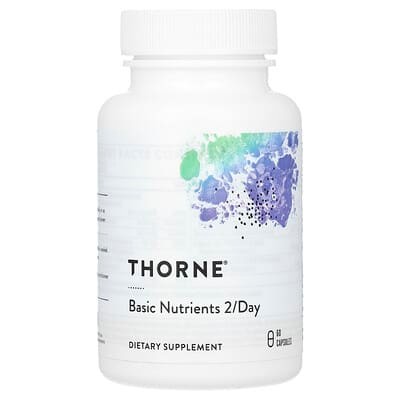

$36.00 $1.20 per serving


Product analysis
Basic Nutrients 2/Day helps fill dietary gaps with vitamins and minerals involved in normal energy use, immune function and bone nutrition. Several individual nutrients are relatively costly for the amounts supplied, which may matter when comparing a broad multivitamin with more targeted options.
AI assessment of the formula, label and price. How scoring works
Nutrient Quality58
Several B vitamins and trace minerals use well-supported forms, although that does not establish extra health benefits. Some other forms remain unspecified or cannot be compared confidently, leaving a mixed picture of ingredient quality.
Ingredient Transparency79
Amounts and most forms are disclosed, making much of the formula easy to compare. One mixture lacks component detail, while another mixture’s breakdown remains uncertain.
Value For Money32
Many of the comparable nutrients offer weak value for their amounts, particularly riboflavin, selenium and boron. Biotin is more moderately priced, while several other comparisons remain uncertain.
Customer Satisfaction91
Customer ratings are favorable across a very large review base. They provide extensive satisfaction feedback without proving the formula’s health benefits.
Product Focus32
The formula’s clearest role is broad nutritional support when dietary intake is low. Its many stated uses overlap, and extra nutrients do not imply extra energy, sharper thinking or other benefits once needs are met.
- Format
Capsule - Container
- 60 Capsule(s)
- Per serving
- $1.20
- Customer rating
- 4.7 · 12,243 ratings
Goals

Impact
Highest effect
Folate · 667 mcg DFEVitamin B12 · 600 mcgVitamin D · 50 mcgMagnesium · 20 mgVitamin K · 400 mcgBoron · 2 mgSelenium · 200 mcgZinc · 15 mgVitamin C · 250 mg
B vitamins and folate provide nutrients for metabolism and blood formation, with vitamin D, zinc and selenium adding nutritional support when intake is low. Iodine and vitamin C make additional contributions. Calcium and magnesium fall below the saved inclusion criteria, and the vitamin K amount is unresolved. Boron receives a smaller contribution, but limited mineral research does not establish broad health benefits.
How this product is rated for Everyday Health
Ingredient fit77
The nutrient amounts contribute unevenly, and the unresolved vitamin K amount limits the amount finding.
Goal fit
Vitamin B9 (Folate) contributes to the identified roles, while additional actives and links to other goals make the formula less focused.
Dose adequacy
The nutrient amounts contribute unevenly, and the unresolved vitamin K amount limits the amount finding.
Pathways100
The identified contributions cover normal metabolism, blood formation, bone and mineral metabolism, antioxidant and immune functions.
Depth
The strongest identified coverage is in energy metabolism cofactors.
Breadth
Coverage extends to normal metabolism, blood formation, bone and mineral metabolism, antioxidant and immune functions.
Evidence82
Vitamin B9 (Folate)'s contribution concerns nutrient availability when intake is low, without establishing extra benefit above adequacy.
Evidence strength
Vitamin B9 (Folate)'s contribution concerns nutrient availability when intake is low, without establishing extra benefit above adequacy.
Studied preparation
The relevant preparations are accepted in the saved finding, without establishing superiority for a named form or delivery method.
Formulation logic98
Vitamin K has no resolved amount, while the other counted ingredients reach the saved minimum amount criterion.
Partner coverage
Each counted ingredient works alone or meets its partner requirement; the finding does not establish extra benefit from combining ingredients.
Conflicts
No configured ingredient conflict was triggered by the supplied facts.
Effective doses
Vitamin K has no resolved amount, while the other counted ingredients reach the saved minimum amount criterion.

Impact
Highest effect
Magnesium · 20 mgVitamin C · 250 mgZinc · 15 mgVitamin A · 1.05 mgVitamin D · 50 mcgSelenium · 200 mcg
Zinc, Vitamin D, Selenium contribute to normal immune-cell function and regulation. Vitamin A also supports protective barriers. Copper, Vitamin B6, Vitamin B12, Folate can help restore immune processes impaired by low intake, without establishing extra protection when intake is adequate. Vitamin C has modest regular-use cold-duration support, without establishing infection prevention. Higher Vitamin B6 amounts do not establish extra benefit or suitability.
How this product is rated for Immunity
Ingredient fit60
Vitamin C connects the formula to immunity. Amounts provide uneven support against the supplied comparisons; smaller or unresolved quantities limit some contributions.
Goal fit
Relevant immune nutrients are included within a broader formula with other active ingredients.
Dose adequacy
Amounts provide uneven support against the supplied comparisons; smaller or unresolved quantities limit some contributions.
Pathways100
The strongest saved finding concerns lymphocyte function and immune regulation.
Depth
The strongest saved finding concerns lymphocyte function and immune regulation.
Breadth
The broader saved findings cover barrier and antimicrobial defense, lymphocyte function and immune regulation, oxidative and inflammatory balance.
Evidence100
Vitamin C provides the strongest saved evidence finding. Nutritional function or modest regular-use symptom support does not establish general infection prevention.
Evidence strength
Vitamin C drives the strongest saved evidence finding; the practical support remains bounded by its specific nutritional or regular-use role.
Studied preparation
The saved finding accepts the declared forms without establishing that they outperform other forms.
Formulation logic100
No unmet ingredient partner or configured conflict was identified. The included contributors meet the saved minimum amount criterion; this does not establish clinical effectiveness.
Partner coverage
The included ingredients have no unmet partner requirement in the supplied findings.
Conflicts
No configured ingredient conflict was identified in the supplied findings.
Effective doses
The included contributors meet the saved minimum amount criterion; this does not establish clinical effectiveness.

Impact
High effect
Iodine · 75 mcgVitamin D · 50 mcgVitamin B5 · 45 mgMagnesium · 20 mgRiboflavin · 12 mgThiamin · 50 mgVitamin B12 · 600 mcg
B12, folate and B6 help fill nutritional gaps that can cause anaemia and fatigue. Riboflavin, niacin and pantothenic acid also contribute to normal nutritional functions relevant to tiredness. Larger amounts and the declared vitamin forms do not establish extra energy when intake is adequate. Vitamin C adds a nutritional role, while the vitamin D fatigue findings concern deficient adults and a different treatment regimen.
How this product is rated for Energy
Ingredient fit69
The B vitamins have a relevant nutritional or fatigue-related connection, but the amount comparison cannot establish clinical benefit.
Goal fit
The B vitamins provide the relevant connection, while the product's wider purposes affect its focus on energy.
Dose adequacy
The known quantities make a partial combined contribution to the saved comparison, rather than establishing a fatigue-treatment dose.
Pathways0
No contribution was recorded for the configured energy pathways; correction of nutrient-related fatigue is a separate role.
Depth
No contribution was recorded for the configured energy pathways; correction of nutrient-related fatigue is a separate role.
Breadth
None of the configured alertness, exercise-energy or stress-fatigue pathways received coverage.
Evidence94
Vitamin D leads the saved evidence finding, but its fatigue trial involved deficient adults and a distinct treatment regimen.
Evidence strength
Vitamin D leads the saved evidence finding, but its fatigue trial involved deficient adults and a distinct treatment regimen.
Studied preparation
Most declared preparations are accepted, but the saved finding retains a preparation limitation; no form-specific fatigue advantage follows.
Formulation logic100
The included ingredients require no additional partner in the saved findings, and no matching conflict was identified. Their minimum amount check is satisfied.
Partner coverage
No additional partner is required for the included ingredients under the saved findings.
Conflicts
No matching conflict was identified by the supplied checks.
Effective doses
All ingredients included in this check meet its minimum amount threshold; that finding does not prove routine fatigue relief.
Vitamin B5 Not classified
No linked studies yet.

Impact
High effect
Folate · 667 mcg DFEMagnesium · 20 mgVitamin B12 · 600 mcgVitamin K · 400 mcgVitamin D · 50 mcg
Vitamin C supports collagen formation; correcting low intake helps prevent skin fragility, without established extra anti-aging benefit when intake is adequate. Vitamin D helps preserve muscle function when deficiency is corrected. Vitamin B12 helps prevent neurological problems caused by deficiency.
How this product is rated for Longevity
Ingredient fit68
The saved findings count a range of ingredients and compare their amounts with reference amounts. Ingredient presence and amount alone do not establish anti-aging effects.
Goal fit
The mixture includes many ingredients serving other purposes, limiting its concentration on this goal.
Dose adequacy
The counted amounts provide partial coverage of the saved references; that comparison does not establish a clinically effective anti-aging dose.
Pathways60
The strongest saved coverage is antioxidant defence. Mechanistic coverage does not demonstrate lifespan extension.
Depth
The strongest saved coverage concerns antioxidant defence, a mechanistic finding rather than evidence of slower human aging.
Breadth
Only antioxidant defence reaches the saved coverage threshold; other routes remain limited.
Evidence81
Vitamin D leads this finding; functional benefit is most relevant to deficiency correction, not additional benefit in replete adults.
Evidence strength
Vitamin D leads this finding; functional benefit is most relevant to deficiency correction, not additional benefit in replete adults.
Studied preparation
The saved preparation check remains incomplete for Vitamin K, Boron. Clinical preparation equivalence cannot be assumed.
Formulation logic98
The saved findings show partner coverage and no matched ingredient conflicts. Some amount or preparation limits may still restrict practical relevance.
Partner coverage
The counted ingredients have their required partners or work independently under the saved findings; this does not demonstrate added benefit from combining them.
Conflicts
No ingredient conflict was matched in the supplied findings.
Effective doses
Lutein falls below the saved amount threshold; this differs from proof that the ingredient is ineffective.
Boron Not classified
No linked studies yet.

Impact
High effect
Biotin · 500 mcgNiacin · 80 mgVitamin B12 · 600 mcgRiboflavin · 12 mgThiamin · 50 mgVitamin B5 · 45 mgVitamin B6 · 20 mgVitamin D · 50 mcgZinc · 15 mgMagnesium · 20 mg
Iodine supports thyroid hormone production, and B vitamins help the body process energy from food. Correcting iodine deficiency can address impaired thyroid function, but extra nutrients do not establish faster metabolism when intake is adequate. Chromium and magnesium findings about metabolic markers are distinct from measured increases in calorie use.
How this product is rated for Metabolism Support
Ingredient fit74
The B vitamins and relevant minerals account for the main retained ingredient links. Amount recognition is distinct from proof of a metabolism boost.
Goal fit
The B vitamins and relevant minerals supply the retained ingredient connections, with other formula components reducing specificity.
Dose adequacy
Known amounts receive partial comparison recognition; the comparison is not a proven dose-response for increased calorie use.
Pathways13
The retained connection concerns insulin sensitivity and metabolic hormones, rather than demonstrated stimulation of heat production.
Depth
The retained connection concerns insulin sensitivity and metabolic hormones, rather than demonstrated stimulation of heat production.
Breadth
No energy-expenditure pathway reaches the saved coverage threshold.
Evidence100
Thiamin supplies the strongest retained connection; its normal carbohydrate-metabolism role does not prove greater calorie use.
Evidence strength
Thiamin supplies the strongest retained connection; its normal carbohydrate-metabolism role does not prove greater calorie use.
Studied preparation
Eligible ingredients meet the saved preparation criteria; this does not establish increased energy expenditure from the exact product.
Formulation logic100
No unmet required partner or configured conflict was identified. The amount threshold does not establish extra effects from combining ingredients.
Partner coverage
The retained ingredients have no unmet required partner in the supplied findings; this does not establish extra benefit from their combination.
Conflicts
No configured ingredient conflict was identified in the supplied findings.
Effective doses
The eligible ingredients meet the saved amount threshold, which does not establish a clinically effective metabolism-boosting dose.

Impact
High effect
Biotin · 500 mcgVitamin D · 50 mcgZinc · 15 mgVitamin C · 250 mg
Zinc can help address shedding caused by inadequate zinc intake. Biotin has a similarly limited role in deficiency-related shedding; higher amounts do not establish extra regrowth with adequate intake. The remaining nutrient functions do not establish routine hair growth. The saved findings mainly recognize nutrient amounts and antioxidant-related coverage, whose practical benefit remains dependent on the specific nutritional circumstances.
How this product is rated for Hair Health
Ingredient fit67
The formula contains recognized hair-related ingredients, but their practical relevance depends on nutritional need and usable amounts. Recognized hair-related ingredients sit alongside ingredients serving other purposes, so the formula has a broader focus.
Goal fit
Recognized hair-related ingredients sit alongside ingredients serving other purposes, so the formula has a broader focus.
Dose adequacy
The saved findings recognize the declared amounts, with differing contributions across the ingredients; this does not establish an effective hair-treatment dose.
Pathways60
Antioxidant-related nutrient coverage is the strongest finding, but normal antioxidant functions do not establish hair regrowth. Meaningful coverage centers on antioxidant-related functions, with limited coverage of the other hair pathways.
Depth
Antioxidant-related nutrient coverage is the strongest finding, but normal antioxidant functions do not establish hair regrowth.
Breadth
Meaningful coverage centers on antioxidant-related functions, with limited coverage of the other hair pathways.
Evidence97
Zinc is the leading recognized ingredient; its practical hair benefit is relevant to deficiency-related shedding, rather than routine regrowth. Preparation matching does not establish a trial of the complete product.
Evidence strength
Zinc is the leading recognized ingredient; its practical hair benefit is relevant to deficiency-related shedding, rather than routine regrowth.
Studied preparation
Recognized preparations meet the saved comparison criteria except iodine; this does not demonstrate hair benefits from the complete formula.
Formulation logic100
The recognized ingredients have no missing required partner or configured conflict. All recognized ingredients meet the saved amount criterion; that criterion is not proof of a clinically effective hair dose.
Partner coverage
No required partner is missing among the recognized ingredients; this does not establish extra benefit from combining them.
Conflicts
No configured ingredient conflict was identified in the supplied findings.
Effective doses
All recognized ingredients meet the saved amount criterion; that criterion is not proof of a clinically effective hair dose.
Ingredients
| Ingredient | Amount per serving | Score |
|---|---|---|
Vitamin A | 1.05 mg | |
Vitamin C (Ascorbic Acid) | 250 mg | |
Vitamin D (Vitamin D3) | 50 mcg | |
Vitamin E (D-Alpha-Tocopheryl Acid Succinate) | 16.5 mg | |
Vitamin K | 400 mcg | |
Thiamine (Thiamine Hydrochloride) | 50 mg | |
Riboflavin (Riboflavin 5-Phosphate Sodium) | 12 mg | |
Niacin (Niacinamide) | 80 mg | |
Vitamin B6 (Pyridoxal 5-Phosphate) | 20 mg | |
Folate | 667 mcg DFE | |
Vitamin B12 (Methylcobalamin) | 600 mcg | |
Biotin | 500 mcg | |
Pantothenic Acid (Calcium Pantothenate) | 45 mg | |
Calcium (Calcium Laurate, Calcium Pantothenate, Dicalcium Phosphate, TRAACS Calcium Bisglycinate Chelate) | 52 mg | |
Iodine (Potassium Iodide) | 75 mcg | |
Magnesium (TRAACS Magnesium Bisglycinate Chelate) | 20 mg | |
Zinc (TRAACS Zinc Bisglycinate Chelate) | 15 mg | |
Selenium (L-Selenomethionine) | 200 mcg | |
Copper (Copper Bisglycinate Chelate) | 750 mcg | |
Manganese (TRAACS Manganese Bisglycinate Chelate) | 3 mg | |
Chromium (TRAACS Chromium Nicotinate Glycinate Chelate) | 400 mcg | |
D-Gamma Tocopherol (Mixed Tocopherols) | 24 mg | |
Boron (Bororganic Boron Glycinate Complex) | 2 mg | |
Lutein (Aztec Marigold extract) | 140 mcg |
Vitamin B6 (Pyridoxal 5-Phosphate) · 20 mg OverallScore72
A serving provides 20 mg of B6, exceeding the European adult daily upper limit. The identified source is pyridoxal 5-phosphate.
How this ingredient is rated
Ingredient Form & Label Quality100
The B6 source is identified as pyridoxal 5-phosphate. The saved facts flag no artificial dyes, titanium dioxide or talc.
Vitamin B6 Form Identification
The B6 source is identified as pyridoxal 5-phosphate.
Clean Label and Excipient Purity
The saved facts flag no artificial dyes, titanium dioxide or talc.
Dose, Safety & Label Transparency65
A serving provides 20 mg of B6, exceeding the European adult daily upper limit. The B6 source is identified on the label.
Vitamin B6 Dose & Safety Policy
A serving provides 20 mg of B6, exceeding the European adult daily upper limit.
Label Transparency
The B6 source is identified on the label.
Value31
The whole-product price is about $0.06 per mg of B6.
Vitamin B6 Price Efficiency
The whole-product price is about $0.06 per mg of B6.
Selenium (L-Selenomethionine) · 200 mcg OverallScore82
A serving provides 200 mcg of selenium as L-selenomethionine, an amount that matches the evaluation’s target. At the whole-product price, the cost scales to about $1.20 per 200 mcg of selenium.
How this ingredient is rated
Active Ingredient Quality & Bioavailability100
L-selenomethionine is specifically identified and is favored in the evaluation.
Selenium Chemical Form
L-selenomethionine is specifically identified and is a form favored by the evaluation.
Form Transparency & Isomer Specificity
The selenium form is identified specifically as L-selenomethionine.
Dose, Safety & Label Transparency100
The 200 mcg per serving matches the amount used as the evaluation’s target. The 200 mcg per serving is within the safety limit used in the evaluation, leaving room for selenium from food.
Dosage Efficacy Sweet Spot
The 200 mcg per serving matches the amount used as the evaluation’s target.
Safety Margin & UL Adherence
The 200 mcg per serving is within the safety limit used in the evaluation, leaving room for selenium from food.
Value10
At the whole-product price, the cost scales to about $1.20 per 200 mcg of selenium. The calculation includes the rest of the product.
Price per 200 mcg Serving
At the whole-product price, the cost scales to about $1.20 per 200 mcg of selenium. The calculation includes the rest of the product.
Each serving provides 400 mcg of chromium as chromium nicotinate glycinate, a form assessed favorably for absorption. The whole-product serving costs about $1.20.
How this ingredient is rated
Active Ingredient Quality & Bioavailability100
The identified form is chromium nicotinate glycinate, which is assessed favorably for absorption. A recognized branded source is recorded.
Chromium Chemical Form
Chromium nicotinate glycinate is assessed favorably for absorption.
Branded & Trademarked Sources
A recognized branded chromium source is recorded, although the saved facts do not name it.
Dose, Safety & Label Transparency85
The saved information gives 400 mcg chromium per serving. It does not give a separate weight for the chromium compound.
Elemental Chromium Dosage
The serving supplies 400 mcg of chromium, an amount assessed favorably.
Label Transparency & Disclosure
The chromium amount is known, but a separate compound weight is not available in the saved information.
Value40
The equivalent of 200 mcg of chromium costs about $0.60, based on the whole-product serving price.
Price per 200 mcg Chromium
At the product price, the equivalent of 200 mcg chromium costs about $0.60.
Alternative products
Report alternatives
Sources
Published studies used for the product analysis and the top-ranked studies for each ingredient and goal.
- [Comparative study of the urinary excretion of boron, calcium, magnesium and phosphorus in postmenopausal women with and without osteoporosis].
- Effect of dietary boron on mineral, estrogen, and testosterone metabolism in postmenopausal women.
- The relationship between boron and magnesium status and bone mineral density in the human: a review.
- Effects of boron supplementation on bone mineral density and dietary, blood, and urinary calcium, phosphorus, magnesium, and boron in female athletes.
- Metabolic responses of postmenopausal women to supplemental dietary boron and aluminum during usual and low magnesium intake: boron, calcium, and magnesium absorption and retention and blood mineral concentrations
- What is the impact of daily oral supplementation of vitamin D3 (cholecalciferol) plus calcium on the incidence of hip fracture in older people? A systematic review and meta-analysis.
- Calcium supplementation prevents seasonal bone loss and changes in biochemical markers of bone turnover in elderly New England women: a randomized placebo-controlled trial.
- The effects of calcium supplementation (milk powder or tablets) and exercise on bone density in postmenopausal women.
- The efficacy of calcium supplementation alone in elderly Thai women over a 2-year period: a randomized controlled trial.
- Calcium-enriched foods and bone mass growth in prepubertal girls: a randomized, double-blind, placebo-controlled trial.
- The Association between Dietary and Circulating Copper Levels and Osteoporosis: a Scoping Review.
- Association between dietary copper, iron, zinc, selenium intake and osteopenia or osteoporosis in elderly hypertensive patients: a retrospective cohort study.
- Associations of dietary copper intake with total bone mineral density and lumbar spine bone mineral density in American adults.
- The association between dietary mineral intake and bone mineral density: a cross-sectional study.
- Association between dietary copper intake and bone mineral density in children and adolescents aged 8-19 years: A cross-sectional study.
- Association between RBC folate and lumbar bone mineral density in postmenopausal women, a cross-sectional study from NHANES 2009-2018.
- Genetic variants modify the associations of concentrations of methylmalonic acid, vitamin B-12, vitamin B-6, and folate with bone mineral density.
- Adequate Intake and Supplementation of B Vitamins, in Particular Folic Acid, can Play a Protective Role in Bone Health.
- Relation of homocysteine, folate, and vitamin B12 to bone mineral density of postmenopausal women.
- Dietary intake of folate, but not vitamin B2 or B12, is associated with increased bone mineral density 5 years after the menopause: results from a 10-year follow-up study in early postmenopausal women.