
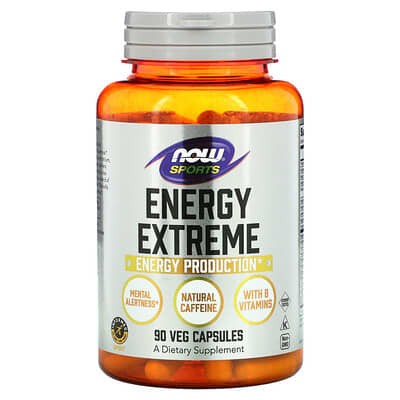

$12.85 $0.28 per serving


Product analysis
Sports Energy Extreme combines caffeine-related alertness with nutrients involved in normal energy use. Several added performance ingredients make only small or uncertain contributions, which limits the case for its broad formula.
AI assessment of the formula, label and price. How scoring works
Nutrient Quality39
Some mineral and B-vitamin sources are clearly identified and have favorable form findings. Many botanical and performance-ingredient preparations remain unspecified, leaving the complete mixture less clear.
Ingredient Transparency78
The listed ingredient amounts make quantity comparisons possible. Many preparation details remain omitted, and the exact caffeine exposure cannot be inferred from botanical weights.
Value For Money47
The serving is affordable for its caffeine contribution, but several smaller performance ingredients are costly for the amounts supplied. That gives the combination a mixed value case rather than an equally good one across its long ingredient list.
Customer Satisfaction82
Customer ratings indicate favorable satisfaction. A large review pool provides a broad base for that feedback.
Product Focus34
Caffeine provides the clearest connection to short-term alertness, while B vitamins mainly support nutritional needs. The long mixture extends into fitness, cognition and metabolism with less consistent support.
- Format
Capsule - Container
- 90 Capsule(s)
- Per serving
- $0.28
- Customer rating
- 4.6 · 2,059 ratings
Goals

Impact
Moderate effect
Folate · 667 mcg DFEVitamin B6 · 10 mgVitamin B12 · 1000 mcgMagnesium · 15 mgCaffeine · 100 mg
L-Tyrosine Not classified
No linked studies yet.

Impact
High effect
Niacin · 20 mgVitamin B12 · 1000 mcgRiboflavin · 10 mgThiamin · 10 mgVitamin B5 · 20 mgVitamin B6 · 10 mgMagnesium · 15 mgCoenzyme Q-10 · 30 mgGreen Tea · 50 mgCaffeine · 100 mg

Impact
High effect
Vitamin B12 · 1000 mcgVitamin B12 · 1000 mcgVitamin B6 · 10 mgMagnesium · 15 mgEleuthero · 50 mgEleuthero · 50 mgCaffeine · 100 mg
Eleuthero Not classified
No linked studies yet.
L-Tyrosine Not classified
No linked studies yet.

Impact
Moderate effect
Iodine · 150 mcgVitamin B5 · 20 mgMagnesium · 15 mgRiboflavin · 10 mgThiamin · 10 mgVitamin B12 · 1000 mcgCoenzyme Q-10 · 30 mgCaffeine · 100 mg
L-Tyrosine Not classified
No linked studies yet.
Vitamin B5 Not classified
No linked studies yet.

Impact
Lower effect
Iodine · 150 mcgMagnesium · 15 mgGreen Tea · 50 mgCaffeine · 100 mg
Rhodiola Not classified
No linked studies yet.

Impact
Moderate effect
Thiamin · 10 mgVitamin B6 · 10 mgFolate · 667 mcg DFEVitamin B12 · 1000 mcgMagnesium · 15 mgGreen Tea · 50 mg
L-Tyrosine Not classified
No linked studies yet.
Ingredients
| Ingredient | Amount per serving | Score |
|---|---|---|
Thiamine (Thiamine Hydrochloride) | 10 mg | |
Riboflavin | 10 mg | |
Niacin (Niacinamide) | 20 mg | |
Vitamin B6 (Pyridoxine Hydrochloride) | 10 mg | |
Folate | 667 mcg DFE | |
Vitamin B12 (Methylcobalamin) | 1000 mcg | |
Pantothenic Acid (Calcium Pantothenate) | 20 mg | |
Iodine (Potassium Iodide) | 150 mcg | |
Magnesium (Magnesium Malate) | 15 mg | |
Chromium (Chromium Nicotinate Glycinate) | 200 mcg | |
natural Caffeine powder | 100 mg | |
Guarana extract | 80 mg | |
Green Tea extract | 50 mg | |
Yerba Mate extract | 50 mg | |
Rhodiola extract | 50 mg | |
organic Eleuthero | 50 mg | |
Panax ginseng | 50 mg | |
Taurine | 250 mg | |
L-Tyrosine | 250 mg | |
L-Carnitine | 250 mg | |
L-Citrulline | 100 mg | |
CoQ10 | 30 mg |
Iodine (Potassium Iodide) · 150 mcg OverallScore96
Vitamin B12 (Methylcobalamin) · 1000 mcg OverallScore90
Each serving provides 1000 mcg of B12 at a moderate cost relative to the amount. It uses Methylcobalamin, an amount used for higher needs.
How this ingredient is rated
Active Ingredient Quality & Bioavailability100
It uses Methylcobalamin, a bioactive form of B12.
Bioactive B12 Form Selection
It uses Methylcobalamin, a bioactive form of B12.
Dose, Safety & Label Transparency100
The label lists 1000 mcg per serving, an amount used for higher needs. The amount and form are named.
Therapeutic Dosage Level
Each serving provides 1000 mcg, an amount used for higher needs.
Label and Form Transparency
The label names Methylcobalamin and its B12 amount.
Value50
The cost relative to the B12 amount is moderate.
Price per 1,000 mcg B12
The cost relative to the B12 amount is moderate.
Chromium (Chromium Nicotinate Glycinate) · 200 mcg OverallScore89
Each serving supplies 200 mcg of chromium; the estimated cost per 200 mcg is moderate. The chromium source is chromium nicotinate glycinate.
How this ingredient is rated
Active Ingredient Quality & Bioavailability100
The chromium source is chromium nicotinate glycinate. A branded chromium source is indicated, though its name is not specified.
Chromium Chemical Form
The chromium source is chromium nicotinate glycinate.
Branded & Trademarked Sources
A branded chromium source is indicated, though its name is not specified.
Dose, Safety & Label Transparency85
A serving provides 200 mcg of chromium; a separate compound weight is not stated.
Elemental Chromium Dosage
A serving provides 200 mcg of chromium.
Label Transparency & Disclosure
The chromium amount is stated, but a separate compound weight is not given.
Value75
The estimated cost per 200 mcg of chromium is moderate.
Price per 200 mcg Chromium
The estimated cost per 200 mcg of chromium is moderate.
Alternative products
Report alternatives
Sources
Published studies used for the product analysis and the top-ranked studies for each ingredient and goal.
- No benefit adding eleutherococcus senticosus to stress management training in stress-related fatigue/weakness, impaired work or concentration, a randomized controlled study.
- Effects of 6-Month Folic Acid Supplementation on Cognitive Function and Blood Biomarkers in Mild Cognitive Impairment: A Randomized Controlled Trial in China.
- Serum folate and B12 levels in association with cognitive impairment among seniors: results from the VELESTINO study in Greece and meta-analysis.
- B vitamins and prevention of cognitive decline and incident dementia: a systematic review and meta-analysis.
- Homocysteine and folate as risk factors for dementia and Alzheimer disease.
- Folate mediates cognitive impairment of aged people with periodontitis.
- Safety and efficacy of cognitive training plus epigallocatechin-3-gallate in young adults with Down's syndrome (TESDAD): a double-blind, randomised, placebo-controlled, phase 2 trial.
- Association between tea consumption and risk of cognitive disorders: A dose-response meta-analysis of observational studies.
- Investigating the Impact of Tea Consumption on Cognitive Function and Exploring Tea-Genetic Interactions in Older Adults Aged 65-105 Years: Findings from the 2002-2018 CLHLS Data.
- Consumption of green tea, but not black tea or coffee, is associated with reduced risk of cognitive decline.
- Green Tea Consumption and the Risk of Incident Dementia in Elderly Japanese: The Ohsaki Cohort 2006 Study.
- Cognitive effects of guarana supplementation with maximal intensity cycling.
- Cognitive Performance Enhancement Induced by Caffeine, Carbohydrate and Guarana Mouth Rinsing during Submaximal Exercise.
- Improved cognitive performance in human volunteers following administration of guarana (Paullinia cupana) extract: comparison and interaction with Panax ginseng.
- The effect of plant active substances on cognitive function in healthy older adults: a systematic review and network meta-analysis of randomized controlled trials.
- Effect of Guarana (Paullinia cupana) on Cognitive Performance: A Systematic Review and Meta-Analysis.
- Magnesium sulphate for women at risk of preterm birth for neuroprotection of the fetus.
- Effects of magnesium valproate adjuvant therapy on patients with dementia: A systematic review and meta-analysis.
- Effects of magnesium supplementation on serum brain-derived neurotrophic factor levels and cognitive function in patients undergoing fluoxetine therapy for depression.
- Magnesium-L-threonate improves sleep quality and daytime functioning in adults with self-reported sleep problems: A randomized controlled trial.