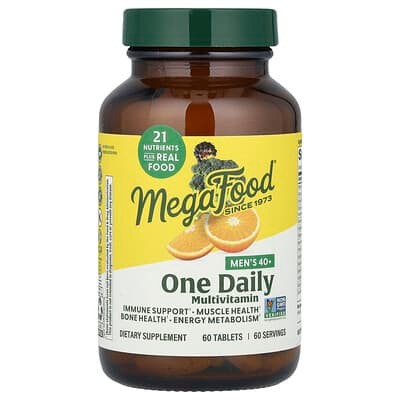
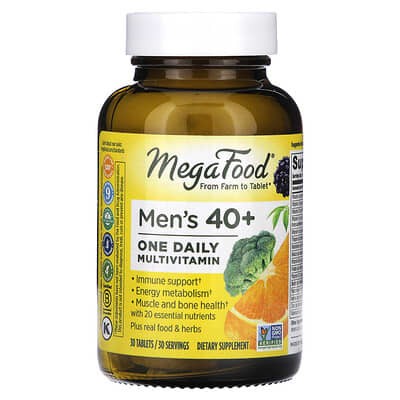
Product Image

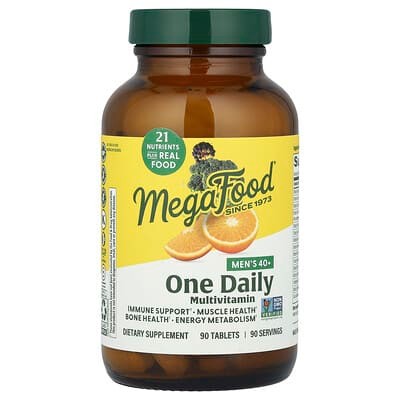
Men Over 40 One Daily

MegaFood
4.8
★ ★ ★ ★ ★
(881 ratings)
Iodine 150 mcg
Molybdenum 40 mcg
Chromium 60 mcg
Product Image
Score64
A broad one-daily formula offers sensible maintenance coverage but limited form precision. Duplicate nutrient entries and an opaque herb blend reduce labeling clarity.
How scoring works
Quantity:90 Tablet(s) • (90 servings)
Goals:
Energy
Metabolism Boost

Score 64

A broad one-daily formula offers sensible maintenance coverage but limited form precision. Duplicate nutrient entries and an opaque herb blend reduce labeling clarity.
How scoring works
$46.99($0.52 per serving)
Vitacost
$ 49.17
iHerb
$ 46.99
Report prices

Analysis

The formula provides a wide set of vitamins and trace minerals in one tablet. Iodine and B vitamins support normal thyroid and energy metabolism when dietary intake is low, while zinc and vitamin D broaden foundational coverage.

Several nutrients appear in duplicate source entries, including vitamin A, niacin, vitamin B6, folate, and vitamin E. The supplied data do not show that these are additive amounts, so the physical label should guide interpretation.

Yeast-bound iodine, chromium, and molybdenum are less chemically specific than well-defined mineral salts or chelates. A 90 mg food-and-herb blend is also opaque, making it unsuitable as evidence of additional effectiveness.

Who is it for
  • Men over 40 seeking a basic once-daily multivitamin
  • Adults wanting iron-free maintenance-level nutrition
Best for
  • Covering common micronutrient gaps
  • Supporting normal energy metabolism when intake is inadequate

Pros

  • Broad vitamin and mineral coverage
  • Convenient single-tablet serving
  • Includes useful iodine, zinc, and vitamin D amounts

Cons

  • Several yeast-bound forms lack chemical specificity
  • Duplicate source entries complicate interpretation
  • The food-and-herb blend is not individually disclosed

Warnings

  • Vitamin K can oppose warfarin and other vitamin-K-antagonist anticoagulants, so intake should remain consistent and medically coordinated.
  • The 150 mcg iodine amount may require medical coordination for people with thyroid disease or those using thyroid-hormone or antithyroid medicine.
  • Check the physical label before combining with other supplements because several nutrients appear in duplicate source entries in the supplied data.

Nutrient quality

70 High impact

Broad vitamin and mineral coverage supports maintenance, but many forms are conventional or vaguely yeast-bound. Goal-relevant amounts are generally modest, and the opaque food blend adds little focused energy or metabolic support.
Ingredient transparency

53 Moderate impact

Many amounts are listed, but duplicate vitamin entries make totals difficult to interpret. The food-and-herb blend hides its components, while inactive ingredients are not provided.

Customer satisfaction

71 High impact

Aggregate customer metrics indicate strong satisfaction from a moderate sample. Missing feedback details prevent judging repeated complaints or whether experiences match the intended use.

Value for money

65 Moderate impact

Broad maintenance coverage and a convenient serving provide fair value. Conventional forms, label duplication, and an opaque blend weaken the quality offered for the cost.

Report analysis

Goals

Energy
Impact
High effect
B+ Goal FitB+ Strength of SupportB- CoverageB Formula Quality
Iodine · 150 mcgVitamin D · 10 mcgVitamin B5 · 10 mgRiboflavin · 3 mgThiamin · 4 mgVitamin B12 · 15 mcg

The 150 mcg iodine amount supports normal thyroid hormone production, while B vitamins provide broader metabolic cofactors. Energy benefit is most relevant when iodine or another included nutrient is inadequate.

The label ties iodine to Saccharomyces cerevisiae but does not identify a precise iodine compound. The broad one-daily formula covers several metabolic needs, though modest doses and an undisclosed herb blend limit depth.

Study evidence
Iodine Adverse 3 studies
Metabolism Boost
Impact
High effect
B- Goal FitB- Strength of SupportB+ CoverageB- Formula Quality
Biotin · 80 mcgNiacin · 20 mg NEVitamin B12 · 15 mcgRiboflavin · 3 mgThiamin · 4 mgVitamin B5 · 10 mgVitamin B6 · 3 mgVitamin D · 10 mcgZinc · 15 mg

Iodine, chromium, B vitamins, and vitamin D provide broad nutritional support for thyroid, glucose, and energy pathways. Most amounts suit maintenance rather than active metabolic stimulation, and a small proprietary food blend adds little verifiable depth.

The one-tablet format is coherent for nutritional coverage but does not replace focused metabolic actives. Vitamin K can reduce warfarin activity, so users of this anticoagulant need stable intake under medical supervision.

Study evidence
Chromium Supportive 47 studies
Iodine Mixed 17 studies
Vitamin D Supportive 65 studies

Ingredients

IngredientAmount per serving
Vitamin A (Beta-Carotene, Carrot)
338 mcg RAE
Vitamin C (Ascorbic Acid)
60 mg
Vitamin D3 (S. cerevisiae)
10 mcg
Vitamin E (D-Alpha-Tocopherol)
12 mg
Vitamin K (Phytonadione)
15 mcg
Thiamin (Thiamine HCl)
4 mg
Riboflavin (organic Brown Rice)
3 mg
Niacin (Niacinamide, S. cerevisiae)
20 mg NE
Vitamin B6 (Pyridoxine Hydrochloride, S. cerevisiae)
3 mg
Folate (Broccoli, Folic Acid)
680 mcg DFE
Vitamin B12 (Cyanocobalamin)
15 mcg
Biotin (Brown Rice)
80 mcg
Pantothenic Acid (Calcium D-Pantothenate)
10 mg
Iodine (Saccharomyces cerevisiae)
150 mcg
Zinc (Saccharomyces cerevisiae)
15 mg
Selenium (Saccharomyces cerevisiae)
14 mcg
Copper (S. cerevisiae)
0.3 mg
Manganese (Saccharomyces cerevisiae)
1 mg
Chromium (S. cerevisiae)
60 mcg
Molybdenum (Saccharomyces cerevisiae)
40 mcg
Boron (S. cerevisiae)
500 mcg
Nourishing Food & Herb Blend
90 mg
Gluten Free Men 18–50 Kosher Dairy Free Vegetarian
Report overview
A- Active Ingredient Quality & BioavailabilityA+ Dose, Safety & Label TransparencyD+ Value

The yeast-based source provides 150 mcg of clearly disclosed iodine for daily maintenance. A single tablet keeps the serving practical and safely below the upper limit. Cost efficiency is moderate, with too little selenium to qualify for a cofactor adjustment.

F Active Ingredient Quality & BioavailabilityC Dose, Safety & Label TransparencyD- Value

The yeast-bound form lacks a defined chelating ligand, while no source branding adds quality verification. The low amount offers limited support beyond basic nutrition, and the amount remains comfortably within the safety limit. Moderate cost is undermined by the low amount.

F Active Ingredient Quality & BioavailabilityF Dose, Safety & Label TransparencyF Value

The 60 mcg chromium serving is suited to nutritional maintenance rather than targeted metabolic support. Yeast-derived chromium may vary in its active chromium content, and no recognized branded source verifies consistency. The broader formula does not include a qualifying high-dose metabolic cofactor for a value adjustment.

Loading alternative details
Report alternatives

Sources

Published studies used for the product analysis and the top-ranked studies for each ingredient and goal.

  1. Improved meta-analytic methods show no effect of chromium supplements on fasting glucose.
    Bailey CH · Biological trace element research · 2014
    Meta-analysis809 participants16 studies pooledMetabolism Boost forChromium
  2. Systematic review and meta-analysis of the efficacy and safety of chromium supplementation in diabetes.
    Suksomboon N; Poolsup N; Yuwanakorn A · Journal of clinical pharmacy and therapeutics · 2015
    Meta-analysis25 studies pooledMetabolism Boost forChromium
  3. Iodine Supplementation Decreases Hypercholesterolemia in Iodine-Deficient, Overweight Women: A Randomized Controlled Trial.
    Herter-Aeberli I; Cherkaoui M; El Ansari N; Rohner R; Stinca S; Chabaa L; von Eckardstein A; Aboussad A; Zimmermann MB · The Journal of nutrition · 2015
    Randomized trial163 participantsMetabolism Boost forIodine
  4. Iodine deficiency and real-life supplementation ineffectiveness in Polish pregnant women and its impact on thyroid metabolism.
    Filipowicz D; Szczepanek-Parulska E; Mikulska-Sauermann AA; Karaźniewicz-Łada M; Główka FK; Szymanowski K; Ołtarzewski M; Schomburg L; Ruchała M · Frontiers in endocrinology · 2023
    Cross-sectional study91 participantsMetabolism Boost forIodine
  5. The relationship between excessive iodine during pregnancy and adverse pregnancy complications.
    Li S; Zha H; Cui Y; Sun L; Yu L; Yuan Q · Endocrine · 2025
    Cohort study595 participantsMetabolism Boost forIodine
  6. Association of radioactive iodine treatment with survivorship symptoms and primary care utilisation in women of reproductive age with thyroid cancer: a retrospective cohort study.
    Devanarayan P; Hartman M; Partin M · Family medicine and community health · 2026
    Cohort study10,882 participantsEnergy forIodine
  7. Energy level and fatigue after surgery for thyroid cancer: A population-based study of patient-reported outcomes.
    Hughes DT; Reyes-Gastelum D; Kovatch KJ; Hamilton AS; Ward KC; Haymart MR · Surgery · 2020
    Cohort study2,584 participantsEnergy forIodine
  8. Health-Related Quality of Life in Differentiated Thyroid Cancer Survivors: A Cross-Sectional Study From Turkey.
    Gültekin A; Kahraman MY; Şengöz T; Şimşek FS · Head & neck · 2026
    Cross-sectional study202 participantsEnergy forIodine
  9. Elevated intakes of supplemental chromium improve glucose and insulin variables in individuals with type 2 diabetes.
    Anderson RA; Cheng N; Bryden NA; Polansky MM; Cheng N; Chi J; Feng J · Diabetes · 1997
    Randomized trial180 participantsMetabolism Boost forChromium
  10. Chromium Supplementation and the Effects on Metabolic Status in Women with Polycystic Ovary Syndrome: A Randomized, Double-Blind, Placebo-Controlled Trial.
    Jamilian M; Asemi Z · Annals of nutrition & metabolism · 2016
    Randomized trial64 participantsMetabolism Boost forChromium
  11. A Comprehensive insight into the effect of chromium supplementation on oxidative stress indices in diabetes mellitus: A systematic review.
    Kooshki F; Tutunchi H; Vajdi M; Karimi A; Niazkar HR; Shoorei H; Pourghassem Gargari B · Clinical and experimental pharmacology & physiology · 2024
    Systematic review33 studies pooledMetabolism Boost forChromium
  12. Comparison of nutritional supplements in improving glycolipid metabolism and endocrine function in polycystic ovary syndrome: a systematic review and network meta-analysis.
    Hu X; Wang W; Su X; Peng H; Tan Z; Li Y; Huang Y · PeerJ · 2023
    Meta-analysis2,362 participants41 studies pooledMetabolism Boost forChromium
  13. [Chromium supplementation in patients with type 2 diabetes and high risk of type 2 diabetes: a meta-analysis of randomized controlled trials].
    San Mauro-Martin I; Ruiz-León AM; Camina-Martín MA; Garicano-Vilar E; Collado-Yurrita L; Mateo-Silleras Bd; Redondo Del Río Mde P · Nutricion hospitalaria · 2017
    Meta-analysis13 studies pooledMetabolism Boost forChromium
  14. Effect of oral iodized oil on thyroid size and thyroid hormone metabolism in children with concurrent selenium and iodine deficiency.
    Zimmermann MB; Adou P; Torresani T; Zeder C; Hurrell RF · European journal of clinical nutrition · 2000
    Single-arm trial51 participantsMetabolism Boost forIodine
  15. Serum Iodine Concentration as a Biomarker for Individual Iodine Nutrition and Thyroid Function in Pregnant Women: A Cross-Sectional Study in Hubei Province.
    Xu M; Dai X; Wang Z; Guo C; Zhang B; Guo H · Public health nutrition · 2026
    Cross-sectional study1,197 participantsMetabolism Boost forIodine
  16. Iron status influences the efficacy of iodine prophylaxis in goitrous children in Côte d'Ivoire.
    Zimmermann MB · International journal for vitamin and nutrition research. Internationale Zeitschrift fur Vitamin- und Ernahrungsforschung. Journal international de vitaminologie et de nutrition · 2002
    OtherMetabolism Boost forIodine
  17. Persistence of goiter despite oral iodine supplementation in goitrous children with iron deficiency anemia in Côte d'Ivoire.
    Zimmermann M; Adou P; Torresani T; Zeder C; Hurrell R · The American journal of clinical nutrition · 2000
    Non-randomized trial109 participantsMetabolism Boost forIodine
  18. Effects of vitamin D supplementation on insulin resistance and lipid metabolic profiles in women with gestational diabetes mellitus: A randomized controlled trial.
    Duan Y; Zhang S; Ma X; Li L; Jia K · African journal of reproductive health · 2026
    Randomized trial120 participantsMetabolism Boost forVitamin D
  19. Vitamin D3 improves glucose metabolism and attenuates inflammation in prediabetic human and mice.
    Zhang Y; Ni P; Miao Y; Chen H; Tang L; Song H; Li W; Li X · The Journal of nutritional biochemistry · 2024
    Randomized trialMetabolism Boost forVitamin D
  20. Effects of vitamin D and calcium supplementation on pancreatic β cell function, insulin sensitivity, and glycemia in adults at high risk of diabetes: the Calcium and Vitamin D for Diabetes Mellitus (CaDDM) randomized controlled trial.
    Mitri J; Dawson-Hughes B; Hu FB; Pittas AG · The American journal of clinical nutrition · 2011
    Randomized trial92 participantsMetabolism Boost forVitamin D
  21. The Effects of Vitamin D Supplementation on Glycemic Control, Lipid Profiles and C-Reactive Protein Among Patients with Cardiovascular Disease: a Systematic Review and Meta-Analysis of Randomized Controlled Trials.
    Ostadmohammadi V; Milajerdi A; Ghayour-Mobarhan M; Ferns G; Taghizadeh M; Badehnoosh B; Mirzaei H; Asemi Z · Current pharmaceutical design · 2020
    Meta-analysis630 participants8 studies pooledMetabolism Boost forVitamin D
  22. The Effect of Improved Serum 25-Hydroxyvitamin D Status on Glycemic Control in Diabetic Patients: A Meta-Analysis.
    Mirhosseini N; Vatanparast H; Mazidi M; Kimball SM · The Journal of clinical endocrinology and metabolism · 2017
    Meta-analysis1,528 participants24 studies pooledMetabolism Boost forVitamin D