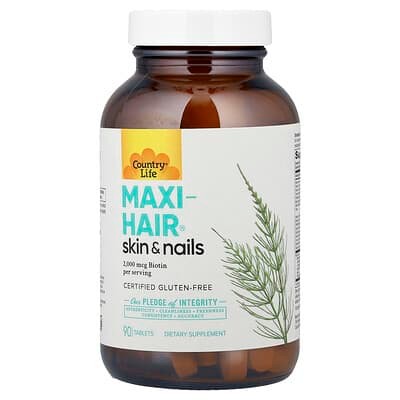
Maxi-Hair

Maxi-Hair

Country Life4.5 (11,356 ratings)
Format:Tablet Quantity: 90 Tablet(s) · 45 servings
Goals
$22.19 $0.49 per serving

About this product

Hair support is most plausible when low zinc or biotin intake contributes to shedding. The declared 15 mg of zinc and 2,000 mcg of D-biotin provide a nutritional basis for that use, but do not establish extra hair growth when needs are already met. Vitamin C contributes to normal collagen formation without demonstrating independent regrowth.

Many vitamin amounts and sources are stated, and the 1 mg of copper makes the accompanying zinc intake easier to assess. The zinc source is described only as an amino acid chelate, while the 1,150 mg Maxi Blend does not identify its individual components. Its total weight cannot establish which extra ingredients are present or whether their amounts are useful.

The 50 mg B6 serving is a significant drawback for casual daily use and warrants reviewing total B6 intake. The broader B-vitamin mix supports normal energy metabolism, but larger amounts do not imply more energy or sharper focus. Value varies by nutrient, so the breadth of the formula does not necessarily justify choosing it for a single dietary gap.

Who is it for
  • Adults considering nutritional support for hair where zinc or biotin intake may be low.
  • People seeking several hair-related nutrients together who have reviewed their B6 intake.
Best for
  • Filling zinc or biotin gaps relevant to hair maintenance.
  • Combining hair-related nutrients with support for normal energy metabolism.

Pros

  • Zinc and D-biotin amounts are disclosed separately.
  • Copper is included alongside zinc, with both amounts stated.
  • Vitamin C adds support for normal collagen formation.

Cons

  • The Maxi Blend leaves individual ingredients and doses unknown.
  • The zinc chelate description does not identify its specific amino acid source.
  • A large biotin amount does not establish added hair growth with adequate intake.
  • Calcium provides only a limited contribution to daily bone-nutrition needs.

Warnings

  • Vitamin B6 provides 50 mg per serving; sustained high intake raises nerve-safety concerns, so review ongoing use and avoid stacking it with another B6 supplement.


Product analysis

56 out of 100

Maxi-Hair provides nutrients that support normal energy use, immune function and skin maintenance when intake is low. Hair benefits are most plausible when zinc or biotin shortfalls contribute to shedding.

AI assessment of the formula, label and price. How scoring works

Nutrient Quality54

Several B vitamins and iodine have clearly identified, favorable forms. The copper preparation and unspecified blend leave important parts of the combination uncertain.

Ingredient Transparency77

All listed amounts and most forms are disclosed, supporting serving comparisons. The proportions within the vitamin C, calcium and combination-blend entries are omitted.

Value For Money44

Value is mixed: vitamin B6 is economical, while niacin, vitamin B5 and choline are relatively expensive for their amounts. Other ingredients range from moderate value to insufficient price information.

Customer Satisfaction85

Customer feedback is positive across many thousands of reviews. The large review history provides a broad picture of satisfaction.

Product Focus22

The main supported role is filling nutrient shortfalls rather than reliably improving hair growth or everyday energy in adequately nourished people. The incompletely described blend leaves some individual contributions uncertain.

Format
Tablet
Container
90 Tablet(s)
Per serving
$0.49
Customer rating
4.5 · 11,356 ratings
Report analysis

Goals

Skin Health
Impact
High effect
C Ingredient FitD PathwaysA+ EvidenceA+ Formulation Logic
Zinc · 15 mgVitamin C · 200 mgCopper · 1 mgSelenium · 50 mcgVitamin E · 33.4 mg

Vitamin C supports collagen formation and helps restore wound healing when intake is deficient. Extra vitamin C has no established skin benefit when intake is adequate, and larger serving amounts do not demonstrate greater improvement. Zinc also supports skin repair when intake is low. Biotin and riboflavin mainly matter when low intake contributes to dermatitis.

How this product is rated for Skin Health

Ingredient fit64

The relevant connection is mainly nutritional support or limited surrogate evidence, rather than established cosmetic improvement.
Goal fit
The relevant connection is mainly nutritional support or limited surrogate evidence, rather than established cosmetic improvement.
Dose adequacy
The declared amounts support the saved exposure comparison; larger nutrient amounts do not establish extra benefit when intake is adequate.

Pathways49

The represented skin route has limited support from the supplied ingredients and amounts.
Depth
The represented skin route has limited support from the supplied ingredients and amounts.
Breadth
Coverage is limited to the skin routes represented by the supplied ingredients; it does not imply broad improvement.

Evidence100

Deficiency-related skin roles are clearer than added benefits in adequately nourished adults.
Evidence strength
Deficiency-related skin roles are clearer than added benefits in adequately nourished adults.
Studied preparation
The supplied preparation finding does not establish superiority of a nutrient form or equivalence to a different studied blend.

Formulation logic100

The supplied findings identify no required missing partner or specified conflict. Amount comparisons do not establish combination benefits.
Partner coverage
No missing required partner limits the eligible ingredients; no automatic combination benefit follows.
Conflicts
No specified ingredient conflict was identified in the supplied findings.
Effective doses
The included ingredients meet the supplied minimum exposure comparison; this is not a proven clinical benefit threshold.
Study evidence
Biotin Supportive 10 studies
Copper Supportive 16 studies
Niacin Supportive 61 studies
Selenium Supportive 22 studies
Vitamin A Supportive 106 studies
Vitamin C Supportive 53 studies
Vitamin E Supportive 38 studies
Zinc Supportive 66 studies
Immunity
Impact
Highest effect
C Ingredient FitA+ PathwaysA+ EvidenceA+ Formulation Logic
Vitamin C · 200 mgZinc · 15 mgVitamin A · 1500 mcgSelenium · 50 mcg

Vitamin A contributes to normal immune function and protective barriers, while zinc and selenium add normal immune and antioxidant roles. Copper, folate, B6 and B12 help maintain immune-cell function when intake is low. Vitamin E receives a saved contribution, but its mixed older-adult trials do not establish extra benefit in adequately nourished adults. The smaller vitamin C amount adds little, and L-cysteine remains unresolved.

How this product is rated for Immunity

Ingredient fit64

The selected serving makes a partial contribution against the comparison amounts, with differences between ingredients and any unresolved quantities retained.
Goal fit
The immune-related ingredients share the formula with other actives, so the formula is less concentrated on this goal.
Dose adequacy
The selected serving makes a partial contribution against the comparison amounts, with differences between ingredients and any unresolved quantities retained.

Pathways99

The most represented area is barrier and antimicrobial defense.
Depth
The most represented area is barrier and antimicrobial defense.
Breadth
The more substantially represented areas are barrier and antimicrobial defense, lymphocyte function and immune regulation, oxidative and inflammatory balance.

Evidence100

Zinc supplies the strongest recognized basis here; the supplied context limits which clinical immune benefits can be claimed.
Evidence strength
Zinc supplies the strongest recognized basis here; the supplied context limits which clinical immune benefits can be claimed.
Studied preparation
The recognized preparations meet the saved check; this does not establish form superiority or automatic clinical benefit.

Formulation logic100

No defined ingredient-conflict condition was triggered by the supplied facts.
Partner coverage
The recognized ingredients can contribute independently or have required partners present; no additional combined benefit is established.
Conflicts
No defined ingredient-conflict condition was triggered by the supplied facts.
Effective doses
All recognized ingredients meet the minimum amount check; this is not a proven treatment threshold.
Study evidence
Selenium Mixed 37 studies
Vitamin A Supportive 107 studies
Vitamin C Supportive 53 studies
Vitamin E Supportive 21 studies
Zinc Supportive 73 studies
Everyday Health
Impact
Highest effect
B+ Ingredient FitA+ PathwaysB+ EvidenceA+ Formulation Logic
Folate · 667 mcg DFEVitamin B12 · 50 mcgSelenium · 50 mcgZinc · 15 mgVitamin C · 200 mg

The B vitamins contribute to nutrient availability across energy-related processes and blood formation. Folate and vitamin B12 provide complementary nutritional contributions when dietary intake is low. Amounts above ordinary intake needs do not establish more energy or better general health in adequately nourished adults, and the declared forms do not establish superior outcomes. Iodine, zinc and selenium add nutritional coverage; these contributions do not establish hair improvement.

How this product is rated for Everyday Health

Ingredient fit82

Relevant ingredients form only part of a formula that also addresses other goals.
Goal fit
Relevant ingredients form only part of a formula that also addresses other goals.
Dose adequacy
The included amounts partly meet the saved references; an unresolved amount cannot establish a dose contribution.

Pathways100

The strongest represented mechanism is energy metabolism cofactors. This describes ingredient roles rather than demonstrated health improvement.
Depth
The strongest represented mechanism is energy metabolism cofactors. This describes ingredient roles rather than demonstrated health improvement.
Breadth
Several mechanisms are represented, without establishing an equally broad range of health benefits.

Evidence82

Vitamin B9 (Folate) supplies the strongest included evidence contribution; preparation and population limitations still apply.
Evidence strength
Vitamin B9 (Folate) supplies the strongest included evidence contribution; preparation and population limitations still apply.
Studied preparation
The included preparations match the saved references, without transferring nutrient availability into broader health benefits.

Formulation logic100

No matching ingredient conflict was identified in the supplied findings.
Partner coverage
The included contributors can act independently or have their required partner; this does not establish combination synergy.
Conflicts
No matching ingredient conflict was identified in the supplied findings.
Effective doses
All included contributors meet the saved minimum amount threshold, which is not a proven minimum effective dose.
Study evidence
Folate Supportive 80 studies
Selenium Supportive 70 studies
Vitamin C Supportive 56 studies
Zinc Supportive 60 studies
Impact
Moderate effect
B- Ingredient FitF PathwaysB EvidenceA+ Formulation Logic
Iodine · 225 mcgVitamin B5 · 50 mgRiboflavin · 50 mgThiamin · 30 mgVitamin B12 · 50 mcg

B vitamins support the normal conversion of food into usable energy. Folate and B12 also support normal blood formation. Benefits for tiredness are most relevant when intake is low; high amounts do not guarantee extra energy. Vitamin C adds nutritional support, while iodine supports normal thyroid function. A high biotin amount has no established independent fatigue benefit.

How this product is rated for Energy

Ingredient fit74

Several nutrients relate to energy metabolism and nutritional adequacy, alongside ingredients with other purposes. Amount coverage varies: some declared nutrients meet their saved references while others provide partial amounts.
Goal fit
Several nutrients relate to energy metabolism and nutritional adequacy, alongside ingredients with other purposes.
Dose adequacy
Amount coverage varies: some declared nutrients meet their saved references while others provide partial amounts.

Pathways0

The saved support concerns nutrient sufficiency, with no substantial direct alertness, muscle-energy or fatigue-resistance coverage.
Depth
The saved support concerns nutrient sufficiency, with no substantial direct alertness, muscle-energy or fatigue-resistance coverage.
Breadth
No direct energy route reaches the saved level for broad coverage.

Evidence77

Evidence is strongest for nutritional needs and selected low-status situations, rather than an extra energy boost for everyone.
Evidence strength
Vitamin B2 (Riboflavin) provides the strongest saved evidence among the assessed ingredients, with benefits dependent on the relevant population and nutritional needs.
Studied preparation
Most assessed preparations are recognized in the saved review, while iodine is not identified as studied.

Formulation logic100

No missing required ingredient partner or configured conflict was found among the assessed ingredients.
Partner coverage
The assessed ingredients work independently or have their required partner.
Conflicts
No configured ingredient conflict was found in the supplied facts.
Effective doses
All ingredients counted for this finding meet the saved minimum amount.
Study evidence
Iodine Adverse 3 studies
Thiamin Disputed 12 studies
Impact
High effect
B- Ingredient FitD- PathwaysA+ EvidenceA+ Formulation Logic
Biotin · 2000 mcgZinc · 15 mgVitamin C · 200 mg

The zinc and biotin in this formula can help address shedding when the corresponding nutrient deficiency is responsible; extra growth with adequate intake is not established. Vitamin C supports normal collagen formation and iron absorption, without establishing independent hair regrowth. Horsetail and methionine remain unresolved in the imported facts.

How this product is rated for Hair Health

Ingredient fit71

The formula has relevant ingredients, while its broader composition or uses make the hair focus less concentrated. Relevant amounts meet the saved comparison only partly; unresolved quantities contribute no amount recognition.
Goal fit
The formula has relevant ingredients, while its broader composition or uses make the hair focus less concentrated.
Dose adequacy
Relevant amounts meet the saved comparison only partly; unresolved quantities contribute no amount recognition.

Pathways44

The main assigned contribution concerns antioxidant protection; normal antioxidant functions do not establish a hair-growth effect. Coverage was concentrated in one specified mechanism.
Depth
The main assigned contribution concerns antioxidant protection; normal antioxidant functions do not establish a hair-growth effect.
Breadth
Only follicle antioxidant protection reached the saved coverage requirement, leaving limited breadth across the specified mechanisms.

Evidence97

Zinc leads the saved evidence comparison. Nutrient functions and preparation recognition alone do not establish routine hair regrowth.
Evidence strength
Zinc provides the strongest recognized evidence here, subject to the supplied population and outcome limitations.
Studied preparation
The saved comparison recognizes most qualifying forms; Iodine lacks a matching studied preparation.

Formulation logic100

The included contributions met the saved minimum amount requirement, with no missing required partner or identified conflict.
Partner coverage
No required partner was missing among the included contributions; this does not demonstrate added benefit from combining them.
Conflicts
No ingredient conflict was identified by the supplied checks.
Effective doses
All included contributions met the saved minimum amount requirement, which is not a proven effective hair-growth dose.
Study evidence
Biotin Supportive 4 studies
Copper Adverse 4 studies
Folate Mixed 15 studies
Iodine No effect 1 study
Niacin Disputed 2 studies
Selenium Disputed 7 studies
Vitamin A Disputed 13 studies
Vitamin E No effect 3 studies
Zinc Supportive 22 studies
Impact
High effect
C- Ingredient FitD- PathwaysA+ EvidenceA+ Formulation Logic
Folate · 667 mcg DFEVitamin B12 · 50 mcgVitamin B6 · 50 mgSelenium · 50 mcgVitamin E · 33.4 mgZinc · 15 mgVitamin C · 200 mgCholine · 21 mgRiboflavin · 50 mg

Folate and B12 support methyl-group metabolism, and selenium supports antioxidant enzymes. Folate and selenium toxin-related findings concern exposed or low-nutrient groups, rather than general clearance. Riboflavin, B6 and zinc have essential cofactor roles. The cysteine declaration remains unreconciled with the imported ingredient inventory, so its individual amount and contribution cannot be established.

How this product is rated for Liver & Detox

Ingredient fit59

The formula includes ingredients connected to the goal alongside ingredients serving broader nutritional or other purposes. The six included ingredients provide a mixed amount contribution.
Goal fit
The formula includes ingredients connected to the goal alongside ingredients serving broader nutritional or other purposes.
Dose adequacy
The six included ingredients provide a mixed amount contribution.

Pathways40

The strongest saved connection is detox-enzyme induction; this describes a biological category, not measured toxin clearance. Only one biological category meets the saved coverage comparison, leaving limited breadth across the goal.
Depth
The strongest saved connection is detox-enzyme induction; this describes a biological category, not measured toxin clearance.
Breadth
Only one biological category meets the saved coverage comparison, leaving limited breadth across the goal.

Evidence97

Folate leads the saved evidence finding, but its supporting context does not establish routine toxin clearance.
Evidence strength
Folate leads the saved evidence finding, but its supporting context does not establish routine toxin clearance.
Studied preparation
Some included preparations match the saved comparison; vitamin b2 and vitamin b6 lack that match. This does not establish product-specific clearance efficacy.

Formulation logic100

The included ingredients do not require a missing partner, and no configured conflict was identified.
Partner coverage
The included ingredients can contribute without a missing required partner; this does not establish an added benefit from combining them.
Conflicts
No configured ingredient conflict was identified; this is a limited formulation check, not a general safety conclusion.
Effective doses
All included ingredients meet the saved amount threshold; that threshold is not a proven effective detoxification dose.
Study evidence
Choline Supportive 6 studies
Folate Supportive 16 studies
Selenium Supportive 10 studies
Vitamin C Supportive 9 studies
Vitamin E Supportive 23 studies
Zinc Supportive 30 studies

Ingredients

IngredientAmount per servingScore
Vitamin A (Retinyl Palmitate)
1500 mcg
Vitamin C (Ascorbic Acid, Rose Hip)
200 mg
Vitamin E (D-Alpha-Tocopheryl Acid Succinate)
33.4 mg
Thiamine (Thiamine Hydrochloride)
30 mg 65
Riboflavin
50 mg 62
Niacin (Niacinamide)
50 mg 71
Vitamin B6 (Pyridoxine Hydrochloride)
50 mg 73
Folate
667 mcg DFE
Vitamin B12 (Cyanocobalamin)
50 mcg
Biotin (D-Biotin)
2000 mcg 76
Pantothenic Acid (Calcium D-Pantothenate)
50 mg 70
Choline (Choline Bitartrate)
21 mg 50
Calcium (Calcium Carbonate, Calcium D-Pantothenate)
200 mg
Iodine (Potassium Iodide)
225 mcg 90
Zinc (Zinc Amino Acid Chelate)
15 mg 64
Selenium (Selenium Rice Chelate)
50 mcg
Copper (Copper Rice Chelate)
1 mg 44
Maxi Blend
1150 mg
Gluten Free Adults 18–50 Dairy Free Vegetarian
Report overview
A+ Active Ingredient Quality & BioavailabilityA+ Dose, Safety & Label TransparencyD+ Value
Each serving provides 225 mcg of iodine as potassium iodide, a form viewed favorably for absorption. The whole-product serving costs about $0.49.
How this ingredient is rated

Active Ingredient Quality & Bioavailability100

The iodine is supplied as potassium iodide, a form viewed favorably for absorption. No marine source is recorded.
Iodine Form & Bioavailability
Potassium iodide is the iodine form assessed and is viewed favorably for absorption.
Marine Source Purity & Sourcing
No marine source is recorded, so the marine-source contamination concern is not applied.

Dose, Safety & Label Transparency100

The iodine amount is stated as 225 mcg per serving; the evaluation does not flag that serving amount as excessive.
Dosage Efficacy for Daily Support
The serving provides 225 mcg of iodine, an amount viewed favorably in the evaluation.
Dosage Safety & Upper Limits
The evaluation does not flag the serving amount as excessive; total iodine intake from other sources is not known.
Elemental Iodine Transparency
The iodine amount and its source are stated: 225 mcg per serving from potassium iodide.

Value50

A whole-product serving costs about $0.49.
Price Per Effective Serving
The price is about $0.49 per whole-product serving.
A+ Ingredient Form & Label QualityF Dose, Safety & Label TransparencyA Value
Each serving contains 50 mg of vitamin B6, exceeding the European adult daily upper limit. The source is pyridoxine hydrochloride; B6 from food or other supplements also adds to total intake.
How this ingredient is rated

Ingredient Form & Label Quality100

Vitamin B6 is supplied as pyridoxine hydrochloride. No artificial colors, titanium dioxide or talc are flagged in the saved evaluation; other excipients may still be present.
Vitamin B6 Form Identification
The identified vitamin B6 source is pyridoxine hydrochloride.
Clean Label and Excipient Purity
No artificial colors, titanium dioxide or talc are flagged in the saved evaluation; other excipients may still be present.

Dose, Safety & Label Transparency37

A serving contains 50 mg of vitamin B6. One serving exceeds the European adult daily upper limit for B6; intake from food and other supplements also counts.
Vitamin B6 Dose & Safety Policy
A serving contains 50 mg of B6. One serving exceeds the European adult daily upper limit for B6; intake from food and other supplements also counts.
Label Transparency
The saved facts identify pyridoxine hydrochloride as the vitamin B6 source.

Value91

At the whole-product price, the equivalent cost is about 0.99 cents per mg of vitamin B6.
Vitamin B6 Price Efficiency
At the whole-product price, the equivalent cost is about 0.99 cents per mg of vitamin B6.
A+ Active Ingredient Quality & BioavailabilityC+ Dose, Safety & Label TransparencyF Value
The saved facts record 50 mg of niacin per serving as niacinamide. Niacinamide generally does not cause the flushing associated with nicotinic acid.
How this ingredient is rated

Active Ingredient Quality & Bioavailability100

Niacinamide is a standard form of vitamin B3, rather than a specialized niacin precursor.
Niacin Form & Goal Alignment
Niacinamide is the form assessed for the stated skin-support goal.
Precursor Source Quality
Niacinamide is a standard B3 form; the saved facts do not identify a specialized precursor.

Dose, Safety & Label Transparency67

The saved facts record 50 mg of niacin per serving as niacinamide, a form generally associated with less flushing than nicotinic acid.
Clarity of Chemical Form
Niacinamide is identified as the niacin form.
Form-Specific Dosage Efficacy
The saved niacin amount is 50 mg per serving.
Flush Risk & Safety Labeling
Niacinamide generally does not cause the flushing associated with nicotinic acid.

Value20

The whole-product price is about $0.49 per serving.
Price Per Effective Serving
The whole-product price is about $0.49 per serving.
Report alternatives

Sources

Published studies used for the product analysis and the top-ranked studies for each ingredient and goal.

  1. Association of radioactive iodine treatment with survivorship symptoms and primary care utilisation in women of reproductive age with thyroid cancer: a retrospective cohort study.
    Devanarayan P; Hartman M; Partin M · Family medicine and community health · 2026
    Cohort study10,882 participantsEnergy forIodine
  2. Energy level and fatigue after surgery for thyroid cancer: A population-based study of patient-reported outcomes.
    Hughes DT; Reyes-Gastelum D; Kovatch KJ; Hamilton AS; Ward KC; Haymart MR · Surgery · 2020
    Cohort study2,584 participantsEnergy forIodine
  3. Health-Related Quality of Life in Differentiated Thyroid Cancer Survivors: A Cross-Sectional Study From Turkey.
    Gültekin A; Kahraman MY; Şengöz T; Şimşek FS · Head & neck · 2026
    Cross-sectional study202 participantsEnergy forIodine
  4. Physicochemical properties of and volatile compounds in riboflavin fortified cloudy apple juice; study of its effect on job fatigue among Egyptian construction workers.
    Fouad S; Ibrahim GE; Hussein AMS; Ibrahim FA; El Gendy A · Heliyon · 2021
    Non-randomized trialEnergy forRiboflavin
  5. Vitamin B status in patients with chronic fatigue syndrome.
    Heap LC; Peters TJ; Wessely S · Journal of the Royal Society of Medicine · 1999
    Case-control study30 participantsEnergy forRiboflavin
  6. B-vitamins, related vitamers, and metabolites in patients with quiescent inflammatory bowel disease and chronic fatigue treated with high dose oral thiamine.
    Bager P; Hvas CL; Hansen MM; Ueland P; Dahlerup JF · Molecular medicine (Cambridge, Mass.) · 2023
    Observational studyEnergy forRiboflavin
  7. Metabolic features of chronic fatigue syndrome.
    Naviaux RK; Naviaux JC; Li K; Bright AT; Alaynick WA; Wang L; Baxter A; Nathan N; Anderson W; Gordon E · Proceedings of the National Academy of Sciences of the United States of America · 2024
    Case-control study84 participantsEnergy forRiboflavin
  8. Effectiveness of Riboflavin in Inherited Metabolic Diseases: A Systematic Review
    Bregje Jaeger, Nina N Stolwijk, Femke Aaldering, Charlotte A Ruys, Marije Smits, Nicole I Wolf, Carla E M Hollak, Annet M Bosch · Journal of Inherited Metabolic Disease · 2026
    Systematic review381 studies pooledEnergy forRiboflavin
  9. Influence of thiamin supplementation on the health and general well-being of an elderly Irish population with marginal thiamin deficiency.
    Smidt LJ; Cremin FM; Grivetti LE; Clifford AJ · Journal of gerontology · 1991
    Randomized trial80 participantsEnergy forThiamin
  10. Randomised clinical trial: high-dose oral thiamine versus placebo for chronic fatigue in patients with quiescent inflammatory bowel disease.
    Bager P; Hvas CL; Rud CL; Dahlerup JF · Alimentary pharmacology & therapeutics · 2021
    Randomized trial40 participantsEnergy forThiamin
  11. Dietary reference values for thiamin.
    EFSA Panel on Dietetic Products, Nutrition and Allergies (NDA); Turck D; Bresson JL; Burlingame B; Dean T; Fairweather-Tait S; Heinonen M; Hirsch-Ernst KI; Mangelsdorf I; McArdle HJ; Naska A; Nowicka G; Pentieva K; Sanz Y; Siani A; Sjödin A; Stern M; Tomé D; Van Loveren H; Vinceti M; Willatts P; Lamberg-Allardt C; Przyrembel H; Tetens I; Gudelj Rakic J; Ioannidou S; de Sesmaisons-Lecarré A; Forss AC; Neuhäuser-Berthold M · EFSA journal. European Food Safety Authority · 2026
    Guideline / consensusEnergy forThiamin
  12. Effects of thiamine supplementation on exercise-induced fatigue.
    Suzuki M; Itokawa Y · Metabolic brain disease · 1996
    Randomized trial16 participantsEnergy forThiamin
  13. Long-term maintenance treatment with 300 mg thiamine for fatigue in patients with inflammatory bowel disease: results from an open-label extension of the TARIF study.
    Bager P; Hvas CL; Rud CL; Dahlerup JF · Scandinavian journal of gastroenterology · 2022
    Randomized trialEnergy forThiamin
  14. A new perspective on vitamin B12 deficiency in rheumatology: a case-based review.
    Dułak NA; Rytlewska M; Jaskólska M; Chmielewski M · Rheumatology international · 2024
    Case series3 participantsEnergy forVitamin B12
  15. Effects of Vitamin B12 Supplementation on Cognitive Function, Depressive Symptoms, and Fatigue: A Systematic Review, Meta-Analysis, and Meta-Regression.
    Markun S; Gravestock I; Jäger L; Rosemann T; Pichierri G; Burgstaller JM · Nutrients · 2021
    Meta-analysis6,276 participants16 studies pooledEnergy forVitamin B12
  16. Patients' experiences with methylcobalamin injections in amyotrophic lateral sclerosis.
    Zubair AS; Saab L; Scharer K; Khokhar B · Brain circulation · 2024
    Qualitative study5 participantsEnergy forVitamin B12
  17. Cobalamin deficiency: clinical picture and radiological findings.
    Briani C; Dalla Torre C; Citton V; Manara R; Pompanin S; Binotto G; Adami F · Nutrients · 2014
    Narrative reviewEnergy forVitamin B12
  18. Vitamin B12 Deficiency: Common Questions and Answers.
    Patel H; McGuirk R · American family physician · 2025
    Narrative reviewEnergy forVitamin B12
  19. Intakes of Folate, Vitamin B6, and Vitamin B12 in Relation to All-Cause and Cause-Specific Mortality: A National Population-Based Cohort.
    Bo Y; Xu H; Zhang H; Zhang J; Wan Z; Zhao X; Yu Z · Nutrients · 2022
    Cohort study55,569 participantsEveryday Health forFolate
  20. The responsiveness of plasma homocysteine to small increases in dietary folic acid: a primary care study.
    Schorah CJ; Devitt H; Lucock M; Dowell AC · European journal of clinical nutrition · 1998
    Randomized trial119 participantsEveryday Health forFolate