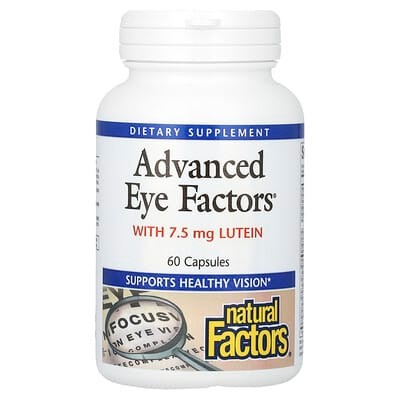
Advanced Eye Factors

Advanced Eye Factors

Natural Factors4.6 (991 ratings)
Format:Capsule Quantity: 60 Capsule(s) · 30 servings
Goals
$24.47 $0.81 per serving

About this product

Broad nutritional support is more firmly supported than the many additional benefits suggested by the ingredient mix. B vitamins support normal energy metabolism, while zinc and selenium contribute to normal immune function when intake is low; taking more does not establish greater energy use or stronger immunity.

Lutein at 15 mg and zeaxanthin at 2.6 mg add a more specialized carotenoid component, but the supplied findings do not establish outcomes for the complete formula. The 2 mg lycopene and 200 mg acetyl-L-carnitine amounts have limited relevance to the higher exposures described in their supporting findings, and the 50 mg ubiquinone declaration does not establish the preparation associated with specific skin effects.

Mineral disclosure is a useful strength: 16 mg zinc as monomethionine is accompanied by 1 mg copper. Several other ingredient forms or preparation details remain unclear, and unresolved ingredient information limits confidence in the full assessment; the relatively high cost is harder to justify if only basic nutrient replacement is needed.

Who is it for
  • Adults who want a broad nutrient formula with lutein and zeaxanthin and accept limits in the supporting detail
Best for
  • Combining nutritional gap support with clearly quantified carotenoids

Pros

  • Zinc and copper amounts are both disclosed
  • B vitamins address several normal nutrient-dependent energy processes
  • Lutein and zeaxanthin amounts can be checked individually

Cons

  • Some ingredient forms and preparation details are missing
  • Acetyl-L-carnitine and lycopene amounts are low relative to the supplied comparison exposures
  • Generic ubiquinone does not establish preparation-specific skin benefits
  • High cost limits value for basic nutrient replacement

Warnings

  • Some ingredient declarations differ or remain unresolved; confirm the current label before combining it with overlapping nutrient supplements


Product analysis

56 out of 100

Advanced Eye Factors combines vitamins, minerals and plant ingredients with nutrients that support normal skin, immune and metabolic functions. The broad formula is relatively costly for several of its individual ingredients.

AI assessment of the formula, label and price. How scoring works

Nutrient Quality40

Zinc is supplied in a form with favorable absorption characteristics. Selenium quality remains uncertain, and most other ingredients lack enough information for a confident absorption comparison.

Ingredient Transparency93

Ingredient amounts and most sources are disclosed. Conflicting lutein quantities prevent a reliable total, while three ingredient forms are missing.

Value For Money30

Several ingredients are expensive at the whole-product price, including selenium, acetyl L-carnitine and lycopene. The broad ingredient list does not by itself establish good value.

Customer Satisfaction78

Customer ratings are positive across a substantial review pool. That provides a broader picture of satisfaction without confirming health effects.

Product Focus52

The wide range of nutrients connects the formula with several nutritional needs. Most expected benefits concern normal function or correcting low intake, rather than extra benefits from taking many ingredients together.

Format
Capsule
Container
60 Capsule(s)
Per serving
$0.81
Customer rating
4.6 · 991 ratings
Report analysis

Goals

Immunity
Impact
Highest effect
C+ Ingredient FitB+ PathwaysA+ EvidenceA+ Formulation Logic
Vitamin C · 120 mgZinc · 16 mgSelenium · 100 mcg
Study evidence
Selenium Mixed 37 studies
Vitamin C Supportive 53 studies
Vitamin E Supportive 21 studies
Zinc Supportive 73 studies
Skin Health
Impact
High effect
C+ Ingredient FitC PathwaysA- EvidenceA+ Formulation Logic
Zinc · 16 mgVitamin C · 120 mgCopper · 1 mgSelenium · 100 mcgLycopene · 2 mgVitamin E · 40.2 mg
Study evidence
Copper Supportive 16 studies
Lycopene Supportive 20 studies
Selenium Supportive 22 studies
Vitamin C Supportive 53 studies
Vitamin E Supportive 38 studies
Zinc Supportive 66 studies
Impact
Highest effect
B- Ingredient FitA+ PathwaysB+ EvidenceA+ Formulation Logic
Folate · 680 mcg DFEVitamin B12 · 100 mcgSelenium · 100 mcgZinc · 16 mgVitamin C · 120 mg
Study evidence
Folate Supportive 80 studies
Selenium Supportive 70 studies
Vitamin C Supportive 56 studies
Zinc Supportive 60 studies
Impact
Moderate effect
C Ingredient FitF PathwaysA+ EvidenceA+ Formulation Logic
Vitamin B12 · 100 mcgRiboflavin · 2.4 mgThiamin · 2.4 mgVitamin B6 · 3 mgZinc · 16 mgCoenzyme Q-10 · 50 mgAcetyl L-Carnitine · 200 mg
Study evidence
Selenium Mixed 28 studies
Thiamin Supportive 11 studies
Vitamin B6 Supportive 16 studies
Zinc Supportive 12 studies
Hair Health
Impact
High effect
C Ingredient FitC- PathwaysA+ EvidenceA+ Formulation Logic
Zinc · 16 mgVitamin C · 120 mg
Study evidence
Copper Adverse 4 studies
Folate Mixed 15 studies
Selenium Disputed 7 studies
Vitamin E No effect 3 studies
Zinc Supportive 22 studies
Bone Health
Impact
High effect
C Ingredient FitC PathwaysA+ EvidenceA+ Formulation Logic
Copper · 1 mgZinc · 16 mgVitamin C · 120 mg
Study evidence
Copper Disputed 20 studies
Folate Supportive 50 studies
Vitamin C Supportive 46 studies
Zinc Supportive 33 studies

Ingredients

IngredientAmount per servingScore
Vitamin C (Ascorbic Acid)
120 mg
Vitamin E (D-Alpha-Tocopheryl Acetate)
40.2 mg
Thiamine (Thiamine Hydrochloride)
2.4 mg
Riboflavin
2.4 mg
Vitamin B6 (Pyridoxine Hydrochloride)
3 mg
Folate
680 mcg DFE
Vitamin B12 (Methylcobalamin)
100 mcg
Zinc (Zinc Monomethionine)
16 mg 80
Selenium (Yeast)
100 mcg 37
Copper (Copper Gluconate)
1 mg 58
N-Acetyl-L-Carnitine Hydrochloride
200 mg 55
Blueberry Fruit Concentrate, Fresh (Vaccinium corymbosum Fruit Concentrate, Fresh)
200 mg
Grape Seed Extract
100 mg
Coenzyme Q10 (Ubiquinone)
50 mg 47
Bilberry Fruit Extract (Vaccinium myrtillus Fruit Extract)
40 mg
Lutein (Marigold)
15 mg
Zeaxanthin (Marigold)
2.6 mg
Lycopene (Tomato)
2 mg 70
Gluten Free Adults 18–50 Dairy Free Sugar Free
Report overview
A+ Active Ingredient Quality & BioavailabilityA- Dose, Safety & Label TransparencyF Value
Each serving provides 16 mg zinc at a high cost per serving. That amount may support zinc maintenance. The zinc comes as zinc methionine. The same serving contains 1 mg copper, giving a zinc-to-copper ratio of 16:1.
How this ingredient is rated

Active Ingredient Quality & Bioavailability100

The zinc comes as zinc methionine.
Zinc Form Bioavailability
The zinc comes as zinc methionine.

Dose, Safety & Label Transparency85

16 mg may support zinc maintenance. The same serving contains 1 mg copper, giving a zinc-to-copper ratio of 16:1.
Elemental Dose Transparency
The zinc amount is clearly stated.
Zinc Dosage Safety & Effectiveness
16 mg may support zinc maintenance.
Zinc-to-Copper Mineral Balance
The same serving contains 1 mg copper, giving a zinc-to-copper ratio of 16:1.

Value30

The cost per serving is high.
Price Per Serving Efficiency
The cost per serving is high.
F Active Ingredient Quality & BioavailabilityA- Dose, Safety & Label TransparencyF Value
Advanced Eye Factors provides 100 mcg of selenium per serving at a high cost for the amount supplied. The selenium form is unknown.
How this ingredient is rated

Active Ingredient Quality & Bioavailability0

The selenium form is unknown, so its chemical form and properties cannot be determined.
Selenium Chemical Form
The available information does not identify the selenium chemical form.
Form Transparency & Isomer Specificity
The selenium form is not specified in the available information.

Dose, Safety & Label Transparency88

The 100 mcg serving falls in a range generally used for daily maintenance. At 100 mcg per serving, it leaves room below the 400 mcg upper limit for selenium from food.
Dosage Efficacy Sweet Spot
The 100 mcg serving falls in a range generally used for daily maintenance.
Safety Margin & UL Adherence
At 100 mcg per serving, it leaves room below the 400 mcg upper limit for selenium from food.

Value10

The cost is high when compared per 200 mcg of selenium.
Price per 200 mcg Serving
The cost is high when compared per 200 mcg of selenium.
C- Active Ingredient Quality & BioavailabilityB- Dose, Safety & Label TransparencyF Value
Each serving provides 1 mg of copper at a high cost per serving. Copper Gluconate is the named copper source. It also supplies 16 mg of zinc; the zinc-to-copper ratio is about 16.0 to 1.
How this ingredient is rated

Active Ingredient Quality & Bioavailability58

Copper Gluconate is the named copper source. The label states the copper amount and names Copper Gluconate as its source.
Copper Form Bioavailability
Copper Gluconate is the named copper source.
Elemental Copper Labeling Clarity
The label states the copper amount and names Copper Gluconate as its source.

Dose, Safety & Label Transparency71

The serving supplies 1 mg of copper. It also supplies 16 mg of zinc; the zinc-to-copper ratio is about 16.0 to 1.
Copper Dosage Safety & Efficacy
The serving supplies 1 mg of copper.
Zinc-to-Copper Balance
It also supplies 16 mg of zinc; the zinc-to-copper ratio is about 16.0 to 1.

Value30

The cost per serving is high.
Price Per Serving Efficiency
The cost per serving is high.
Report alternatives

Sources

Published studies used for the product analysis and the top-ranked studies for each ingredient and goal.

  1. The Association between Dietary and Circulating Copper Levels and Osteoporosis: a Scoping Review.
    Ju Y; Xiong W; Pang Y; Chen Z; Hou J; Zheng S; Li Z; Liu T; Xia H; Xia M; Zhong Y; Li J; Jiang X · Biological trace element research · 2026
    Scoping review18 studies pooledBone Health forCopper
  2. Association between dietary copper, iron, zinc, selenium intake and osteopenia or osteoporosis in elderly hypertensive patients: a retrospective cohort study.
    Chen M; Jia L; Gao R · Frontiers in nutrition · 2024
    Cohort study5,286 participantsBone Health forCopper
  3. Associations of dietary copper intake with total bone mineral density and lumbar spine bone mineral density in American adults.
    Hu M; Wang Z; Li C; Zheng Y; Hu J · Medicine · 2025
    Cross-sectional studyBone Health forCopper
  4. The association between dietary mineral intake and bone mineral density: a cross-sectional study.
    Wei M; Wei J; Huang S · Journal of health, population, and nutrition · 2025
    Cross-sectional study11,520 participantsBone Health forCopper
  5. Association between dietary copper intake and bone mineral density in children and adolescents aged 8-19 years: A cross-sectional study.
    Cui A; Yan J; Li H; Fan Z; Wei X; Wang H; Zhuang Y · PloS one · 2024
    Cross-sectional study6,965 participantsBone Health forCopper
  6. Association between RBC folate and lumbar bone mineral density in postmenopausal women, a cross-sectional study from NHANES 2009-2018.
    Wei H; Jin Z; Zhou L; Tang G; Chai S; Che X; Tan Y; Zeng W · Frontiers in endocrinology · 2025
    Cross-sectional study1,315 participantsBone Health forFolate
  7. Genetic variants modify the associations of concentrations of methylmalonic acid, vitamin B-12, vitamin B-6, and folate with bone mineral density.
    Liu CT; Karasik D; Xu H; Zhou Y; Broe K; Cupples LA; Cpgm de Groot L; Ham A; Hannan MT; Hsu YH; Jacques P; McLean RR; Paul L; Selhub J; Trajanoska K; van der Velde N; van Schoor N; Kiel DP · The American journal of clinical nutrition · 2021
    Cohort study4,310 participantsBone Health forFolate
  8. Adequate Intake and Supplementation of B Vitamins, in Particular Folic Acid, can Play a Protective Role in Bone Health.
    Rondanelli M; Tartara A; Fossari F; Vecchio V; Faliva MA; Naso M; Perna S; Nichetti M; Peroni G · Current aging science · 2022
    Narrative review35,298 participants29 studies pooledBone Health forFolate Bone Health forVitamin B6
  9. Relation of homocysteine, folate, and vitamin B12 to bone mineral density of postmenopausal women.
    Cagnacci A; Baldassari F; Rivolta G; Arangino S; Volpe A · Bone · 2004
    Cross-sectional study161 participantsBone Health forFolate
  10. Dietary intake of folate, but not vitamin B2 or B12, is associated with increased bone mineral density 5 years after the menopause: results from a 10-year follow-up study in early postmenopausal women.
    Rejnmark L; Vestergaard P; Hermann AP; Brot C; Eiken P; Mosekilde L · Calcified tissue international · 2008
    Cohort study1,869 participantsBone Health forFolate
  11. Effect of Vitamin B12 and Folic Acid Supplementation on Bone Mineral Density and Quantitative Ultrasound Parameters in Older People with an Elevated Plasma Homocysteine Level: B-PROOF, a Randomized Controlled Trial.
    Enneman AW; Swart KM; van Wijngaarden JP; van Dijk SC; Ham AC; Brouwer-Brolsma EM; van der Zwaluw NL; Dhonukshe-Rutten RA; van der Cammen TJ; de Groot LC; van Meurs J; Lips P; Uitterlinden AG; Zillikens MC; van Schoor NM; van der Velde N · Calcified tissue international · 2016
    Randomized trial1,111 participantsBone Health forVitamin B12
  12. Plasma B vitamins, homocysteine, and their relation with bone loss and hip fracture in elderly men and women.
    McLean RR; Jacques PF; Selhub J; Fredman L; Tucker KL; Samelson EJ; Kiel DP; Cupples LA; Hannan MT · The Journal of clinical endocrinology and metabolism · 2008
    Cohort study1,002 participantsBone Health forVitamin B12
  13. Relation between homocysteine and B-vitamin status indicators and bone mineral density in older Americans.
    Morris MS; Jacques PF; Selhub J · Bone · 2006
    Cross-sectional study1,550 participantsBone Health forVitamin B12
  14. The role of B-vitamin intake, B-vitamin-rich dietary patterns, the B-vitamin deficiency index in bone mineral density among school-aged children.
    Tan L; Zhang Y; Cui N; Huang S; Weng S; Bao M; Jiang Y; Huang M; Yang X · Pediatric research · 2026
    Cross-sectional study1,026 participantsBone Health forVitamin B12
  15. Hyperhomocysteinemia is Associated with Inflammation, Bone Resorption, Vitamin B12 and Folate Deficiency and MTHFR C677T Polymorphism in Postmenopausal Women with Decreased Bone Mineral Density.
    De Martinis M; Sirufo MM; Nocelli C; Fontanella L; Ginaldi L · International journal of environmental research and public health · 2020
    Cross-sectional study252 participantsBone Health forVitamin B12
  16. The Effects of the AGE Inhibitor Pyridoxamine on Bone in Older Women With Type 2 Diabetes: A Randomized Clinical Trial.
    Brossfield AV; McMahon DJ; Fernando J; Omeragic B; Majeed R; Agarwal S; Sroga GE; Wang B; Vashishth D; Rubin MR · The Journal of clinical endocrinology and metabolism · 2025
    Randomized trial55 participantsBone Health forVitamin B6
  17. Dietary B vitamin intake and risk of hip fracture: the Singapore Chinese Health Study.
    Dai Z; Wang R; Ang LW; Yuan JM; Koh WP · Osteoporosis international : a journal established as result of cooperation between the European Foundation for Osteoporosis and the National Osteoporosis Foundation of the USA · 2014
    Cohort study63,257 participantsBone Health forVitamin B6
  18. Hip fracture patients may be vitamin B6 deficient. Controlled study of serum pyridoxal-5'-phosphate.
    Reynolds TM; Marshall PD; Brain AM · Acta orthopaedica Scandinavica · 1993
    Case-control study103 participantsBone Health forVitamin B6
  19. Degree of mineralization-related collagen crosslinking in the femoral neck cancellous bone in cases of hip fracture and controls.
    Saito M; Fujii K; Marumo K · Calcified tissue international · 2006
    Case-control study50 participantsBone Health forVitamin B6
  20. Can Dietary Intake of Vitamin C-Oriented Foods Reduce the Risk of Osteoporosis, Fracture, and BMD Loss? Systematic Review With Meta-Analyses of Recent Studies.
    Zeng LF; Luo MH; Liang GH; Yang WY; Xiao X; Wei X; Yu J; Guo D; Chen HY; Pan JK; Huang HT; Liu Q; Guan ZT; Han YH; Zhao D; Zhao JL; Hou SR; Wu M; Lin JT; Li JH; Liang WX; Ou AH; Wang Q; Li ZP; Liu J · Frontiers in endocrinology · 2020
    Meta-analysis19,484 participants17 studies pooledBone Health forVitamin C



