
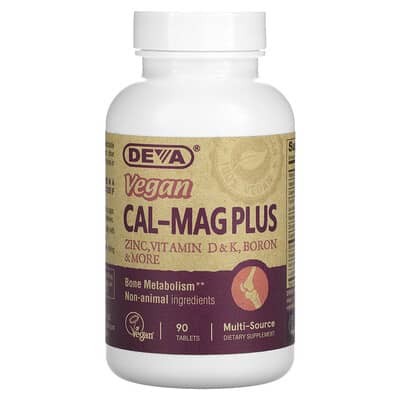

$7.83 $0.26 per serving


Product analysis
Vegan Cal Mag Plus supplies calcium, magnesium and supporting nutrients for normal bone nutrition, especially when intake is low. Undisclosed proportions within the calcium and magnesium mixtures make their absorption profiles harder to compare.
AI assessment of the formula, label and price. How scoring works
Nutrient Quality35
Calcium combines several named forms, while magnesium combines chelate and oxide. Their proportions are undisclosed, and limited information for other ingredients prevents a complete quality comparison.
Ingredient Transparency75
All listed amounts are disclosed, and most forms are named. Missing calcium and magnesium proportions leave the amounts of their individual forms unclear.
Value For Money51
Calcium and vitamin K offer favorable value at the serving price. Magnesium and boron are less economical, while the value of several other ingredients remains uncertain.
Customer Satisfaction81
The available reviewers report very positive satisfaction. Hundreds of ratings offer useful buyer feedback without proving bone or hormone benefits.
Product Focus59
The clearest role is filling mineral gaps relevant to normal bones and energy metabolism. The wider range of hormone, stress and cardiovascular aims has more conditional or limited support.
- Format
Tablet - Container
- 90 Tablet(s)
- Per serving
- $0.26
- Customer rating
- 4.7 · 948 ratings
Goals

Impact
Highest effect
Vitamin K · 80 mcgMagnesium · 400 mgCalcium · 1000 mgVitamin D · 20 mcgCopper · 0.38 mgLysine · 75 mgBoron · 2 mgZinc · 11 mgVitamin C · 60 mg
Calcium supplies bone mineral, and vitamin D supports calcium absorption and normal mineralization. Magnesium adds nutritional support for normal bone metabolism when intake is low. Vitamin C and copper have roles in building and cross-linking collagen, but their small amounts were not counted in the saved findings. The vitamin K is K1, so the limited bone-density findings for MK-7 cannot be transferred to it.
How this product is rated for Bone Health
Ingredient fit75
The formula contains several bone-related nutrients, alongside inulin and a broader range of uses.
Goal fit
The formula contains several bone-related nutrients, alongside inulin and a broader range of uses.
Dose adequacy
Calcium and magnesium make substantial contributions; several smaller ingredients were below the saved amount threshold.
Pathways100
Mineral supply and calcium regulation lead, with a smaller saved contribution to matrix formation.
Depth
Bone mineral supply is the strongest aspect.
Breadth
The saved findings cover mineral supply, calcium regulation and matrix formation; K1 does not provide the MK-7-specific contribution.
Evidence100
The saved findings recognize the declared preparations, but nutritional roles and direct bone outcomes have different levels of support.
Evidence strength
Calcium supplies the strongest saved evidence contribution; this does not establish fracture prevention.
Studied preparation
The saved findings recognize the preparations of the ingredients meeting the amount criteria.
Formulation logic100
The saved findings identify no matched ingredient conflicts. The credited ingredients have no unmet partner requirement.
Partner coverage
No credited ingredient has an unmet partner requirement.
Conflicts
No evaluated ingredient conflict was found; this is not a general safety conclusion.
Effective doses
All ingredients included in this rule meet the saved amount threshold; that threshold is not a proven effective dose.
Horsetail Not classified
No linked studies yet.

Impact
High effect
Vitamin D · 20 mcgMagnesium · 400 mgVitamin K · 80 mcgBoron · 2 mgZinc · 11 mgVitamin C · 60 mg
Calcium and magnesium contribute to mineral nutrition, with magnesium also involved in normal nutrient metabolism. Vitamins D and K and zinc add nutritional contributions when intake is low. Boron receives recognition in the saved findings, but small mineral studies do not establish routine broad benefit. The named chelates do not establish superior outcomes or an added combination effect.
How this product is rated for Everyday Health
Ingredient fit65
Calcium, magnesium, vitamins D and K, and zinc provide the relevant connection. Their amounts make nutritional contributions of varying size.
Goal fit
The meaningful connection comes from calcium, magnesium, vitamins d and k, and zinc; product naming and broader uses do not establish extra benefit.
Dose adequacy
Amounts provide uneven contributions across the included nutrients, rather than demonstrating a biological limit or an ideal dose.
Pathways80
The relevant areas are nutrient metabolism and mineral nutrition. The findings cover two main areas.
Depth
The strongest contribution concerns nutrient metabolism and mineral nutrition.
Breadth
The findings cover two main areas.
Evidence86
Magnesium leads the saved finding. The supported role remains nutritional, without established added benefit above adequate intake.
Evidence strength
Magnesium provides the leading evidence contribution, subject to the supplied population and nutritional limits.
Studied preparation
The included preparations satisfy the supplied comparison; the finding does not establish superior effects from named forms or delivery methods.
Formulation logic100
No configured ingredient conflict was identified; this finding does not establish overall safety. The included ingredients meet the amount threshold and have no missing required partner.
Partner coverage
The included ingredients work independently or have their required partner; no extra combination benefit follows.
Conflicts
No configured ingredient conflict was identified; this finding does not establish overall safety.
Effective doses
The included ingredients meet the saved amount threshold; this does not prove clinical effectiveness.

Impact
Moderate effect
Vitamin D · 20 mcgMagnesium · 400 mg
Magnesium at 400 mg supports normal energy metabolism and can help fill a nutritional gap associated with tiredness. Vitamin C also contributes to normal nutrition; vitamin D fatigue findings are limited to deficient adults. The supplied facts do not establish an additional energy boost when nutrient needs are already met.
How this product is rated for Energy
Ingredient fit55
The saved assessment identifies 3 relevant ingredients and 8 other active ingredients; the formula serves 9 goals. The saved amount assessment is moderate overall, with unknown amounts contributing no support.
Goal fit
The saved assessment identifies 3 relevant ingredients and 8 other active ingredients; the formula serves 9 goals.
Dose adequacy
The saved amount assessment is moderate overall, with unknown amounts contributing no support.
Pathways0
The saved assessment identifies no direct energy mechanism; the relevant contribution is nutritional. 0 of the three mechanism targets meets the saved coverage threshold.
Depth
The saved assessment identifies no direct energy mechanism; the relevant contribution is nutritional.
Breadth
0 of the three mechanism targets meets the saved coverage threshold.
Evidence95
Vitamin D leads the saved evidence comparison among ingredients meeting the amount threshold. This comparison does not imply uniform fatigue relief. The qualifying ingredients match the preparations recognized by the saved assessment.
Evidence strength
Vitamin D leads the saved evidence comparison among ingredients meeting the amount threshold. This comparison does not imply uniform fatigue relief.
Studied preparation
The qualifying ingredients match the preparations recognized by the saved assessment.
Formulation logic100
The assessed ingredients work alone or have their required partner. No configured conflict was identified. 3 of 3 assessed ingredients meet the saved minimum amount threshold.
Partner coverage
The assessed ingredients work alone or have their required partner.
Conflicts
No configured conflict was identified.
Effective doses
3 of 3 assessed ingredients meet the saved minimum amount threshold.

Impact
Moderate effect
Vitamin D · 20 mcgMagnesium · 400 mgVitamin C · 60 mg
Magnesium may help with stress when magnesium levels are low. Its most relevant connection here is calming, although lasting relief from everyday stress remains uncertain. Zinc and vitamin D also have a conditional connection to stress that depends on nutritional status; their presence doesn't mean a generally healthy adult can expect a reliable calming effect.
How this product is rated for Stress Relief
Ingredient fit53
Vitamin C, Magnesium, Vitamin D, Zinc provide the relevant connection to stress. Serving amounts and ingredient identity qualify that connection.
Goal fit
Vitamin C, Magnesium, Vitamin D, Zinc provide the main connection to stress among a broader set of ingredients.
Dose adequacy
Vitamin C 60 mg, Magnesium 400 mg, Vitamin D 20 mcg, Zinc 11 mg per selected serving; comparison amounts vary by ingredient.
Pathways50
The main connection is neural calming. This describes how the ingredients relate to stress, not how much relief you will feel.
Depth
The strongest ingredient connection is neural calming, which describes a possible route rather than a guaranteed effect.
Breadth
The ingredients relate most clearly to neural calming; broader effects remain less certain.
Evidence76
Magnesium may help when levels are low; lasting everyday stress relief is uncertain.
Evidence strength
Magnesium may help when levels are low; lasting everyday stress relief is uncertain.
Studied preparation
The relevant ingredient preparations are identified without an additional preparation mismatch.
Formulation logic100
No particular ingredient conflict is identified, and the relevant ingredients can contribute independently or with their partner.
Partner coverage
The relevant ingredients can contribute independently or have their required partner present.
Conflicts
No particular ingredient conflict is identified.
Effective doses
The relevant declared serving amounts meet the lower comparison band; this comparison alone cannot predict stress relief.

Impact
High effect
Vitamin K · 80 mcgMagnesium · 400 mgVitamin D · 20 mcg
Magnesium supports electrolyte balance and blood-vessel tone, although blood-pressure effects are small and inconsistent. Vitamin D has not demonstrated a reduction in major cardiovascular events, and an added D/K benefit is not established.
How this product is rated for Heart Health
Ingredient fit55
Magnesium, Vitamin D connect to heart-related functions. Some amounts provide only partial exposure relative to the supplied comparisons.
Goal fit
Magnesium, Vitamin D provide the relevant connection; the product's broader ingredient and goal mix limits its focus.
Dose adequacy
Vitamin D provide partial exposure compared with the supplied comparison ranges; this does not establish an ineffective dose.
Pathways57
The clearest connection is electrolyte and vascular-tone balance. Support is concentrated in that route.
Depth
The strongest represented route is electrolyte and vascular-tone balance, with support limited to the ingredients and amounts supplied.
Breadth
The findings cover one route, with limited breadth beyond that mechanism.
Evidence89
Magnesium supplies the strongest relevant support here, though blood-pressure results are inconsistent.
Evidence strength
Magnesium supplies the strongest relevant support here, though blood-pressure results are inconsistent.
Studied preparation
The eligible declared ingredients meet the supplied preparation comparison; this does not establish superiority over other forms.
Formulation logic100
The relevant ingredients do not require another partner, and no specified conflict was identified. The amount comparisons do not establish added benefit from combining ingredients.
Partner coverage
The relevant ingredients can contribute without an additional required partner; no extra combination benefit is established.
Conflicts
No specified ingredient conflict was identified in the supplied findings.
Effective doses
The ingredients included in this finding clear the supplied minimum exposure comparison; this is not a proven clinical efficacy threshold.

Impact
High effect
Vitamin K · 80 mcgMagnesium · 400 mgVitamin D · 20 mcgVitamin C · 60 mg
Magnesium offers limited support for vascular function, with inconsistent findings for arterial stiffness and blood pressure. A contribution is more plausible in low-magnesium or elevated-blood-pressure settings than in healthy adults with adequate magnesium. The declared chelate and oxide sources do not establish superior cardiovascular efficacy. Vitamin K is K1 rather than the reviewed MK-7 preparation, and vitamin D does not establish routine cardiovascular-event prevention.
How this product is rated for Cardiovascular Support
Ingredient fit56
Magnesium supplies the main vascular connection; vitamin D has retained amount findings without established routine event-prevention benefit. The main counted ingredient reaches the supplied amount reference; this does not establish the same effect as a trial regimen.
Goal fit
Relevant cardiovascular ingredients are present alongside other ingredients or broader product goals, limiting the focus on this goal.
Dose adequacy
The main counted ingredient reaches the supplied amount reference; this does not establish the same effect as a trial regimen.
Pathways54
The strongest saved coverage is blood-vessel tone and sodium balance. Coverage is concentrated in blood-vessel tone and sodium balance, rather than several cardiovascular areas.
Depth
The strongest saved coverage is blood-vessel tone and sodium balance.
Breadth
Coverage is concentrated in blood-vessel tone and sodium balance, rather than several cardiovascular areas.
Evidence79
Magnesium provides the strongest relevant vascular-marker evidence, which remains inconsistent.
Evidence strength
Magnesium provides the strongest relevant vascular-marker evidence, which remains inconsistent.
Studied preparation
The counted ingredients pass the saved preparation check; population and outcome limitations still apply.
Formulation logic100
The counted ingredients work alone or have their required partners, with no evaluated conflict identified.
Partner coverage
The counted ingredients work alone or have the partners required by the saved findings.
Conflicts
No evaluated ingredient conflict was identified.
Effective doses
The counted ingredients meet the saved amount threshold; this is not a proven clinical efficacy threshold.
Ingredients
| Ingredient | Amount per serving | Score |
|---|---|---|
Vitamin C (Ascorbic Acid) | 60 mg | |
Vitamin D2 (Ergocalciferol) | 20 mcg | |
Vitamin K (Phytonadione) | 80 mcg | |
Calcium (Calcium Amino Acid Chelate, Calcium Carbonate, Calcium Citrate, Calcium Malate) | 1000 mg | |
Magnesium (Magnesium Chelate, Magnesium Oxide) | 400 mg | |
Zinc (Zinc Amino Acid Chelate) | 11 mg | |
Copper (Copper Amino Acid Chelate) | 0.38 mg | |
Boron (Boron Amino Acid Chelate) | 2 mg | |
Horsetail extract (Silica) | 60 mg | |
Inulin | 100 mg | |
L-Lysine Hydrochloride | 75 mg |
Calcium (Calcium Amino Acid Chelate, Calcium Carbonate, Calcium Citrate, Calcium Malate) · 1000 mg OverallScore68
A serving provides 1000 mg of elemental calcium from calcium amino acid chelate, calcium carbonate, calcium citrate and calcium malate. The evaluation cautions that absorption may be less efficient at this serving amount.
How this ingredient is rated
Active Ingredient Quality & Bioavailability72
Calcium is recorded from calcium amino acid chelate, calcium carbonate, calcium citrate and calcium malate; the stated amount is elemental calcium.
Calcium Form & Absorption Potential
The recorded sources are calcium amino acid chelate, calcium carbonate, calcium citrate and calcium malate; their individual proportions are not established.
Elemental Calcium Transparency
The recorded 1000 mg per serving refers to calcium itself, rather than the weight of a source compound.
Dose, Safety & Label Transparency48
The serving provides 1000 mg of elemental calcium. The evaluation cautions that absorption may be less efficient at this amount. The saved evaluation records a flow agent in the other-ingredients information.
Absorption-Optimized Serving Dose
A serving provides 1000 mg of calcium; the evaluation cautions that absorption may be less efficient at this amount.
Formulation Purity & Additives
The saved evaluation records a flow agent in the other-ingredients information.
Value100
The whole product costs about $0.26 per serving, a relatively low serving price in the evaluation.
Price Per Serving Efficiency
A whole-product serving costs about $0.26; the comparison uses that serving price.
Magnesium (Magnesium Chelate, Magnesium Oxide) · 400 mg OverallScore50
A serving supplies 400 mg of magnesium and 1000 mg of calcium. The much higher calcium amount relative to magnesium is flagged in the evaluation.
How this ingredient is rated
Active Ingredient Quality & Bioavailability21
The magnesium comes from magnesium oxide and magnesium chelate, but their individual proportions are unknown.
Magnesium Form & Absorption Potential
The magnesium sources are magnesium oxide and magnesium chelate; their individual proportions are unknown.
Patented Materials & Chelation Quality
The saved facts do not establish a qualifying branded material or a full-chelation or full-reaction claim.
Dose, Safety & Label Transparency80
A serving supplies 400 mg magnesium and 1000 mg calcium. The evaluation flags the much higher calcium-to-magnesium balance.
Elemental Yield Transparency
The elemental magnesium amount is declared as 400 mg per serving.
Therapeutic Dosage Alignment
A serving provides 400 mg of magnesium.
Synergistic Formulation Logic
A serving contains 1000 mg calcium and 400 mg magnesium; the evaluation flags the much higher calcium-to-magnesium balance.
Value48
The whole-product serving costs about $0.26.
Price Per Elemental Quality
The whole-product serving costs about $0.26.
Boron (Boron Amino Acid Chelate) · 2 mg OverallScore55
A serving provides 2 mg boron as boron amino acid chelate, a relatively small amount. The precise carrier is unknown, limiting comparisons with more specifically identified forms.
How this ingredient is rated
Active Ingredient Quality & Bioavailability43
Boron is supplied as boron amino acid chelate, but the precise carrier is not identified in the saved facts.
Boron Form & Bioavailability
The source is boron amino acid chelate; the available facts do not identify its exact carrier.
Trademarked & High-Purity Sources
The saved facts do not identify a trademarked boron source or a specific purity marker.
Dose, Safety & Label Transparency80
The serving states 2 mg elemental boron, a relatively small amount in the evaluation.
Elemental Dose Transparency
The saved facts give 2 mg elemental boron per serving and identify its source form.
Dosage Efficacy & Safety Margin
The serving provides 2 mg boron, a relatively small amount in the evaluation.
Value30
The estimated cost is $0.39 per 3 mg boron, based on the whole-product price.
Price per 3mg Elemental Boron
The estimated cost is $0.39 per 3 mg boron, based on the whole-product price.
Alternative products
Report alternatives
Sources
Published studies used for the product analysis and the top-ranked studies for each ingredient and goal.
- [Comparative study of the urinary excretion of boron, calcium, magnesium and phosphorus in postmenopausal women with and without osteoporosis].
- Effect of dietary boron on mineral, estrogen, and testosterone metabolism in postmenopausal women.
- The relationship between boron and magnesium status and bone mineral density in the human: a review.
- Effects of boron supplementation on bone mineral density and dietary, blood, and urinary calcium, phosphorus, magnesium, and boron in female athletes.
- Metabolic responses of postmenopausal women to supplemental dietary boron and aluminum during usual and low magnesium intake: boron, calcium, and magnesium absorption and retention and blood mineral concentrations
- What is the impact of daily oral supplementation of vitamin D3 (cholecalciferol) plus calcium on the incidence of hip fracture in older people? A systematic review and meta-analysis.
- Calcium supplementation prevents seasonal bone loss and changes in biochemical markers of bone turnover in elderly New England women: a randomized placebo-controlled trial.
- The effects of calcium supplementation (milk powder or tablets) and exercise on bone density in postmenopausal women.
- The efficacy of calcium supplementation alone in elderly Thai women over a 2-year period: a randomized controlled trial.
- Calcium-enriched foods and bone mass growth in prepubertal girls: a randomized, double-blind, placebo-controlled trial.
- The Association between Dietary and Circulating Copper Levels and Osteoporosis: a Scoping Review.
- Association between dietary copper, iron, zinc, selenium intake and osteopenia or osteoporosis in elderly hypertensive patients: a retrospective cohort study.
- Associations of dietary copper intake with total bone mineral density and lumbar spine bone mineral density in American adults.
- The association between dietary mineral intake and bone mineral density: a cross-sectional study.
- Association between dietary copper intake and bone mineral density in children and adolescents aged 8-19 years: A cross-sectional study.
- Amino Acid Intakes Are Associated With Bone Mineral Density and Prevalence of Low Bone Mass in Women: Evidence From Discordant Monozygotic Twins.
- Dietary L-lysine and calcium metabolism in humans.
- Association between Serum Magnesium and Fractures: A Systematic Review and Meta-Analysis of Observational Studies.
- Bioabsorbable Magnesium-Based Materials Potential and Safety in Bone Surgery: A Systematic Review.
- Vascularized bone grafting fixed by biodegradable magnesium screw for treating osteonecrosis of the femoral head.