
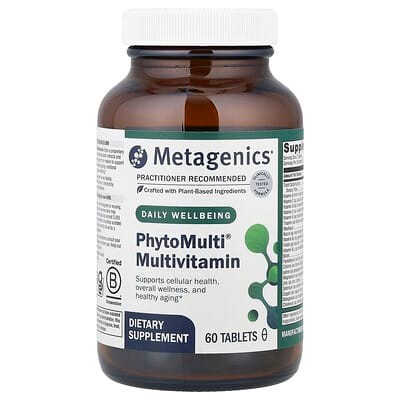

$44.95 $1.49 per serving

Product analysis
PhytoMulti Tablets may help fill dietary gaps that affect everyday nutrition and normal immune function. Its extensive mix and undisclosed plant-blend contents make the contribution of its extras harder to judge.
AI assessment of the formula, label and price. How scoring works
Nutrient Quality53
Natural vitamin E, B5 and several minerals use favorable forms. Other forms are less favorable or uncertain, and the unidentified blend limits judgment of the extras.
Ingredient Transparency72
Listed ingredient amounts and most forms are stated, making much of the formula easy to compare. The blend contents and proportions of several mixed vitamin forms are omitted.
Value For Money30
Many vitamins, minerals and extras offer limited value at the full serving cost. Biotin is more reasonably priced, while value for several other ingredients remains uncertain.
Customer Satisfaction76
Customer ratings are very positive, with a few hundred reviews. The review base gives useful satisfaction context without establishing health benefits.
Product Focus0
The extensive formula covers many purposes, with its clearest role in filling nutritional gaps. Its breadth and unidentified blend make it difficult to target one need or judge every extra ingredient.
- Format
Tablet - Container
- 60 Tablet(s)
- Per serving
- $1.49
- Also available
 PhytoMulti Tablets$77.95
- Customer rating
- 4.8 · 254 ratings
Goals

Impact
Highest effect
Folate · 1360 mcg DFEVitamin B12 · 200 mcgVitamin D · 25 mcgMagnesium · 40 mgVitamin K · 120 mcgSelenium · 100 mcgZinc · 15 mgVitamin C · 120 mg

Impact
High effect
Zinc · 15 mgVitamin E · 67 IUVitamin C · 120 mgCopper · 1 mgVitamin A · 3000 mcg
carotenoids Not classified
No linked studies yet.

Impact
High effect
Magnesium · 40 mgVitamin C · 120 mgZinc · 15 mgVitamin A · 3000 mcgVitamin D · 25 mcgSelenium · 100 mcg

Impact
High effect
Biotin · 500 mcgVitamin D · 25 mcgZinc · 15 mgVitamin C · 120 mg

Impact
High effect
Vitamin K · 120 mcgMagnesium · 40 mgVitamin B12 · 200 mcgVitamin B6 · 25 mgFolate · 1360 mcg DFEVitamin D · 25 mcg

Impact
High effect
Biotin · 500 mcgNiacin · 50 mgVitamin B12 · 200 mcgRiboflavin · 15 mgThiamin · 25 mgVitamin B5 · 75 mgVitamin B6 · 25 mgVitamin D · 25 mcgZinc · 15 mgMagnesium · 40 mgResveratrol · 10 mg
Ingredients
| Ingredient | Amount per serving | Score |
|---|---|---|
Total Carbohydrates | 1 Gram(s) | |
Vitamin A (Mixed Carotenoids, Retinyl Acetate) | 3000 mcg | |
Vitamin C (Ascorbic Acid, Ascorbyl Palmitate) | 120 mg | |
Vitamin D (Cholecalciferol) | 25 mcg | |
Vitamin E (D-Alpha-Tocopheryl Succinate) | 67 IU | |
Vitamin K (Phytonadione) | 120 mcg | |
Thiamine (Thiamine Mononitrate) | 25 mg | |
Riboflavin | 15 mg | |
Niacin (Niacinamide) | 50 mg | |
Vitamin B6 (Pyridoxine Hydrochloride) | 25 mg | |
Folate (Calcium L-5-Methyltetrahydrofolate) | 1360 mcg DFE | |
Vitamin B12 (Methylcobalamin) | 200 mcg | |
Biotin | 500 mcg | |
Pantothenic Acid (Calcium D-Pantothenate) | 75 mg | |
Choline (Choline Bitartrate) | 25 mg | |
Iodine (Potassium Iodide) | 150 mcg | |
Magnesium (Magnesium Citrate) | 40 mg | |
Zinc (Zinc Citrate) | 15 mg | |
Selenium (Selenium Aspartate) | 100 mcg | |
Copper (Copper Citrate) | 1 mg | |
Manganese (Manganese Citrate) | 0.5 mg | |
Chromium (Chromium Polynicotinate) | 200 mcg | |
Molybdenum (Molybdenum Aspartate Complex) | 50 mcg | |
Proprietary Phytonutrient Blend | 400 mg | |
Myo-Inositol | 25 mg | |
Resveratrol (Polygonum cuspidatum root extract) | 10 mg | |
Lutein | 6 mg | |
Lycopene | 6 mg | |
Zeaxanthin | 2 mg |
Iodine (Potassium Iodide) · 150 mcg OverallScore84
150 mcg of iodine per serving provides an amount suited to daily support, at a high cost per serving. The iodine is supplied as potassium iodide.
How this ingredient is rated
Active Ingredient Quality & Bioavailability100
Potassium iodide supplies the iodine; no marine source is indicated.
Iodine Form & Bioavailability
The iodine comes from potassium iodide.
Marine Source Purity & Sourcing
No marine iodine source is indicated, so the marine-specific contamination concern does not apply.
Dose, Safety & Label Transparency100
The label states 150 mcg of iodine per serving, an amount within the daily support range. It is below the upper intake level.
Dosage Efficacy for Daily Support
150 mcg per serving falls within the range used for daily iodine support.
Dosage Safety & Upper Limits
The 150 mcg serving is below the 1,100 mcg upper intake level.
Elemental Iodine Transparency
The iodine amount is stated as 150 mcg per serving.
Value20
The cost per serving is high.
Price Per Effective Serving
The cost per serving is high.
Vitamin B6 (Pyridoxine Hydrochloride) · 25 mg OverallScore70
A serving provides 25 mg of vitamin B6 at a high cost per milligram. That amount exceeds the European adult upper limit of 12 mg per day. The source is Pyridoxine Hydrochloride.
How this ingredient is rated
Ingredient Form & Label Quality100
The vitamin B6 source is Pyridoxine Hydrochloride. The available additive information reports no artificial colors, titanium dioxide, or talc.
Vitamin B6 Form Identification
The vitamin B6 source is Pyridoxine Hydrochloride.
Clean Label and Excipient Purity
The available additive information reports no artificial colors, titanium dioxide, or talc.
Dose, Safety & Label Transparency60
25 mg per serving exceeds the European adult upper limit of 12 mg per day; total daily intake can also include food and other supplements. The chemical source is named.
Vitamin B6 Dose & Safety Policy
25 mg per serving exceeds the European adult upper limit of 12 mg per day; total daily intake can also include food and other supplements.
Label Transparency
The chemical source, Pyridoxine Hydrochloride, is named.
Value31
The cost per milligram of vitamin B6 is high.
Vitamin B6 Price Efficiency
The cost per milligram of vitamin B6 is high.
Zinc (Zinc Citrate) · 15 mg OverallScore74
Each serving provides 15 mg of zinc at a high cost per serving. It uses Zinc Citrate. It also contains 1 mg of copper per serving.
How this ingredient is rated
Active Ingredient Quality & Bioavailability80
Zinc Citrate is the named zinc source.
Zinc Form Bioavailability
Zinc Citrate is the named zinc source.
Dose, Safety & Label Transparency91
The zinc amount is clearly stated as 15 mg per serving. It also contains 1 mg of copper per serving.
Elemental Dose Transparency
The label states 15 mg of elemental zinc per serving.
Zinc Dosage Safety & Effectiveness
Each serving provides 15 mg of zinc.
Zinc-to-Copper Mineral Balance
It also contains 1 mg of copper per serving.
Value30
The cost per serving is high.
Price Per Serving Efficiency
The cost per serving is high.
Alternative products
Report alternatives
Sources
Published studies used for the product analysis and the top-ranked studies for each ingredient and goal.
- The Association between Dietary and Circulating Copper Levels and Osteoporosis: a Scoping Review.
- Association between dietary copper, iron, zinc, selenium intake and osteopenia or osteoporosis in elderly hypertensive patients: a retrospective cohort study.
- Associations of dietary copper intake with total bone mineral density and lumbar spine bone mineral density in American adults.
- The association between dietary mineral intake and bone mineral density: a cross-sectional study.
- Association between dietary copper intake and bone mineral density in children and adolescents aged 8-19 years: A cross-sectional study.
- Association between RBC folate and lumbar bone mineral density in postmenopausal women, a cross-sectional study from NHANES 2009-2018.
- Genetic variants modify the associations of concentrations of methylmalonic acid, vitamin B-12, vitamin B-6, and folate with bone mineral density.
- Adequate Intake and Supplementation of B Vitamins, in Particular Folic Acid, can Play a Protective Role in Bone Health.
- Relation of homocysteine, folate, and vitamin B12 to bone mineral density of postmenopausal women.
- Dietary intake of folate, but not vitamin B2 or B12, is associated with increased bone mineral density 5 years after the menopause: results from a 10-year follow-up study in early postmenopausal women.
- Association between Serum Magnesium and Fractures: A Systematic Review and Meta-Analysis of Observational Studies.
- Bioabsorbable Magnesium-Based Materials Potential and Safety in Bone Surgery: A Systematic Review.
- Vascularized bone grafting fixed by biodegradable magnesium screw for treating osteonecrosis of the femoral head.
- An update on magnesium and bone health.
- Sex-specific differences in the association of magnesium intake with femoral neck bone mineral density among older adults.
- Risk of Environmental Chemicals on Bone Fractures Is Independent of Low Bone Mass in US Adults: Insights from 2017 to 2018 NHANES.
- The Manganese-Bone Connection: Investigating the Role of Manganese in Bone Health.
- Associations of multiple metals with bone mineral density: A population-based study in US adults.
- Sex-specific associations of urinary mixed-metal concentrations with femoral bone mineral density among older people: an NHANES (2017-2020) analysis.
- Relationship between blood manganese and bone mineral density and bone mineral content in adults: A population-based cross-sectional study.