
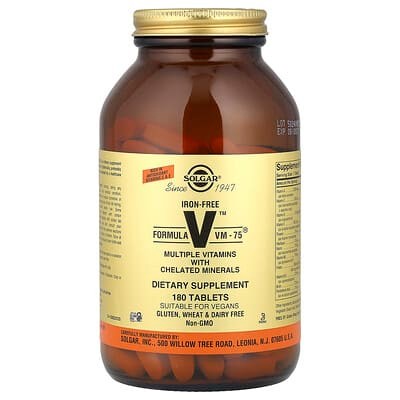

$40.78 $0.22 per serving


Product analysis
Iron-Free Formula VM-75 offers broad vitamin and mineral support for dietary gaps, including nutrients used in normal energy metabolism. Several mixtures omit their proportions, making their exact makeup harder to compare.
AI assessment of the formula, label and price. How scoring works
Nutrient Quality49
Copper and molybdenum use favorable forms, while several other ingredients cannot be confidently compared. Some forms are also unnamed, leaving the formula unevenly described.
Ingredient Transparency70
All ingredient amounts are stated, but several forms and mixture proportions are missing. You can check total quantities more readily than the exact composition of each mixture.
Value For Money52
Value is mixed, with favorable comparisons for some B vitamins, iodine and selected minerals. Other nutrients offer less value or remain too uncertain for a confident comparison.
Customer Satisfaction82
Customer feedback is positive across a substantial number of ratings. The broader review pool gives a more useful picture of satisfaction, without proving effectiveness.
Product Focus10
The long ingredient list provides broad nutritional coverage. Its practical benefit is mainly filling dietary gaps, while the unidentified blend prevents a complete count of active ingredients.
- Format
Tablet - Container
- 180 Tablet(s)
- Per serving
- $0.22
- Also available
 Iron-Free Formula VM-75$23.13
- Customer rating
- 4.7 · 1,456 ratings
Goals

Impact
High effect
Biotin · 75 mcgVitamin D · 10 mcgZinc · 10 mgVitamin C · 250 mg
Zinc can help address low intake associated with shedding, and vitamin C supports normal collagen formation and iron absorption. Copper contributes to normal pigmentation, without establishing routine regrowth from supplementation. The vitamin A amount remains unresolved because of an import mismatch, while biotin, selenium and vitamin D are below the amounts needed to contribute to the saved comparison.
How this product is rated for Hair Health
Ingredient fit57
The formula mixes hair-relevant ingredients with actives for other purposes. Some nutrients contribute only partly, and the unresolved amount reduces the amount-based finding.
Goal fit
The formula includes relevant ingredients alongside several actives serving other purposes, reducing its focus on hair health.
Dose adequacy
Some nutrients contribute only partly, and the unresolved amount reduces the amount-based finding.
Pathways40
The saved findings identify follicle antioxidant protection as the main covered area; this does not establish a clinical hair outcome.
Depth
The saved findings identify follicle antioxidant protection as the main covered area; this does not establish a clinical hair outcome.
Breadth
Only follicle antioxidant protection reaches the comparison's coverage threshold.
Evidence97
Zinc leads the saved evidence finding. Some preparation matches remain limited.
Evidence strength
Zinc provides the strongest qualifying evidence contribution here; the supplied scientific limitations still constrain expected hair benefits.
Studied preparation
Most qualifying ingredients meet the saved preparation criterion, but Iodine does not.
Formulation logic97
Partner requirements are met and no configured conflict is matched, but one unresolved amount limits the dose finding.
Partner coverage
The relevant ingredients meet the saved partner requirements or are treated as able to contribute without a partner.
Conflicts
No configured ingredient conflict was matched; this finding does not establish overall safety or individual suitability.
Effective doses
Most included ingredients meet the amount threshold, but Vitamin A does not.

Impact
Moderate effect
Iodine · 150 mcgVitamin D · 10 mcgVitamin B5 · 75 mgMagnesium · 10 mgRiboflavin · 75 mgThiamin · 75 mgVitamin B12 · 75 mcgPotassium · 1.8 mg
B vitamins, folate and vitamin C provide nutritional support for normal energy metabolism and tiredness related to inadequate intake. Iodine supports thyroid function. High B-vitamin amounts do not imply additional energy once needs are met.
How this product is rated for Energy
Ingredient fit74
Relevant energy-support nutrients sit within a formula with several other purposes. The relevant declared amounts have strong overall support in the saved dose assessment.
Goal fit
Relevant energy-support nutrients sit within a formula with several other purposes.
Dose adequacy
The relevant declared amounts have strong overall support in the saved dose assessment.
Pathways0
The saved findings mainly reflect nutritional support, without measurable coverage of the assessed direct energy mechanisms.
Depth
The saved findings mainly reflect nutritional support, without measurable coverage of the assessed direct energy mechanisms.
Breadth
No combination of assessed direct energy mechanisms reaches broad support in the saved findings.
Evidence77
Vitamin B2 (Riboflavin) is the strongest evidence contributor in the saved findings; nutritional need and the studied population still affect likely benefit. Most counted ingredients match studied preparations; Iodine. has less preparation-specific support.
Evidence strength
Vitamin B2 (Riboflavin) is the strongest evidence contributor in the saved findings; nutritional need and the studied population still affect likely benefit.
Studied preparation
Most counted ingredients match studied preparations; Iodine. has less preparation-specific support.
Formulation logic100
No missing required partner or assessed ingredient conflict was identified. All counted ingredients pass the saved minimum amount check, although the strength of their contributions differs.
Partner coverage
No required supporting partner is missing for the counted ingredients.
Conflicts
No assessed ingredient conflict was identified.
Effective doses
All counted ingredients pass the saved minimum amount check, although the strength of their contributions differs.
Vitamin B5 Not classified
No linked studies yet.

Impact
High effect
Biotin · 75 mcgNiacin · 75 mgVitamin B12 · 75 mcgRiboflavin · 75 mgThiamin · 75 mgVitamin B5 · 75 mgVitamin B6 · 75 mgVitamin D · 10 mcgZinc · 10 mgMagnesium · 10 mg
Iodine helps make thyroid hormones that regulate normal metabolic rate; correcting low iodine intake can address that nutritional limitation, but extra iodine does not establish a boost with adequate intake. B vitamins help process nutrients into usable energy without demonstrating a higher whole-body energy expenditure.
How this product is rated for Metabolism Support
Ingredient fit67
Vitamin B1 (Thiamin) leads the included ingredient findings. The retained amounts make uneven contributions against their references.
Goal fit
The relevant ingredients share the formula with ingredients aimed at other health goals, reducing its concentration on this outcome.
Dose adequacy
The included amounts make partial contributions against their references, limiting the amount-based finding without establishing an effective metabolism-boosting dose.
Pathways0
The saved findings do not assign coverage to a specific rate-increasing route. Normal nutrient-dependent energy metabolism remains a separate outcome.
Depth
No specific route receives coverage in the saved findings, despite recognition of the ingredients’ normal metabolic roles.
Breadth
No route reaches meaningful coverage, leaving little breadth across distinct processes related to increased energy expenditure.
Evidence100
The leading nutrient references describe normal metabolic roles or selected-population findings, rather than a demonstrated general increase in calorie burning.
Evidence strength
Vitamin B1 (Thiamin) leads the included evidence finding; its normal role or specific study outcomes do not establish a general metabolism boost.
Studied preparation
The retained ingredients meet the saved preparation comparison; this does not establish that the product increases whole-body energy expenditure.
Formulation logic100
The retained ingredients meet the partner and minimum amount conditions, with no listed conflict triggered. These findings do not establish a lasting metabolic-rate or weight-loss effect.
Partner coverage
The retained ingredients have no unmet partner requirement; this does not establish extra calorie expenditure from combining them.
Conflicts
None of the listed ingredient-conflict conditions was triggered by the supplied facts.
Effective doses
All retained ingredients meet the minimum amount condition, which is not a proven dose for raising whole-body energy expenditure.
Ingredients
| Ingredient | Amount per serving | Score |
|---|---|---|
Vitamin A (Beta-Carotene) | 2250 mcg | |
Vitamin C (L-Ascorbic Acid, Niacinamide Ascorbate) | 250 mg | |
Vitamin D (Ergocalciferol) | 10 mcg | |
Vitamin E (D-Alpha-Tocopheryl Succinate) | 100 mg | |
Thiamine (Thiamine Mononitrate) | 75 mg | |
Riboflavin | 75 mg | |
Niacin (Niacinamide Ascorbate) | 75 mg | |
Vitamin B6 (Pyridoxine Hydrochloride) | 75 mg | |
Folate | 666 mcg DFE | |
Vitamin B12 (Cobalamin) | 75 mcg | |
Biotin | 75 mcg | |
Pantothenic Acid (D-Calcium Pantothenate) | 75 mg | |
Choline (Choline Bitartrate) | 31 mg | |
Calcium (Calcium Amino Acid Chelate, Calcium Carbonate) | 20 mg | |
Iodine (Kelp) | 150 mcg | |
Magnesium (Magnesium Glycinate Amino Acid Chelate, Magnesium Oxide) | 10 mg | |
Zinc (Zinc Glycinate Amino Acid Chelate, Zinc Oxide) | 10 mg | |
Selenium (L-Selenomethionine) | 25 mcg | |
Copper (Copper Glycinate Amino Acid Chelate) | 1 mg | |
Manganese (Manganese Glycinate Amino Acid Chelate) | 1 mg | |
Chromium (Chromium Nicotinate Amino Acid Chelate) | 25 mcg | |
Molybdenum (Molybdenum Glycinate Amino Acid Chelate) | 25 mcg | |
Potassium (Potassium Amino Acid Complex) | 1.8 mg | |
Inositol | 75 mg | |
Rutin | 37.5 mg | |
Citrus Bioflavonoid Complex | 25 mg | |
Betaine HCl | 25 mg | |
Hesperidin | 8.5 mg | |
Powdered Blend | 4 mg | |
Boron (Boron Amino Acid Complex) | 0.5 mg | |
Carotenoid Mix | 86 mcg |
Copper (Copper Glycinate Amino Acid Chelate) · 1 mg OverallScore90
Thiamin (Thiamine Mononitrate) · 75 mg OverallScore71
Iodine (Kelp) · 150 mcg OverallScore74
Alternative products
Report alternatives
Sources
Published studies used for the product analysis and the top-ranked studies for each ingredient and goal.
- Association of radioactive iodine treatment with survivorship symptoms and primary care utilisation in women of reproductive age with thyroid cancer: a retrospective cohort study.
- Energy level and fatigue after surgery for thyroid cancer: A population-based study of patient-reported outcomes.
- Health-Related Quality of Life in Differentiated Thyroid Cancer Survivors: A Cross-Sectional Study From Turkey.
- Magnesium-L-threonate improves sleep quality and daytime functioning in adults with self-reported sleep problems: A randomized controlled trial.
- Total magnesium intake and risk of frailty in older women.
- Red blood cell magnesium and chronic fatigue syndrome.
- Exercise, magnesium and immune function.
- [Efficacy of potassium N-acetylaminosuccinate (Cogitum) in the treatment of asthenic syndrome: results of double-blind placebo-controlled trial].
- Human resting energy expenditure in relation to dietary potassium.
- Physicochemical properties of and volatile compounds in riboflavin fortified cloudy apple juice; study of its effect on job fatigue among Egyptian construction workers.
- Vitamin B status in patients with chronic fatigue syndrome.
- B-vitamins, related vitamers, and metabolites in patients with quiescent inflammatory bowel disease and chronic fatigue treated with high dose oral thiamine.
- Metabolic features of chronic fatigue syndrome.
- Effectiveness of Riboflavin in Inherited Metabolic Diseases: A Systematic Review
- Influence of thiamin supplementation on the health and general well-being of an elderly Irish population with marginal thiamin deficiency.
- Randomised clinical trial: high-dose oral thiamine versus placebo for chronic fatigue in patients with quiescent inflammatory bowel disease.
- Dietary reference values for thiamin.
- Effects of thiamine supplementation on exercise-induced fatigue.
- Long-term maintenance treatment with 300 mg thiamine for fatigue in patients with inflammatory bowel disease: results from an open-label extension of the TARIF study.
- A new perspective on vitamin B12 deficiency in rheumatology: a case-based review.