
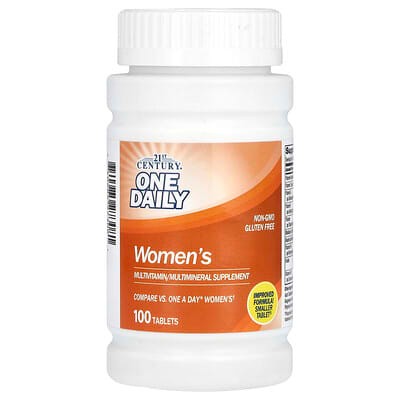

$6.75 $0.06 per serving


Product analysis
One Daily Women's offers broad nutrient support that may help fatigue or hair shedding linked to low intake. Its copper sulfate is a less favorable source when comparing ingredient quality.
AI assessment of the formula, label and price. How scoring works
Nutrient Quality44
D-biotin and potassium iodide are favorable sources, while calcium carbonate is a more moderate choice. Copper sulfate is less favorable, and quality remains uncertain for many other nutrients.
Ingredient Transparency79
The listed amounts and most forms are disclosed, helping you review the serving. Folate’s form and the proportions of the vitamin A sources are missing.
Value For Money54
Several mineral contributions offer favorable value, while biotin is more moderate. Value remains uncertain for many other nutrients, limiting a complete cost comparison.
Customer Satisfaction92
Customer feedback is positive. The extensive review base gives a well-established picture of satisfaction.
Product Focus36
The formula addresses a broad range of nutritional needs, with benefits mainly tied to low intake. Its biotin serving is below the daily amount in the small nail studies, so matching those findings is uncertain.
- Format
Tablet - Container
- 100 Tablet(s)
- Per serving
- $0.06
- Customer rating
- 4.7 · 36,809 ratings
Goals

Impact
Moderate effect
Iodine · 150 mcgVitamin D · 25 mcgVitamin B5 · 5 mgRiboflavin · 1.3 mgThiamin · 1.2 mgVitamin B12 · 6 mcgIron · 18 mg
B vitamins support normal energy metabolism, while folate and vitamin B12 help maintain normal blood formation. Their energy relevance is mainly nutritional: helping meet needs can matter when intake is low, while high amounts do not promise extra energy once needs are met. Iron at 18 mg supports normal oxygen transport, and vitamin C provides another nutrient linked to tiredness when intake is low.
How this product is rated for Energy
Ingredient fit62
Energy-related ingredients share the formula with ingredients aimed at other health goals. The assessed amounts provide partial coverage of the saved references.
Goal fit
Energy-related ingredients share the formula with ingredients aimed at other health goals.
Dose adequacy
The assessed amounts provide partial coverage of the saved references.
Pathways0
The main contribution is nutritional support rather than a specific assessed performance mechanism. The saved findings show limited coverage across specific energy-performance processes.
Depth
The main contribution is nutritional support rather than a specific assessed performance mechanism.
Breadth
The saved findings show limited coverage across specific energy-performance processes.
Evidence97
Iron provides the strongest evidence contribution among the assessed ingredients, within the supplied evidence's limits. Preparation matching is incomplete for Iodine, limiting direct application of the reviewed findings.
Evidence strength
Iron provides the strongest evidence contribution among the assessed ingredients, within the supplied evidence's limits.
Studied preparation
Preparation matching is incomplete for Iodine, limiting direct application of the reviewed findings.
Formulation logic100
The assessed ingredients can contribute individually or have their required companion present. No configured ingredient conflict was identified in the supplied assessment. All ingredients counted in this finding meet the saved minimum amount threshold.
Partner coverage
The assessed ingredients can contribute individually or have their required companion present.
Conflicts
No configured ingredient conflict was identified in the supplied assessment.
Effective doses
All ingredients counted in this finding meet the saved minimum amount threshold.
Vitamin B5 Not classified
No linked studies yet.

Impact
Moderate effect
Biotin · 1000 mcgVitamin D · 25 mcgZinc · 8 mgIron · 18 mgVitamin C · 75 mg
Iron and zinc may help reduce diffuse shedding when low levels of those minerals are the cause. Getting enough matters for hair, but taking extra doesn't imply regrowth when your levels are already adequate. Vitamin C also helps normal collagen formation and iron absorption. Those nutrient roles don't show that the combination will reverse other types of hair loss.
How this product is rated for Hair Health
Ingredient fit63
Zinc's practical hair benefit concerns correcting deficiency, rather than routine regrowth.
Goal fit
Zinc's practical hair benefit concerns correcting deficiency, rather than routine regrowth.
Dose adequacy
One selected serving declares Thiamin (B1) 1.2 mg, Riboflavin (B2) 1.3 mg, Pantothenic acid (B5) 5 mg. These amounts alone don't demonstrate hair regrowth.
Pathways9
The ingredients relate most closely to antioxidant protection around hair follicles; this biological role doesn't guarantee more hair.
Depth
The ingredients relate most closely to antioxidant protection around hair follicles; this biological role doesn't guarantee more hair.
Breadth
The ingredients don't provide broad, substantial contributions across the described hair mechanisms.
Evidence97
Zinc's practical hair benefit concerns correcting deficiency, rather than routine regrowth.
Evidence strength
Zinc's practical hair benefit concerns correcting deficiency, rather than routine regrowth.
Studied preparation
Iodine isn't identified here as a preparation with directly transferable hair benefits.
Formulation logic100
The relevant ingredients have no missing required partners or identified conflicts. Amount comparisons don't guarantee a hair benefit.
Partner coverage
No required ingredient partner is missing from the relevant combinations.
Conflicts
No particular ingredient conflict is identified.
Effective doses
The relevant declared amounts reach at least a quarter of their comparison curves; these comparisons aren't minimum effective doses.

Impact
High effect
Vitamin C · 75 mgZinc · 8 mgVitamin A · 700 mcgVitamin D · 25 mcgSelenium · 27.5 mcg
Zinc, Vitamin D and Selenium contribute to normal immune function, without establishing extra protection when intake is adequate. Vitamin A supports normal immune and barrier functions when intake is low. Copper, Folate, Vitamin B6, Vitamin B12 and Iron can help fill dietary gaps that impair immune-cell function.
How this product is rated for Immunity
Ingredient fit58
Lower or unavailable amounts limit the contribution compared with the saved references.
Goal fit
The formula includes immunity-related ingredients alongside ingredients directed at other goals.
Dose adequacy
Lower or unavailable amounts limit the contribution compared with the saved references.
Pathways50
The strongest saved connection is lymphocyte function and immune regulation, rather than a direct measure of infection protection.
Depth
The strongest saved connection is lymphocyte function and immune regulation, rather than a direct measure of infection protection.
Breadth
The saved findings cover lymphocyte function and immune regulation.
Evidence100
Zinc provides the leading saved contribution; its supported role does not establish infection prevention.
Evidence strength
Zinc provides the leading saved contribution; its supported role does not establish infection prevention.
Studied preparation
The saved findings accept the preparations with sufficient amounts; this does not establish testing of the complete formula.
Formulation logic100
All counted ingredients reach the saved minimum amount threshold, which is not proof of clinical effectiveness.
Partner coverage
The counted ingredients can contribute without an additional partner; this does not establish synergy.
Conflicts
No configured ingredient conflict was identified.
Effective doses
All counted ingredients reach the saved minimum amount threshold, which is not proof of clinical effectiveness.

Impact
High effect
Biotin · 1000 mcg
Biotin has limited evidence for improving brittle nails and nail growth, based largely on small studies with weak controls. The 1000 mcg per serving is below the 2500 mcg daily amount used in the small nail studies, so matching those results is uncertain. A serving does not establish the sustained daily regimen used in those studies. Iron can also help when deficiency causes brittle or spoon-shaped nails.
How this product is rated for Nail Health
Ingredient fit51
This broader nutrient formula has a nail-related nutritional connection through biotin and zinc, with variable amounts and limited nail-specific evidence.
Goal fit
Nail-related nutrients appear alongside many ingredients serving broader nutritional purposes.
Dose adequacy
Amounts provide partial or varied exposure recognition; this does not establish a proven nail response.
Pathways55
Keratinization cofactors are the only substantially represented area in the saved findings.
Depth
Keratinization cofactors are the only substantially represented area in the saved findings.
Breadth
One nail-related area reaches substantial representation; broader coverage is limited.
Evidence99
Biotin leads the saved evidence comparison, but the small studies do not establish robust routine efficacy.
Evidence strength
Biotin leads the saved evidence comparison, but the small studies do not establish robust routine efficacy.
Studied preparation
Selenium does not meet the saved studied-preparation comparison; the other amount-qualified ingredients do.
Formulation logic100
The amount-qualified ingredients require no missing partner, and no configured conflict was identified.
Partner coverage
The assessed ingredients work alone or have their required partner.
Conflicts
No configured ingredient conflict was identified.
Effective doses
All ingredients included in this amount check meet the saved minimum comparison; ingredients excluded for low amounts remain excluded.

Impact
Moderate effect
Biotin · 1000 mcgNiacin · 16 mgVitamin B12 · 6 mcgRiboflavin · 1.3 mgThiamin · 1.2 mgVitamin B5 · 5 mgVitamin B6 · 1.7 mgVitamin D · 25 mcgZinc · 8 mg
Iron may help restore heat production when iron-deficiency anaemia has reduced it. That is a benefit of correcting anaemia, rather than an extra metabolic boost for someone with enough iron. B vitamins also help your body carry out normal energy metabolism, and iodine is needed to make thyroid hormones. Those nutrient roles don't mean taking more reliably increases calorie burning.
How this product is rated for Metabolism Support
Ingredient fit63
The declared ingredients have roles in metabolism, but normal nutrient functions and a direct increase in calorie burning are different outcomes.
Goal fit
Iron, Vitamin B12, Vitamin B3 (Niacin) are present; their metabolic roles don't necessarily imply increased calorie burning.
Dose adequacy
Iron 18 mg, Vitamin B12 6 mcg, Vitamin B3 (Niacin) 16 mg per label serving; these amounts alone don't prove a metabolic-rate increase.
Pathways0
No direct heat-production mechanism is identified for the ingredients and preparations present.
Depth
No direct heat-production mechanism is identified for the ingredients and preparations present.
Breadth
Broad effects across distinct routes to increased calorie burning aren't demonstrated for these ingredients and preparations.
Evidence100
Iron may help restore heat production when iron-deficiency anaemia has reduced it. That is a benefit of correcting anaemia, rather than an extra metabolic boost for someone with enough iron.
Evidence strength
Vitamin B1 (Thiamin) has a relevant metabolic role, but this doesn't imply that extra intake reliably raises energy expenditure.
Studied preparation
The ingredient preparations match the applicable preparation descriptions; that match alone doesn't guarantee a rise in calorie burning.
Formulation logic100
No particular ingredient conflict is identified. Ingredient amounts and preparation details still determine what can be expected from the combination.
Partner coverage
No required ingredient partner is missing for the applicable ingredients; this doesn't imply an added benefit from combining them.
Conflicts
No particular ingredient conflict is identified.
Effective doses
The applicable ingredients have amounts within their dose comparison ranges; these ranges don't define a minimum effective dose.

Ingredients
| Ingredient | Amount per serving | Score |
|---|---|---|
Vitamin A (Beta-Carotene, Vitamin A Acetate) | 700 mcg | |
Vitamin C (Ascorbic Acid) | 75 mg | |
Vitamin D3 (Cholecalciferol) | 25 mcg | |
Vitamin E (DL-Alpha-Tocopheryl Acetate) | 7.5 mg | |
Vitamin K (Phytonadione) | 25 mcg | |
Thiamine (Thiamine Mononitrate) | 1.2 mg | |
Riboflavin | 1.3 mg | |
Niacin (Niacinamide) | 16 mg | |
Vitamin B6 (Pyridoxine Hydrochloride) | 1.7 mg | |
Folate | 667 mcg DFE | |
Vitamin B12 (Cyanocobalamin) | 6 mcg | |
Biotin (D-Biotin) | 1000 mcg | |
Pantothenic Acid (D-Calcium Pantothenate) | 5 mg | |
Calcium (Calcium Carbonate) | 380 mg | |
Iron (Ferrous Fumarate) | 18 mg | |
Iodine (Potassium Iodide) | 150 mcg | |
Zinc (Zinc Oxide) | 8 mg | |
Selenium (Sodium Selenate) | 27.5 mcg | |
Copper (Copper Sulfate) | 0.9 mg | |
Manganese (Manganese Sulfate) | 1.8 mg | |
Chromium (Chromium Chloride) | 25 mcg |
Iodine (Potassium Iodide) · 150 mcg OverallScore100
Calcium (Calcium Carbonate) · 380 mg OverallScore63
Iron (Ferrous Fumarate) · 18 mg OverallScore73
Alternative products
Report alternatives
Sources
Published studies used for the product analysis and the top-ranked studies for each ingredient and goal.
- Association of radioactive iodine treatment with survivorship symptoms and primary care utilisation in women of reproductive age with thyroid cancer: a retrospective cohort study.
- Energy level and fatigue after surgery for thyroid cancer: A population-based study of patient-reported outcomes.
- Health-Related Quality of Life in Differentiated Thyroid Cancer Survivors: A Cross-Sectional Study From Turkey.
- Large-dose intravenous ferric carboxymaltose injection for iron deficiency anemia in heavy uterine bleeding: a randomized, controlled trial.
- The Effect of Parenteral or Oral Iron Supplementation on Fatigue, Sleep, Quality of Life and Restless Legs Syndrome in Iron-Deficient Blood Donors: A Secondary Analysis of the IronWoMan RCT.
- Ferric carboxymaltose vs. oral iron in the treatment of pregnant women with iron deficiency anemia: an international, open-label, randomized controlled trial (FER-ASAP).
- Effect of iron therapy on fatigue symptoms in non-anaemic iron deficient women of reproductive age- A Randomized Controlled Trial.
- Intravenous iron isomaltoside treatment of women suffering from severe fatigue after postpartum hemorrhage.
- Physicochemical properties of and volatile compounds in riboflavin fortified cloudy apple juice; study of its effect on job fatigue among Egyptian construction workers.
- Vitamin B status in patients with chronic fatigue syndrome.
- B-vitamins, related vitamers, and metabolites in patients with quiescent inflammatory bowel disease and chronic fatigue treated with high dose oral thiamine.
- Metabolic features of chronic fatigue syndrome.
- Effectiveness of Riboflavin in Inherited Metabolic Diseases: A Systematic Review
- Influence of thiamin supplementation on the health and general well-being of an elderly Irish population with marginal thiamin deficiency.
- Randomised clinical trial: high-dose oral thiamine versus placebo for chronic fatigue in patients with quiescent inflammatory bowel disease.
- Dietary reference values for thiamin.
- Effects of thiamine supplementation on exercise-induced fatigue.
- Long-term maintenance treatment with 300 mg thiamine for fatigue in patients with inflammatory bowel disease: results from an open-label extension of the TARIF study.
- A new perspective on vitamin B12 deficiency in rheumatology: a case-based review.
- Effects of Vitamin B12 Supplementation on Cognitive Function, Depressive Symptoms, and Fatigue: A Systematic Review, Meta-Analysis, and Meta-Regression.