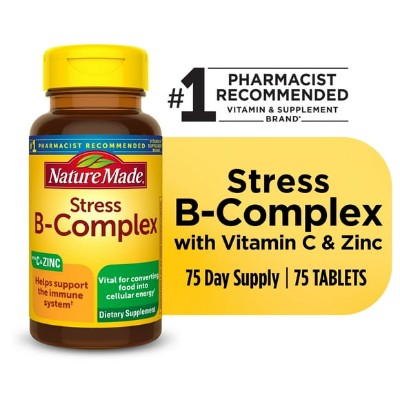
Stress B-Complex

Stress B-Complex

Nature Made4.8 (154 ratings)
Format:Tablet Quantity: 75 Tablet(s) · 75 servings
Goals
$10.49 $0.13 per serving

About this product

Nutritional support is a firmer expectation than direct stress relief. B vitamins support normal energy metabolism, while vitamin C at 500 mg and zinc at 23.9 mg contribute to normal immune and tissue functions. Larger nutrient amounts do not establish extra energy or better stress tolerance when intake is already adequate.

Ingredient forms are mixed despite the low serving cost. Niacinamide and calcium D-pantothenate are clearly identified, but zinc sulfate and copper oxide are less favorable choices than several alternative mineral forms. Vitamin E is synthetic dl-alpha-tocopheryl acetate, with an IU amount but no milligram declaration.

The mixture makes sense when several of its nutrients are needed together. Calcium is too small to make it a useful calcium supplement, and 45 mcg of biotin does not match the much larger amounts in the limited nail findings. Its broad contents therefore do not establish focused benefits for bones, nails or stress beyond meeting nutritional needs.

Who is it for
  • Adults with several dietary gaps who want B vitamins with vitamin C and minerals
Best for
  • Budget-conscious support for normal nutrient metabolism
  • Combining B-vitamin and vitamin C intake when both are needed

Pros

  • Low serving cost for a broad nutrient mixture
  • Vitamin C source and amount are clearly identified
  • Zinc and copper are both quantified

Cons

  • Zinc sulfate and copper oxide weaken the mineral-form choices
  • Synthetic vitamin E lacks a milligram declaration
  • Several source forms and calcium proportions are unresolved
  • Little basis for expecting extra energy or stress relief with adequate intake

Warnings

  • The 23.9 mg zinc serving already supplies a substantial amount; account for additional zinc products before combining them.


Product analysis

57 out of 100

Stress B-Complex supplies nutrients that can help fill dietary gaps and support normal energy metabolism, skin maintenance and immune function. Several nutrient forms and the split between calcium sources are unspecified, limiting detailed comparisons.

AI assessment of the formula, label and price. How scoring works

Nutrient Quality39

Ingredient quality is mixed, with favorable choices for some B vitamins alongside less favorable vitamin E, zinc and copper forms. Several other forms are unspecified or remain uncertain, so the breadth of the formula does not guarantee consistent quality.

Ingredient Transparency73

Amounts and most nutrient forms are identified, but several forms and the calcium mixture proportions are unspecified. That leaves some details unclear when comparing similar formulas.

Value For Money56

Value varies substantially across the nutrients, with favorable serving costs for some and weaker value for others. The value of several ingredients also remains uncertain, limiting confidence in the combination as a whole.

Customer Satisfaction74

Customer ratings are very positive, although the review base is relatively modest. That gives a useful but limited picture of wider satisfaction.

Product Focus55

The main role is nutritional support, especially when intake is low. The broad mix is linked to many goals, but extra energy, hair growth and other benefits above adequate intake are not established.

Format
Tablet
Container
75 Tablet(s)
Per serving
$0.13
Customer rating
4.8 · 154 ratings
Report analysis

Goals

Immunity
Impact
High effect
C Ingredient FitB- PathwaysA+ EvidenceA+ Formulation Logic
Vitamin C · 500 mgZinc · 23.9 mg

Vitamin C supports immune-cell activity and antioxidant protection, with modest cold-duration evidence from regular use. Zinc contributes to normal immune function, while copper, B6, B12 and folate help when intake is low. Larger amounts of these nutrients do not establish extra benefit after nutritional needs are met. The vitamin E amount is unresolved, and its supplied context does not establish routine respiratory benefit.

How this product is rated for Immunity

Ingredient fit61

The relevant ingredients have a connection to immune support, with the strength of their amount findings varying by nutrient.
Goal fit
The formula includes relevant immune ingredients alongside ingredients aimed at other uses, which makes its immune focus less concentrated.
Dose adequacy
The declared amounts provide partial coverage of the saved comparisons; unresolved amounts cannot establish a contribution.

Pathways72

The strongest saved connection is lymphocyte function and immune regulation.
Depth
The strongest saved connection is lymphocyte function and immune regulation.
Breadth
The saved findings cover two main immune areas, with more limited coverage elsewhere.

Evidence100

The main support concerns normal nutrient functions, with any respiratory benefit limited to the specific evidence described above.
Evidence strength
Vitamin C leads the saved evidence finding; normal immune function does not itself establish infection prevention.
Studied preparation
The saved findings accept the relevant preparations; this does not imply that one nutrient form gives greater immune benefit.

Formulation logic96

The recognized ingredients meet the partner checks, and no configured conflict was found. Amount uncertainties still limit ingredients whose quantities are unresolved.
Partner coverage
The recognized ingredients do not require an additional partner for the roles considered here.
Conflicts
No configured ingredient conflict was identified from the available facts; this does not establish overall safety.
Effective doses
Vitamin E has an unresolved amount; the other recognized ingredients reach the saved amount threshold.
Study evidence
Vitamin C Supportive 53 studies
Vitamin E Supportive 21 studies
Zinc Supportive 73 studies
Everyday Health
Impact
Highest effect
A- Ingredient FitA+ PathwaysB+ EvidenceA+ Formulation Logic
Folate · 400 mcgVitamin B12 · 12 mcgZinc · 23.9 mgVitamin C · 500 mg

B vitamins contribute nutrients used in normal energy metabolism; folate contributes to normal blood formation; vitamin C contributes to normal antioxidant and immune functions. These nutrients can help fill dietary shortfalls; additional benefit above adequate intake is not established.

How this product is rated for Everyday Health

Ingredient fit86

The formula offers several nutritional contributions, with differing amounts and some ingredients outside the supported general-health roles.
Goal fit
Recognized nutrients support the general-health connection; other actives and wider product uses affect how specifically the formula addresses nutritional gaps.
Dose adequacy
The counted amounts provide partial coverage of the supplied comparisons, without establishing inadequate intake or a clinical treatment dose.

Pathways100

The strongest saved connection is energy metabolism cofactors, reflecting nutritional roles rather than demonstrated broad health outcomes.
Depth
The strongest saved connection is energy metabolism cofactors, reflecting nutritional roles rather than demonstrated broad health outcomes.
Breadth
The covered functions are energy metabolism cofactors, one-carbon metabolism and blood formation, antioxidant and immune defence.

Evidence82

The evidence supports nutrient availability and correction of dietary gaps, rather than extra benefit when intake is adequate.
Evidence strength
Vitamin B9 (Folate) leads the saved evidence finding, with benefit limited to its supported nutritional role and filling low intake.
Studied preparation
The counted preparations match those recognized in the supplied comparison, without establishing superiority of a particular chemical form or delivery method.

Formulation logic100

No unmet partner requirement or specified conflict was identified, and the counted ingredients meet the supplied minimum amount comparisons.
Partner coverage
No counted ingredient has an unmet partner requirement in the supplied findings; this does not establish added benefit from combining ingredients.
Conflicts
No specified ingredient conflict was identified in the supplied findings.
Effective doses
All counted ingredients meet the supplied minimum amount comparison; this is not a proven threshold for broad health benefit.
Study evidence
Folate Supportive 80 studies
Vitamin C Supportive 56 studies
Zinc Supportive 60 studies
Impact
Moderate effect
C+ Ingredient FitF PathwaysB EvidenceA+ Formulation Logic
Vitamin B5 · 20 mgRiboflavin · 10 mgThiamin · 10 mgVitamin B12 · 12 mcg

Thiamin, riboflavin, niacin and B5 support normal nutrient metabolism, while folate, B6, B12 and vitamin C relate to fatigue associated with nutritional shortfalls. The contribution is mainly nutritional, and the larger niacin amount does not imply extra energy once needs are met.

How this product is rated for Energy

Ingredient fit70

The counted ingredients are relevant to nutritional or fatigue support, while the formula also serves other goals. The counted amounts have a partial match to the saved dose comparison.
Goal fit
The counted ingredients are relevant to nutritional or fatigue support, while the formula also serves other goals.
Dose adequacy
The counted amounts have a partial match to the saved dose comparison.

Pathways0

No direct alertness, muscle-buffering, mitochondrial, stress-fatigue or blood-flow contribution was assigned; nutritional relevance is assessed separately.
Depth
No direct alertness, muscle-buffering, mitochondrial, stress-fatigue or blood-flow contribution was assigned; nutritional relevance is assessed separately.
Breadth
No assessed area reaches the saved breadth threshold.

Evidence78

Vitamin B2 (Riboflavin) provides the strongest saved evidence finding at the assessed amount. The counted preparations meet the saved studied-preparation criteria.
Evidence strength
Vitamin B2 (Riboflavin) provides the strongest saved evidence finding at the assessed amount.
Studied preparation
The counted preparations meet the saved studied-preparation criteria.

Formulation logic100

The counted ingredients work independently or have their required partners. No configured ingredient conflict was found in the supplied facts.
Partner coverage
The counted ingredients work independently or have their required partners.
Conflicts
No configured ingredient conflict was found in the supplied facts.
Effective doses
7 of 7 counted ingredients meet the saved minimum amount comparison.
Study evidence
Thiamin Disputed 12 studies
Skin Health
Impact
High effect
B- Ingredient FitC- PathwaysA+ EvidenceA+ Formulation Logic
Zinc · 23.9 mgVitamin C · 500 mgCopper · 3 mgVitamin E · 30 IU

Vitamin C supports collagen formation and zinc contributes to skin repair, particularly when intake is inadequate. Copper is needed for enzymes that strengthen collagen and elastin, but added copper has no established skin benefit when intake is adequate. B6 and riboflavin can address deficiency-related dermatitis; the unresolved vitamin E amount limits its contribution.

How this product is rated for Skin Health

Ingredient fit72

The relevant ingredients provide the included contribution, with partial coverage of the comparison amounts.
Goal fit
The relevant ingredients contribute alongside ingredients directed at other uses.
Dose adequacy
The included amounts partly cover the saved comparison ranges, which describe exposure rather than proven treatment doses.

Pathways56

The strongest recorded connection is dermal collagen matrix, with partial coverage of the comparison range.
Depth
The strongest recorded connection is dermal collagen matrix, with partial coverage of the comparison range.
Breadth
Dermal collagen matrix reached the coverage threshold; the remaining configured pathways did not.

Evidence100

Vitamin C provides the strongest included evidence, within the limits of its studied outcomes and populations.
Evidence strength
Vitamin C provides the strongest included evidence, within the limits of its studied outcomes and populations.
Studied preparation
The included preparations were matched to studied material, within the limits of the outcomes and populations studied.

Formulation logic96

No configured ingredient conflict was identified. The included ingredients can stand alone or have their required partner present.
Partner coverage
The included ingredients can stand alone or have their required partner present.
Conflicts
No configured ingredient conflict was identified.
Effective doses
Vitamin E remain below the saved amount threshold or have unresolved amounts; the other included ingredients clear it.
Study evidence
Biotin Supportive 10 studies
Copper Supportive 16 studies
Niacin Supportive 61 studies
Vitamin C Supportive 53 studies
Vitamin E Supportive 38 studies
Zinc Supportive 66 studies
Impact
High effect
B- Ingredient FitF PathwaysA+ EvidenceA+ Formulation Logic
Biotin · 45 mcgNiacin · 100 mgVitamin B12 · 12 mcgRiboflavin · 10 mgThiamin · 10 mgVitamin B5 · 20 mgVitamin B6 · 5 mgZinc · 23.9 mg

B vitamins help the body carry out normal energy-yielding metabolism: thiamin supports carbohydrate processing, riboflavin and niacin provide coenzymes, and B6 participates in protein and glycogen metabolism. These essential functions do not show that extra vitamins raise resting or daily calorie expenditure when intake is adequate. The declared amounts therefore do not establish a faster metabolic rate or sustained weight loss.

How this product is rated for Metabolism Support

Ingredient fit71

B vitamins provide the main connection. The included amounts provide only a partial match to reference exposures; this does not establish effective doses for raising calorie expenditure.
Goal fit
B vitamins provide the main metabolic connection, within a formula also associated with other health goals.
Dose adequacy
The included amounts provide only a partial match to reference exposures; this does not establish effective doses for raising calorie expenditure.

Pathways0

No direct thermogenic pathway was identified beyond the ordinary nutrient roles. No pathway reached the coverage threshold, so direct support for a metabolism boost remains limited.
Depth
No direct thermogenic pathway was identified beyond the ordinary nutrient roles.
Breadth
No pathway reached the coverage threshold, so direct support for a metabolism boost remains limited.

Evidence100

Thiamin leads the saved comparison, but normal carbohydrate metabolism does not establish increased calorie expenditure from extra thiamin.
Evidence strength
Thiamin leads the saved comparison, but normal carbohydrate metabolism does not establish increased calorie expenditure from extra thiamin.
Studied preparation
The included preparations match the saved comparison, which does not establish a measured increase in energy expenditure.

Formulation logic100

No missing required partner or configured conflict was identified. The included amounts meet the minimum exposure comparison without demonstrating an extra benefit from combining them.
Partner coverage
No missing required partner was identified; the combination does not establish an additional metabolic-rate effect.
Conflicts
No configured ingredient conflict was identified in the supplied facts.
Effective doses
The included ingredients meet the minimum exposure comparison, which does not establish an effective thermogenic or weight-loss dose.
Study evidence
Biotin Supportive 5 studies
Niacin Supportive 17 studies
Thiamin Supportive 11 studies
Vitamin B6 Supportive 16 studies
Zinc Supportive 12 studies
Impact
Highest effect
B Ingredient FitC PathwaysA+ EvidenceA+ Formulation Logic
Biotin · 45 mcgZinc · 23.9 mgVitamin C · 500 mg

Zinc can help with diffuse shedding when intake is low or deficiency is present, but extra regrowth benefit is not established when intake is adequate. The broader nutrient mix receives antioxidant-related credit, without demonstrating routine hair growth from normal nutrient functions. Biotin and B12 fall below their saved comparison thresholds. Ordinary vitamin E does not match the mixed tocotrienol preparation used in the limited hair-count study.

How this product is rated for Hair Health

Ingredient fit79

Zinc and several nutrients receive credit within a broad formula. Most counted nutrient amounts reach the comparison anchors; folate contributes partially.
Goal fit
Zinc and several nutrients receive credit within a broad formula.
Dose adequacy
Most counted nutrient amounts reach the comparison anchors; folate contributes partially.

Pathways60

Antioxidant protection predominates, with a smaller hair-fibre contribution.
Depth
Antioxidant protection predominates, with a smaller hair-fibre contribution.
Breadth
Coverage is concentrated in one pathway, leaving the other evaluated mechanisms unrepresented or limited.

Evidence98

Zinc provides the strongest saved evidence contribution, conditional on nutritional need. All five counted preparations are treated as studied.
Evidence strength
Zinc provides the strongest saved evidence contribution, conditional on nutritional need.
Studied preparation
All five counted preparations are treated as studied.

Formulation logic100

The counted ingredients need no missing partners, and no configured conflicts were identified. Amount coverage follows the saved comparison rather than proving hair outcomes.
Partner coverage
The counted ingredients work independently or have the partners required by the saved comparison.
Conflicts
No configured ingredient conflicts were identified.
Effective doses
All counted ingredients meet the saved amount threshold; this does not establish a proven hair-growth dose.
Study evidence
Biotin Supportive 4 studies
Copper Adverse 4 studies
Folate Mixed 15 studies
Niacin Disputed 2 studies
Vitamin E No effect 3 studies
Zinc Supportive 22 studies

Ingredients

IngredientAmount per servingScore
Vitamin C (Ascorbic Acid)
500 mg 58
Vitamin E (DL-Alpha-Tocopheryl Acetate)
30 IU 27
Thiamine (Thiamine Mononitrate)
10 mg 65
Riboflavin
10 mg 58
Niacin (Niacinamide)
100 mg 83
Vitamin B6 (Pyridoxine Hydrochloride)
5 mg
Folic Acid
400 mcg 58
Vitamin B12 (Cyanocobalamin)
12 mcg
Biotin
45 mcg
Pantothenic Acid (D-Calcium Pantothenate)
20 mg 61
Calcium (Dibasic Calcium Phosphate, Calcium Carbonate)
19 mg
Zinc (Zinc Sulfate)
23.9 mg 58
Copper (Copper Oxide)
3 mg 55
Gluten Free Adults 18–50
Report overview
A- Active Ingredient Quality & BioavailabilityA Dose, Safety & Label TransparencyC Value
B- Active Ingredient Quality & BioavailabilityB- Dose, Safety & Label TransparencyD- Value
F Active Ingredient Quality & BioavailabilityA- Dose, Safety & Label TransparencyB+ Value
The serving clearly provides 23.9 mg of zinc, though sulfate is a less favorable form for absorption. It also supplies 3 mg of copper, making the mineral balance assessable rather than leaving it unknown.
How this ingredient is rated

Active Ingredient Quality & Bioavailability20

Sulfate is the identified source; it is a less favorable zinc form for absorption in this comparison.
Zinc Form Bioavailability
Sulfate is the identified source; it is a less favorable zinc form for absorption in this comparison.

Dose, Safety & Label Transparency85

Both mineral amounts are clear: 23.9 mg zinc and 3 mg copper per serving. Their balance can be assessed, although the ratio alone does not establish suitability.
Elemental Dose Transparency
The elemental zinc amount is clearly stated as 23.9 mg per serving, with its source identified.
Zinc Dosage Safety & Effectiveness
The clearly stated 23.9 mg provides a moderate zinc contribution per serving.
Zinc-to-Copper Mineral Balance
The serving contains 23.9 mg zinc and 3 mg copper, a ratio of about 7.97:1; this alone does not establish safety.

Value80

A whole-product serving costs about $0.14; that price covers the full serving, not zinc alone.
Price Per Serving Efficiency
About $0.14 per labeled whole-product serving; the calculation is not a price for zinc alone.
Report alternatives

Sources

Published studies used for the product analysis and the top-ranked studies for each ingredient and goal.

  1. Physicochemical properties of and volatile compounds in riboflavin fortified cloudy apple juice; study of its effect on job fatigue among Egyptian construction workers.
    Fouad S; Ibrahim GE; Hussein AMS; Ibrahim FA; El Gendy A · Heliyon · 2021
    Non-randomized trialEnergy forRiboflavin
  2. Vitamin B status in patients with chronic fatigue syndrome.
    Heap LC; Peters TJ; Wessely S · Journal of the Royal Society of Medicine · 1999
    Case-control study30 participantsEnergy forRiboflavin
  3. B-vitamins, related vitamers, and metabolites in patients with quiescent inflammatory bowel disease and chronic fatigue treated with high dose oral thiamine.
    Bager P; Hvas CL; Hansen MM; Ueland P; Dahlerup JF · Molecular medicine (Cambridge, Mass.) · 2023
    Observational studyEnergy forRiboflavin
  4. Metabolic features of chronic fatigue syndrome.
    Naviaux RK; Naviaux JC; Li K; Bright AT; Alaynick WA; Wang L; Baxter A; Nathan N; Anderson W; Gordon E · Proceedings of the National Academy of Sciences of the United States of America · 2024
    Case-control study84 participantsEnergy forRiboflavin
  5. Effectiveness of Riboflavin in Inherited Metabolic Diseases: A Systematic Review
    Bregje Jaeger, Nina N Stolwijk, Femke Aaldering, Charlotte A Ruys, Marije Smits, Nicole I Wolf, Carla E M Hollak, Annet M Bosch · Journal of Inherited Metabolic Disease · 2026
    Systematic review381 studies pooledEnergy Metabolism Support forRiboflavin
  6. Influence of thiamin supplementation on the health and general well-being of an elderly Irish population with marginal thiamin deficiency.
    Smidt LJ; Cremin FM; Grivetti LE; Clifford AJ · Journal of gerontology · 1991
    Randomized trial80 participantsEnergy forThiamin
  7. Randomised clinical trial: high-dose oral thiamine versus placebo for chronic fatigue in patients with quiescent inflammatory bowel disease.
    Bager P; Hvas CL; Rud CL; Dahlerup JF · Alimentary pharmacology & therapeutics · 2021
    Randomized trial40 participantsEnergy forThiamin
  8. Dietary reference values for thiamin.
    EFSA Panel on Dietetic Products, Nutrition and Allergies (NDA); Turck D; Bresson JL; Burlingame B; Dean T; Fairweather-Tait S; Heinonen M; Hirsch-Ernst KI; Mangelsdorf I; McArdle HJ; Naska A; Nowicka G; Pentieva K; Sanz Y; Siani A; Sjödin A; Stern M; Tomé D; Van Loveren H; Vinceti M; Willatts P; Lamberg-Allardt C; Przyrembel H; Tetens I; Gudelj Rakic J; Ioannidou S; de Sesmaisons-Lecarré A; Forss AC; Neuhäuser-Berthold M · EFSA journal. European Food Safety Authority · 2026
    Guideline / consensusEnergy forThiamin
  9. Effects of thiamine supplementation on exercise-induced fatigue.
    Suzuki M; Itokawa Y · Metabolic brain disease · 1996
    Randomized trial16 participantsEnergy forThiamin
  10. Long-term maintenance treatment with 300 mg thiamine for fatigue in patients with inflammatory bowel disease: results from an open-label extension of the TARIF study.
    Bager P; Hvas CL; Rud CL; Dahlerup JF · Scandinavian journal of gastroenterology · 2022
    Randomized trialEnergy forThiamin
  11. A new perspective on vitamin B12 deficiency in rheumatology: a case-based review.
    Dułak NA; Rytlewska M; Jaskólska M; Chmielewski M · Rheumatology international · 2024
    Case series3 participantsEnergy forVitamin B12
  12. Effects of Vitamin B12 Supplementation on Cognitive Function, Depressive Symptoms, and Fatigue: A Systematic Review, Meta-Analysis, and Meta-Regression.
    Markun S; Gravestock I; Jäger L; Rosemann T; Pichierri G; Burgstaller JM · Nutrients · 2021
    Meta-analysis6,276 participants16 studies pooledEnergy forVitamin B12
  13. Patients' experiences with methylcobalamin injections in amyotrophic lateral sclerosis.
    Zubair AS; Saab L; Scharer K; Khokhar B · Brain circulation · 2024
    Qualitative study5 participantsEnergy forVitamin B12
  14. Cobalamin deficiency: clinical picture and radiological findings.
    Briani C; Dalla Torre C; Citton V; Manara R; Pompanin S; Binotto G; Adami F · Nutrients · 2014
    Narrative reviewEnergy forVitamin B12
  15. Vitamin B12 Deficiency: Common Questions and Answers.
    Patel H; McGuirk R · American family physician · 2025
    Narrative reviewEnergy forVitamin B12
  16. Intakes of Folate, Vitamin B6, and Vitamin B12 in Relation to All-Cause and Cause-Specific Mortality: A National Population-Based Cohort.
    Bo Y; Xu H; Zhang H; Zhang J; Wan Z; Zhao X; Yu Z · Nutrients · 2022
    Cohort study55,569 participantsEveryday Health forFolate
  17. The responsiveness of plasma homocysteine to small increases in dietary folic acid: a primary care study.
    Schorah CJ; Devitt H; Lucock M; Dowell AC · European journal of clinical nutrition · 1998
    Randomized trial119 participantsEveryday Health forFolate
  18. Associations of Serum Folate and Homocysteine Concentrations with All-Cause, Cardiovascular Disease, and Cancer Mortality in Men and Women in Korea: the Cardiovascular Disease Association Study.
    Song S; Song BM; Park HY · The Journal of nutrition · 2023
    Cohort study21,260 participantsEveryday Health forFolate
  19. The concept of folic acid supplementation and its role in prevention of neural tube defect among pregnant women: PRISMA.
    Seyoum Tola F · Medicine · 2024
    Systematic reviewEveryday Health forFolate
  20. Systematic review of adverse health outcomes associated with high serum or red blood cell folate concentrations.
    Colapinto CK; O'Connor DL; Sampson M; Williams B; Tremblay MS · Journal of public health (Oxford, England) · 2017
    Systematic review71,847 participants46 studies pooledEveryday Health forFolate



