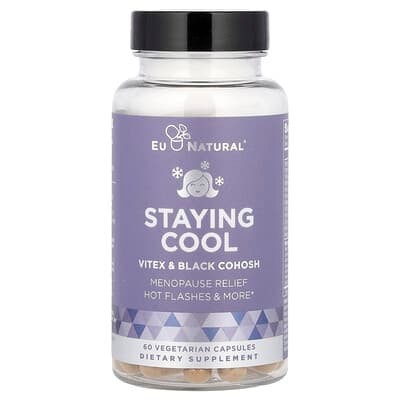
Staying Cool

Staying Cool

Eu Natural3.9 (3,816 ratings)
Format:Capsule Quantity: 60 Capsule(s) · 30 servings
Goals
$29.99 $0.99 per serving

About this product

Nutritional support is better established than a targeted menopause benefit. B vitamins contribute to normal energy metabolism, while vitamin D and 15 mg of zinc support normal immune function when intake is low. Extra energy, hormone changes and broader benefits remain uncertain once nutrient needs are met.

Several clearly named forms are useful features, including vitamin D3, methylfolate and bisglycinate minerals. The 1,000 mcg folate amount is stated as methylfolate rather than dietary folate equivalents, which limits direct comparisons with labels using that other measure. Zinc is accompanied by 1 mg copper, although their presence together does not establish added benefit or personal suitability.

The 1 g menopause complex leaves its full composition and individual amounts unclear. Ashwagandha is identified in the ingredient findings without a usable individual amount, while St. John's wort and black cohosh introduce medicine-interaction and liver concerns. The relatively high cost is harder to justify if the main aim is obtaining a few common nutrients.

Who is it for
  • Adults with identified dietary gaps who want several nutrients together
  • People considering menopause nutrition who can first verify the full herbal blend
Best for
  • Supporting normal energy metabolism when B-vitamin intake is low
  • Adding clearly stated zinc, copper and vitamin D amounts

Pros

  • Methylfolate and several bisglycinate minerals have clearly named forms
  • Zinc includes a disclosed copper companion
  • The main vitamin and mineral amounts are available for comparison

Cons

  • The menopause blend does not reveal individual herbal amounts
  • Targeted stress, hormone and hair effects cannot be predicted from the blend total
  • Relatively high cost for meeting isolated nutrient needs
  • Some nutrient findings remain uncertain despite the broad ingredient list

Warnings

  • St. John's wort has many medicine interactions; ask a pharmacist to check it against your medicines before use.
  • Black cohosh carries a liver-injury concern, making the undisclosed blend particularly relevant for anyone with liver problems.

Product analysis

57 out of 100

Staying Cool supplies vitamins and minerals that may help fill nutritional gaps and support normal immune and bone function. Its herbal ingredients raise practical concerns: St. John’s wort can interact with many medicines, and black cohosh carries a liver-injury concern.

AI assessment of the formula, label and price. How scoring works

Nutrient Quality74

Several vitamins and minerals use favorable forms, including vitamin D, folate and zinc. The unidentified blend leaves part of the formula’s quality uncertain.

Ingredient Transparency76

Most nutrient forms and declared amounts are stated. The blend does not disclose individual contents clearly enough to establish each ingredient’s contribution.

Value For Money31

The full serving cost makes several individual nutrients relatively expensive. The broad combination offers convenience, but does not establish good value for each nutrient.

Customer Satisfaction69

Customer feedback is moderately positive across thousands of ratings. The sizeable response base does not remove the less enthusiastic satisfaction picture.

Product Focus21

The formula spans many goals, with the clearest benefits related to filling nutritional gaps. Undisclosed herbal amounts make the expected contribution of the blend uncertain.

Format
Capsule
Container
60 Capsule(s)
Per serving
$0.99
Customer rating
3.9 · 3,816 ratings
Report analysis

Goals

Immunity
Impact
Highest effect
C+ Ingredient FitA+ PathwaysA+ EvidenceA+ Formulation Logic
Zinc · 15 mgVitamin D · 2000 IUSelenium · 70 mcg

Zinc and vitamin D contribute to normal immune regulation, while folate, vitamins B6 and B12 and copper can restore function impaired by low intake. Selenium adds antioxidant nutrition, with limited expectation of extra benefit at adequate status. Vitamin E's amount remains unresolved. The nutritional contributions do not establish additional protection against infection in well-nourished adults.

How this product is rated for Immunity

Ingredient fit65

Zinc, vitamin D, folate, vitamins B6 and B12, copper and selenium provide relevant immune contributions within a broader formula or product purpose. Nutrient amounts vary, and vitamin E has no resolved amount.
Goal fit
Zinc, vitamin D, folate, vitamins B6 and B12, copper and selenium provide relevant immune contributions within a broader formula or product purpose.
Dose adequacy
Nutrient amounts vary, and vitamin E has no resolved amount.

Pathways100

The supplied coverage centres on barrier defence, immune-cell regulation, and oxidative balance.
Depth
The strongest contribution is in immune-cell regulation.
Breadth
The supplied coverage centres on barrier defence, immune-cell regulation, and oxidative balance.

Evidence100

Zinc supplies the strongest supported contribution at the stated amount; its clinical limits remain relevant.
Evidence strength
Zinc supplies the strongest supported contribution at the stated amount, without establishing infection prevention.
Studied preparation
The supplied findings accept the contributing preparations, without establishing superior clinical effects from particular forms.

Formulation logic97

Vitamin E does not meet the amount criterion because its amount remains unresolved.
Partner coverage
The included contributions have no unmet required ingredient partner.
Conflicts
No listed ingredient conflict was identified in the supplied findings.
Effective doses
Vitamin E does not meet the amount criterion because its amount remains unresolved.
Study evidence
Selenium Mixed 37 studies
Vitamin D Supportive 85 studies
Vitamin E Supportive 21 studies
Zinc Supportive 73 studies
Impact
Moderate effect
D Ingredient FitF PathwaysA EvidenceA Formulation Logic
Zinc · 15 mgVitamin D · 2000 IU

Zinc may help testosterone recover if you're low in zinc. KSM-66 ashwagandha has a possible testosterone effect in men starting resistance training, but its individual amount here is undisclosed, so the amount can't be matched to that setting. The blend total doesn't reveal how much ashwagandha you're getting.

How this product is rated for Testosterone Support

Ingredient fit49

Zinc's testosterone benefit is most relevant when zinc levels are low. Zinc provides 15 mg per serving; that amount alone doesn't predict a testosterone increase.
Goal fit
Zinc's testosterone benefit is most relevant when zinc levels are low. Other ingredients broaden the mixture beyond testosterone-related nutrients.
Dose adequacy
Zinc provides 15 mg per serving; that amount alone doesn't predict a testosterone increase.

Pathways15

Zinc deficiency can affect testosterone; this doesn't imply that extra zinc stimulates hormone production when intake is adequate.
Depth
Zinc deficiency can affect testosterone; this doesn't imply that extra zinc stimulates hormone production when intake is adequate.
Breadth
The ingredient mix doesn't demonstrate several independent ways to raise testosterone in everyday use.

Evidence91

Zinc's testosterone benefit is most relevant when zinc levels are low. Ingredient form alone does not predict the hormone effect.
Evidence strength
Zinc's testosterone benefit is most relevant when zinc levels are low.
Studied preparation
The declared nutrient forms identify what is supplied, but don't guarantee a testosterone response.

Formulation logic92

The relevant nutrients need no missing partner, and no particular ingredient conflict is identified.
Partner coverage
No required ingredient partner is missing for the nutrient contribution described here.
Conflicts
No particular ingredient conflict is identified here.
Effective doses
Vitamin E and Ashwagandha have undisclosed individual amounts, so their amounts can't be compared reliably.
Study evidence
Selenium No effect 16 studies
Vitamin D Supportive 56 studies
Vitamin E Disputed 3 studies
Zinc Disputed 7 studies
Hair Health
Impact
High effect
C Ingredient FitD- PathwaysA+ EvidenceA Formulation Logic
Vitamin D · 2000 IUZinc · 15 mg

Zinc can help address diffuse shedding when zinc intake is inadequate. Folate supports cell division, while copper and selenium contribute to normal tissue and antioxidant functions; these roles do not establish added hair growth with adequate intake. KSM-66 ashwagandha has limited preparation-specific hair findings, but its individual amount here is undisclosed, so a comparable exposure cannot be established.

How this product is rated for Hair Health

Ingredient fit62

The formula includes hair-relevant nutrients, alongside broader nutritional ingredients. Several contributions depend on intake, amount or preparation rather than establishing routine regrowth.
Goal fit
Relevant nutrients share the formula with ingredients aimed at other goals, making its hair focus less concentrated.
Dose adequacy
Several included amounts provide only partial coverage of the saved comparisons, with unresolved amounts contributing nothing.

Pathways44

The strongest coverage concerns antioxidant functions, with limited breadth across the other assessed hair mechanisms.
Depth
Antioxidant-related nutrients provide the strongest coverage; normal antioxidant functions do not by themselves establish hair regrowth.
Breadth
Coverage reaches the saved level for antioxidant protection only, leaving the other assessed hair mechanisms less supported.

Evidence98

The leading ingredient findings must be read alongside their nutritional and preparation limits. Recognition in the saved comparisons does not establish routine regrowth from this product.
Evidence strength
Zinc leads the ingredient findings, with hair benefits most relevant when intake is inadequate.
Studied preparation
The saved findings recognize the included preparations; this does not establish a product-specific hair-growth effect.

Formulation logic93

Required partners are accounted for and no configured conflicts were found. The amount findings describe comparison coverage, without proving combined hair benefit.
Partner coverage
No required ingredient partner is missing from the saved findings; this does not imply added benefit from combining ingredients.
Conflicts
No configured ingredient conflict was identified; unassessed interactions and suitability remain unresolved.
Effective doses
Some included ingredients fall below the minimum amount comparison: Ashwagandha, Vitamin D; this limits their recognized contribution.
Study evidence
Copper Adverse 4 studies
Folate Mixed 15 studies
Niacin Disputed 2 studies
Selenium Disputed 7 studies
Vitamin D Disputed 34 studies
Vitamin E No effect 3 studies
Zinc Supportive 22 studies
Everyday Health
Impact
Highest effect
B Ingredient FitA+ PathwaysB+ EvidenceA+ Formulation Logic
Folate · 1000 mcgVitamin B12 · 30 mcgVitamin D · 2000 IUSelenium · 70 mcgZinc · 15 mg

B vitamins and folate contribute to normal energy metabolism and blood formation, while vitamin D, zinc and selenium provide mineral and defence-related nutrition. Their value is chiefly filling dietary gaps, without established extra benefit when intake is adequate. Ashwagandha is declared, but its individual amount is undisclosed, and preparation-specific stress findings cannot establish broad general-health benefit. The selected serving is the basis of these findings; repeated daily use has not been inferred.

How this product is rated for Everyday Health

Ingredient fit78

The relevant ingredients contribute to energy metabolism, blood formation, mineral metabolism, normal defence functions. Unresolved amounts limit part of the formula. Boron remain unresolved and add no established contribution.
Goal fit
The counted ingredients align with the nutritional roles described here, although the product is also linked to other goals.
Dose adequacy
Ashwagandha has an unresolved individual amount, limiting the amount that can be supported.

Pathways100

The counted ingredients span energy metabolism, blood formation, mineral metabolism, normal defence functions. These are contributions to normal nutrient functions rather than proof of broad health improvements.
Depth
Folate and the accompanying B vitamins provide the strongest contribution to normal blood formation.
Breadth
The saved findings extend across energy metabolism, blood formation, mineral metabolism, normal defence functions; this describes nutritional roles rather than proven improvements in all these areas.

Evidence82

Vitamin B9 (Folate) anchors the strongest supported nutritional contribution. The preparation findings do not establish extra benefit from named chemical forms or supplementation above adequate intake.
Evidence strength
Vitamin B9 (Folate) provides the strongest supported contribution among the counted ingredients, primarily as nutrition for low intake rather than demonstrated extra benefit above adequacy.
Studied preparation
The counted preparations meet the saved preparation finding; no superiority of a named form or delivery method is established.

Formulation logic98

The counted ingredients satisfy the partner and conflict checks, but Ashwagandha has an unresolved amount.
Partner coverage
The counted nutrients work independently or have their required partner present; this does not establish an added combination benefit.
Conflicts
None of the evaluated ingredient combinations triggered a conflict finding; this does not establish overall suitability.
Effective doses
Ashwagandha does not meet the amount check because usable amounts are unresolved; the other counted ingredients meet it.
Study evidence
Folate Supportive 80 studies
Selenium Supportive 70 studies
Vitamin D Supportive 115 studies
Zinc Supportive 60 studies
Impact
Moderate effect
C+ Ingredient FitF PathwaysA+ EvidenceA+ Formulation Logic
Vitamin D · 2000 IUVitamin B5 · 10 mgRiboflavin · 17 mgThiamin · 15 mgVitamin B12 · 30 mcg

Thiamin, riboflavin, niacin, B5 and B6 support normal energy metabolism, and folate contributes to blood formation. KSM-66 ashwagandha is declared without a resolved individual amount, so its contribution cannot be confidently judged from the supplied serving.

How this product is rated for Energy

Ingredient fit67

Energy-related nutrients form a substantial part of the assessed formula alongside other uses. The assessed amounts provide partial alignment with the saved exposure comparisons.
Goal fit
Energy-related nutrients form a substantial part of the assessed formula alongside other uses.
Dose adequacy
The assessed amounts provide partial alignment with the saved exposure comparisons.

Pathways0

The saved findings identify no coverage of the specific energy mechanisms assessed; the nutritional roles remain relevant. None of the assessed mechanisms reaches the saved coverage threshold.
Depth
The saved findings identify no coverage of the specific energy mechanisms assessed; the nutritional roles remain relevant.
Breadth
None of the assessed mechanisms reaches the saved coverage threshold.

Evidence95

Vitamin D provides the strongest saved evidence connection at the assessed amounts, without implying an energy benefit for every user. The ingredients included in the saved effective-amount comparison meet its preparation criteria; no extra benefit from a named form is implied.
Evidence strength
Vitamin D provides the strongest saved evidence connection at the assessed amounts, without implying an energy benefit for every user.
Studied preparation
The ingredients included in the saved effective-amount comparison meet its preparation criteria; no extra benefit from a named form is implied.

Formulation logic97

The assessed ingredients can stand alone or have the required partner present. No configured ingredient conflicts were identified in the supplied findings. Seven of the eight assessed ingredients meet the saved minimum exposure comparison; ashwagandha has an unresolved amount and falls below it.
Partner coverage
The assessed ingredients can stand alone or have the required partner present.
Conflicts
No configured ingredient conflicts were identified in the supplied findings.
Effective doses
Seven of the eight assessed ingredients meet the saved minimum exposure comparison; ashwagandha has an unresolved amount and falls below it.
Study evidence
Thiamin Disputed 12 studies
Vitamin D Supportive 32 studies
Longevity
Impact
High effect
C Ingredient FitD PathwaysB+ EvidenceA Formulation Logic
Folate · 1000 mcgVitamin B12 · 30 mcgVitamin D · 2000 IU

Vitamin D supports bone and muscle function, while B12 is relevant to neurological problems caused by deficiency. Their contribution concerns correction of low status, without established extra anti-aging benefit in adequately nourished adults. Selenium's antioxidant-enzyme role does not establish slower aging. Ashwagandha is declared but lacks an individual eligible amount; its stress and sleep findings are indirect to this goal. Vitamin E also lacks a usable amount.

How this product is rated for Longevity

Ingredient fit65

Nutrients contribute within a broader formula; ashwagandha and vitamin E amounts remain unresolved.
Goal fit
Nutrients contribute within a broader formula; ashwagandha and vitamin E amounts remain unresolved.
Dose adequacy
Known amounts receive partial recognition; ashwagandha and vitamin E lack usable amounts.

Pathways47

Antioxidant defense is the strongest represented area in the saved findings. Other areas have limited coverage.
Depth
Antioxidant defense is the strongest mapped area; the mapping does not establish slower aging or longer life.
Breadth
Only antioxidant defense reaches the saved coverage threshold.

Evidence83

Vitamin D leads the saved evidence finding. The credited preparations are recognized in the saved findings.
Evidence strength
Vitamin D leads the saved evidence finding; its role does not establish universal anti-aging benefit.
Studied preparation
The saved findings recognize the credited preparations, while the specific clinical and population limitations still apply.

Formulation logic93

No unmet partner requirement or configured conflict was found. Ashwagandha and vitamin E do not clear the amount threshold because their amounts are unresolved; the other credited ingredients do.
Partner coverage
Each credited ingredient works independently or has its required partner.
Conflicts
No configured conflict was matched among the evaluated combinations.
Effective doses
Ashwagandha and vitamin E do not clear the amount threshold because their amounts are unresolved; the other credited ingredients do.
Study evidence
Folate Supportive 16 studies
Selenium Supportive 27 studies
Vitamin D Supportive 50 studies
Vitamin E Supportive 19 studies
Zinc Supportive 10 studies

Ingredients

IngredientAmount per servingScore
Vitamin D (Cholecalciferol)
2000 IU 70
Vitamin E (D-Alpha-Tocopheryl Succinate)
60 IU 53
Thiamin (Thiamine Hydrochloride)
15 mg 68
Riboflavin
17 mg 40
Niacin (Niacinamide)
10 mg
Vitamin B6 (Pyridoxine Hydrochloride)
10 mg
Folate (L-Methylfolate)
1000 mcg 76
Vitamin B12 (Methylcobalamin)
30 mcg
Pantothenic Acid (Calcium Pantothenate)
10 mg
Zinc (TRAACS Zinc Bisglycinate Chelate)
15 mg 82
Selenium (L-Selenomethionine)
70 mcg 70
Copper (TRAACS Copper Bisglycinate Chelate)
1 mg 80
Manganese (TRAACS Manganese Bisglycinate Chelate)
2 mg 78
Staying Cool Menopause Complex
1 Gram(s)
Gluten Free Women 50+ Women 18–50 Menopause
Report overview
A+ Active Ingredient Quality & BioavailabilityA Dose, Safety & Label TransparencyF Value
+5
A serving supplies 15 mg of zinc at a high cost per serving. The zinc comes as zinc bisglycinate. The serving also contains 1 mg of copper.
How this ingredient is rated

Active Ingredient Quality & Bioavailability100

The zinc comes as zinc bisglycinate.
Zinc Form Bioavailability
The zinc comes as zinc bisglycinate.

Dose, Safety & Label Transparency91

The zinc amount and source are stated. The serving also contains 1 mg of copper.
Elemental Dose Transparency
The elemental zinc amount and its source are stated.
Zinc Dosage Safety & Effectiveness
A serving provides 15 mg of zinc.
Zinc-to-Copper Mineral Balance
The serving also contains 1 mg of copper.

Value30

The cost per serving is high.
Price Per Serving Efficiency
The cost per serving is high.
A+ Active Ingredient Quality & BioavailabilityA- Dose, Safety & Label TransparencyF Value
Each serving supplies 1 mg of copper as bisglycinate, a form assessed favorably for absorption. Its 15 mg of zinc gives a zinc-to-copper balance that aligns with the evaluation.
How this ingredient is rated

Active Ingredient Quality & Bioavailability100

Copper Bisglycinate is a named amino acid chelate assessed favorably for absorption potential, and the label gives the copper amount.
Copper Form Bioavailability
Copper Bisglycinate is an amino acid chelate assessed favorably for absorption potential.
Elemental Copper Labeling Clarity
The copper row lists 1 mg per serving and names copper bisglycinate as its source.

Dose, Safety & Label Transparency86

The serving provides 1 mg of copper. The 15:1 zinc-to-copper ratio aligns with the evaluation’s preferred balance.
Copper Dosage Safety & Efficacy
The serving provides 1 mg of copper.
Zinc-to-Copper Balance
15 mg of zinc and 1 mg of copper give a 15:1 ratio, which aligns with the evaluation’s preferred balance.

Value30

A whole-product serving costs about $1.00, making it a higher-priced choice in this comparison.
Price Per Serving Efficiency
A whole-product serving costs about $1.00, making it a higher-priced choice in this comparison.
A+ Active Ingredient Quality & BioavailabilityA- Dose, Safety & Label TransparencyF Value
It supplies a stated 2 mg of manganese per serving at a high cost per serving. It uses manganese bisglycinate.
How this ingredient is rated

Active Ingredient Quality & Bioavailability100

The manganese source is manganese bisglycinate.
Manganese Chemical Form
The manganese source is manganese bisglycinate.

Dose, Safety & Label Transparency86

The label states 2 mg of manganese per serving. It is below the adult upper limit of 11 mg.
Manganese Dosage Efficacy & Safety
Each serving supplies 2 mg of manganese.
Elemental Weight Disclosure
The manganese amount is stated as 2 mg per serving.

Value20

The cost per serving is high.
Price per Serving vs. Median
The cost per serving is high.
Report alternatives

Sources

Published studies used for the product analysis and the top-ranked studies for each ingredient and goal.

  1. The Association between Dietary and Circulating Copper Levels and Osteoporosis: a Scoping Review.
    Ju Y; Xiong W; Pang Y; Chen Z; Hou J; Zheng S; Li Z; Liu T; Xia H; Xia M; Zhong Y; Li J; Jiang X · Biological trace element research · 2026
    Scoping review18 studies pooledBone Health forCopper
  2. Association between dietary copper, iron, zinc, selenium intake and osteopenia or osteoporosis in elderly hypertensive patients: a retrospective cohort study.
    Chen M; Jia L; Gao R · Frontiers in nutrition · 2024
    Cohort study5,286 participantsBone Health forCopper
  3. Associations of dietary copper intake with total bone mineral density and lumbar spine bone mineral density in American adults.
    Hu M; Wang Z; Li C; Zheng Y; Hu J · Medicine · 2025
    Cross-sectional studyBone Health forCopper
  4. The association between dietary mineral intake and bone mineral density: a cross-sectional study.
    Wei M; Wei J; Huang S · Journal of health, population, and nutrition · 2025
    Cross-sectional study11,520 participantsBone Health forCopper
  5. Association between dietary copper intake and bone mineral density in children and adolescents aged 8-19 years: A cross-sectional study.
    Cui A; Yan J; Li H; Fan Z; Wei X; Wang H; Zhuang Y · PloS one · 2024
    Cross-sectional study6,965 participantsBone Health forCopper
  6. Association between RBC folate and lumbar bone mineral density in postmenopausal women, a cross-sectional study from NHANES 2009-2018.
    Wei H; Jin Z; Zhou L; Tang G; Chai S; Che X; Tan Y; Zeng W · Frontiers in endocrinology · 2025
    Cross-sectional study1,315 participantsBone Health forFolate
  7. Genetic variants modify the associations of concentrations of methylmalonic acid, vitamin B-12, vitamin B-6, and folate with bone mineral density.
    Liu CT; Karasik D; Xu H; Zhou Y; Broe K; Cupples LA; Cpgm de Groot L; Ham A; Hannan MT; Hsu YH; Jacques P; McLean RR; Paul L; Selhub J; Trajanoska K; van der Velde N; van Schoor N; Kiel DP · The American journal of clinical nutrition · 2021
    Cohort study4,310 participantsBone Health forFolate
  8. Adequate Intake and Supplementation of B Vitamins, in Particular Folic Acid, can Play a Protective Role in Bone Health.
    Rondanelli M; Tartara A; Fossari F; Vecchio V; Faliva MA; Naso M; Perna S; Nichetti M; Peroni G · Current aging science · 2022
    Narrative review35,298 participants29 studies pooledBone Health forFolate Bone Health forVitamin B6
  9. Relation of homocysteine, folate, and vitamin B12 to bone mineral density of postmenopausal women.
    Cagnacci A; Baldassari F; Rivolta G; Arangino S; Volpe A · Bone · 2004
    Cross-sectional study161 participantsBone Health forFolate
  10. Dietary intake of folate, but not vitamin B2 or B12, is associated with increased bone mineral density 5 years after the menopause: results from a 10-year follow-up study in early postmenopausal women.
    Rejnmark L; Vestergaard P; Hermann AP; Brot C; Eiken P; Mosekilde L · Calcified tissue international · 2008
    Cohort study1,869 participantsBone Health forFolate
  11. Risk of Environmental Chemicals on Bone Fractures Is Independent of Low Bone Mass in US Adults: Insights from 2017 to 2018 NHANES.
    Ling R; Ai Y; Chen C; Zhang J; Zou Z; Cheng S; Li C; Li X; Wang B · Metabolites · 2023
    Cross-sectional study2,640 participantsBone Health forManganese
  12. The Manganese-Bone Connection: Investigating the Role of Manganese in Bone Health.
    Taskozhina G; Batyrova G; Umarova G; Issanguzhina Z; Kereyeva N · Journal of clinical medicine · 2024
    Narrative reviewBone Health forManganese
  13. Associations of multiple metals with bone mineral density: A population-based study in US adults.
    Wei MH; Cui Y; Zhou HL; Song WJ; Di DS; Zhang RY; Huang Q; Liu JA; Wang Q · Chemosphere · 2021
    Cross-sectional studyBone Health forManganese
  14. Sex-specific associations of urinary mixed-metal concentrations with femoral bone mineral density among older people: an NHANES (2017-2020) analysis.
    Li H; Li G; Yi M; Zhou J; Deng Y; Huang Y; He S; Meng X; Liu L · Frontiers in public health · 2024
    Cross-sectional study31 participantsBone Health forManganese
  15. Relationship between blood manganese and bone mineral density and bone mineral content in adults: A population-based cross-sectional study.
    Wang C; Zhu Y; Long H; Ou M; Zhao S · PloS one · 2022
    Cross-sectional study9,732 participantsBone Health forManganese
  16. Effect of Vitamin B12 and Folic Acid Supplementation on Bone Mineral Density and Quantitative Ultrasound Parameters in Older People with an Elevated Plasma Homocysteine Level: B-PROOF, a Randomized Controlled Trial.
    Enneman AW; Swart KM; van Wijngaarden JP; van Dijk SC; Ham AC; Brouwer-Brolsma EM; van der Zwaluw NL; Dhonukshe-Rutten RA; van der Cammen TJ; de Groot LC; van Meurs J; Lips P; Uitterlinden AG; Zillikens MC; van Schoor NM; van der Velde N · Calcified tissue international · 2016
    Randomized trial1,111 participantsBone Health forVitamin B12
  17. Plasma B vitamins, homocysteine, and their relation with bone loss and hip fracture in elderly men and women.
    McLean RR; Jacques PF; Selhub J; Fredman L; Tucker KL; Samelson EJ; Kiel DP; Cupples LA; Hannan MT · The Journal of clinical endocrinology and metabolism · 2008
    Cohort study1,002 participantsBone Health forVitamin B12
  18. Relation between homocysteine and B-vitamin status indicators and bone mineral density in older Americans.
    Morris MS; Jacques PF; Selhub J · Bone · 2006
    Cross-sectional study1,550 participantsBone Health forVitamin B12
  19. The role of B-vitamin intake, B-vitamin-rich dietary patterns, the B-vitamin deficiency index in bone mineral density among school-aged children.
    Tan L; Zhang Y; Cui N; Huang S; Weng S; Bao M; Jiang Y; Huang M; Yang X · Pediatric research · 2026
    Cross-sectional study1,026 participantsBone Health forVitamin B12
  20. Hyperhomocysteinemia is Associated with Inflammation, Bone Resorption, Vitamin B12 and Folate Deficiency and MTHFR C677T Polymorphism in Postmenopausal Women with Decreased Bone Mineral Density.
    De Martinis M; Sirufo MM; Nocelli C; Fontanella L; Ginaldi L · International journal of environmental research and public health · 2020
    Cross-sectional study252 participantsBone Health forVitamin B12



