


Vitamin D Supportive
$59.99 $2.39 per serving
Product analysis
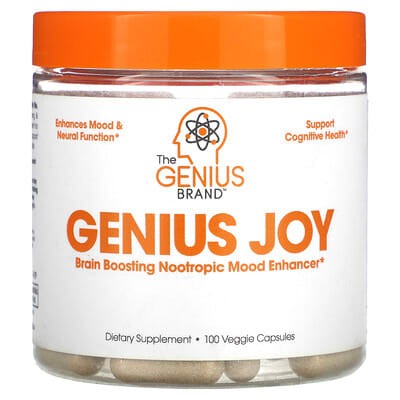
The Genius Brand Genius Joy is a mood and stress-support blend with 300 mg rhodiola and 100 mg L-theanine per four capsules, targeting stress-related fatigue and calm attention. Its 1,000 mg Adomix SAMe salt declaration does not establish how much active SAMe is present, and the rhodiola preparation is not a close match to the specific extracts behind the strongest evidence.
AI assessment of the formula, label and price. How scoring works
Nutrient Quality71
Several vitamins use well-identified forms, and rhodiola is identified by species. The quality and delivery of some of the other mood-support ingredients, particularly SAMe, are less certain.
Ingredient Transparency71
Amounts are listed for all assessed ingredients, using a four-capsule label serving. Forms and composition are less consistently detailed, particularly the active SAMe content.
Value For Money18
The blend is expensive for the amounts of rhodiola and L-theanine it supplies, and the supporting vitamins are also costly by comparison. The value of SAMe is less clear because the active amount is uncertain.
Customer Satisfaction88
Customer feedback is very positive, averaging 4.97 out of 5. More than a thousand ratings make that feedback considerably more representative.
Product Focus51
The clearest fit is stress-related mood and attention, alongside basic nutritional support. With 14 actives and relevance to many other goals, the blend is less focused than a dedicated stress-support supplement.
- Format
Capsule - Container
- 100 Capsule(s)
- Per serving
- $2.39
- Customer rating
- 5.0 · 1,122 ratings
Goals

Impact
High effect
Vitamin B6 · 2 mgVitamin B12 · 6 mcgVitamin D · 1000 IUSAMe · 1000 mg
Genius Joy has a moderate fit for stress-associated mood support, with the supplied comparison based on four capsules rather than the catalogue’s two-capsule serving. Rhodiola at 300 mg leads its stress-related contribution, while 100 mg of theanine adds a smaller calming role. Niacin at 20 mg can help fill a dietary gap relevant to mood when deficiency is present. SAMe is listed without a usable active amount, limiting what it adds to the choice.
Vitamin B12 Supportive
SAMe Disputed
Vitamin B6 Supportive
Rhodiola Supportive
Theanine Supportive

Impact
High effect
Vitamin D · 1000 IUSAMe · 1000 mgVitamin B12 · 6 mcgVitamin B6 · 2 mgTheanine · 100 mg
Genius Joy offers a mixed approach to stress, led by rhodiola for stress-related fatigue. The amounts here refer to four capsules, although the catalogue lists two. Rhodiola extract at 300 mg provides the leading support; 100 mg theanine adds a smaller relaxation role. Vitamin D3 at 25 mcg contributes conditionally when nutritional status is inadequate, while the undisclosed SAMe amount prevents a useful assessment of its mood-related contribution.
Vitamin D Supportive
Rhodiola Supportive
Theanine Supportive
Vitamin B6 Supportive
Vitamin B12 Mixed
SAMe No studies yet
Vitamin B5 No studies yet

Impact
High effect
Vitamin B12 · 6 mcgVitamin B6 · 2 mgVitamin D · 1000 IUThiamin · 1.5 mg
Genius Joy has a stress-and-attention focus with limited direct support for general brain-health benefit. The amounts apply to four capsules, despite a two-capsule catalogue serving. Rhodiola at 300 mg supplies the main stress-fatigue-related role, while 100 mg theanine adds a smaller calm-attention role. Thiamin at 1.5 mg supports normal nerve function and matters when dietary intake is insufficient.
Vitamin D Supportive
Vitamin B12 Supportive
Thiamin Supportive
Vitamin B6 Supportive
Theanine Supportive
Rhodiola Supportive

Impact
High effect
Thiamin · 1.5 mgVitamin B6 · 2 mgVitamin B12 · 6 mcgVitamin D · 1000 IUTheanine · 100 mg
Genius Joy has a limited cognitive-support fit centered on stress-related mental performance. Its 100 mg theanine has preliminary executive-function relevance in people with lower baseline performance. Rhodiola at 300 mg adds stress-fatigue relevance, but the preparation does not receive full equivalence to the reviewed extract. Vitamin B6 at 2 mg contributes through correction of inadequate nutrient status.
Vitamin D Supportive
Vitamin B12 Disputed
Thiamin Supportive
Theanine Supportive
Vitamin B6 Supportive
Rhodiola Supportive

Impact
High effect
Vitamin D · 1000 IUVitamin B5 · 10 mgRiboflavin · 1.7 mgThiamin · 1.5 mgVitamin B12 · 6 mcg
Genius Joy has a limited, stress-related fit for energy alongside nutritional support. The amounts shown apply to four capsules, while the catalogue lists two, so the serving size matters when comparing it. Its 300 mg of rhodiola offers a modest stress-fatigue contribution, with uncertainty because the named extract is not the specifically supported preparation. The 25 mcg of vitamin D and 1.7 mg of riboflavin are relevant to fatigue when low nutrient status is involved, rather than a stimulant effect.
Vitamin D Supportive
Rhodiola Supportive
Vitamin B12 Disputed
Thiamin Disputed
Riboflavin Mixed
Theanine No studies yet
Vitamin B5 No studies yet

Impact
Moderate effect
Vitamin D · 1000 IU
Genius Joy offers some nutritional immune support within a formula aimed at many goals. Vitamin D at 25 mcg contributes to normal immune-cell regulation. Vitamin B6 at 2 mg and vitamin B12 at 6 mcg matter chiefly when correcting dietary gaps that impair immune-cell function.
Vitamin D Supportive
Ingredients
| Ingredient | Amount per serving | Score |
|---|---|---|
Vitamin D3 (Cholecalciferol) | 1000 IU | |
Vitamin B1 (Thiamine Hydrochloride) | 1.5 mg | |
Vitamin B2 (Riboflavin 5-Phosphate) | 1.7 mg | |
Vitamin B3 (Niacinamide) | 20 mg | |
Vitamin B6 (Pyridoxal 5-Phosphate) | 2 mg | |
Vitamin B12 (Methylcobalamin) | 6 mcg | |
Vitamin B5 (D-Calcium Pantothenate) | 10 mg | |
Adomix (S-Adenosyl-L-Methionine (SAMe) Tosylate Disulfate) | 1000 mg | |
N-Acetyl-L-Tyrosine | 350 mg | |
Rhodiola5Plus Rhodiola rosea (Rosavins, Salidrosides) | 300 mg | |
Red Panax ginseng root powder | 250 mg | |
HTPurity Griffonia simplicifolia (5-HTP) | 100 mg | |
NeuroFactor Coffea arabica fruit extract | 100 mg | |
L-Theanine | 100 mg |
Theanine · 100 mg OverallScore73
The Genius Brand Genius Joy offers 100 mg L-Theanine per serving, with expensive at $2.40 per 100 mg. That is also the price per serving of the full formula. No branded form or additional purity claim is indicated. L-Theanine is the form associated with studied calming and focus effects.
Rhodiola (Rosavins, Salidrosides) · 300 mg OverallScore78
The Genius Brand Genius Joy offers costly rhodiola: a labeled serving provides 300 mg of Rhodiola rosea. The preparation declares 3% rosavins and 2% salidrosides. At $1.60 per 200 mg of rhodiola for comparison, while a labeled serving costs $2.40, the rhodiola is costly; the serving price covers the full product.
Vitamin D (Cholecalciferol) · 1000 IU OverallScore62
The Genius Brand Genius Joy offers above the comparison midpoint value for vitamin D at $2.40 per 1,000 IU of vitamin D and per labeled serving for the full formula. A labeled serving provides 1000.0 IU of vitamin D. The form is vitamin D3 (cholecalciferol). The original source of the vitamin D is not specified. No third-party seal, certificate of analysis or GMP claim is listed.
Alternative products
Report alternatives
Sources
Published studies used for the product analysis and the top-ranked studies for each ingredient and goal.
- Dose-Response Effects of Short-Term Rhodiola rosea (Golden Root Extract) Supplementation on Anaerobic Exercise Performance and Cognitive Function in Resistance-Trained Athletes: A Randomized, Crossover, Double-Blind, and Placebo-Controlled Study.
- A combination of green tea, rhodiola, magnesium and B vitamins modulates brain activity and protects against the effects of induced social stress in healthy volunteers.
- Rosenroot (Rhodiola rosea): traditional use, chemical composition, pharmacology and clinical efficacy.
- Rhodiola rosea in stress induced fatigue--a double blind cross-over study of a standardized extract SHR-5 with a repeated low-dose regimen on the mental performance of healthy physicians during night duty.
- Effects of a Rhodiola rosea extract on mental resource allocation and attention: An event-related potential dual task study.
- Effects of L-Theanine Administration on Stress-Related Symptoms and Cognitive Functions in Healthy Adults: A Randomized Controlled Trial.
- A Randomized, Triple-Blind, Placebo-Controlled, Crossover Study to Investigate the Efficacy of a Single Dose of AlphaWave® L-Theanine on Stress in a Healthy Adult Population.
- Effects of Tea (Camellia sinensis) or its Bioactive Compounds l-Theanine or l-Theanine plus Caffeine on Cognition, Sleep, and Mood in Healthy Participants: A Systematic Review and Meta-Analysis of Randomized Controlled Trials.
- Assessing the effects of caffeine and theanine on the maintenance of vigilance during a sustained attention task.
- Effects of l-Theanine on Cognitive Function in Middle-Aged and Older Subjects: A Randomized Placebo-Controlled Study.
- Can thiamine substitution restore cognitive function in alcohol use disorder?
- EFNS guidelines for diagnosis, therapy and prevention of Wernicke encephalopathy.
- Diagnosis and treatment of Wernicke's encephalopathy: A systematic literature review.
- Vitamin Supplementation and Dementia: A Systematic Review.
- Association between dietary vitamin B1 intake and cognitive function among older adults: a cross-sectional study.
- Relationship between vitamin B12 levels and motor development: A systematic review.
- Vitamin B12 supplementation improves cognitive function in middle aged and elderly patients with cognitive impairment.
- Structural and Functional Brain Changes Associated with Vitamin B12 Deficiency using Magnetic Resonance Imaging: A Systematic Review and Meta-analysis.
- Maternal vitamin B12, vitamin D, and folic acid status during pregnancy and child neurodevelopment: a systematic review.
- Higher vitamin B12 from mid- to late life is related to slower rates of cognitive decline.