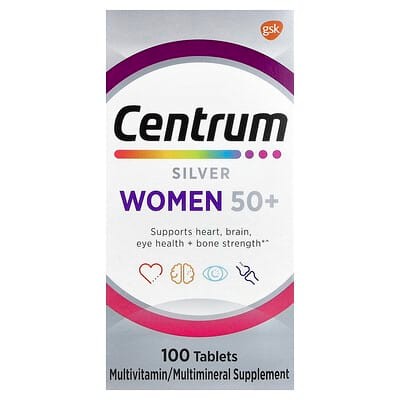
Centrum Silver Women 50+

Centrum Silver Women 50+

Centrum4.8 (20,681 ratings)
Format:Tablet Quantity: 100 Tablet(s) · 100 servings
Goals
$10.76 $0.10 per serving

About this product

Broad coverage makes the formula most useful when the diet leaves several nutrient gaps. B vitamins support normal energy use and blood formation, while the 8 mg iron contribution may matter when iron intake is low; those roles do not establish an energy or focus boost in someone whose needs are already met.

Calcium at 300 mg, vitamin D3 at 25 mcg and magnesium at 100 mg provide a meaningful nutritional contribution to bone maintenance, while leaving a role for dietary intake. Vitamin C, copper and zinc also support normal skin functions, but extra cosmetic or hair benefits depend largely on an underlying nutrient shortfall.

Amounts are stated throughout, although many nutrient forms are unclear on the main listing. The ingredient details identify vitamin K1 rather than MK-7 and zinc oxide, which is a less favored zinc form in the supplied findings; the low serving cost is appealing for broad coverage, but the formula is less suited to a specific high-dose nutrient need.

Who is it for
  • Women aged 50 and over whose diet leaves several nutrient gaps
  • People seeking broad nutritional coverage who also have a reason to include iron
Best for
  • Daily nutritional gap filling
  • Adding calcium, vitamin D and magnesium alongside dietary sources

Pros

  • Calcium, vitamin D and magnesium contribute together to bone nutrition
  • Includes a modest iron amount for a genuine dietary shortfall
  • Individual nutrient amounts are disclosed
  • Low serving cost for broad coverage

Cons

  • Many nutrient forms are missing or only partly resolved
  • Zinc oxide is a less favored source than the better-described alternatives in the supplied findings
  • Calcium and magnesium provide only part of total nutritional needs
  • An 8 mg iron serving is not a dedicated higher-iron formula

Product analysis

50 out of 100

Centrum Silver Women 50+ brings a broad range of vitamins and minerals together at an economical serving cost. Most ingredient forms are unspecified, making their quality difficult to compare.

AI assessment of the formula, label and price. How scoring works

Nutrient Quality21

Most ingredient forms are unspecified, limiting quality comparisons across the mixture. The limited source details that are available do not establish a consistent form-quality advantage.

Ingredient Transparency64

Every listed amount is disclosed, making it easy to compare servings. Almost all forms are omitted, leaving much less clarity about the sources used.

Value For Money58

Several mineral components and vitamin K offer economical value at the serving cost. Value for many of the other vitamins and minerals remains uncertain.

Customer Satisfaction93

Customer ratings are very positive across a particularly large review pool. The volume strengthens the satisfaction signal without establishing benefits.

Product Focus35

The combination has moderate support for a broad set of intended benefits. Its many ingredients provide breadth, although their number alone does not establish greater benefit.

Format
Tablet
Container
100 Tablet(s)
Per serving
$0.10
Customer rating
4.8 · 20,681 ratings
Report analysis

Goals

Immunity
Impact
High effect
D+ Ingredient FitB PathwaysA+ EvidenceA+ Formulation Logic
Magnesium · 100 mgVitamin C · 100 mgZinc · 15 mgVitamin A · 1050 mcgVitamin D · 25 mcgSelenium · 22 mcg

Zinc and relevant vitamins contribute to normal immune-cell function, while vitamin A supplies a nutrient involved in protective barriers. Folate, copper and B vitamins can help when low intake impairs immune processes. The ingredients make differing contributions at the selected serving, and normal nutrient functions do not establish extra protection against infection in adults whose needs are already met.

How this product is rated for Immunity

Ingredient fit54

Relevant nutrients contribute to immune function, while additional actives broaden the formula beyond the supported contributions.
Goal fit
Relevant nutrients contribute to immune function, while additional actives broaden the formula beyond the supported contributions.
Dose adequacy
The serving supplies partial amounts against the saved references; this comparison does not establish an optimal dose or a clinical response.

Pathways75

Barrier functions and lymphocyte-related functions reach the saved threshold; innate-cell and oxidative coverage remain smaller.
Depth
The strongest recognized area is lymphocyte function and immune regulation; this describes functional coverage rather than observed infection prevention.
Breadth
Barrier functions and lymphocyte-related functions reach the saved threshold; innate-cell and oxidative coverage remain smaller.

Evidence100

Zinc drives the strongest saved evidence finding, within the supplied limits on normal immune function and respiratory outcomes.
Evidence strength
Zinc drives the strongest saved evidence finding, within the supplied limits on normal immune function and respiratory outcomes.
Studied preparation
The saved result recognizes the preparations meeting its amount threshold; no superiority of particular forms is established.

Formulation logic100

No configured ingredient conflict was triggered; the finding covers only the evaluated combinations. All recognized ingredients meet the saved minimum amount threshold; this does not establish a clinical response.
Partner coverage
Recognized ingredients work independently or have their required partners; this does not establish added combination benefit.
Conflicts
No configured ingredient conflict was triggered; the finding covers only the evaluated combinations.
Effective doses
All recognized ingredients meet the saved minimum amount threshold; this does not establish a clinical response.
Study evidence
Iron Supportive 23 studies
Magnesium Supportive 8 studies
Selenium Mixed 37 studies
Vitamin A Supportive 107 studies
Vitamin C Supportive 53 studies
Vitamin D Supportive 85 studies
Vitamin E Supportive 21 studies
Zinc Supportive 73 studies
Impact
High effect
C Ingredient FitB+ PathwaysA+ EvidenceA+ Formulation Logic
Phosphorus · 20 mgVitamin K · 50 mcgMagnesium · 100 mgCalcium · 300 mgVitamin D · 25 mcgCopper · 0.5 mgManganese · 2.3 mgZinc · 15 mgVitamin C · 100 mg

Calcium can fill a dietary gap for mineralization, and vitamin D supports calcium absorption. Magnesium contributes nutritional support for bone metabolism, while trace minerals have matrix-related roles without established extra fracture benefit. The saved result recognized matrix and calcium-regulation coverage, but the unspecified vitamin K preparation does not establish MK-7 trial equivalence. Small phosphorus and vitamin C amounts did not contribute.

How this product is rated for Bone Health

Ingredient fit60

Several relevant nutrients appear within a broad formulation.
Goal fit
Several relevant nutrients appear within a broad formulation.
Dose adequacy
Contributing amounts received partial recognition; small phosphorus and vitamin C amounts did not contribute.

Pathways80

Collagen matrix formation was the strongest saved finding. Calcium regulation and matrix formation reached the saved criteria.
Depth
Collagen matrix formation was the strongest saved finding; this does not measure stronger bone.
Breadth
Calcium regulation and matrix formation reached the saved criteria.

Evidence97

Calcium drove the saved evidence finding; the amount recognition does not establish extra bone-density or fracture benefit.
Evidence strength
Calcium drove the saved evidence finding; the amount recognition does not establish extra bone-density or fracture benefit.
Studied preparation
Vitamin K and potassium lacked studied-preparation recognition.

Formulation logic100

No contributing ingredient lacked a required partner in the saved result. No listed conflict was matched.
Partner coverage
No contributing ingredient lacked a required partner in the saved result.
Conflicts
No listed ingredient conflict was matched in the saved result.
Effective doses
All contributing ingredients met the saved minimum amount criterion; this is not proof of a clinically effective bone dose.
Study evidence
Calcium Supportive 144 studies
Copper Disputed 20 studies
Folate Supportive 50 studies
Magnesium Supportive 48 studies
Manganese Adverse 12 studies
Phosphorus Supportive 44 studies
Potassium Supportive 39 studies
Vitamin A Adverse 56 studies
Vitamin C Supportive 46 studies
Vitamin D Supportive 202 studies
Vitamin K Supportive 78 studies
Zinc Supportive 33 studies
Everyday Health
Impact
Highest effect
B Ingredient FitA+ PathwaysA- EvidenceA+ Formulation Logic
Folate · 667 mcg DFEVitamin B12 · 50 mcgVitamin D · 25 mcgMagnesium · 100 mgVitamin K · 50 mcgSelenium · 22 mcgZinc · 15 mgVitamin C · 100 mg

The vitamins and minerals can help fill gaps in nutrient intake. B vitamins and folate contribute to nutritional coverage, while vitamin D and magnesium add mineral-related support; iodine helps avoid consequences of low iodine intake. These roles do not establish improved general-health outcomes above adequate intake or special benefits from combining the ingredients.

How this product is rated for Everyday Health

Ingredient fit75

Relevant ingredients form only part of a formula that also addresses other goals.
Goal fit
Relevant ingredients form only part of a formula that also addresses other goals.
Dose adequacy
The included amounts partly meet the saved references; an unresolved amount cannot establish a dose contribution.

Pathways100

The strongest represented mechanism is energy metabolism cofactors. This describes ingredient roles rather than demonstrated health improvement.
Depth
The strongest represented mechanism is energy metabolism cofactors. This describes ingredient roles rather than demonstrated health improvement.
Breadth
Several mechanisms are represented, without establishing an equally broad range of health benefits.

Evidence86

Magnesium supplies the strongest included evidence contribution; preparation and population limitations still apply.
Evidence strength
Magnesium supplies the strongest included evidence contribution; preparation and population limitations still apply.
Studied preparation
The included preparations match the saved references, without transferring nutrient availability into broader health benefits.

Formulation logic100

No matching ingredient conflict was identified in the supplied findings.
Partner coverage
The included contributors can act independently or have their required partner; this does not establish combination synergy.
Conflicts
No matching ingredient conflict was identified in the supplied findings.
Effective doses
All included contributors meet the saved minimum amount threshold, which is not a proven minimum effective dose.
Study evidence
Folate Supportive 80 studies
Magnesium Supportive 114 studies
Selenium Supportive 70 studies
Vitamin C Supportive 56 studies
Vitamin D Supportive 115 studies
Vitamin K Supportive 34 studies
Zinc Supportive 60 studies
Hair Health
Impact
Moderate effect
C- Ingredient FitF PathwaysA+ EvidenceA+ Formulation Logic
Biotin · 30 mcgVitamin D · 25 mcgZinc · 15 mgIron · 8 mgVitamin C · 100 mg

Zinc may help with diffuse shedding when low zinc is the cause. That benefit concerns correcting low levels; taking extra zinc hasn’t been shown to regrow hair when you already get enough. Iron can also matter when low iron contributes to shedding.

How this product is rated for Hair Health

Ingredient fit57

Zinc’s hair benefit mainly concerns deficiency-related shedding.
Goal fit
Zinc’s hair benefit mainly concerns deficiency-related shedding.
Dose adequacy
Vitamin B12: 50 mcg; Zinc: 15 mg; Biotin: 30 mcg per selected label serving. These amounts alone don’t predict hair regrowth.

Pathways2

The nutrients relate to hair-fibre structure or antioxidant functions. These roles don’t mean routine supplementation will regrow hair.
Depth
Some ingredients relate to hair-fibre structure, without showing that the serving will increase hair growth.
Breadth
A broad effect across hair-growth mechanisms is unclear.

Evidence97

Zinc’s hair benefit mainly concerns deficiency-related shedding. The ingredient form alone doesn’t guarantee a hair-growth benefit.
Evidence strength
Zinc’s hair benefit mainly concerns deficiency-related shedding.
Studied preparation
Iodine’s thyroid role doesn’t show that it improves hair growth; the other ingredient forms don’t remove their benefit limitations.

Formulation logic100

No particular ingredient conflict or missing required partner is identified.
Partner coverage
No required ingredient partner is missing for the contributions described.
Conflicts
No particular ingredient conflict is identified.
Effective doses
Vitamin B12: 50 mcg; Zinc: 15 mg; Biotin: 30 mcg per selected label serving; these are amounts, not guarantees of a hair benefit.
Study evidence
Biotin Supportive 4 studies
Copper Adverse 4 studies
Folate Mixed 15 studies
Iodine No effect 1 study
Iron Disputed 25 studies
Niacin Disputed 2 studies
Selenium Disputed 7 studies
Vitamin A Disputed 13 studies
Vitamin D Disputed 34 studies
Vitamin E No effect 3 studies
Zinc Supportive 22 studies
Skin Health
Impact
Moderate effect
D Ingredient FitF PathwaysA- EvidenceA+ Formulation Logic
Zinc · 15 mgVitamin C · 100 mgCopper · 0.5 mgSelenium · 22 mcgVitamin E · 15.8 mg

Vitamin C supports collagen production, copper helps cross-link collagen and elastin, and zinc contributes to normal skin repair. Riboflavin, B6, niacin and biotin help meet nutrient needs whose deficiency can affect skin.

Vitamin A supports normal skin-cell development, while vitamin E and selenium have antioxidant roles. These functions do not establish additional cosmetic benefits in adequately nourished adults, and the small carotenoid amount is below the supplied skin-trial exposure.

How this product is rated for Skin Health

Ingredient fit45

The ingredients have a connection to skin support, with amount comparisons kept separate from expected cosmetic results.
Goal fit
The skin-related ingredients are part of a formula with broader purposes, giving a partial specific match to skin support.
Dose adequacy
The assessed amounts provide a partial match to the saved exposure comparisons.

Pathways18

The strongest connection in the saved findings is skin collagen structure, with partial overall coverage.
Depth
The strongest connection in the saved findings is skin collagen structure, with partial overall coverage.
Breadth
None of the specified skin mechanisms reaches the saved coverage threshold.

Evidence89

The saved evidence finding reflects the assessed ingredients, with benefits limited by nutritional status or preparation-specific research.
Evidence strength
Copper leads the saved evidence comparison among ingredients meeting the amount criterion. Nutritional roles or limited trial findings do not establish universal cosmetic benefit.
Studied preparation
The assessed ingredients meeting the amount criterion match the saved preparation criteria.

Formulation logic100

The saved assessment flags no missing required partners or ingredient conflicts, while the amount comparison remains ingredient-specific.
Partner coverage
The assessed ingredients can stand alone or have the partners required by the saved assessment.
Conflicts
No configured ingredient conflicts were flagged.
Effective doses
5 of 5 assessed ingredients meet the saved minimum amount criterion. That criterion does not establish a cosmetic benefit.
Study evidence
Biotin Supportive 10 studies
Copper Supportive 16 studies
Niacin Supportive 61 studies
Selenium Supportive 22 studies
Vitamin A Supportive 106 studies
Vitamin C Supportive 53 studies
Vitamin E Supportive 38 studies
Zinc Supportive 66 studies
Testosterone Support
Impact
Moderate effect
F Ingredient FitF PathwaysA EvidenceA+ Formulation Logic
Magnesium · 100 mgZinc · 15 mgVitamin D · 25 mcg

Zinc may help restore testosterone when low zinc is the cause of reduced levels. The useful distinction is between correcting a shortage and raising testosterone when you already get enough zinc; extra zinc hasn't shown the latter benefit. Vitamin D adds a possible benefit in people with low vitamin D, but a general testosterone increase in people with adequate levels is unclear.

How this product is rated for Testosterone Support

Ingredient fit38

Zinc can help with testosterone reduced by zinc deficiency. Several other nutrients are present, but their presence alone does not add a testosterone benefit.
Goal fit
Zinc can help with testosterone reduced by zinc deficiency.
Dose adequacy
The serving supplies 15 mg zinc and 100 mg magnesium. Amounts alone do not predict a hormone increase.

Pathways10

Zinc and magnesium relate to different hormone processes, but their presence does not guarantee broader testosterone benefits.
Depth
Zinc deficiency can lower testosterone; replacing zinc concerns that nutritional condition.
Breadth
Zinc and magnesium relate to different hormone processes, but their presence does not guarantee broader testosterone benefits.

Evidence91

Zinc can help with testosterone reduced by zinc deficiency. Vitamin D has a narrower possible benefit in initially deficient overweight men.
Evidence strength
Zinc can help with testosterone reduced by zinc deficiency. Vitamin D benefits also depend on the population and nutrient status.
Studied preparation
The declared nutrient forms do not demonstrate an isolated testosterone benefit from vitamin B6.

Formulation logic100

No particular ingredient conflict or missing required partner is identified. Combining the ingredients does not itself show an added testosterone benefit.
Partner coverage
No additional ingredient partner is required for the individual contributions described here.
Conflicts
No particular ingredient conflict is identified for this goal.
Effective doses
The serving contains 15 mg zinc. This amount does not guarantee a hormone increase.
Study evidence
Magnesium Disputed 5 studies
Selenium No effect 16 studies
Vitamin D Supportive 56 studies
Vitamin E Disputed 3 studies
Zinc Disputed 7 studies
Impact
Moderate effect
C- Ingredient FitF PathwaysA EvidenceA+ Formulation Logic
Iodine · 150 mcgVitamin D · 25 mcgVitamin B5 · 5 mgMagnesium · 100 mgRiboflavin · 1.1 mgThiamin · 1.1 mgVitamin B12 · 50 mcgIron · 8 mgPotassium · 80 mg

Thiamin, riboflavin, niacin, B6 and folate contribute to normal energy and blood-related processes. Iron at 8 mg and magnesium at 100 mg add nutritional contributions that may matter when intake is low. Benefits from covering a dietary gap should not be assumed in someone whose needs are already met.

How this product is rated for Energy

Ingredient fit58

Energy-related nutrients sit within a broader formula serving several health purposes. The assessed amounts provide partial alignment with the saved exposure comparisons.
Goal fit
Energy-related nutrients sit within a broader formula serving several health purposes.
Dose adequacy
The assessed amounts provide partial alignment with the saved exposure comparisons.

Pathways0

The saved findings identify no coverage of the specific energy mechanisms assessed; the nutritional roles remain relevant. None of the assessed mechanisms reaches the saved coverage threshold.
Depth
The saved findings identify no coverage of the specific energy mechanisms assessed; the nutritional roles remain relevant.
Breadth
None of the assessed mechanisms reaches the saved coverage threshold.

Evidence95

Vitamin D provides the strongest saved evidence connection at the assessed amounts, without implying an energy benefit for every user. The preparation comparison is limited by Iodine, which is not matched to the relevant studied preparation.
Evidence strength
Vitamin D provides the strongest saved evidence connection at the assessed amounts, without implying an energy benefit for every user.
Studied preparation
The preparation comparison is limited by Iodine, which is not matched to the relevant studied preparation.

Formulation logic100

The assessed ingredients can stand alone or have the required partner present. No configured ingredient conflicts were identified in the supplied findings. 11 of 11 assessed ingredients meet the saved minimum exposure comparison, which does not guarantee an effect.
Partner coverage
The assessed ingredients can stand alone or have the required partner present.
Conflicts
No configured ingredient conflicts were identified in the supplied findings.
Effective doses
11 of 11 assessed ingredients meet the saved minimum exposure comparison, which does not guarantee an effect.
Study evidence
Iodine Adverse 3 studies
Iron Supportive 74 studies
Magnesium Supportive 4 studies
Potassium Supportive 2 studies
Thiamin Disputed 12 studies
Vitamin D Supportive 32 studies

Ingredients

IngredientAmount per servingScore
Vitamin A (Beta-Carotene)
1050 mcg
Vitamin C
100 mg
Vitamin D3
25 mcg
Vitamin E
15.8 mg
Vitamin K
50 mcg 42
Thiamine
1.1 mg
Riboflavin
1.1 mg
Niacin
14 mg
Vitamin B6
5 mg
Folate
667 mcg DFE
Vitamin B12
50 mcg
Biotin
30 mcg
Pantothenic Acid
5 mg
Calcium
300 mg 52
Iron
8 mg 51
Phosphorus
20 mg
Iodine
150 mcg 88
Magnesium
100 mg
Zinc
15 mg 58
Selenium
22 mcg
Copper
0.5 mg 38
Manganese
2.3 mg 54
Chromium
52 mcg 27
Molybdenum
50 mcg 46
Chloride
72 mg 77
Potassium
80 mg
Lutein
300 mcg
Gluten Free Women 50+
Report overview
Iodine · 150 mcg OverallScore88
C+ Active Ingredient Quality & BioavailabilityA+ Dose, Safety & Label TransparencyA+ Value
Each serving provides 150 mcg of iodine. Potassium iodide is listed among the other ingredients, but how much of the iodine it supplies is unclear.
How this ingredient is rated

Active Ingredient Quality & Bioavailability69

Potassium iodide appears among the other ingredients, but its contribution to the labeled iodine amount is unclear.
Iodine Form & Bioavailability
Potassium iodide is listed among the other ingredients, but how much of the iodine it supplies is unknown.
Marine Source Purity & Sourcing
No marine source is identified in the saved facts, so the marine-specific sourcing check does not apply.

Dose, Safety & Label Transparency100

The label lists 150 mcg per serving, an amount the evaluation considers aligned with daily support.
Dosage Efficacy for Daily Support
150 mcg per serving aligns with the evaluation's range for daily support.
Dosage Safety & Upper Limits
The evaluation does not flag the 150 mcg serving as exceeding its safety threshold.
Elemental Iodine Transparency
The iodine amount is listed as 150 mcg per serving.

Value100

A whole-product serving costs about $0.11.
Price Per Effective Serving
A whole-product serving costs about $0.11.
Calcium · 300 mg OverallScore52
F Active Ingredient Quality & BioavailabilityD- Dose, Safety & Label TransparencyA+ Value
A serving lists 300 mg of calcium, with its source unresolved. The whole-product serving costs about $0.11 and the evaluation identifies an artificial additive.
How this ingredient is rated

Active Ingredient Quality & Bioavailability37

The label lists 300 mg of calcium per serving, but its source remains unresolved.
Calcium Form & Absorption Potential
The calcium entry does not identify its source. Calcium compounds appear elsewhere, but their contribution to that amount is unknown.
Elemental Calcium Transparency
The calcium amount is explicitly listed as 300 mg per serving.

Dose, Safety & Label Transparency42

The serving provides 300 mg of calcium, and the evaluation identifies an artificial additive.
Absorption-Optimized Serving Dose
The serving supplies 300 mg of calcium.
Formulation Purity & Additives
The evaluation identifies an artificial additive; sugar information is unavailable.

Value100

The whole-product serving costs about $0.11.
Price Per Serving Efficiency
The whole-product serving costs about $0.11.
Zinc · 15 mg OverallScore58
F Active Ingredient Quality & BioavailabilityA- Dose, Safety & Label TransparencyB+ Value
The serving provides 15 mg of zinc as oxide. Zinc oxide receives a lower absorption assessment than some other forms.
How this ingredient is rated

Active Ingredient Quality & Bioavailability20

Zinc oxide receives a lower absorption assessment than some other forms.
Zinc Form Bioavailability
Zinc oxide receives a lower absorption assessment than some other forms.

Dose, Safety & Label Transparency85

The serving provides 15 mg of zinc and 0.5 mg of copper. The zinc amount and source are identified.
Elemental Dose Transparency
The saved facts specify the elemental zinc amount and its source.
Zinc Dosage Safety & Effectiveness
The serving provides 15 mg of zinc, an amount the evaluation considers suitable for nutritional maintenance.
Zinc-to-Copper Mineral Balance
The serving also provides 0.5 mg of copper; the zinc-to-copper ratio falls in an intermediate band under the evaluation’s provisional criteria.

Value80

A whole-product serving costs about $0.11, which is modest in this comparison.
Price Per Serving Efficiency
A whole-product serving costs about $0.11, which is modest in this comparison.
Report alternatives

Sources

Published studies used for the product analysis and the top-ranked studies for each ingredient and goal.

  1. What is the impact of daily oral supplementation of vitamin D3 (cholecalciferol) plus calcium on the incidence of hip fracture in older people? A systematic review and meta-analysis.
    Manoj P; Derwin R; George S · International journal of older people nursing · 2023
    Meta-analysis12,620 participants7 studies pooledBone Health forCalcium
  2. Calcium supplementation prevents seasonal bone loss and changes in biochemical markers of bone turnover in elderly New England women: a randomized placebo-controlled trial.
    Storm D; Eslin R; Porter ES; Musgrave K; Vereault D; Patton C; Kessenich C; Mohan S; Chen T; Holick MF; Rosen CJ · The Journal of clinical endocrinology and metabolism · 1998
    Randomized trial60 participantsBone Health forCalcium
  3. The effects of calcium supplementation (milk powder or tablets) and exercise on bone density in postmenopausal women.
    Prince R; Devine A; Dick I; Criddle A; Kerr D; Kent N; Price R; Randell A · Journal of bone and mineral research : the official journal of the American Society for Bone and Mineral Research · 1995
    Randomized trial168 participantsBone Health forCalcium
  4. The efficacy of calcium supplementation alone in elderly Thai women over a 2-year period: a randomized controlled trial.
    Rajatanavin R; Chailurkit L; Saetung S; Thakkinstian A; Nimitphong H · Osteoporosis international : a journal established as result of cooperation between the European Foundation for Osteoporosis and the National Osteoporosis Foundation of the USA · 2014
    Randomized trial404 participantsBone Health forCalcium
  5. Calcium-enriched foods and bone mass growth in prepubertal girls: a randomized, double-blind, placebo-controlled trial.
    Bonjour JP; Carrie AL; Ferrari S; Clavien H; Slosman D; Theintz G; Rizzoli R · The Journal of clinical investigation · 1997
    Randomized trial149 participantsBone Health forCalcium
  6. The Association between Dietary and Circulating Copper Levels and Osteoporosis: a Scoping Review.
    Ju Y; Xiong W; Pang Y; Chen Z; Hou J; Zheng S; Li Z; Liu T; Xia H; Xia M; Zhong Y; Li J; Jiang X · Biological trace element research · 2026
    Scoping review18 studies pooledBone Health forCopper
  7. Association between dietary copper, iron, zinc, selenium intake and osteopenia or osteoporosis in elderly hypertensive patients: a retrospective cohort study.
    Chen M; Jia L; Gao R · Frontiers in nutrition · 2024
    Cohort study5,286 participantsBone Health forCopper
  8. Associations of dietary copper intake with total bone mineral density and lumbar spine bone mineral density in American adults.
    Hu M; Wang Z; Li C; Zheng Y; Hu J · Medicine · 2025
    Cross-sectional studyBone Health forCopper
  9. The association between dietary mineral intake and bone mineral density: a cross-sectional study.
    Wei M; Wei J; Huang S · Journal of health, population, and nutrition · 2025
    Cross-sectional study11,520 participantsBone Health forCopper
  10. Association between dietary copper intake and bone mineral density in children and adolescents aged 8-19 years: A cross-sectional study.
    Cui A; Yan J; Li H; Fan Z; Wei X; Wang H; Zhuang Y · PloS one · 2024
    Cross-sectional study6,965 participantsBone Health forCopper
  11. Association between RBC folate and lumbar bone mineral density in postmenopausal women, a cross-sectional study from NHANES 2009-2018.
    Wei H; Jin Z; Zhou L; Tang G; Chai S; Che X; Tan Y; Zeng W · Frontiers in endocrinology · 2025
    Cross-sectional study1,315 participantsBone Health forFolate
  12. Genetic variants modify the associations of concentrations of methylmalonic acid, vitamin B-12, vitamin B-6, and folate with bone mineral density.
    Liu CT; Karasik D; Xu H; Zhou Y; Broe K; Cupples LA; Cpgm de Groot L; Ham A; Hannan MT; Hsu YH; Jacques P; McLean RR; Paul L; Selhub J; Trajanoska K; van der Velde N; van Schoor N; Kiel DP · The American journal of clinical nutrition · 2021
    Cohort study4,310 participantsBone Health forFolate
  13. Adequate Intake and Supplementation of B Vitamins, in Particular Folic Acid, can Play a Protective Role in Bone Health.
    Rondanelli M; Tartara A; Fossari F; Vecchio V; Faliva MA; Naso M; Perna S; Nichetti M; Peroni G · Current aging science · 2022
    Narrative review35,298 participants29 studies pooledBone Health forFolate Bone Health forVitamin B6
  14. Relation of homocysteine, folate, and vitamin B12 to bone mineral density of postmenopausal women.
    Cagnacci A; Baldassari F; Rivolta G; Arangino S; Volpe A · Bone · 2004
    Cross-sectional study161 participantsBone Health forFolate
  15. Dietary intake of folate, but not vitamin B2 or B12, is associated with increased bone mineral density 5 years after the menopause: results from a 10-year follow-up study in early postmenopausal women.
    Rejnmark L; Vestergaard P; Hermann AP; Brot C; Eiken P; Mosekilde L · Calcified tissue international · 2008
    Cohort study1,869 participantsBone Health forFolate
  16. Association between Serum Magnesium and Fractures: A Systematic Review and Meta-Analysis of Observational Studies.
    Dominguez LJ; Veronese N; Ciriminna S; Pérez-Albela JL; Vásquez-López VF; Rodas-Regalado S; Di Bella G; Parisi A; Tagliaferri F; Barbagallo M · Nutrients · 2023
    Meta-analysis119,755 participants4 studies pooledBone Health forMagnesium
  17. Bioabsorbable Magnesium-Based Materials Potential and Safety in Bone Surgery: A Systematic Review.
    Hung CH; Kwok YC; Yip J; Wong HH; Leung YY · Craniomaxillofacial trauma & reconstruction · 2025
    Systematic review386 participants8 studies pooledBone Health forMagnesium
  18. Vascularized bone grafting fixed by biodegradable magnesium screw for treating osteonecrosis of the femoral head.
    Zhao D; Huang S; Lu F; Wang B; Yang L; Qin L; Yang K; Li Y; Li W; Wang W; Tian S; Zhang X; Gao W; Wang Z; Zhang Y; Xie X; Wang J; Li J · Biomaterials · 2016
    Randomized trial48 participantsBone Health forMagnesium
  19. An update on magnesium and bone health.
    Rondanelli M; Faliva MA; Tartara A; Gasparri C; Perna S; Infantino V; Riva A; Petrangolini G; Peroni G · Biometals : an international journal on the role of metal ions in biology, biochemistry, and medicine · 2022
    Narrative reviewBone Health forMagnesium
  20. Sex-specific differences in the association of magnesium intake with femoral neck bone mineral density among older adults.
    Wang B; Tan X; Yao X; Zhu Z · Endocrine connections · 2025
    Cross-sectional study1,343 participantsBone Health forMagnesium