
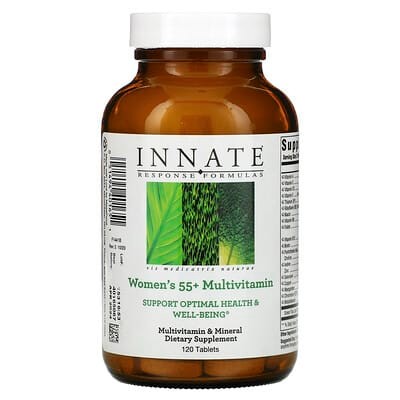
Women's 55+ Multivitamin

Goals
$44.99 $0.74 per serving


Product analysis
Women's 55+ Multivitamin supplies nutrients that support normal skin, nerve and metabolic functions, with benefits most relevant when intake is low. Several forms are unspecified, making the complete formula harder to compare.
AI assessment of the formula, label and price. How scoring works
Nutrient Quality37
Many ingredient forms are identified, including the choline source, but comparative quality across most of the formula remains uncertain. Unspecified vitamin forms and a nonspecific molybdenum source further limit a complete comparison.
Ingredient Transparency95
All listed amounts and most forms are disclosed, making much of the label straightforward. Vitamin C, vitamin D and green tea preparation details remain unspecified.
Value For Money40
Choline and chromium are relatively expensive, while biotin and molybdenum have middling value. Most other comparisons remain uncertain, so the complete formula has no clear demonstrated cost advantage.
Customer Satisfaction73
Customer feedback is very positive from a modest review pool. Those ratings describe satisfaction without establishing benefits specific to older women.
Product Focus42
The formula supplies nutrients used in normal skin, nerve and metabolic functions. Its numerous ingredients make it broader than a targeted supplement, and extra benefit depends on nutritional need.
- Format
Tablet - Container
- 120 Tablet(s)
- Per serving
- $0.74
- Customer rating
- 4.7 · 202 ratings
Goals

Impact
High effect
Folate · 340 mcg DFEVitamin B12 · 20 mcgVitamin B6 · 6 mgMolybdenum · 60 mcgSelenium · 50 mcgVitamin E · 15 mgZinc · 15 mgVitamin C · 100 mgCholine · 200 mgRiboflavin · 2.6 mg
Riboflavin Not classified
No linked studies yet.
Vitamin B6 Not classified
No linked studies yet.

Impact
Moderate effect
Choline · 200 mgThiamin · 2 mgVitamin B6 · 6 mgFolate · 340 mcg DFEVitamin B12 · 20 mcgVitamin D · 25 mcgGreen Tea · 250 mg

Impact
High effect
Folate · 340 mcg DFEVitamin B12 · 20 mcgVitamin D · 25 mcgGreen Tea · 250 mg

Impact
High effect
Zinc · 15 mgVitamin C · 100 mgCopper · 0.2 mcgSelenium · 50 mcgGreen Tea · 250 mgVitamin E · 15 mg

Impact
Moderate effect
Vitamin D · 25 mcgVitamin E · 15 mgVitamin C · 100 mgGreen Tea · 250 mg
Ingredients
| Ingredient | Amount per serving | Score |
|---|---|---|
Vitamin A (Beta Carotene) | 360 mcg RAE | |
Vitamin C (organic Orange) | 100 mg | |
Vitamin D3 (S. cerevisiae) | 25 mcg | |
Vitamin E (D-Alpha-Tocopherol) | 15 mg | |
Thiamin (Thiamine HCl) | 2 mg | |
Riboflavin (Riboflavin 5'-Phosphate Sodium) | 2.6 mg | |
Niacin (Niacinamide, S. cerevisiae) | 20 mg NE | |
Vitamin B6 (Pyridoxal 5-Phosphate) | 6 mg | |
Folate (L-5-MTHF) | 340 mcg DFE | |
Vitamin B12 (Methylcobalamin) | 20 mcg | |
Biotin (Brown Rice) | 300 mcg | |
Pantothenic Acid (Calcium D-Pantothenate) | 8 mg | |
Choline (Choline Bitartrate) | 200 mg | |
Iodine (S. cerevisiae) | 50 mcg | |
Zinc (Rice Amino Acid Chelate) | 15 mg | |
Selenium (S. cerevisiae) | 50 mcg | |
Copper (S. cerevisiae) | 0.2 mcg | |
Manganese (S. cerevisiae) | 1 mg | |
Chromium (S. cerevisiae) | 120 mcg | |
Molybdenum (S. cerevisiae) | 60 mcg | |
Green Tea leaf extract | 250 mg |
Choline (Choline Bitartrate) · 200 mg OverallScore62
200 mg of choline per serving comes at a high cost for the amount. Choline bitartrate is a standard form used for systemic support.
How this ingredient is rated
Active Ingredient Quality & Bioavailability68
Choline bitartrate is a standard form used for systemic support. The formula includes processing aids.
Choline Form Efficacy & Bioavailability
Choline bitartrate is a standard form used for systemic support.
Formula Purity & Excipient Quality
The formula includes processing aids.
Dose, Safety & Label Transparency77
Each serving supplies 200 mg of choline. The bitartrate source is named.
Choline Dose by Declared Basis
Each serving supplies 200 mg of choline.
Elemental Yield Transparency
The choline amount and its bitartrate source are stated.
Value20
The cost per 100 mg of choline is high.
Price per 100 mg of Declared Choline Basis
The cost per 100 mg of choline is high.
Biotin (Brown Rice) · 300 mcg OverallScore59
Each serving provides 300 mcg of biotin, a modest amount for hair and nail support. The cost also covers other vitamins and minerals, so the biotin-only cost overstates its cost. The label does not specify the biotin isomer.
How this ingredient is rated
Active Ingredient Quality & Bioavailability82
The label names biotin but does not specify its isomer. No artificial colors or sweeteners are reported.
Biologically Active d-Biotin Isomer
The label names biotin but does not specify its isomer.
Excipient Purity
No artificial colors or sweeteners are reported.
Dose, Safety & Label Transparency36
300 mcg per serving is a modest amount for hair and nail support. The amount is clearly stated.
Biotin Potency for Health Goals
300 mcg per serving is a modest amount for hair and nail support.
Label Transparency & Exact Disclosure
The label states the biotin amount in micrograms.
Value60
The cost is shared with other vitamins and minerals, so a biotin-only cost would overstate its cost.
Price per 5,000 mcg Biotin
The cost is shared with other vitamins and minerals, so a biotin-only cost would overstate its cost.
Molybdenum (S. cerevisiae) · 60 mcg OverallScore36
It provides a modest 60 mcg of molybdenum per serving at a moderately high cost per serving. Its molybdenum form is unspecified.
How this ingredient is rated
Active Ingredient Quality & Bioavailability0
The molybdenum form is not specified in the available information. No branded molybdenum source is identified in the available information.
Molybdenum Chemical Form
The molybdenum form is not specified in the available information.
Branded or Patented Source
No branded molybdenum source is identified in the available information.
Dose, Safety & Label Transparency64
Each serving provides 60 mcg of molybdenum, below the adult upper limit. It is a modest amount.
Elemental Dose Optimization
The serving contains 60 mcg of molybdenum, a modest amount.
Upper Limit (UL) Safety Compliance
The 60 mcg per serving is below the adult upper limit of 2,000 mcg; total intake can include other sources.
Value50
The cost per serving is moderately high.
Price per Effective Serving
The cost per serving is moderately high.
Alternative products
Report alternatives
Sources
Published studies used for the product analysis and the top-ranked studies for each ingredient and goal.
- Cognitive improvement in mild to moderate Alzheimer's dementia after treatment with the acetylcholine precursor choline alfoscerate: a multicenter, double-blind, randomized, placebo-controlled trial.
- Association of dietary choline intake with incidence of dementia, Alzheimer disease, and mild cognitive impairment: a large population-based prospective cohort study.
- Choline intake during pregnancy and child cognition at age 7 years.
- Effects of choline alfoscerate on cognitive function and quality of life in type 2 diabetes: A double-blind, randomized, placebo-controlled trial.
- Maternal choline supplementation mitigates alcohol exposure effects on neonatal brain volumes.
- Effects of 6-Month Folic Acid Supplementation on Cognitive Function and Blood Biomarkers in Mild Cognitive Impairment: A Randomized Controlled Trial in China.
- Serum folate and B12 levels in association with cognitive impairment among seniors: results from the VELESTINO study in Greece and meta-analysis.
- B vitamins and prevention of cognitive decline and incident dementia: a systematic review and meta-analysis.
- Homocysteine and folate as risk factors for dementia and Alzheimer disease.
- Folate mediates cognitive impairment of aged people with periodontitis.
- Safety and efficacy of cognitive training plus epigallocatechin-3-gallate in young adults with Down's syndrome (TESDAD): a double-blind, randomised, placebo-controlled, phase 2 trial.
- Association between tea consumption and risk of cognitive disorders: A dose-response meta-analysis of observational studies.
- Investigating the Impact of Tea Consumption on Cognitive Function and Exploring Tea-Genetic Interactions in Older Adults Aged 65-105 Years: Findings from the 2002-2018 CLHLS Data.
- Consumption of green tea, but not black tea or coffee, is associated with reduced risk of cognitive decline.
- Green Tea Consumption and the Risk of Incident Dementia in Elderly Japanese: The Ohsaki Cohort 2006 Study.
- Thiamine supplementation holds neurocognitive benefits for breastfed infants during the first year of life.
- What is the impact of thiamine deficiency on cognitive function in patients with alcohol use disorder? - A systematic review.
- Association between dietary vitamin B1 intake and cognitive function among older adults: a cross-sectional study.
- Association of vitamin B1 intake with geriatric cognitive function: An analysis of the National Health and Nutrition Examination Survey (NHANES) from 2011 to 2014.
- A systematic review of treatments for alcohol-related cognitive impairment: lessons from the past and gaps for future interventions.