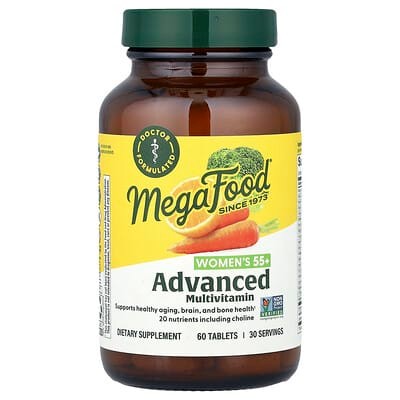
Multi for Women 55+

Multi for Women 55+

MegaFood4.8 (2,682 ratings)
Format:Tablet Quantity: 60 Tablet(s) · 30 servings
Goals
$26.99 $0.89 per serving

About this product

Everyday nutritional support is the main reason to consider the formula. Vitamin D at 25 mcg supports normal muscle function when status is low, while B12 contributes to normal nerve function. These roles do not establish extra cognitive or anti-aging benefits when nutritional needs are already met.

The 15 mg zinc serving uses bisglycinate, and molybdenum also has a clearly named chelated source. No iron is listed, which may suit someone who wants broad coverage without supplemental iron. Only 0.2 mg copper accompanies the zinc, while the 50 mcg iodine contribution is limited if iodine is a main dietary gap.

Green tea adds 250 mg of extract without stated EGCG, catechin or caffeine content. Its total extract weight cannot establish an alertness effect or a meaningful contribution to skin, immune or inflammation goals. Unclear chromium proportions and the relatively high cost for individual nutrient amounts further favor using it for broad gap coverage rather than a targeted result.

Who is it for
  • Women over 55 seeking broad nutrient coverage without listed iron
  • People with dietary gaps in vitamin D, B vitamins or zinc
Best for
  • Maintaining normal nutrient intake
  • Vitamin D and B12 support when dietary intake or status is low

Pros

  • Zinc uses the identified bisglycinate form
  • Vitamin D and B12 amounts are stated
  • No iron is listed for people who do not need supplemental iron

Cons

  • Green tea active-compound amounts are undisclosed
  • Copper is low relative to zinc
  • Iodine makes only a limited contribution
  • Chromium blend proportions are unknown
  • Relatively high cost for individual nutrient needs

Warnings

  • Green tea caffeine content is not stated, leaving suitability uncertain for people who need to avoid caffeine.
  • With 15 mg zinc and 0.2 mg copper, review total mineral intake before adding another zinc supplement.


Product analysis

56 out of 100

Multi for Women 55+ can help fill nutritional gaps and support normal immune function. Its benefits are clearest when it corrects low intake, with limited evidence of extra benefit once needs are met.

AI assessment of the formula, label and price. How scoring works

Nutrient Quality47

Several mineral forms are favorable, especially zinc and molybdenum. Many other ingredient qualities remain uncertain, and the chromium mixture proportions are unclear.

Ingredient Transparency76

Amounts and most forms are stated, helping you check much of the formula. Missing forms and undisclosed chromium proportions prevent a complete quality comparison.

Value For Money39

Value is mixed, with moderate biotin value but less favorable choline, zinc and chromium costs. Most other nutrient contributions remain uncertain for value.

Customer Satisfaction89

Customer ratings are strongly favorable across a substantial number of reviews. They describe satisfaction rather than establish health benefits.

Product Focus39

The main benefit is meeting nutritional needs, including nutrients involved in normal immune function. The broader detox, hair and hormone goals mostly depend on correcting low intake or on specific circumstances.

Format
Tablet
Container
60 Tablet(s)
Per serving
$0.89
Customer rating
4.8 · 2,682 ratings
Report analysis

Goals

Everyday Health
Impact
Highest effect
B Ingredient FitA+ PathwaysB+ EvidenceA+ Formulation Logic
Folate · 340 mcg DFEVitamin B12 · 20 mcgVitamin D · 25 mcgSelenium · 50 mcgZinc · 15 mgVitamin C · 100 mg
Study evidence
Folate Supportive 80 studies
Selenium Supportive 70 studies
Vitamin C Supportive 56 studies
Vitamin D Supportive 115 studies
Zinc Supportive 60 studies
Immunity
Impact
High effect
C- Ingredient FitB- PathwaysA+ EvidenceA+ Formulation Logic
Vitamin C · 100 mgZinc · 15 mgVitamin A · 360 mcg RAEVitamin D · 25 mcgSelenium · 50 mcg
Study evidence
Green Tea Not classified 2 studies
Selenium Mixed 37 studies
Vitamin A Supportive 107 studies
Vitamin C Supportive 53 studies
Vitamin D Supportive 85 studies
Vitamin E Supportive 21 studies
Zinc Supportive 73 studies
Impact
Moderate effect
C- Ingredient FitF PathwaysA+ EvidenceA+ Formulation Logic
Choline · 200 mgThiamin · 2 mgVitamin B6 · 6 mgFolate · 340 mcg DFEVitamin B12 · 20 mcgVitamin D · 25 mcgGreen Tea · 250 mg
Study evidence
Choline Supportive 76 studies
Folate Supportive 68 studies
Green Tea Supportive 32 studies
Thiamin Supportive 30 studies
Vitamin B6 Supportive 17 studies
Vitamin D Supportive 118 studies
Zinc Supportive 48 studies
Hair Health
Impact
Moderate effect
D+ Ingredient FitF PathwaysA+ EvidenceA+ Formulation Logic
Biotin · 300 mcgVitamin D · 25 mcgZinc · 15 mgVitamin C · 100 mg
Study evidence
Biotin Supportive 4 studies
Copper Adverse 4 studies
Folate Mixed 15 studies
Iodine No effect 1 study
Niacin Disputed 2 studies
Selenium Disputed 7 studies
Vitamin A Disputed 13 studies
Vitamin D Disputed 34 studies
Vitamin E No effect 3 studies
Zinc Supportive 22 studies
Impact
Moderate effect
D- Ingredient FitF PathwaysA EvidenceA+ Formulation Logic
Zinc · 15 mgVitamin D · 25 mcg
Study evidence
Selenium No effect 16 studies
Vitamin D Supportive 56 studies
Vitamin E Disputed 3 studies
Zinc Disputed 7 studies
Impact
High effect
D+ Ingredient FitD PathwaysA+ EvidenceA+ Formulation Logic
Folate · 340 mcg DFEVitamin B12 · 20 mcgVitamin B6 · 6 mgMolybdenum · 60 mcgSelenium · 50 mcgVitamin E · 14.7 mgZinc · 15 mgVitamin C · 100 mgCholine · 200 mgRiboflavin · 2.6 mg
Study evidence
Choline Supportive 6 studies
Folate Supportive 16 studies
Green Tea Disputed 16 studies
Selenium Supportive 10 studies
Vitamin C Supportive 9 studies
Vitamin E Supportive 23 studies
Zinc Supportive 30 studies

Ingredients

IngredientAmount per servingScore
Vitamin A (Beta Carotene)
360 mcg RAE
Vitamin C (organic Orange)
100 mg
Vitamin D3
25 mcg
Vitamin E (D-Alpha-Tocopherol)
14.7 mg
Thiamin (Thiamine Hydrochloride, S. cerevisiae)
2 mg
Riboflavin (riboflavin 5'-phosphate sodium, organic Brown Rice)
2.6 mg
Niacin (Niacinamide, S. cerevisiae)
20 mg NE
Vitamin B6 (Pyridoxal 5-Phosphate, organic Brown Rice)
6 mg
Folate (L-5-Methyltetrahydrofolate)
340 mcg DFE
Vitamin B12 (Methylcobalamin)
20 mcg
Biotin
300 mcg 59
Pantothenic Acid (Calcium D-Pantothenate)
8 mg
Choline (Choline Bitartrate)
200 mg 62
Iodine (fermented Iodine Glycinate)
50 mcg
Zinc (Zinc Bisglycinate)
15 mg 72
Selenium (Selenium Glycinate)
50 mcg
Copper (Copper Bisglycinate)
0.2 mg
Manganese (fermented Manganese Bisglycinate)
1 mg
Chromium (Chromium Nicotinate, fermented Chromium Glycinate, Glutamate)
120 mcg 38
Molybdenum (fermented Molybdenum Bisglycinate)
60 mcg 70
Green Tea extract
250 mg 8
Gluten Free Kosher Dairy Free Women 50+ Vegetarian
Report overview
A+ Active Ingredient Quality & BioavailabilityC Dose, Safety & Label TransparencyF Value
It provides 15 mg zinc per serving at a high cost per serving. It uses zinc bisglycinate. It also provides 0.2 mg copper.
How this ingredient is rated

Active Ingredient Quality & Bioavailability100

It uses zinc bisglycinate.
Zinc Form Bioavailability
It uses zinc bisglycinate.

Dose, Safety & Label Transparency64

15 mg of zinc per serving can support nutritional maintenance. The serving also contains 0.2 mg copper, giving a zinc-to-copper ratio of 75:1.
Elemental Dose Transparency
The label states the zinc amount and its source.
Zinc Dosage Safety & Effectiveness
15 mg of zinc per serving can support nutritional maintenance.
Zinc-to-Copper Mineral Balance
The serving also contains 0.2 mg copper, giving a zinc-to-copper ratio of 75:1.

Value30

The cost per serving is high.
Price Per Serving Efficiency
The cost per serving is high.
A- Active Ingredient Quality & BioavailabilityC Dose, Safety & Label TransparencyD+ Value
60 mcg of molybdenum per serving comes at a moderate cost per serving. The source is molybdenum bisglycinate. No branded molybdenum source is identified in the available information.
How this ingredient is rated

Active Ingredient Quality & Bioavailability85

The source is molybdenum bisglycinate. No branded molybdenum source is identified in the available information.
Molybdenum Chemical Form
The source is molybdenum bisglycinate.
Branded or Patented Source
No branded molybdenum source is identified in the available information.

Dose, Safety & Label Transparency64

The serving provides 60 mcg of molybdenum. That amount is below the adult upper intake level.
Elemental Dose Optimization
The serving provides 60 mcg of molybdenum.
Upper Limit (UL) Safety Compliance
That amount is below the adult upper intake level.

Value50

The cost per serving is moderate.
Price per Effective Serving
The cost per serving is moderate.
C+ Active Ingredient Quality & BioavailabilityB Dose, Safety & Label TransparencyF Value
Each serving provides 200 mg of choline, a moderate amount, and the cost is high for the amount of choline supplied. Choline bitartrate is a systemic form used for liver and general body support. The Other Ingredients panel indicates standard flow agents.
How this ingredient is rated

Active Ingredient Quality & Bioavailability68

Choline bitartrate is a systemic form used for liver and general body support. The Other Ingredients panel indicates standard flow agents.
Choline Form Efficacy & Bioavailability
Choline bitartrate is a systemic form used for liver and general body support.
Formula Purity & Excipient Quality
The Other Ingredients panel indicates standard flow agents.

Dose, Safety & Label Transparency77

The choline amount is stated as 200 mg per serving.
Choline Dose by Declared Basis
Each serving provides 200 mg of choline.
Elemental Yield Transparency
The amount of choline itself is stated.

Value20

The cost is high for the amount of choline supplied.
Price per 100 mg of Declared Choline Basis
The cost is high for the amount of choline supplied.
Report alternatives

Sources

Published studies used for the product analysis and the top-ranked studies for each ingredient and goal.

  1. Cognitive improvement in mild to moderate Alzheimer's dementia after treatment with the acetylcholine precursor choline alfoscerate: a multicenter, double-blind, randomized, placebo-controlled trial.
    De Jesus Moreno Moreno M · Clinical therapeutics · 2003
    Randomized trial261 participantsCognitive Support forCholine
  2. Association of dietary choline intake with incidence of dementia, Alzheimer disease, and mild cognitive impairment: a large population-based prospective cohort study.
    Niu YY; Yan HY; Zhong JF; Diao ZQ; Li J; Li CP; Chen LH; Huang WQ; Xu M; Xu ZT; Liang XF; Li ZH; Liu D · The American journal of clinical nutrition · 2025
    Cohort study125,594 participantsCognitive Support forCholine
  3. Choline intake during pregnancy and child cognition at age 7 years.
    Boeke CE; Gillman MW; Hughes MD; Rifas-Shiman SL; Villamor E; Oken E · American journal of epidemiology · 2013
    Cohort study895 participantsCognitive Support forCholine
  4. Effects of choline alfoscerate on cognitive function and quality of life in type 2 diabetes: A double-blind, randomized, placebo-controlled trial.
    Sohn M; Park YH; Lim S · Diabetes, obesity & metabolism · 2025
    Randomized trial36 participantsCognitive Support forCholine
  5. Maternal choline supplementation mitigates alcohol exposure effects on neonatal brain volumes.
    Warton FL; Molteno CD; Warton CMR; Wintermark P; Lindinger NM; Dodge NC; Zöllei L; van der Kouwe AJW; Carter RC; Jacobson JL; Jacobson SW; Meintjes EM · Alcoholism, clinical and experimental research · 2022
    Randomized trial52 participantsCognitive Support forCholine
  6. Effects of 6-Month Folic Acid Supplementation on Cognitive Function and Blood Biomarkers in Mild Cognitive Impairment: A Randomized Controlled Trial in China.
    Ma F; Wu T; Zhao J; Han F; Marseglia A; Liu H; Huang G · The journals of gerontology. Series A, Biological sciences and medical sciences · 2017
    Randomized trial180 participantsCognitive Support forFolate
  7. Serum folate and B12 levels in association with cognitive impairment among seniors: results from the VELESTINO study in Greece and meta-analysis.
    Michelakos T; Kousoulis AA; Katsiardanis K; Dessypris N; Anastasiou A; Katsiardani KP; Kanavidis P; Stefanadis C; Papadopoulos FC; Petridou ET · Journal of aging and health · 2013
    Meta-analysis8,122 participants9 studies pooledCognitive Support forFolate
  8. B vitamins and prevention of cognitive decline and incident dementia: a systematic review and meta-analysis.
    Wang Z; Zhu W; Xing Y; Jia J; Tang Y · Nutrition reviews · 2022
    Meta-analysis46,175 participants95 studies pooledCognitive Support forFolate
  9. Homocysteine and folate as risk factors for dementia and Alzheimer disease.
    Ravaglia G; Forti P; Maioli F; Martelli M; Servadei L; Brunetti N; Porcellini E; Licastro F · The American journal of clinical nutrition · 2005
    Cohort study816 participantsCognitive Support forFolate
  10. Folate mediates cognitive impairment of aged people with periodontitis.
    Liu F; Liu Y; Feng Y; Zhao J; Wang M; Ye M; Zhang Y; Gan X; Pan Q; Shen J · Nutritional neuroscience · 2025
    Cross-sectional study1,966 participantsCognitive Support forFolate
  11. Safety and efficacy of cognitive training plus epigallocatechin-3-gallate in young adults with Down's syndrome (TESDAD): a double-blind, randomised, placebo-controlled, phase 2 trial.
    de la Torre R; de Sola S; Hernandez G; Farré M; Pujol J; Rodriguez J; Espadaler JM; Langohr K; Cuenca-Royo A; Principe A; Xicota L; Janel N; Catuara-Solarz S; Sanchez-Benavides G; Bléhaut H; Dueñas-Espín I; Del Hoyo L; Benejam B; Blanco-Hinojo L; Videla S; Fitó M; Delabar JM; Dierssen M; TESDAD study group · The Lancet. Neurology · 2017
    Randomized trial87 participantsCognitive Support forGreen Tea
  12. Association between tea consumption and risk of cognitive disorders: A dose-response meta-analysis of observational studies.
    Liu X; Du X; Han G; Gao W · Oncotarget · 2018
    Meta-analysis48,435 participants17 studies pooledCognitive Support forGreen Tea
  13. Investigating the Impact of Tea Consumption on Cognitive Function and Exploring Tea-Genetic Interactions in Older Adults Aged 65-105 Years: Findings from the 2002-2018 CLHLS Data.
    Yu L; Yang M; Ye KX; Li C; Zou M; Wang J; Yuan X; Zheng D; Sun C; Zhang Y; Feng Q; Maier AB; Sun L; Feng L; Wang Y; Chen H; Zeng Y · The journal of prevention of Alzheimer's disease · 2024
    Cohort study76,270 participantsCognitive Support forGreen Tea
  14. Consumption of green tea, but not black tea or coffee, is associated with reduced risk of cognitive decline.
    Noguchi-Shinohara M; Yuki S; Dohmoto C; Ikeda Y; Samuraki M; Iwasa K; Yokogawa M; Asai K; Komai K; Nakamura H; Yamada M · PloS one · 2014
    Cohort study490 participantsCognitive Support forGreen Tea
  15. Green Tea Consumption and the Risk of Incident Dementia in Elderly Japanese: The Ohsaki Cohort 2006 Study.
    Tomata Y; Sugiyama K; Kaiho Y; Honkura K; Watanabe T; Zhang S; Sugawara Y; Tsuji I · The American journal of geriatric psychiatry : official journal of the American Association for Geriatric Psychiatry · 2018
    Cohort study13,645 participantsCognitive Support forGreen Tea
  16. Thiamine supplementation holds neurocognitive benefits for breastfed infants during the first year of life.
    Measelle JR; Baldwin DA; Gallant J; Chan K; Green TJ; Wieringa FT; Borath M; Prak S; Hampel D; Shahab-Ferdows S; Allen LH; Kroeun H; Whitfield KC · Annals of the New York Academy of Sciences · 2021
    Randomized trial335 participantsCognitive Support forThiamin
  17. What is the impact of thiamine deficiency on cognitive function in patients with alcohol use disorder? - A systematic review.
    Teixeira J; Pereira I; Castanho M; Simões do Couto F · European journal of internal medicine · 2025
    Systematic reviewCognitive Support forThiamin
  18. Association between dietary vitamin B1 intake and cognitive function among older adults: a cross-sectional study.
    Jia W; Wang H; Li C; Shi J; Yong F; Jia H · Journal of translational medicine · 2024
    Cross-sectional study2,422 participantsCognitive Support forThiamin
  19. Association of vitamin B1 intake with geriatric cognitive function: An analysis of the National Health and Nutrition Examination Survey (NHANES) from 2011 to 2014.
    Ji K; Sun M; Hong Y; Li L; Wang X; Li C; Yang S; Du W; Xu K; Zhou H · Heliyon · 2024
    Cross-sectional study2,896 participantsCognitive Support forThiamin
  20. A systematic review of treatments for alcohol-related cognitive impairment: lessons from the past and gaps for future interventions.
    Caballeria E; Oliveras C; Nuño L; Balcells-Oliveró M; Gual A; López-Pelayo H · Psychological medicine · 2021
    Systematic review26 studies pooledCognitive Support forThiamin