
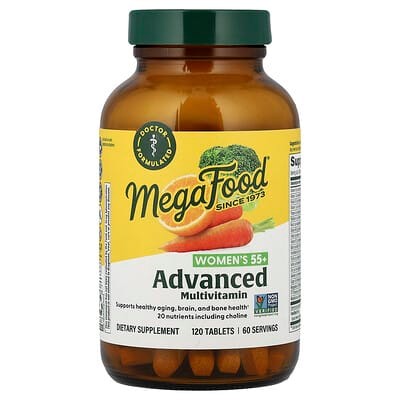

$50.99 $0.84 per serving


Product analysis
Multi for Women 55+ offers nutrients that may help maintain normal muscle, nerve and skin functions when intake is low. The broad mix may be less practical if you need only a few nutrients.
AI assessment of the formula, label and price. How scoring works
Nutrient Quality44
Most preparations are named, including choline and molybdenum, but many quality conclusions remain uncertain. Chromium source proportions are undisclosed, and the green tea preparation is unspecified.
Ingredient Transparency79
All listed amounts and nearly all forms are disclosed, helping identify the basic contents. The relative amounts of the chromium sources are not disclosed.
Value For Money40
Biotin and molybdenum offer moderate cost comparisons, while choline and chromium compare poorly. Most other ingredients lack a reliable value comparison.
Customer Satisfaction89
Customer ratings are generally positive across a substantial review base. The feedback does not establish effectiveness or safety.
Product Focus42
The strongest role is filling nutrient gaps that can affect muscle, nerve and skin functions. The broad mix does not establish slower aging or sharper thinking when nutrition is already adequate.
- Format
Tablet - Container
- 120 Tablet(s)
- Per serving
- $0.84
- Also available
 Multi for Women 55+$26.99
- Customer rating
- 4.7 · 5,647 ratings
Goals

Impact
High effect
Folate · 340 mcg DFEVitamin B12 · 20 mcgVitamin B6 · 6 mgMolybdenum · 60 mcgSelenium · 50 mcgVitamin E · 14.7 mgZinc · 15 mgVitamin C · 100 mgCholine · 200 mgRiboflavin · 2.6 mg
Folate participates in methyl-group metabolism, with arsenic-related findings limited to defined exposure and folate-status settings; they do not establish routine detoxification or equivalence of methylfolate. Choline has a limited nutritional role in maintaining liver function when intake is low. The other enzyme and antioxidant nutrient roles do not demonstrate increased toxin removal.
How this product is rated for Liver & Detox
Ingredient fit55
Vitamin B9 (Folate) is relevant to the saved ingredient finding. Small quantities of some ingredients were excluded from the main findings.
Goal fit
Relevant ingredients sit within a broader formula; other actives and links to other goals limit detoxification-specific focus.
Dose adequacy
Relevant declared amounts provide partial overall coverage; this amount comparison does not establish a clinical detoxification dose.
Pathways45
The strongest saved finding concerns the enzyme-support category. Coverage remains concentrated in one category.
Depth
The enzyme-support category has partial coverage. This finding does not measure toxin elimination.
Breadth
Detox-enzyme induction is the only category meeting the coverage threshold; gut binding does not contribute.
Evidence96
Vitamin B9 (Folate) leads the saved evidence finding. Its scientific context limits routine detoxification claims despite the recorded ingredient allowance.
Evidence strength
Folate leads this finding; arsenic studies depend on exposure, folate status and preparation, rather than demonstrating routine detoxification.
Studied preparation
Some ingredients lack studied preparation correspondence, including Molybdenum, Vitamin B2 (Riboflavin), Vitamin B6. Matching the others does not establish routine toxin clearance.
Formulation logic100
There is no unmet required partner or matched conflict. Included ingredients meet the amount threshold, which does not establish a combined toxin-removal effect.
Partner coverage
No required partner is missing in the saved findings. This does not establish added benefit from combining ingredients.
Conflicts
No configured conflict was matched. This limited finding does not establish general safety.
Effective doses
All ingredients included in this rule meet its saved amount threshold; previously excluded ingredients remain excluded. This is not a proven toxin-clearance threshold.
Riboflavin Not classified
No linked studies yet.
Vitamin B6 Not classified
No linked studies yet.

Impact
High effect
Zinc · 15 mgVitamin C · 100 mgCopper · 0.2 mgSelenium · 50 mcgGreen Tea · 250 mgVitamin E · 14.7 mg
Vitamin C supports collagen formation and wound healing when intake is low; added vitamin C has no established skin benefit when intake is adequate. Zinc supports skin repair in deficiency, without established extra benefit in adequately nourished adults. The B vitamins help prevent deficiency-related dermatitis; larger amounts do not establish further skin improvement.
How this product is rated for Skin Health
Ingredient fit56
Ingredients relevant to skin health sit within a broader formula with other active ingredients. The relevant declared amounts provide partial coverage of the saved exposure comparison.
Goal fit
Ingredients relevant to skin health sit within a broader formula with other active ingredients.
Dose adequacy
The relevant declared amounts provide partial coverage of the saved exposure comparison.
Pathways46
The strongest saved connection is to UV antioxidant defence. Coverage across other roles is limited.
Depth
The strongest saved connection is to UV antioxidant defence.
Breadth
The broader saved findings cover UV antioxidant defence. .
Evidence89
Green Tea leads the saved evidence finding. Accepted preparation matches do not remove the ingredient-specific limitations described above.
Evidence strength
Green Tea provides the leading evidence contribution in the saved comparison; its clinical limitations still apply.
Studied preparation
The saved finding accepts the preparations used for its included ingredients; it does not establish that every labelled preparation matches a clinical trial.
Formulation logic100
The saved checks find no missing required partner or configured conflict. The included amounts pass the minimum comparison screen.
Partner coverage
The included ingredients do not lack a required partner under the saved finding; this does not establish added benefit from combining them.
Conflicts
No configured ingredient conflict was triggered by the supplied facts.
Effective doses
All ingredients included in this amount screen meet its minimum comparison level; that level is not a proven effective dose.

Impact
Moderate effect
Vitamin D · 25 mcgVitamin E · 14.7 mgVitamin C · 100 mgGreen Tea · 250 mg
Vitamin D supports normal immune function, while selenium and zinc help antioxidant defenses and nutrient adequacy. Their inflammation-related value depends on nutritional status and context. The saved assessment records modest coverage of inflammatory signalling and oxidative stress, with no broad routine benefit implied.
How this product is rated for Inflammation
Ingredient fit46
Relevant ingredients sit alongside actives aimed at other needs, so the formula has a broader focus. The relevant amounts provide a partial match to the saved dose comparisons.
Goal fit
Relevant ingredients sit alongside actives aimed at other needs, so the formula has a broader focus.
Dose adequacy
The relevant amounts provide a partial match to the saved dose comparisons.
Pathways19
The strongest saved connection is inflammatory gene signalling (nf-kb), with limited coverage. None of the reviewed routes reaches the saved level for broad coverage.
Depth
The strongest saved connection is inflammatory gene signalling (nf-kb), with limited coverage.
Breadth
None of the reviewed routes reaches the saved level for broad coverage.
Evidence93
Vitamin D provides the strongest saved evidence at the assessed amount; its relevance remains dependent on the studied context. The preparations at the assessed amounts match those recognized in the saved review.
Evidence strength
Vitamin D provides the strongest saved evidence at the assessed amount; its relevance remains dependent on the studied context.
Studied preparation
The preparations at the assessed amounts match those recognized in the saved review.
Formulation logic100
The assessed ingredients can work independently or have their relevant partner. No ingredient conflicts were recorded in the supplied assessment. 4 of 4 assessed ingredients reach the saved amount threshold.
Partner coverage
The assessed ingredients can work independently or have their relevant partner.
Conflicts
No ingredient conflicts were recorded in the supplied assessment.
Effective doses
4 of 4 assessed ingredients reach the saved amount threshold.

Impact
High effect
Choline · 200 mgThiamin · 2 mgVitamin B6 · 6 mgFolate · 340 mcg DFEVitamin B12 · 20 mcgVitamin D · 25 mcgGreen Tea · 250 mg
Thiamin, niacin and folate help fill nutritional gaps whose deficiencies can impair memory and attention. Choline supplies a precursor for acetylcholine, and B6 supports neurotransmitter metabolism, but these normal roles do not establish enhanced cognition with adequate intake. The saved result also credits green tea, vitamin D and zinc despite limited routine cognitive findings. B12 receives no saved contribution because its amount is below the configured threshold.
How this product is rated for Cognitive Support
Ingredient fit58
The saved contributions span several nutrients and green tea, with partial amount coverage for most and no counted B12 contribution.
Goal fit
Numerous other actives and links to other goals reduce the formula's focus on cognition.
Dose adequacy
Niacin reaches its full saved amount anchor; most other counted ingredients receive partial coverage.
Pathways19
Green tea and choline populate the saved protection and acetylcholine categories, but neither reaches the pathway coverage threshold.
Depth
The protection category has the strongest saved coverage, below the threshold for a covered pathway.
Breadth
No evaluated pathway meets the saved coverage threshold; nutritional contributions are tracked separately.
Evidence100
B6 leads the saved evidence finding; normal nutrient functions and antioxidant mechanisms do not demonstrate broad cognitive improvement.
Evidence strength
B6 supplies the strongest saved evidence contribution, despite limited support for routine cognitive enhancement.
Studied preparation
All counted ingredients receive preparation recognition in the saved result.
Formulation logic100
No counted ingredient lacks a required partner, and no configured conflict was found.
Partner coverage
All counted ingredients satisfy the saved partner requirements.
Conflicts
None of the configured ingredient conflicts was matched.
Effective doses
Every counted ingredient passes the saved minimum amount threshold; B12 is excluded for its low amount.

Impact
High effect
Folate · 340 mcg DFEVitamin B12 · 20 mcgVitamin D · 25 mcgGreen Tea · 250 mg
Vitamin D can help preserve muscle function when deficiency causes weakness, while vitamin B12 can address neurological effects of deficiency. Vitamin C supports collagen formation and helps prevent skin fragility when intake is low. These nutritional roles do not establish slower aging when intake is adequate, and larger amounts do not demonstrate additional benefit.
How this product is rated for Longevity
Ingredient fit60
The relevant vitamins and minerals provide the main connection. The included amounts provide a partial match to reference exposures; this does not establish effective doses for slowing aging.
Goal fit
The relevant vitamins and minerals provide the main goal-related connection, within a formula also aimed at other health goals.
Dose adequacy
The included amounts provide a partial match to reference exposures; this does not establish effective doses for slowing aging.
Pathways60
The main connection concerns antioxidant processes; antioxidant activity alone does not establish slower aging. The main coverage is concentrated in one area rather than broad preservation of aging-related function.
Depth
The main connection concerns antioxidant processes; antioxidant activity alone does not establish slower aging.
Breadth
The main coverage is concentrated in one area rather than broad preservation of aging-related function.
Evidence83
Vitamin D leads the saved evidence comparison, but its functional benefit depends on correcting deficiency.
Evidence strength
Vitamin D leads the saved evidence comparison, but its functional benefit depends on correcting deficiency.
Studied preparation
The included preparations match the saved comparison, which does not establish equivalent aging-related outcomes or remove population limitations.
Formulation logic100
No missing required partner or configured conflict was identified. The included amounts meet the minimum exposure comparison.
Partner coverage
No missing required partner was identified; the combination does not establish an added anti-aging effect.
Conflicts
No configured ingredient conflict was identified in the supplied facts.
Effective doses
The included ingredients meet the minimum exposure comparison, which does not establish a proven anti-aging dose.
Ingredients
| Ingredient | Amount per serving | Score |
|---|---|---|
Vitamin A (Beta Carotene) | 360 mcg RAE | |
Vitamin C (Ascorbic Acid) | 100 mg | |
Vitamin D3 (Cholecalciferol) | 25 mcg | |
Vitamin E (D-Alpha-Tocopherol) | 14.7 mg | |
Thiamin (Thiamine Hydrochloride) | 2 mg | |
Riboflavin (riboflavin 5'-phosphate sodium, organic Brown Rice) | 2.6 mg | |
Niacin (Niacinamide, S. cerevisiae) | 20 mg NE | |
Vitamin B6 (Pyridoxal 5-Phosphate, organic Brown Rice) | 6 mg | |
Folate (L-5-Methyltetrahydrofolate) | 340 mcg DFE | |
Vitamin B12 (Methylcobalamin) | 20 mcg | |
Biotin | 300 mcg | |
Pantothenic Acid (Calcium D-Pantothenate) | 8 mg | |
Choline (Choline Bitartrate) | 200 mg | |
Iodine (Iodine Glycinate) | 50 mcg | |
Zinc (Zinc Bisglycinate) | 15 mg | |
Selenium (Selenium Glycinate) | 50 mcg | |
Copper (Copper Bisglycinate) | 0.2 mg | |
Manganese (Manganese Bisglycinate) | 1 mg | |
Chromium (Chromium Glutamate, Chromium Glycinate, Chromium Nicotinate) | 120 mcg | |
Molybdenum (Molybdenum Bisglycinate) | 60 mcg | |
Green Tea Leaf Extract | 250 mg |
Molybdenum (Molybdenum Bisglycinate) · 60 mcg OverallScore70
A serving lists 60 mcg of molybdenum as bisglycinate. The whole-product serving costs about $0.85.
How this ingredient is rated
Active Ingredient Quality & Bioavailability85
The declared form is molybdenum bisglycinate; the saved information does not identify a branded source.
Molybdenum Chemical Form
Molybdenum bisglycinate is the declared chemical form.
Branded or Patented Source
The saved information does not identify a branded molybdenum source.
Dose, Safety & Label Transparency64
A serving lists 60 mcg of molybdenum. The amount is within the evaluated upper limit for a serving; other sources can add to total intake.
Elemental Dose Optimization
The declared molybdenum amount is 60 mcg per serving.
Upper Limit (UL) Safety Compliance
The declared serving amount is within the evaluated upper limit; the assessment does not include molybdenum from other sources.
Value50
About $0.85 per whole-product serving pays for the entire product, including its other ingredients.
Price per Effective Serving
About $0.85 per whole-product serving is the basis of the price comparison, not a separate price for molybdenum.
Choline (Choline Bitartrate) · 200 mg OverallScore62
Each serving provides 200 mg of choline from choline bitartrate. The whole-product serving price works out to about $0.42 per 100 mg of choline.
How this ingredient is rated
Active Ingredient Quality & Bioavailability68
Choline Bitartrate is a standard source of choline. The evaluation notes standard flow agents.
Choline Form Efficacy & Bioavailability
Choline Bitartrate is a standard source of choline.
Formula Purity & Excipient Quality
The evaluation notes standard flow agents.
Dose, Safety & Label Transparency77
The serving provides 200 mg of choline, a moderate amount in the evaluation. The amount and source are both stated.
Choline Dose by Declared Basis
The serving provides 200 mg of choline, a moderate amount in the evaluation.
Elemental Yield Transparency
The choline amount and its source are both stated.
Value20
The whole-product serving price works out to about $0.42 per 100 mg of choline.
Price per 100 mg of Declared Choline Basis
The whole-product serving price works out to about $0.42 per 100 mg of choline.
Biotin · 300 mcg OverallScore59
A serving provides 300 mcg of biotin, a relatively small amount for the evaluation's hair and nail focus. It comes alongside other vitamins and minerals, and the label does not identify the biotin isomer.
How this ingredient is rated
Active Ingredient Quality & Bioavailability82
The label lists biotin without identifying its specific isomer. No artificial colors or sweeteners were flagged in the saved information.
Biologically Active d-Biotin Isomer
The label lists biotin without identifying its specific isomer.
Excipient Purity
No artificial colors or sweeteners were flagged; the added-sugar amount was not established.
Dose, Safety & Label Transparency36
The amount is clearly disclosed and is a relatively small amount for the evaluation's hair and nail focus.
Biotin Potency for Health Goals
The 300 mcg of biotin per serving is a relatively small amount for the evaluation's hair and nail focus.
Label Transparency & Exact Disclosure
The label specifies 300 mcg of biotin per serving.
Value60
At about $0.85 per serving, the price covers biotin alongside other vitamins and minerals.
Price per 5,000 mcg Biotin
The whole-product price works out to about $14.16 per 5,000 mcg of biotin; it also covers other vitamins and minerals.
Alternative products
Report alternatives
Sources
Published studies used for the product analysis and the top-ranked studies for each ingredient and goal.
- Cognitive improvement in mild to moderate Alzheimer's dementia after treatment with the acetylcholine precursor choline alfoscerate: a multicenter, double-blind, randomized, placebo-controlled trial.
- Association of dietary choline intake with incidence of dementia, Alzheimer disease, and mild cognitive impairment: a large population-based prospective cohort study.
- Choline intake during pregnancy and child cognition at age 7 years.
- Effects of choline alfoscerate on cognitive function and quality of life in type 2 diabetes: A double-blind, randomized, placebo-controlled trial.
- Maternal choline supplementation mitigates alcohol exposure effects on neonatal brain volumes.
- Effects of 6-Month Folic Acid Supplementation on Cognitive Function and Blood Biomarkers in Mild Cognitive Impairment: A Randomized Controlled Trial in China.
- Serum folate and B12 levels in association with cognitive impairment among seniors: results from the VELESTINO study in Greece and meta-analysis.
- B vitamins and prevention of cognitive decline and incident dementia: a systematic review and meta-analysis.
- Homocysteine and folate as risk factors for dementia and Alzheimer disease.
- Folate mediates cognitive impairment of aged people with periodontitis.
- Safety and efficacy of cognitive training plus epigallocatechin-3-gallate in young adults with Down's syndrome (TESDAD): a double-blind, randomised, placebo-controlled, phase 2 trial.
- Association between tea consumption and risk of cognitive disorders: A dose-response meta-analysis of observational studies.
- Investigating the Impact of Tea Consumption on Cognitive Function and Exploring Tea-Genetic Interactions in Older Adults Aged 65-105 Years: Findings from the 2002-2018 CLHLS Data.
- Consumption of green tea, but not black tea or coffee, is associated with reduced risk of cognitive decline.
- Green Tea Consumption and the Risk of Incident Dementia in Elderly Japanese: The Ohsaki Cohort 2006 Study.
- Thiamine supplementation holds neurocognitive benefits for breastfed infants during the first year of life.
- What is the impact of thiamine deficiency on cognitive function in patients with alcohol use disorder? - A systematic review.
- Association between dietary vitamin B1 intake and cognitive function among older adults: a cross-sectional study.
- Association of vitamin B1 intake with geriatric cognitive function: An analysis of the National Health and Nutrition Examination Survey (NHANES) from 2011 to 2014.
- A systematic review of treatments for alcohol-related cognitive impairment: lessons from the past and gaps for future interventions.