
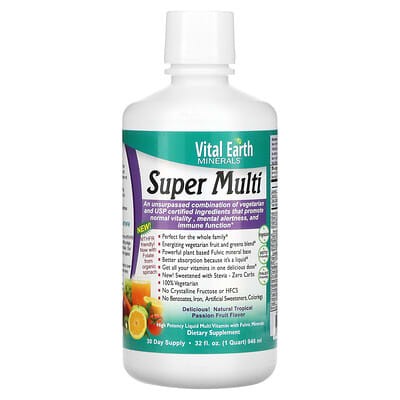

$36.99 $1.15 per serving


Product analysis
Super Multi offers broad vitamin and mineral support to help fill dietary gaps, including nutrients used in normal energy and immune function. Its many additions and undisclosed blends make it harder to judge which extras are useful.
AI assessment of the formula, label and price. How scoring works
Nutrient Quality47
Some nutrients have favorable identified forms, including vitamin B5, chromium and vitamin K. Missing form details and unclear blend contents prevent an equally clear view of the rest of the formula.
Ingredient Transparency66
Most amounts and many nutrient forms are listed, making the core vitamins and minerals easier to understand. Several combined ingredients and blends lack a complete breakdown.
Value For Money33
The serving is relatively costly when judged by several individual nutrient contributions, despite some favorable forms. The extras do not have clear enough value information to establish that the added cost is worthwhile.
Customer Satisfaction80
Customer feedback is broadly positive across a large number of ratings. The volume provides a wider picture of satisfaction without proving health benefits.
Product Focus9
Filling dietary gaps is the clearest purpose of the broad nutrient mix. Additional blends make the formula more complex, while benefits beyond adequate nutrition remain uncertain.
- Format
Liquid - Container
- 32 Fluid Ounce(s)
- Per serving
- $1.15
- Customer rating
- 4.6 · 1,032 ratings
Goals

Impact
Highest effect
Vitamin C · 400 mgZinc · 5 mgVitamin A · 1500 mcg RAEVitamin D · 25 mcgSelenium · 70 mcg

Impact
Highest effect
Folate · 400 mcg DFEVitamin B12 · 300 mcgVitamin D · 25 mcgVitamin K · 80 mcgBoron · 1 mgSelenium · 70 mcgZinc · 5 mgVitamin C · 400 mg

Impact
Moderate effect
Biotin · 300 mcgNiacin · 20 mg NEVitamin B12 · 300 mcgRiboflavin · 3.5 mgThiamin · 3 mgVitamin B5 · 21 mgVitamin B6 · 4 mgVitamin D · 25 mcgZinc · 5 mg

Impact
Moderate effect
Vitamin D · 25 mcgVitamin B5 · 21 mgRiboflavin · 3.5 mgThiamin · 3 mgVitamin B12 · 300 mcg
Vitamin B5 Not classified
No linked studies yet.

Impact
High effect
Biotin · 300 mcgVitamin D · 25 mcgZinc · 5 mgVitamin C · 400 mg

Impact
High effect
Vitamin K · 80 mcgVitamin D · 25 mcgManganese · 2 mgBoron · 1 mgZinc · 5 mgVitamin C · 400 mg
Ingredients
| Ingredient | Amount per serving | Score |
|---|---|---|
Calories | 2 Calorie(s) | |
Total Fat | 0 NP | |
Total Carbohydrates | 0 Gram(s) | |
Total Sugars | 0 Gram(s) | |
Vitamin A (Beta-Carotene) | 1500 mcg RAE | |
Vitamin C (Ascorbic Acid, Cassava, Tapioca) | 400 mg | |
Vitamin D3 (Cholecalciferol) | 25 mcg | |
Vitamin E (D-Alpha-Tocopherol Acetate, Sunflower) | 20 mg | |
Thiamine (Thiamine Hydrochloride) | 3 mg | |
Riboflavin | 3.5 mg | |
Niacinamide | 20 mg NE | |
Vitamin B6 (Pyridoxal 5-Phosphate, Pyridoxine Hydrochloride) | 4 mg | |
Vitamin B12 (Methylcobalamin) | 300 mcg | |
Biotin | 300 mcg | |
Pantothenic Acid (Calcium D-Pantothenate) | 21 mg | |
Choline (Choline Bitartrate) | 30 mg | |
Zinc (Zinc Picolinate) | 5 mg | |
Selenium (Selenium Amino Acid Chelate) | 70 mcg | |
Manganese (Manganese Glycinate Chelate) | 2 mg | |
Chromium (Chromium Polynicotinate) | 200 mcg | |
Folate (Spinach, Vitamin B9) | 400 mcg DFE | |
Vitamin K2 (Menaquinone-7) | 80 mcg | |
Inositol | 30 mg | |
Boron (Boron Glycinate) | 1 mg | |
Fulvic Acid | 9 mg | |
Fruit and Greens Blend | 100 mg | |
Golden Chlorella Amino Acid Blend | 50 mg |
Manganese (Manganese Glycinate Chelate) · 2 mg OverallScore66
Vitamin K (Menaquinone-7) · 80 mcg OverallScore66
Chromium (Chromium Polynicotinate) · 200 mcg OverallScore64
Each serving provides 200 mcg of chromium per serving, at a high cost for the chromium supplied. It uses Chromium Polynicotinate. The chromium amount is stated, but the compound weight is not separately specified.
How this ingredient is rated
Active Ingredient Quality & Bioavailability70
It uses Chromium Polynicotinate. No branded chromium source is specified.
Chromium Chemical Form
It uses Chromium Polynicotinate.
Branded & Trademarked Sources
No branded chromium source is specified.
Dose, Safety & Label Transparency85
Each serving provides 200 mcg of chromium per serving. The chromium amount is stated, but the compound weight is not separately specified.
Elemental Chromium Dosage
Each serving provides 200 mcg of chromium per serving.
Label Transparency & Disclosure
The chromium amount is stated, but the compound weight is not separately specified.
Value10
The cost is high for the chromium provided.
Price per 200 mcg Chromium
The cost is high for the chromium provided.
Alternative products
Report alternatives
Sources
Published studies used for the product analysis and the top-ranked studies for each ingredient and goal.
- [Comparative study of the urinary excretion of boron, calcium, magnesium and phosphorus in postmenopausal women with and without osteoporosis].
- Effect of dietary boron on mineral, estrogen, and testosterone metabolism in postmenopausal women.
- The relationship between boron and magnesium status and bone mineral density in the human: a review.
- Effects of boron supplementation on bone mineral density and dietary, blood, and urinary calcium, phosphorus, magnesium, and boron in female athletes.
- Metabolic responses of postmenopausal women to supplemental dietary boron and aluminum during usual and low magnesium intake: boron, calcium, and magnesium absorption and retention and blood mineral concentrations
- Association between RBC folate and lumbar bone mineral density in postmenopausal women, a cross-sectional study from NHANES 2009-2018.
- Genetic variants modify the associations of concentrations of methylmalonic acid, vitamin B-12, vitamin B-6, and folate with bone mineral density.
- Adequate Intake and Supplementation of B Vitamins, in Particular Folic Acid, can Play a Protective Role in Bone Health.
- Relation of homocysteine, folate, and vitamin B12 to bone mineral density of postmenopausal women.
- Dietary intake of folate, but not vitamin B2 or B12, is associated with increased bone mineral density 5 years after the menopause: results from a 10-year follow-up study in early postmenopausal women.
- Risk of Environmental Chemicals on Bone Fractures Is Independent of Low Bone Mass in US Adults: Insights from 2017 to 2018 NHANES.
- The Manganese-Bone Connection: Investigating the Role of Manganese in Bone Health.
- Associations of multiple metals with bone mineral density: A population-based study in US adults.
- Sex-specific associations of urinary mixed-metal concentrations with femoral bone mineral density among older people: an NHANES (2017-2020) analysis.
- Relationship between blood manganese and bone mineral density and bone mineral content in adults: A population-based cross-sectional study.
- Evaluating the Protective Role of Vitamin A Supplementation in Periodontal Health: A Comprehensive Systematic Review and Meta-Analysis.
- Dietary vitamin A intake and bone health in the elderly: the Rotterdam Study.
- Vitamin A and its dervatives effect on bone mineral density, a systematic review.
- Association of vitamins with bone mineral density and osteoporosis measured by dual-energy x-ray absorptiometry: a cross-sectional study.
- Association of dietary consumption and serum levels of vitamin A and β-carotene with bone mineral density in Chinese adults.