
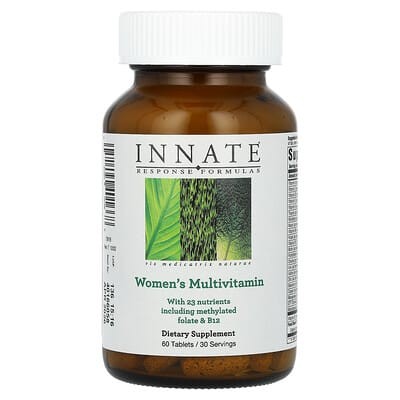

$27.20 $0.90 per serving


Product analysis
Women's Multivitamin supplies nutrients that can help fill dietary gaps and support normal energy use, blood formation and immune function. Undisclosed proportions in its vitamin K and chromium mixtures make parts of the composition harder to compare.
AI assessment of the formula, label and price. How scoring works
Nutrient Quality42
Natural vitamin E and methylfolate are favorable form choices, while several minerals are identified only by their yeast source. Those broad source names and missing vitamin preparations limit confidence in the complete formula.
Ingredient Transparency77
Amounts and most ingredient forms are disclosed, making much of the formula straightforward to compare. Vitamin C and D preparation details and the proportions within two mixtures remain unclear.
Value For Money36
Many ingredients are relatively costly at the full product price, including chromium, iron, iodine and choline. Vitamin D, biotin and molybdenum offer more moderate value, while several other comparisons remain uncertain.
Customer Satisfaction72
Customer ratings are positive, but the review base is modest. Broader feedback would give a firmer picture of satisfaction.
Product Focus22
The clearest role is filling dietary gaps that affect normal energy use, immune function and blood formation. The wide ingredient range and many health aims make it less focused on one particular need.
- Format
Tablet - Container
- 60 Tablet(s)
- Per serving
- $0.90
- Customer rating
- 4.8 · 72 ratings
Goals

Impact
Highest effect
Folate · 400 mcgVitamin B12 · 10 mcgVitamin D · 800 IUVitamin K · 80 mcgSelenium · 50 mcgZinc · 15 mgVitamin C · 100 mg

Impact
Moderate effect
Iodine · 150 mcgVitamin D · 800 IUVitamin B5 · 10 mgRiboflavin · 1.7 mgThiamin · 1.5 mgVitamin B12 · 10 mcgIron · 15 mgPotassium · 4 mg
Vitamin B5 Not classified
No linked studies yet.

Impact
Moderate effect
Vitamin C · 100 mgZinc · 15 mgVitamin A · 4000 IUVitamin D · 800 IUSelenium · 50 mcg

Impact
Moderate effect
Biotin · 300 mcgVitamin D · 800 IUZinc · 15 mgIron · 15 mgVitamin C · 100 mg

Impact
Moderate effect
Folate · 400 mcgVitamin B12 · 10 mcgVitamin B6 · 6 mgMolybdenum · 55 mcgSelenium · 50 mcgVitamin E · 30 IUZinc · 15 mgVitamin C · 100 mgCholine · 200 mgRiboflavin · 1.7 mg
Riboflavin Not classified
No linked studies yet.
Vitamin B6 Not classified
No linked studies yet.

Impact
Moderate effect
Zinc · 15 mgVitamin C · 100 mgCopper · 150 mcgSelenium · 50 mcgVitamin E · 30 IU
Ingredients
| Ingredient | Amount per serving | Score |
|---|---|---|
Vitamin A (Beta Carotene) | 4000 IU | |
Vitamin C (organic Orange) | 100 mg | |
Vitamin D3 (S. cerevisiae) | 800 IU | |
Vitamin E (D-Alpha-Tocopherol) | 30 IU | |
Vitamin K1/K2 (Vitamin K2) | 80 mcg | |
Thiamin (Thiamine HCl) | 1.5 mg | |
Riboflavin (Riboflavin 5'-Phosphate Sodium) | 1.7 mg | |
Niacin (Niacinamide, S. cerevisiae) | 20 mg | |
Vitamin B6 (Pyridoxal 5-Phosphate) | 6 mg | |
Folate (L-5-MTHF) | 400 mcg | |
Vitamin B12 (Methylcobalamin) | 10 mcg | |
Biotin (Brown Rice) | 300 mcg | |
Pantothenic Acid (Calcium D-Pantothenate) | 10 mg | |
Iron (S. cerevisiae) | 15 mg | |
Iodine (S. cerevisiae) | 150 mcg | |
Zinc (Rice Amino Acid Chelate) | 15 mg | |
Selenium (S. cerevisiae) | 50 mcg | |
Copper (S. cerevisiae) | 150 mcg | |
Manganese (S. cerevisiae) | 2 mg | |
Chromium (S. cerevisiae) | 100 mcg | |
Molybdenum (S. cerevisiae) | 55 mcg | |
Potassium (S. cerevisiae) | 4 mg | |
Choline (Choline Bitartrate) | 200 mg |
Folate (L-5-MTHF) · 400 mcg OverallScore84
The serving provides 400 mcg of folate at a higher cost per serving. It uses L-5-Methyltetrahydrofolate, an active form that bypasses the MTHFR conversion step.
How this ingredient is rated
Active Ingredient Quality & Bioavailability91
It uses L-5-Methyltetrahydrofolate, an active form that bypasses the MTHFR conversion step. The L designation indicates the active isomer.
Folate Form Hierarchy
It uses L-5-Methyltetrahydrofolate, an active form that bypasses the MTHFR conversion step.
Patented Sources & Isomeric Purity
The L designation indicates the active isomer.
Dose, Safety & Label Transparency100
The serving declares 400 mcg of folate.
Folate Dosage by Declared Basis
The serving declares 400 mcg of folate.
Value40
The cost per serving is higher.
Price per Bioavailable Serving
The cost per serving is higher.
Iodine (S. cerevisiae) · 150 mcg OverallScore68
The serving provides 150 mcg iodine at a high cost per serving, an amount consistent with daily thyroid maintenance. The chemical form of iodine is unknown.
How this ingredient is rated
Active Ingredient Quality & Bioavailability61
The chemical form of iodine is unknown. Marine-source purity is not applicable to the recorded source.
Iodine Form & Bioavailability
The chemical form of iodine is unknown.
Marine Source Purity & Sourcing
Marine-source purity is not applicable to the recorded source.
Dose, Safety & Label Transparency100
The serving states 150 mcg iodine, an amount consistent with daily thyroid maintenance. The 150 mcg serving is below the adult upper intake level.
Dosage Efficacy for Daily Support
150 mcg iodine per serving is an amount consistent with daily thyroid maintenance.
Dosage Safety & Upper Limits
The 150 mcg serving is below the adult upper intake level.
Elemental Iodine Transparency
The iodine amount per serving is stated.
Value20
The cost per serving is high.
Price Per Effective Serving
The cost per serving is high.
Choline (Choline Bitartrate) · 200 mg OverallScore62
200 mg of choline per serving comes at a high cost for the amount. Choline bitartrate is a standard form used for systemic support.
How this ingredient is rated
Active Ingredient Quality & Bioavailability68
Choline bitartrate is a standard form used for systemic support. The formula includes processing aids.
Choline Form Efficacy & Bioavailability
Choline bitartrate is a standard form used for systemic support.
Formula Purity & Excipient Quality
The formula includes processing aids.
Dose, Safety & Label Transparency77
Each serving supplies 200 mg of choline. The bitartrate source is named.
Choline Dose by Declared Basis
Each serving supplies 200 mg of choline.
Elemental Yield Transparency
The choline amount and its bitartrate source are stated.
Value20
The cost per 100 mg of choline is high.
Price per 100 mg of Declared Choline Basis
The cost per 100 mg of choline is high.
Alternative products
Report alternatives
Sources
Published studies used for the product analysis and the top-ranked studies for each ingredient and goal.
- The Association between Dietary and Circulating Copper Levels and Osteoporosis: a Scoping Review.
- Association between dietary copper, iron, zinc, selenium intake and osteopenia or osteoporosis in elderly hypertensive patients: a retrospective cohort study.
- Associations of dietary copper intake with total bone mineral density and lumbar spine bone mineral density in American adults.
- The association between dietary mineral intake and bone mineral density: a cross-sectional study.
- Association between dietary copper intake and bone mineral density in children and adolescents aged 8-19 years: A cross-sectional study.
- Association between RBC folate and lumbar bone mineral density in postmenopausal women, a cross-sectional study from NHANES 2009-2018.
- Genetic variants modify the associations of concentrations of methylmalonic acid, vitamin B-12, vitamin B-6, and folate with bone mineral density.
- Adequate Intake and Supplementation of B Vitamins, in Particular Folic Acid, can Play a Protective Role in Bone Health.
- Relation of homocysteine, folate, and vitamin B12 to bone mineral density of postmenopausal women.
- Dietary intake of folate, but not vitamin B2 or B12, is associated with increased bone mineral density 5 years after the menopause: results from a 10-year follow-up study in early postmenopausal women.
- Risk of Environmental Chemicals on Bone Fractures Is Independent of Low Bone Mass in US Adults: Insights from 2017 to 2018 NHANES.
- The Manganese-Bone Connection: Investigating the Role of Manganese in Bone Health.
- Associations of multiple metals with bone mineral density: A population-based study in US adults.
- Sex-specific associations of urinary mixed-metal concentrations with femoral bone mineral density among older people: an NHANES (2017-2020) analysis.
- Relationship between blood manganese and bone mineral density and bone mineral content in adults: A population-based cross-sectional study.
- Effect of potassium citrate on bone density, microarchitecture, and fracture risk in healthy older adults without osteoporosis: a randomized controlled trial.
- Long-term persistence of the urine calcium-lowering effect of potassium bicarbonate in postmenopausal women.
- Partial neutralization of the acidogenic Western diet with potassium citrate increases bone mass in postmenopausal women with osteopenia.
- Potassium citrate supplementation results in sustained improvement in calcium balance in older men and women.
- Effects of potassium chloride and potassium bicarbonate on endothelial function, cardiovascular risk factors, and bone turnover in mild hypertensives.