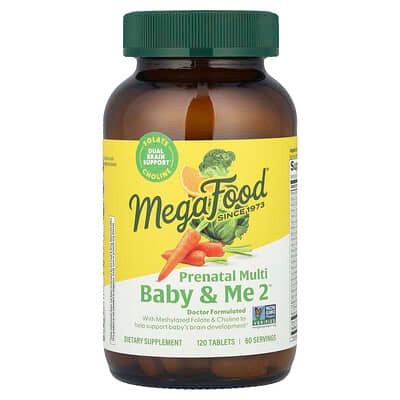
Baby & Me 2

Baby & Me 2

MegaFood4.8 (18,105 ratings)
Format:Tablet Quantity: 120 Tablet(s) · 60 servings
Goals
$55.99 $0.93 per serving

About this product

Iron, folate and B vitamins make dietary gap coverage the main reason to consider the formula. The 18 mg iron serving supports normal oxygen transport, while methylfolate and B12 contribute to normal blood formation. Extra energy or sharper attention is not established when nutrient needs are already met.

Iron and zinc use bisglycinate forms, and folate is identified as L-5-methyltetrahydrofolate. Choline at 300 mg adds a stated contribution from bitartrate, although that form has limited support for routine memory improvement. Calcium and DHA are absent from the ingredient list, leaving those parts of a prenatal nutrition plan to other sources.

The mineral balance is a limitation: 15 mg zinc is paired with just 0.2 mg copper. That is a zinc-heavy combination, although the suggested preferred proportions remain provisional. MK-7 is named at 30 mcg without isomer detail, and the full serving is relatively costly if the main aim is adding a single nutrient.

Who is it for
  • People building a prenatal nutrition routine who need iron, folate and choline
  • Adults with identified nutritional gaps that match the listed amounts
Best for
  • Nutritional support for normal blood formation
  • Combining stated choline with broad vitamin coverage

Pros

  • Iron bisglycinate is favored for absorption and stomach tolerance
  • Folate is identified as methylfolate
  • Choline source and amount are stated

Cons

  • Copper is low relative to the zinc contribution
  • Calcium and DHA are not listed
  • The MK-7 declaration lacks isomer detail
  • Expensive as a source of one isolated nutrient

Warnings

  • With 15 mg zinc and 0.2 mg copper, review total mineral intake before adding another zinc supplement.
  • Zinc in the same serving may compete with iron absorption, which matters when iron support is the main goal.


Product analysis

58 out of 100

Baby & Me 2 provides a broad mix of vitamins and minerals, including favorably characterized zinc and vitamin K forms. The formula is relatively costly when judged on several of its nutrient contributions.

AI assessment of the formula, label and price. How scoring works

Nutrient Quality47

Zinc bisglycinate and the presence of MK-7 give parts of the formula favorable form characteristics. Other nutrients are less fully characterized, and vitamins C and D omit their forms.

Ingredient Transparency87

Most forms and all listed amounts are disclosed, helping comparisons across the formula. The chromium source proportions remain unclear, and differing vitamin K declarations do not establish a single combined amount.

Value For Money37

Several nutrient contributions are relatively costly, including vitamin K, choline, iron and iodine. Biotin offers more moderate value, while many other nutrients lack enough cost information for a reliable comparison.

Customer Satisfaction93

Customer feedback is very positive across a substantial number of ratings. The ratings reflect satisfaction and do not establish effectiveness or safety.

Product Focus32

The broad nutrient mix appears reasonably aligned with its intended uses. Many ingredients and a wide range of uses make it less focused than a single-purpose supplement.

Format
Tablet
Container
120 Tablet(s)
Per serving
$0.93
Customer rating
4.8 · 18,105 ratings
Report analysis

Goals

Everyday Health
Impact
Highest effect
B Ingredient FitA+ PathwaysB+ EvidenceA+ Formulation Logic
Folate · 1020 mcg DFEVitamin B12 · 8 mcgVitamin D · 15 mcgVitamin K · 30 mcgSelenium · 50 mcgZinc · 15 mgVitamin C · 100 mg

The B vitamins contribute nutrients used in energy metabolism, while folate and B12 add to the formula's nutritional coverage. Vitamin D adds to nutrient availability, with usefulness depending on the total diet. Vitamin C and zinc contribute to nutritional adequacy rather than proven prevention of infections or chronic disease. Iron can help correct an intake shortfall associated with iron-deficiency anaemia.

How this product is rated for Everyday Health

Ingredient fit78

The ingredient focus and declared amounts provide a partial match to the saved references. The relevant roles remain limited to the specific outcomes described above.
Goal fit
The relevant ingredients are concentrated on this goal; their links to other uses also affect the saved focus finding.
Dose adequacy
The recognized amounts only partly match the saved references; these references do not define proven effective clinical doses.

Pathways100

The strongest saved finding concerns energy metabolism cofactors. The recognized breadth is limited across the other nutritional processes.
Depth
The strongest saved contribution concerns energy metabolism cofactors, describing ingredient roles rather than proven improvement in health.
Breadth
More than one pathway reaches the saved coverage threshold, without establishing benefits across every aging-related process.

Evidence82

Vitamin B9 (Folate) leads the saved evidence finding. The population, outcome and preparation limits described above still apply.
Evidence strength
Vitamin B9 (Folate) supplies the leading saved evidence finding, subject to its specific population and outcome limitations.
Studied preparation
The saved findings recognize preparation matches for qualifying ingredients, without extending the evidence to broader aging outcomes.

Formulation logic98

The recognized ingredients have their required partners or work independently, and no matched conflict was recorded. Amount limitations remain relevant.
Partner coverage
The recognized ingredients work independently or have their required partner; no extra combination benefit is established.
Conflicts
No matched ingredient conflict was recorded in the supplied calculation.
Effective doses
All recognized ingredients meet the saved amount threshold, a calculation reference rather than proof of general-health benefit.
Study evidence
Folate Supportive 80 studies
Selenium Supportive 70 studies
Vitamin C Supportive 56 studies
Vitamin D Supportive 115 studies
Vitamin K Supportive 34 studies
Zinc Supportive 60 studies
Hair Health
Impact
Moderate effect
C- Ingredient FitF PathwaysA+ EvidenceA+ Formulation Logic
Biotin · 300 mcgVitamin D · 15 mcgZinc · 15 mgIron · 18 mgVitamin C · 100 mg

Iron and zinc may help reduce shedding when low levels of these nutrients are the cause. They contribute to nutrient adequacy, rather than offering a general treatment for hair loss. Having several vitamins alongside them doesn't mean you'll grow more hair if you already get enough iron and zinc.

How this product is rated for Hair Health

Ingredient fit59

Several ingredients relate to hair nutrition, alongside ingredients with other roles.
Goal fit
Several ingredients relate to hair nutrition, alongside ingredients with other roles.
Dose adequacy
Vitamin B9 (Folate) 1020 mcg DFE, Iron 18 mg, Vitamin B3 (Niacin) 20 mg per selected serving; other nutrient amounts vary. These comparisons don't predict hair growth.

Pathways16

The main connection is to the building blocks or condition of hair fibres; this doesn't imply follicular regrowth.
Depth
The main connection is to the building blocks or condition of hair fibres; this doesn't imply follicular regrowth.
Breadth
The ingredient connections are concentrated in one hair-related process, with limited breadth across the others.

Evidence97

Zinc may help shedding caused by low zinc, rather than hair loss in everyone.
Evidence strength
Zinc may help shedding caused by low zinc, rather than hair loss in everyone.
Studied preparation
Most relevant nutrient forms have applicable context; iodine's hair effect remains uncertain.

Formulation logic97

The relevant ingredients have no identified missing partner or particular conflict.
Partner coverage
No required ingredient partner is missing for the relevant ingredients.
Conflicts
No particular ingredient conflict is identified.
Effective doses
Vitamin D's usable amount remains unresolved, despite a separately retained label declaration.
Study evidence
Biotin Supportive 4 studies
Copper Adverse 4 studies
Folate Mixed 15 studies
Iodine No effect 1 study
Iron Disputed 25 studies
Niacin Disputed 2 studies
Selenium Disputed 7 studies
Vitamin A Disputed 13 studies
Vitamin D Disputed 34 studies
Vitamin E No effect 3 studies
Zinc Supportive 22 studies
Impact
Moderate effect
C- Ingredient FitF PathwaysA+ EvidenceA+ Formulation Logic
Iodine · 150 mcgVitamin D · 15 mcgVitamin B5 · 10 mgRiboflavin · 1.7 mgThiamin · 1.5 mgVitamin B12 · 8 mcgIron · 18 mg

B vitamins support the normal conversion of food into usable energy. Folate and B12 also support normal blood formation. Benefits for tiredness are most relevant when intake is low; high amounts do not guarantee extra energy. Iron at 18 mg supports oxygen transport, with fatigue benefits most relevant when iron stores are low. Vitamin C contributes to normal nutrition, while iodine and vitamin D have roles in maintaining health rather than providing an immediate boost.

How this product is rated for Energy

Ingredient fit59

Several nutrients relate to energy metabolism and nutritional adequacy, alongside ingredients with other purposes. Amount coverage varies: some declared nutrients meet their saved references while others provide partial amounts.
Goal fit
Several nutrients relate to energy metabolism and nutritional adequacy, alongside ingredients with other purposes.
Dose adequacy
Amount coverage varies: some declared nutrients meet their saved references while others provide partial amounts.

Pathways0

The saved support concerns nutrient sufficiency, with no substantial direct alertness, muscle-energy or fatigue-resistance coverage.
Depth
The saved support concerns nutrient sufficiency, with no substantial direct alertness, muscle-energy or fatigue-resistance coverage.
Breadth
No direct energy route reaches the saved level for broad coverage.

Evidence97

Evidence is strongest for nutritional needs and selected low-status situations, rather than an extra energy boost for everyone.
Evidence strength
Iron provides the strongest saved evidence among the assessed ingredients, with benefits dependent on the relevant population and nutritional needs.
Studied preparation
Most assessed preparations are recognized in the saved review, while iodine is not identified as studied.

Formulation logic100

No missing required ingredient partner or configured conflict was found among the assessed ingredients.
Partner coverage
The assessed ingredients work independently or have their required partner.
Conflicts
No configured ingredient conflict was found in the supplied facts.
Effective doses
All ingredients counted for this finding meet the saved minimum amount.
Study evidence
Iodine Adverse 3 studies
Iron Supportive 74 studies
Thiamin Disputed 12 studies
Vitamin D Supportive 32 studies
Immunity
Impact
High effect
C- Ingredient FitA PathwaysA+ EvidenceA+ Formulation Logic
Vitamin C · 100 mgZinc · 15 mgVitamin A · 750 mcg RAEVitamin D · 15 mcgSelenium · 50 mcg

Zinc and vitamin D support normal immune-cell function, while vitamin A contributes to barrier defenses. Selenium supports normal immune function; folate, vitamins B6 and B12, copper help maintain immune-cell function when intake is low. These nutrient roles do not establish extra protection when intake is adequate.

How this product is rated for Immunity

Ingredient fit56

The formula includes nutrients relevant to normal immune function, alongside ingredients serving other purposes. Zinc, vitamin D and several other nutrients contribute, while vitamin C and copper fall below the saved amount requirement.
Goal fit
The formula includes nutrients relevant to normal immune function, alongside ingredients serving other purposes.
Dose adequacy
Zinc, vitamin D and several other nutrients contribute, while vitamin C and copper fall below the saved amount requirement.

Pathways92

The saved findings place the strongest contribution in lymphocyte function and immune regulation. Coverage is concentrated in barrier defenses, immune regulation and oxidative balance.
Depth
The strongest saved contribution concerns lymphocyte function and immune regulation; this describes ingredient roles rather than proven resistance to infection.
Breadth
The saved findings cover barrier defenses, immune regulation and oxidative balance, with less support across the remaining areas.

Evidence100

Zinc supplies the leading supported contribution. Nutrient-function evidence does not establish additional infection prevention.
Evidence strength
Zinc supplies the leading supported contribution; normal nutrient functions do not establish added protection when intake is adequate.
Studied preparation
The retained ingredients met the saved preparation check; this does not establish clinical superiority for the declared forms.

Formulation logic100

The retained ingredients need no missing partner under the supplied checks. Their counted amounts do not imply extra benefit from combining them.
Partner coverage
The retained ingredients can contribute without an additional partner under the supplied checks; no added benefit from combining them is established.
Conflicts
The supplied combination checks found no matching zinc conflict; this does not assess every possible interaction.
Effective doses
All retained contributors meet the saved minimum amount condition. That condition is a comparison rule, not proof of an effective clinical regimen.
Study evidence
Iron Supportive 23 studies
Selenium Mixed 37 studies
Vitamin A Supportive 107 studies
Vitamin C Supportive 53 studies
Vitamin D Supportive 85 studies
Vitamin E Supportive 21 studies
Zinc Supportive 73 studies
Impact
High effect
C- Ingredient FitD- PathwaysA+ EvidenceA+ Formulation Logic
Choline · 300 mgThiamin · 1.5 mgVitamin B6 · 8 mgFolate · 1020 mcg DFEVitamin B12 · 8 mcgVitamin D · 15 mcg

Iron can support attention, memory and processing speed when iron deficiency is corrected. Folate, thiamin, niacin and vitamin B12 also help address nutrient gaps associated with cognitive impairment, without establishing extra benefit when intake is adequate. Choline supplies a precursor for acetylcholine, but generic choline has not consistently improved memory in healthy adults. Vitamin B6 supports neurotransmitter metabolism without established routine enhancement.

How this product is rated for Cognitive Support

Ingredient fit57

choline, folate, thiamin and Vitamin B6 provide the main relevant connections. Their amounts provide a mixed match to the reference exposures.
Goal fit
choline, folate, thiamin and Vitamin B6 provide cognitive connections within a broader formula containing ingredients aimed at other goals.
Dose adequacy
The declared amounts give an uneven match to the reference exposures; lower or unresolved amounts limit the comparison.

Pathways43

The strongest connection is acetylcholine signalling, without establishing a clinical benefit from that mechanism alone. The main coverage is concentrated in one area rather than spanning several cognitive functions.
Depth
The strongest connection is acetylcholine signalling, without establishing a clinical benefit from that mechanism alone.
Breadth
The main coverage is concentrated in one area rather than spanning several cognitive functions.

Evidence100

Vitamin B6 leads the saved evidence comparison, but its normal metabolic roles do not establish routine cognitive improvement.
Evidence strength
Vitamin B6 provides the leading evidence connection among the included ingredients; its specific limitations still apply.
Studied preparation
The included ingredients have a preparation match in the saved comparison; this alone does not establish the same cognitive outcomes.

Formulation logic100

The included ingredients have no missing required partner or configured conflict. Their amounts meet the minimum exposure comparison.
Partner coverage
No missing required partner was identified for the included ingredients; this does not imply an extra benefit from combining them.
Conflicts
No configured ingredient conflict was identified in the supplied facts.
Effective doses
The included ingredients meet the minimum exposure comparison, which is not proof of an effective cognitive dose.
Study evidence
Choline Supportive 76 studies
Folate Supportive 68 studies
Thiamin Supportive 30 studies
Vitamin B6 Supportive 17 studies
Vitamin D Supportive 118 studies
Zinc Supportive 48 studies
Mental Focus
Impact
High effect
C Ingredient FitD- PathwaysB- EvidenceA+ Formulation Logic
Choline · 300 mgFolate · 1020 mcg DFEVitamin B6 · 8 mgVitamin D · 15 mcgVitamin B12 · 8 mcg

B12, folate, thiamin and niacin can support attention when inadequate intake causes deficiency-related concentration problems. Extra intake does not establish sharper focus in adequately nourished adults. Iron can help restore attention and concentration when iron status is low.

How this product is rated for Mental Focus

Ingredient fit63

The saved finding includes vitamin b4 (choline) among its relevant ingredients. Amounts make uneven contributions to the saved comparison; smaller or preparation-limited contributions reduce the overall match.
Goal fit
The relevant ingredients share the formula with actives serving other goals, limiting its focus.
Dose adequacy
Amounts make uneven contributions to the saved comparison; smaller or preparation-limited contributions reduce the overall match.

Pathways44

The strongest saved connection is cholinergic signalling. One pathway reaches the configured coverage threshold.
Depth
The strongest saved connection is cholinergic signalling.
Breadth
One pathway reaches the configured coverage threshold.

Evidence74

Vitamin B4 (Choline) leads the saved evidence finding. Preparation, population and outcome limits remain relevant to the practical benefit.
Evidence strength
Vitamin B4 (Choline) leads the saved evidence finding, while the supplied scientific context limits claims of acute focus enhancement.
Studied preparation
The saved finding recognizes the counted preparations; this does not establish a special form or delivery advantage.

Formulation logic100

The counted ingredients work alone or have the partner required by the configuration. No configured ingredient conflict was found.
Partner coverage
The counted ingredients work alone or have the partner required by the configuration.
Conflicts
No configured ingredient conflict was found.
Effective doses
All counted ingredients pass the configured amount threshold; it is not a proven effective dose.
Study evidence
Choline Supportive 22 studies
Folate Mixed 12 studies
Iodine No effect 17 studies
Iron Adverse 33 studies
Zinc Mixed 16 studies

Ingredients

IngredientAmount per servingScore
Vitamin A (Beta Carotene)
750 mcg RAE
Vitamin C (organic Orange)
100 mg
Vitamin D3
15 mcg
Vitamin E (D-Alpha-Tocopherol)
20 mg
Vitamin K (Phytonadione)
60 mcg 57
Thiamin (Thiamine Hydrochloride)
1.5 mg
Riboflavin (riboflavin 5'-phosphate sodium, organic Brown Rice)
1.7 mg
Niacin (Niacinamide, S. cerevisiae)
20 mg NE
Vitamin B6 (Pyridoxal 5-Phosphate, organic Brown Rice)
8 mg
Folate (L-5-Methyltetrahydrofolate)
1020 mcg DFE
Vitamin B12 (Methylcobalamin)
8 mcg
Biotin (organic Brown Rice)
300 mcg 59
Pantothenic Acid (Calcium D-Pantothenate)
10 mg
Choline (Choline Bitartrate)
300 mg 68
Iron (Iron Bisglycinate)
18 mg 69
Iodine (fermented Iodine Glycinate)
150 mcg 75
Zinc (Zinc Bisglycinate)
15 mg 72
Selenium (Selenium Glycinate)
50 mcg
Copper (Copper Bisglycinate)
0.2 mg
Manganese (fermented Manganese Bisglycinate)
1 mg
GTF Chromium (fermented Chromium Glycinate, Chromium Glutamate, Chromium Nicotinate)
50 mcg
Molybdenum (fermented Molybdenum Bisglycinate)
10 mcg
Vitamin K2 (Menaquinone-7, Cabbage)
30 mcg 57
Gluten Free Kosher Dairy Free Pregnant Vegetarian
Report overview
B Active Ingredient Quality & BioavailabilityA+ Dose, Safety & Label TransparencyF Value
Each serving supplies 150 mcg of iodine from an iodine amino acid chelate, an amount aligned with the evaluation’s daily-support criterion. A whole-product serving costs about $0.93.
How this ingredient is rated

Active Ingredient Quality & Bioavailability78

Iodine is listed as an iodine amino acid chelate. No marine source is recorded, so marine-specific sourcing is not assessed.
Iodine Form & Bioavailability
Iodine is listed as an iodine amino acid chelate.
Marine Source Purity & Sourcing
No marine source is recorded, so the marine-specific check does not apply; this does not establish that contaminants are absent.

Dose, Safety & Label Transparency100

The label records 150 mcg of iodine per serving, an amount aligned with the evaluation’s daily-support criterion. The general safety check flags no excess.
Dosage Efficacy for Daily Support
The 150 mcg serving aligns with the evaluation’s daily-support criterion.
Dosage Safety & Upper Limits
The evaluation flags no excess for the 150 mcg serving under its general safety check.
Elemental Iodine Transparency
The label records 150 mcg of iodine and its source per serving.

Value20

A whole-product serving costs about $0.93.
Price Per Effective Serving
A whole-product serving costs about $0.93.
A+ Active Ingredient Quality & BioavailabilityC Dose, Safety & Label TransparencyF Value
+2
Each serving provides 15 mg of zinc as bisglycinate, a favorably assessed form in this comparison. The serving has much more zinc than copper by weight, with 0.2 mg copper.
How this ingredient is rated

Active Ingredient Quality & Bioavailability100

Zinc bisglycinate is the named source and is assessed favorably for its form in this comparison.
Zinc Form Bioavailability
Zinc bisglycinate is the named source and is assessed favorably for its form in this comparison.

Dose, Safety & Label Transparency64

Each serving provides 15 mg zinc and 0.2 mg copper. Zinc greatly outweighs copper in the serving.
Elemental Dose Transparency
The label identifies both the 15 mg elemental zinc amount and its source form.
Zinc Dosage Safety & Effectiveness
Each serving supplies 15 mg of zinc.
Zinc-to-Copper Mineral Balance
The serving has 15 mg zinc and 0.2 mg copper, making the zinc-to-copper ratio high in this comparison.

Value30

A whole-product serving costs about $0.93; that price covers the entire serving.
Price Per Serving Efficiency
The whole-product serving costs about $0.93.
C+ Active Ingredient Quality & BioavailabilityA Dose, Safety & Label TransparencyF Value
Each serving provides 300 mg of choline from choline bitartrate, a substantial amount. The whole-product serving costs about $0.93, which is high relative to its choline content.
How this ingredient is rated

Active Ingredient Quality & Bioavailability68

Choline bitartrate is a standard source of choline for the body. The saved ingredient information indicates standard flow agents.
Choline Form Efficacy & Bioavailability
Choline bitartrate is a standard source of choline for the body.
Formula Purity & Excipient Quality
The saved ingredient information indicates standard flow agents.

Dose, Safety & Label Transparency91

Each serving provides 300 mg of choline and identifies choline bitartrate as its source.
Choline Dose by Declared Basis
Each serving supplies 300 mg of choline, a substantial amount.
Elemental Yield Transparency
The stated 300 mg is the choline amount, with choline bitartrate identified as its source.

Value20

Based on the whole-product serving price, the cost is about $0.31 per 100 mg of choline.
Price per 100 mg of Declared Choline Basis
Based on the whole-product serving price, the cost is about $0.31 per 100 mg of choline.
Report alternatives

Sources

Published studies used for the product analysis and the top-ranked studies for each ingredient and goal.

  1. Cognitive improvement in mild to moderate Alzheimer's dementia after treatment with the acetylcholine precursor choline alfoscerate: a multicenter, double-blind, randomized, placebo-controlled trial.
    De Jesus Moreno Moreno M · Clinical therapeutics · 2003
    Randomized trial261 participantsCognitive Support forCholine
  2. Association of dietary choline intake with incidence of dementia, Alzheimer disease, and mild cognitive impairment: a large population-based prospective cohort study.
    Niu YY; Yan HY; Zhong JF; Diao ZQ; Li J; Li CP; Chen LH; Huang WQ; Xu M; Xu ZT; Liang XF; Li ZH; Liu D · The American journal of clinical nutrition · 2025
    Cohort study125,594 participantsCognitive Support forCholine
  3. Choline intake during pregnancy and child cognition at age 7 years.
    Boeke CE; Gillman MW; Hughes MD; Rifas-Shiman SL; Villamor E; Oken E · American journal of epidemiology · 2013
    Cohort study895 participantsCognitive Support forCholine
  4. Effects of choline alfoscerate on cognitive function and quality of life in type 2 diabetes: A double-blind, randomized, placebo-controlled trial.
    Sohn M; Park YH; Lim S · Diabetes, obesity & metabolism · 2025
    Randomized trial36 participantsCognitive Support forCholine
  5. Maternal choline supplementation mitigates alcohol exposure effects on neonatal brain volumes.
    Warton FL; Molteno CD; Warton CMR; Wintermark P; Lindinger NM; Dodge NC; Zöllei L; van der Kouwe AJW; Carter RC; Jacobson JL; Jacobson SW; Meintjes EM · Alcoholism, clinical and experimental research · 2022
    Randomized trial52 participantsCognitive Support forCholine
  6. Effects of 6-Month Folic Acid Supplementation on Cognitive Function and Blood Biomarkers in Mild Cognitive Impairment: A Randomized Controlled Trial in China.
    Ma F; Wu T; Zhao J; Han F; Marseglia A; Liu H; Huang G · The journals of gerontology. Series A, Biological sciences and medical sciences · 2017
    Randomized trial180 participantsCognitive Support forFolate
  7. Serum folate and B12 levels in association with cognitive impairment among seniors: results from the VELESTINO study in Greece and meta-analysis.
    Michelakos T; Kousoulis AA; Katsiardanis K; Dessypris N; Anastasiou A; Katsiardani KP; Kanavidis P; Stefanadis C; Papadopoulos FC; Petridou ET · Journal of aging and health · 2013
    Meta-analysis8,122 participants9 studies pooledCognitive Support forFolate
  8. B vitamins and prevention of cognitive decline and incident dementia: a systematic review and meta-analysis.
    Wang Z; Zhu W; Xing Y; Jia J; Tang Y · Nutrition reviews · 2022
    Meta-analysis46,175 participants95 studies pooledCognitive Support forFolate
  9. Homocysteine and folate as risk factors for dementia and Alzheimer disease.
    Ravaglia G; Forti P; Maioli F; Martelli M; Servadei L; Brunetti N; Porcellini E; Licastro F · The American journal of clinical nutrition · 2005
    Cohort study816 participantsCognitive Support forFolate
  10. Folate mediates cognitive impairment of aged people with periodontitis.
    Liu F; Liu Y; Feng Y; Zhao J; Wang M; Ye M; Zhang Y; Gan X; Pan Q; Shen J · Nutritional neuroscience · 2025
    Cross-sectional study1,966 participantsCognitive Support forFolate
  11. Thiamine supplementation holds neurocognitive benefits for breastfed infants during the first year of life.
    Measelle JR; Baldwin DA; Gallant J; Chan K; Green TJ; Wieringa FT; Borath M; Prak S; Hampel D; Shahab-Ferdows S; Allen LH; Kroeun H; Whitfield KC · Annals of the New York Academy of Sciences · 2021
    Randomized trial335 participantsCognitive Support forThiamin
  12. What is the impact of thiamine deficiency on cognitive function in patients with alcohol use disorder? - A systematic review.
    Teixeira J; Pereira I; Castanho M; Simões do Couto F · European journal of internal medicine · 2025
    Systematic reviewCognitive Support forThiamin
  13. Association between dietary vitamin B1 intake and cognitive function among older adults: a cross-sectional study.
    Jia W; Wang H; Li C; Shi J; Yong F; Jia H · Journal of translational medicine · 2024
    Cross-sectional study2,422 participantsCognitive Support forThiamin
  14. Association of vitamin B1 intake with geriatric cognitive function: An analysis of the National Health and Nutrition Examination Survey (NHANES) from 2011 to 2014.
    Ji K; Sun M; Hong Y; Li L; Wang X; Li C; Yang S; Du W; Xu K; Zhou H · Heliyon · 2024
    Cross-sectional study2,896 participantsCognitive Support forThiamin
  15. A systematic review of treatments for alcohol-related cognitive impairment: lessons from the past and gaps for future interventions.
    Caballeria E; Oliveras C; Nuño L; Balcells-Oliveró M; Gual A; López-Pelayo H · Psychological medicine · 2021
    Systematic review26 studies pooledCognitive Support forThiamin
  16. Maternal Vitamin B12 Status During Pregnancy and Its Association With Outcomes of Pregnancy and Health of the Offspring: A Systematic Review and Implications for Policy in India.
    Behere RV; Deshmukh AS; Otiv S; Gupte MD; Yajnik CS · Frontiers in endocrinology · 2021
    Systematic review46 studies pooledCognitive Support forVitamin B12
  17. Effect of Maternal Vitamin B12 Supplementation on Cognitive Outcomes in South Indian Children: A Randomized Controlled Clinical Trial.
    Thomas S; Thomas T; Bosch RJ; Ramthal A; Bellinger DC; Kurpad AV; Duggan CP; Srinivasan K · Maternal and child health journal · 2019
    Randomized trial218 participantsCognitive Support forVitamin B12
  18. Effects of Folic Acid and Vitamin B12, Alone and in Combination on Cognitive Function and Inflammatory Factors in the Elderly with Mild Cognitive Impairment: A Single-blind Experimental Design.
    Ma F; Zhou X; Li Q; Zhao J; Song A; An P; Du Y; Xu W; Huang G · Current Alzheimer research · 2020
    Randomized trial240 participantsCognitive Support Productivity Boost forVitamin B12
  19. Vitamin B12 supplementation improves cognitive function in middle aged and elderly patients with cognitive impairment.
    Zhou L; Bai X; Huang J; Tan Y; Yang Q · Nutricion hospitalaria · 2023
    Randomized trial115 participantsCognitive Support Mental Focus forVitamin B12
  20. Prenatal vitamin B12 status and cognitive functioning in children at 4 years of age: The ECLIPSES Study.
    Cruz-Rodríguez J; Canals-Sans J; Hernández-Martínez C; Voltas-Moreso N; Arija V · Maternal & child nutrition · 2023
    Cohort study249 participantsCognitive Support forVitamin B12