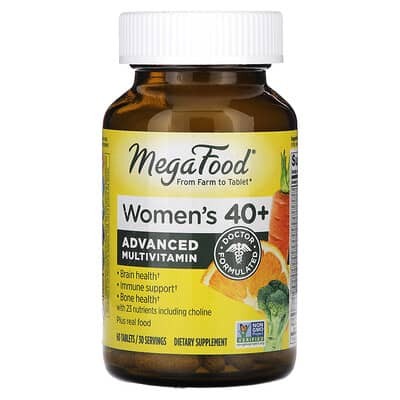
Multi for Women 40+

Multi for Women 40+

MegaFood4.7 (3,070 ratings)
Format:Tablet Quantity: 60 Tablet(s) · 30 servings
Goals

About this product

Daily nutritional support is the clearest fit, especially when the diet leaves gaps in B vitamins, zinc or vitamin D. Vitamin D at 25 mcg supports normal calcium absorption, while B vitamins contribute to normal energy use. Calcium is not listed, so the formula supplies only part of what matters for bone nutrition.

Iron bisglycinate provides a modest 9 mg contribution, making it more suited to adding to dietary intake than to substantial iron replacement. Zinc and manganese also use named bisglycinate forms. However, 15 mg zinc is paired with only 0.2 mg copper, leaving a zinc-heavy balance under the provisional guidance.

The 200 mg choline bitartrate listing does not establish the amount of choline itself in the supplied ingredient findings. K1 and MK-7 are separately named, but wider bone and cardiovascular claims remain uncertain, and chromium proportions are undisclosed. The relatively high serving cost is easier to justify for broad gap coverage than for a single nutrient or a promised focus or longevity benefit.

Who is it for
  • Women over 40 whose diet leaves several nutrient gaps
  • People seeking a modest iron contribution within a broader daily supplement
Best for
  • Supporting normal energy use when intake is low
  • Adding vitamin D for normal calcium absorption

Pros

  • Vitamin D amount is clearly stated
  • Iron bisglycinate is favored for absorption and stomach tolerance
  • Zinc and manganese use named chelated forms

Cons

  • Calcium is absent
  • Copper is low relative to zinc
  • Choline yield is unresolved from the compound-weight listing
  • Chromium blend proportions are missing
  • High cost for modest individual mineral amounts

Warnings

  • With 15 mg zinc and 0.2 mg copper, review total intake before combining it with more zinc.
  • Zinc in the same serving can compete with iron absorption; the 9 mg iron amount may not suit someone seeking substantial iron support.


Product analysis

58 out of 100

Multi for Women 40+ may help cover nutritional gaps that affect normal energy use, bone health and immune function. Its broad formula is more suited to general nutritional support than a single targeted need.

AI assessment of the formula, label and price. How scoring works

Nutrient Quality53

Several minerals use favourable forms, including zinc, manganese and molybdenum. Missing vitamin C and D forms and undisclosed chromium proportions limit a fuller quality comparison.

Ingredient Transparency87

Ingredient amounts and most forms are disclosed, making the formula reasonably easy to compare. Vitamin C and D forms are missing, and the chromium blend does not show its proportions.

Value For Money35

Several individual nutrient contributions are costly relative to comparable servings, so the formula is less compelling on price. Biotin and molybdenum offer more moderate value, while value remains uncertain for many other nutrients.

Customer Satisfaction86

Customer feedback is very positive. Thousands of ratings provide a broad base for judging satisfaction.

Product Focus28

The formula is broad nutritional support, with its clearest roles in everyday nutrition, bones and normal immune function. Its many ingredients and purposes make it less focused for someone seeking one specific benefit.

Format
Tablet
Container
60 Tablet(s)
Per serving
$1.00
Customer rating
4.7 · 3,070 ratings
Report analysis

Goals

Everyday Health
Impact
Highest effect
B Ingredient FitA+ PathwaysB+ EvidenceA+ Formulation Logic
Folate · 340 mcg DFEVitamin B12 · 12 mcgVitamin D · 25 mcgVitamin K · 40 mcgSelenium · 50 mcgZinc · 15 mgVitamin C · 100 mg

B vitamins contribute nutrients used in normal energy metabolism, while folate and B6 support normal blood formation and related metabolism. Zinc and selenium contribute to normal antioxidant and immune functions, and vitamin D supports mineral metabolism. These nutritional roles can help when intake is low; they do not establish extra benefits when intake is adequate. Vitamin K is present, but its usable combined amount remains unresolved.

How this product is rated for Everyday Health

Ingredient fit77

Relevant nutrients contribute to the goal, with the extent depending on their amounts and the focus of the formula.
Goal fit
The relevant ingredients fit the goal, although the product is also associated with other uses.
Dose adequacy
The relevant amounts provide uneven contributions, with some below the saved comparison endpoints or unresolved.

Pathways100

Normal energy metabolism is the strongest represented function; this does not imply increased energy. The saved findings span several distinct nutritional functions, rather than relying on one area alone.
Depth
Normal energy metabolism is the strongest represented function; this does not imply increased energy.
Breadth
The saved findings span several distinct nutritional functions, rather than relying on one area alone.

Evidence82

Vitamin B9 (Folate) leads the saved evidence finding; its role does not establish additional benefit when nutritional intake is adequate.
Evidence strength
Vitamin B9 (Folate) leads the saved evidence finding; its role does not establish additional benefit when nutritional intake is adequate.
Studied preparation
The counted preparations match the saved preparation finding, without establishing superiority of their chemical forms or delivery method.

Formulation logic98

The counted ingredients do not require an unsupported combination benefit, and no listed formulation conflict was triggered.
Partner coverage
The counted ingredients can contribute independently or have their relevant partners; this does not establish an added combination benefit.
Conflicts
No listed formulation conflict was triggered; this finding does not establish safety of the whole product.
Effective doses
Vitamin K falls below the saved amount threshold because its combined usable amount is unresolved; the other counted ingredients reach that threshold.
Study evidence
Folate Supportive 80 studies
Selenium Supportive 70 studies
Vitamin C Supportive 56 studies
Vitamin D Supportive 115 studies
Vitamin K Supportive 34 studies
Zinc Supportive 60 studies
Immunity
Impact
High effect
D+ Ingredient FitB PathwaysA+ EvidenceA+ Formulation Logic
Vitamin C · 100 mgZinc · 15 mgVitamin A · 525 mcg RAEVitamin D · 25 mcgSelenium · 50 mcg

Zinc and vitamin D support normal immune-cell function, while vitamin A contributes to protective barriers and selenium supports normal immune nutrition. Vitamins B6 and B12, folate and iron can help where low intake or deficiency impairs immune cells. The smaller vitamin C and copper amounts were not counted in the saved findings. These nutrient roles do not establish extra infection protection when intake is adequate.

How this product is rated for Immunity

Ingredient fit55

The formula contains several relevant immune nutrients alongside ingredients for broader nutritional goals. Some relevant nutrients are present below the amounts counted.
Goal fit
Immune-related nutrients share this formula with ingredients aimed at other nutritional goals.
Dose adequacy
Vitamin C and Copper fall below the amounts counted; the other credited ingredients provide differing contributions per serving.

Pathways75

The saved findings emphasize lymphocyte function and immune regulation. Coverage also spans the listed immune areas to differing degrees.
Depth
The strongest recorded coverage is lymphocyte function and immune regulation.
Breadth
The main recorded areas are lymphocyte function and immune regulation, oxidative and inflammatory balance.

Evidence100

Zinc anchors the strongest counted evidence. Its practical contribution remains bounded by the supplied nutrient-function or regular-use evidence.
Evidence strength
Zinc provides the strongest counted evidence here, subject to its nutrient-function or regular-use limitations.
Studied preparation
The saved findings recognize the counted preparations; this does not establish superiority over other forms or proven infection prevention.

Formulation logic100

The counted ingredients have no missing required partner or configured conflict, and their amounts meet the saved minimum comparison.
Partner coverage
The counted ingredients do not require an additional missing partner for their assigned roles.
Conflicts
No configured ingredient conflict was identified in the supplied findings.
Effective doses
All 9 counted ingredients meet the saved minimum amount comparison; this is not proof of clinical effectiveness.
Study evidence
Iron Supportive 23 studies
Selenium Mixed 37 studies
Vitamin A Supportive 107 studies
Vitamin C Supportive 53 studies
Vitamin D Supportive 85 studies
Vitamin E Supportive 21 studies
Zinc Supportive 73 studies
Impact
Moderate effect
C- Ingredient FitF PathwaysA+ EvidenceA+ Formulation Logic
Iodine · 150 mcgVitamin D · 25 mcgVitamin B5 · 10 mgRiboflavin · 2 mgThiamin · 2 mgVitamin B12 · 12 mcgIron · 9 mg

Thiamin, riboflavin, niacin, B5 and B6 support normal energy metabolism. Iron at 9 mg adds a possible role in covering intake needs associated with tiredness, while folate supports blood formation. The practical contribution depends on nutritional status rather than a guaranteed increase in energy.

How this product is rated for Energy

Ingredient fit58

Energy-related nutrients sit within a broader formula serving several health purposes. The assessed amounts provide partial alignment with the saved exposure comparisons.
Goal fit
Energy-related nutrients sit within a broader formula serving several health purposes.
Dose adequacy
The assessed amounts provide partial alignment with the saved exposure comparisons.

Pathways0

The saved findings identify no coverage of the specific energy mechanisms assessed; the nutritional roles remain relevant. None of the assessed mechanisms reaches the saved coverage threshold.
Depth
The saved findings identify no coverage of the specific energy mechanisms assessed; the nutritional roles remain relevant.
Breadth
None of the assessed mechanisms reaches the saved coverage threshold.

Evidence97

Iron provides the strongest saved evidence connection at the assessed amounts, without implying an energy benefit for every user. The preparation comparison is limited by Iodine, which is not matched to the relevant studied preparation.
Evidence strength
Iron provides the strongest saved evidence connection at the assessed amounts, without implying an energy benefit for every user.
Studied preparation
The preparation comparison is limited by Iodine, which is not matched to the relevant studied preparation.

Formulation logic100

The assessed ingredients can stand alone or have the required partner present. No configured ingredient conflicts were identified in the supplied findings. 10 of 10 assessed ingredients meet the saved minimum exposure comparison, which does not guarantee an effect.
Partner coverage
The assessed ingredients can stand alone or have the required partner present.
Conflicts
No configured ingredient conflicts were identified in the supplied findings.
Effective doses
10 of 10 assessed ingredients meet the saved minimum exposure comparison, which does not guarantee an effect.
Study evidence
Iodine Adverse 3 studies
Iron Supportive 74 studies
Thiamin Disputed 12 studies
Vitamin D Supportive 32 studies
Impact
Moderate effect
D Ingredient FitD- PathwaysA+ EvidenceA+ Formulation Logic
Folate · 340 mcg DFEVitamin B12 · 12 mcgVitamin B6 · 6 mgMolybdenum · 70 mcgSelenium · 50 mcgVitamin E · 20 mgZinc · 15 mgVitamin C · 100 mgCholine · 200 mgRiboflavin · 2 mg

Choline at 200 mg supports normal liver cell function and fat transport. Folate and B12 contribute to methyl-group metabolism, while selenium supports antioxidant enzymes. The contribution is mainly nutritional, without evidence of enhanced routine toxin removal in a nutrient-replete person.

How this product is rated for Liver & Detox

Ingredient fit47

The broad formula contains some ingredients relevant to liver-related nutrition. The amounts provide partial alignment with the saved exposure comparison.
Goal fit
The broad formula contains some ingredients relevant to liver-related nutrition.
Dose adequacy
The amounts provide partial alignment with the saved exposure comparison.

Pathways42

The strongest saved connection concerns detoxification-related enzymes. One mechanism has meaningful coverage; the findings are concentrated rather than broad.
Depth
The strongest saved connection concerns detoxification-related enzymes.
Breadth
One mechanism has meaningful coverage; the findings are concentrated rather than broad.

Evidence98

Folate provides the strongest assessed evidence contribution at its amount. Most of the assessed preparation evidence is matched, with Molybdenum and B6 remaining unmatched to a studied preparation.
Evidence strength
Folate provides the strongest assessed evidence contribution at its amount.
Studied preparation
Most of the assessed preparation evidence is matched, with Molybdenum and B6 remaining unmatched to a studied preparation.

Formulation logic100

6 of 6 assessed ingredients meet the saved minimum amount comparison. No assessed conflict was identified.
Partner coverage
The assessed ingredients can contribute independently or have their required partner.
Conflicts
No conflict was identified by the supplied ingredient checks.
Effective doses
6 of 6 assessed ingredients meet the saved minimum amount comparison.
Study evidence
Choline Supportive 6 studies
Folate Supportive 16 studies
Selenium Supportive 10 studies
Vitamin C Supportive 9 studies
Vitamin E Supportive 23 studies
Zinc Supportive 30 studies
Mental Focus
Impact
Moderate effect
C- Ingredient FitF PathwaysB- EvidenceA+ Formulation Logic
Choline · 200 mgFolate · 340 mcg DFEVitamin B6 · 6 mgVitamin D · 25 mcgVitamin B12 · 12 mcg

Choline at 200 mg supports acetylcholine signalling involved in attention and provides a partial contribution in the supplied comparison. Folate, B6, thiamin, niacin, iodine, zinc, iron and vitamin D add nutritional support for normal brain and nerve function; B12 contributes little at the declared 12 mcg.

How this product is rated for Mental Focus

Ingredient fit60

Attention-related ingredients sit alongside broader nutritional or other uses. The counted amounts provide partial support, with smaller or unresolved amounts limiting some contributions.
Goal fit
Attention-related ingredients sit alongside broader nutritional or other uses.
Dose adequacy
The counted amounts provide partial support, with smaller or unresolved amounts limiting some contributions.

Pathways16

The clearest support involves cholinergic signalling, with partial coverage in the saved findings. No specific attention mechanism reaches the saved coverage threshold.
Depth
The clearest support involves cholinergic signalling, with partial coverage in the saved findings.
Breadth
No specific attention mechanism reaches the saved coverage threshold.

Evidence74

Vitamin B4 (Choline) supplies the strongest relevant evidence at a counted amount, with benefits limited to the particular contexts and outcomes assessed. The preparations counted here match those recognized in the supplied evidence.
Evidence strength
Vitamin B4 (Choline) supplies the strongest relevant evidence at a counted amount, with benefits limited to the particular contexts and outcomes assessed.
Studied preparation
The preparations counted here match those recognized in the supplied evidence.

Formulation logic100

The counted ingredients can contribute independently or have their needed partner. No configured ingredient conflict was identified. All ingredients counted here reach a meaningful amount in the saved comparison.
Partner coverage
The counted ingredients can contribute independently or have their needed partner.
Conflicts
No configured ingredient conflict was identified.
Effective doses
All ingredients counted here reach a meaningful amount in the saved comparison.
Study evidence
Choline Supportive 22 studies
Folate Mixed 12 studies
Iodine No effect 17 studies
Iron Adverse 33 studies
Zinc Mixed 16 studies
Bone Health
Impact
High effect
C- Ingredient FitB+ PathwaysA+ EvidenceA+ Formulation Logic
Vitamin K · 40 mcgVitamin D · 25 mcgCopper · 0.2 mgManganese · 2 mgZinc · 15 mgVitamin C · 100 mg

Vitamin D supports calcium absorption and deficiency-related mineralization. This is the clearest bone-related contribution in a broad multivitamin whose zinc and manganese have normal cofactor roles without established extra bone benefit. The mixed vitamin K declaration leaves the MK-7 amount unresolved, so the preparation-specific bone-density findings cannot be assigned to it. The small copper amount also limits its contribution to collagen support.

How this product is rated for Bone Health

Ingredient fit56

Bone-related nutrients sit within a broader formula serving several nutritional purposes.
Goal fit
Bone-related nutrients sit within a broader formula serving several nutritional purposes.
Dose adequacy
Small or unresolved amounts limit some contributions, while the more substantial declared nutrients provide the main nutritional support.

Pathways80

Collagen-matrix roles are most represented, although nutrient cofactor functions do not establish extra bone benefit when intake is adequate.
Depth
Collagen-matrix roles are most represented, although nutrient cofactor functions do not establish extra bone benefit when intake is adequate.
Breadth
The represented areas are calcium absorption and regulation, collagen matrix formation. These roles do not by themselves establish fracture prevention.

Evidence98

Zinc has a normal bone-cell role, but the supplied evidence does not establish an independent adult bone-density or fracture benefit.
Evidence strength
Zinc has a normal bone-cell role, but the supplied evidence does not establish an independent adult bone-density or fracture benefit.
Studied preparation
The qualifying preparations are accepted in the supplied comparison, without implying that every nutrient has independently proven bone outcomes.

Formulation logic97

The supplied partner check leaves Vitamin D without its required companion; presence of the nutrient alone does not satisfy that check.
Partner coverage
The supplied partner check leaves Vitamin D without its required companion; presence of the nutrient alone does not satisfy that check.
Conflicts
No matching formulation conflict was identified in the supplied checks.
Effective doses
The qualifying ingredients meet the supplied minimum amount comparison, which does not establish a proven effective dose or fracture benefit.
Study evidence
Copper Disputed 20 studies
Folate Supportive 50 studies
Manganese Adverse 12 studies
Vitamin A Adverse 56 studies
Vitamin C Supportive 46 studies
Vitamin D Supportive 202 studies
Vitamin K Supportive 78 studies
Zinc Supportive 33 studies

Ingredients

IngredientAmount per servingScore
Vitamin A (Beta Carotene)
525 mcg RAE
Vitamin C (organic Orange)
100 mg
Vitamin D3
25 mcg
Vitamin E (D-Alpha-Tocopherol)
20 mg
Vitamin K (Phytonadione)
120 mcg 57
Thiamin (Thiamine Hydrochloride)
2 mg
Riboflavin (riboflavin 5'-phosphate sodium, organic Brown Rice)
2 mg
Niacin (Niacinamide, S. cerevisiae)
20 mg NE
Vitamin B6 (Pyridoxal 5-Phosphate, organic Brown Rice)
6 mg
Folate (L-5-Methyltetrahydrofolate)
340 mcg DFE
Vitamin B12 (Methylcobalamin)
12 mcg
Biotin
300 mcg 59
Pantothenic Acid (Calcium D-Pantothenate)
10 mg
Choline (Choline Bitartrate)
200 mg 62
Iron (Iron Bisglycinate)
9 mg 57
Iodine (fermented Iodine Glycinate)
150 mcg 75
Zinc (Zinc Bisglycinate)
15 mg 72
Selenium (Selenium Glycinate)
50 mcg
Copper (Copper Bisglycinate)
0.2 mg
Manganese (fermented Manganese Bisglycinate)
2 mg 78
GTF Chromium (Chromium Glutamate, Chromium Nicotinate, fermented Chromium Glycinate)
120 mcg 38
Molybdenum (fermented Molybdenum Bisglycinate)
70 mcg 70
Vitamin K2 (Menaquinone-7, Cabbage)
40 mcg 57
Gluten Free Vegan Kosher Dairy Free Vegetarian
Report overview
B Active Ingredient Quality & BioavailabilityA+ Dose, Safety & Label TransparencyF Value
Each serving provides 150 mcg iodine as iodine amino acid chelate. The evaluation considers the amount suitable for general daily support.
How this ingredient is rated

Active Ingredient Quality & Bioavailability78

The identified iodine form is iodine amino acid chelate.
Iodine Form & Bioavailability
The identified iodine form is iodine amino acid chelate.
Marine Source Purity & Sourcing
The evaluation does not identify a marine source, so the seaweed sourcing criterion does not apply.

Dose, Safety & Label Transparency100

The saved facts specify 150 mcg iodine per serving, and the amount falls within the evaluation’s adult safety benchmark.
Dosage Efficacy for Daily Support
The evaluation considers 150 mcg iodine per serving consistent with general daily support.
Dosage Safety & Upper Limits
The 150 mcg serving amount does not exceed the evaluation’s adult upper-limit benchmark; total intake is not assessed.
Elemental Iodine Transparency
The saved facts give an elemental iodine amount of 150 mcg per serving.

Value20

The whole-product serving costs about $1.00.
Price Per Effective Serving
The whole-product serving costs about $1.00.
A+ Active Ingredient Quality & BioavailabilityC Dose, Safety & Label TransparencyF Value
+2
Each serving provides 15 mg of zinc as zinc bisglycinate. Its 75:1 zinc-to-copper ratio is high in the evaluation, and the whole-product serving costs about $1.00.
How this ingredient is rated

Active Ingredient Quality & Bioavailability100

Zinc bisglycinate receives a favorable assessment for its form in this evaluation.
Zinc Form Bioavailability
Zinc bisglycinate receives a favorable assessment for its form in this evaluation.

Dose, Safety & Label Transparency64

The label identifies the zinc amount and source. The serving supplies 15 mg of zinc, an amount in a favorable category in this evaluation. The zinc-to-copper ratio is considered high in the evaluation.
Elemental Dose Transparency
The label identifies 15 mg of elemental zinc and names its source form.
Zinc Dosage Safety & Effectiveness
The serving supplies 15 mg of zinc, an amount in a favorable category in this evaluation.
Zinc-to-Copper Mineral Balance
The 75:1 zinc-to-copper ratio, based on 15 mg zinc and 0.2 mg copper, is considered high in the evaluation.

Value30

A whole-product serving costs about $1.00, at the higher end of this evaluation’s price categories.
Price Per Serving Efficiency
A whole-product serving costs about $1.00, at the higher end of this evaluation’s price categories.
A+ Active Ingredient Quality & BioavailabilityA- Dose, Safety & Label TransparencyF Value
Each serving provides 2 mg of manganese as manganese bisglycinate. A whole-product serving costs about $1.00.
How this ingredient is rated

Active Ingredient Quality & Bioavailability100

The recorded source is manganese bisglycinate.
Manganese Chemical Form
The recorded source is manganese bisglycinate.

Dose, Safety & Label Transparency86

The serving declares 2 mg of elemental manganese.
Manganese Dosage Efficacy & Safety
The serving declares 2 mg of elemental manganese.
Elemental Weight Disclosure
The serving declares 2 mg of elemental manganese.

Value20

A whole-product serving costs about $1.00.
Price per Serving vs. Median
A whole-product serving costs about $1.00.
Report alternatives

Sources

Published studies used for the product analysis and the top-ranked studies for each ingredient and goal.

  1. The Association between Dietary and Circulating Copper Levels and Osteoporosis: a Scoping Review.
    Ju Y; Xiong W; Pang Y; Chen Z; Hou J; Zheng S; Li Z; Liu T; Xia H; Xia M; Zhong Y; Li J; Jiang X · Biological trace element research · 2026
    Scoping review18 studies pooledBone Health forCopper
  2. Association between dietary copper, iron, zinc, selenium intake and osteopenia or osteoporosis in elderly hypertensive patients: a retrospective cohort study.
    Chen M; Jia L; Gao R · Frontiers in nutrition · 2024
    Cohort study5,286 participantsBone Health forCopper
  3. Associations of dietary copper intake with total bone mineral density and lumbar spine bone mineral density in American adults.
    Hu M; Wang Z; Li C; Zheng Y; Hu J · Medicine · 2025
    Cross-sectional studyBone Health forCopper
  4. The association between dietary mineral intake and bone mineral density: a cross-sectional study.
    Wei M; Wei J; Huang S · Journal of health, population, and nutrition · 2025
    Cross-sectional study11,520 participantsBone Health forCopper
  5. Association between dietary copper intake and bone mineral density in children and adolescents aged 8-19 years: A cross-sectional study.
    Cui A; Yan J; Li H; Fan Z; Wei X; Wang H; Zhuang Y · PloS one · 2024
    Cross-sectional study6,965 participantsBone Health forCopper
  6. Association between RBC folate and lumbar bone mineral density in postmenopausal women, a cross-sectional study from NHANES 2009-2018.
    Wei H; Jin Z; Zhou L; Tang G; Chai S; Che X; Tan Y; Zeng W · Frontiers in endocrinology · 2025
    Cross-sectional study1,315 participantsBone Health forFolate
  7. Genetic variants modify the associations of concentrations of methylmalonic acid, vitamin B-12, vitamin B-6, and folate with bone mineral density.
    Liu CT; Karasik D; Xu H; Zhou Y; Broe K; Cupples LA; Cpgm de Groot L; Ham A; Hannan MT; Hsu YH; Jacques P; McLean RR; Paul L; Selhub J; Trajanoska K; van der Velde N; van Schoor N; Kiel DP · The American journal of clinical nutrition · 2021
    Cohort study4,310 participantsBone Health forFolate
  8. Adequate Intake and Supplementation of B Vitamins, in Particular Folic Acid, can Play a Protective Role in Bone Health.
    Rondanelli M; Tartara A; Fossari F; Vecchio V; Faliva MA; Naso M; Perna S; Nichetti M; Peroni G · Current aging science · 2022
    Narrative review35,298 participants29 studies pooledBone Health forFolate Bone Health forVitamin B6
  9. Relation of homocysteine, folate, and vitamin B12 to bone mineral density of postmenopausal women.
    Cagnacci A; Baldassari F; Rivolta G; Arangino S; Volpe A · Bone · 2004
    Cross-sectional study161 participantsBone Health forFolate
  10. Dietary intake of folate, but not vitamin B2 or B12, is associated with increased bone mineral density 5 years after the menopause: results from a 10-year follow-up study in early postmenopausal women.
    Rejnmark L; Vestergaard P; Hermann AP; Brot C; Eiken P; Mosekilde L · Calcified tissue international · 2008
    Cohort study1,869 participantsBone Health forFolate
  11. Risk of Environmental Chemicals on Bone Fractures Is Independent of Low Bone Mass in US Adults: Insights from 2017 to 2018 NHANES.
    Ling R; Ai Y; Chen C; Zhang J; Zou Z; Cheng S; Li C; Li X; Wang B · Metabolites · 2023
    Cross-sectional study2,640 participantsBone Health forManganese
  12. The Manganese-Bone Connection: Investigating the Role of Manganese in Bone Health.
    Taskozhina G; Batyrova G; Umarova G; Issanguzhina Z; Kereyeva N · Journal of clinical medicine · 2024
    Narrative reviewBone Health forManganese
  13. Associations of multiple metals with bone mineral density: A population-based study in US adults.
    Wei MH; Cui Y; Zhou HL; Song WJ; Di DS; Zhang RY; Huang Q; Liu JA; Wang Q · Chemosphere · 2021
    Cross-sectional studyBone Health forManganese
  14. Sex-specific associations of urinary mixed-metal concentrations with femoral bone mineral density among older people: an NHANES (2017-2020) analysis.
    Li H; Li G; Yi M; Zhou J; Deng Y; Huang Y; He S; Meng X; Liu L · Frontiers in public health · 2024
    Cross-sectional study31 participantsBone Health forManganese
  15. Relationship between blood manganese and bone mineral density and bone mineral content in adults: A population-based cross-sectional study.
    Wang C; Zhu Y; Long H; Ou M; Zhao S · PloS one · 2022
    Cross-sectional study9,732 participantsBone Health forManganese
  16. Evaluating the Protective Role of Vitamin A Supplementation in Periodontal Health: A Comprehensive Systematic Review and Meta-Analysis.
    Luca MM; Buzatu R; Bumbu BA · Journal of clinical medicine · 2024
    Meta-analysisBone Health forVitamin A
  17. Dietary vitamin A intake and bone health in the elderly: the Rotterdam Study.
    de Jonge EA; Kiefte-de Jong JC; Campos-Obando N; Booij L; Franco OH; Hofman A; Uitterlinden AG; Rivadeneira F; Zillikens MC · European journal of clinical nutrition · 2016
    Cohort study5,288 participantsBone Health forVitamin A
  18. Vitamin A and its dervatives effect on bone mineral density, a systematic review.
    Khojah Q; AlRumaihi S; AlRajeh G; Aburas A; AlOthman A; Ferwana M · Journal of family medicine and primary care · 2022
    Systematic review8 studies pooledBone Health forVitamin A
  19. Association of vitamins with bone mineral density and osteoporosis measured by dual-energy x-ray absorptiometry: a cross-sectional study.
    Wang Q; Yu H; Kong Y · BMC musculoskeletal disorders · 2024
    Cross-sectional study1,536 participantsBone Health forVitamin A
  20. Association of dietary consumption and serum levels of vitamin A and β-carotene with bone mineral density in Chinese adults.
    Chen GD; Zhu YY; Cao Y; Liu J; Shi WQ; Liu ZM; Chen YM · Bone · 2016
    Cohort study3,154 participantsBone Health forVitamin A