
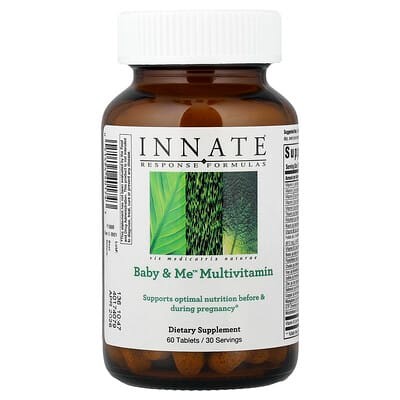
Baby & Me Multivitamin

Goals
$35.83 $1.19 per serving


Product analysis
Baby & Me Multivitamin provides broad nutritional support that may help with fatigue and concentration when nutrient intake is low. Extra nutrients do not reliably improve energy, hair growth or focus when intake is already adequate.
AI assessment of the formula, label and price. How scoring works
Nutrient Quality43
The vitamin K mixture includes a form with a favorable quality comparison, while choline has a more moderate comparison. Most other form-quality conclusions remain uncertain despite the detailed ingredient names.
Ingredient Transparency100
Amounts and forms are disclosed throughout the formula, making serving and ingredient comparisons easier. The vitamin K mixture has a breakdown, although its different declarations do not establish a combined total.
Value For Money41
Value varies by nutrient, with a favorable vitamin K comparison and more moderate comparisons for choline and iodine. The iron-based serving comparison is relatively expensive, while value for most other nutrients is uncertain.
Customer Satisfaction81
Customer feedback indicates high satisfaction. Nearly a thousand reviews provide a broad picture of buyer sentiment.
Product Focus49
The broad nutrient mix is most relevant to filling gaps that affect energy, concentration and normal function. Its range of potential uses does not establish extra benefits for someone already well nourished.
- Format
Tablet - Container
- 60 Tablet(s)
- Per serving
- $1.19
- Also available
 Baby & Me Multivitamin$74.99
- Customer rating
- 4.7 · 989 ratings
Goals

Impact
High effect
Iodine · 150 mcgVitamin D · 15 mcgVitamin B5 · 10 mgRiboflavin · 1.7 mgThiamin · 1.5 mgVitamin B12 · 8 mcgIron · 18 mg
Iron and folate can address nutrient gaps associated with anemia and fatigue, while vitamins C, B2, B5, B6 and niacin support nutritional adequacy. Thiamin supports normal carbohydrate metabolism without established extra energy in well-nourished adults. Vitamin D fatigue findings concern deficient adults. The higher nutrient amounts and named forms do not establish greater fatigue relief; B12 is below the saved inclusion threshold, and iodine has no unconditional energy benefit.
How this product is rated for Energy
Ingredient fit69
The relevant nutrients mainly address nutritional sufficiency. Amounts and the presence of other actives shape the saved findings.
Goal fit
Relevant ingredients sit within a broader formula containing ingredients without an assessed energy contribution.
Dose adequacy
The relevant amounts receive partial recognition overall; smaller amounts limit the saved findings without establishing ineffectiveness.
Pathways0
The saved findings identify no direct energy route among those evaluated. This does not remove the separate relevance of nutritional sufficiency.
Depth
No direct alertness, muscle-energy, mitochondrial, stress-fatigue or blood-flow contribution was found here.
Breadth
None of the evaluated direct energy routes reaches the required coverage; nutritional sufficiency is considered separately.
Evidence97
Iron drives this finding; fatigue benefits concern iron deficiency and selected low-ferritin populations.
Evidence strength
Iron drives this finding; fatigue benefits concern iron deficiency and selected low-ferritin populations.
Studied preparation
The saved findings accept most relevant preparations, with iodine unconfirmed against the studied preparation requirement.
Formulation logic100
No required partner is missing and no specified conflict was identified. Included ingredients satisfy the saved minimum amount requirement.
Partner coverage
The relevant ingredients do not require a missing partner in the saved findings.
Conflicts
No specified ingredient conflict was identified in the supplied facts.
Effective doses
Included ingredients pass the saved minimum amount requirement; B12 remains below it.
Vitamin B5 Not classified
No linked studies yet.

Impact
Highest effect
Biotin · 300 mcgVitamin D · 15 mcgZinc · 15 mgIron · 18 mgVitamin C · 100 mg
Zinc, iron and biotin can help address nutrient gaps associated with diffuse shedding, rather than reliably stimulating growth when intake is adequate. Folate supports cell division, while vitamin C supports collagen formation and iron absorption; neither role establishes an independent regrowth effect. Selenium contributes antioxidant biology, with uncertain routine hair benefit and potential hair loss from excess. Vitamin D has an association with hair-loss conditions, but that does not establish routine regrowth.
How this product is rated for Hair Health
Ingredient fit75
Zinc supplies a relevant connection to nutrient-related shedding. The formula has uneven amount support across its relevant nutrients.
Goal fit
Relevant hair nutrients sit within a broader formula, so the hair-related ingredients account for only part of its focus.
Dose adequacy
The relevant amounts provide substantial but uneven support in the saved comparison; some fall short of its reference amounts.
Pathways60
The strongest connection is antioxidant biology, chiefly through selenium and other relevant nutrients. Coverage across the other assessed hair pathways is limited.
Depth
Selenium and other relevant nutrients give the strongest connection to antioxidant biology, without establishing routine hair regrowth.
Breadth
Antioxidant support is the only substantially covered area; androgen signalling and stress regulation receive no contribution.
Evidence97
Zinc supplies the strongest relevant basis for deficiency-related shedding. Other normal nutrient functions and matching preparations do not establish routine regrowth.
Evidence strength
Zinc provides the strongest relevant basis, principally for deficiency-related shedding rather than routine growth when intake is adequate.
Studied preparation
Most contributing forms align with the saved preparation comparison; iodine does not. Preparation alignment alone does not demonstrate a hair outcome.
Formulation logic100
No missing required partners or configured conflicts were identified. The retained ingredients meet the saved minimum amount comparison, without implying synergy or a proven growth dose.
Partner coverage
No missing required partner was identified for the contributing ingredients; this does not imply an added benefit from combining them.
Conflicts
No configured ingredient conflict was identified among the assessed ingredients.
Effective doses
All ingredients retained in this finding reach its minimum amount comparison; that threshold is not a proven effective hair-growth dose.

Impact
Highest effect
Folate · 1020 mcg DFEVitamin B12 · 8 mcgVitamin B6 · 8 mgMolybdenum · 10 mcgSelenium · 50 mcgVitamin E · 20 mgZinc · 15 mgVitamin C · 100 mgCholine · 300 mgRiboflavin · 1.7 mg
Choline supports liver fat export, and the 600 mg per serving is substantial for the supplied nutritional comparison; higher amounts do not imply greater toxin clearance. Selenium supports antioxidant enzymes, with mercury findings limited to exposed or low-selenium adults. Folate supports methyl-group metabolism, but this methylfolate form cannot inherit the supplied folic-acid arsenic findings. Extra folate does not establish extra detoxification benefit.
How this product is rated for Liver & Detox
Ingredient fit67
The formula supplies nutrients connected with normal liver and enzyme functions, within a broader nutritional product. Their amounts support differing levels of nutritional comparison.
Goal fit
The formula includes relevant nutritional ingredients alongside ingredients serving other purposes, so its focus is broader than this goal.
Dose adequacy
The declared nutrient amounts contribute unevenly to the supplied comparisons; these reference amounts are not proven toxin-clearance doses.
Pathways80
Nutritional coverage is strongest for liver cell function and fat export. Other areas have varying coverage; these findings do not demonstrate toxin removal.
Depth
The strongest retained area is liver cell function and fat export, reflecting nutrient roles rather than demonstrated toxin removal.
Breadth
The retained areas are liver cell function and fat export, enzyme-related nutrition; this describes nutritional coverage, not proven clearance of toxins.
Evidence97
Folate leads the retained evidence comparison, with important limits around arsenic exposure, nutrient status and preparation. Some nutrient preparations lack a matching comparison.
Evidence strength
Folate provides the strongest retained support, but its arsenic findings are specific to exposure, nutrient status and preparation.
Studied preparation
Most retained ingredients match the supplied preparation comparisons; riboflavin, Vitamin B6 lack that match. This does not establish product-level toxin removal.
Formulation logic100
The retained contributions have no missing required partners or configured conflicts, and their amounts meet the supplied minimum comparison.
Partner coverage
No required ingredient partner is missing among the retained contributions; this does not establish an added benefit from combining them.
Conflicts
No configured ingredient conflict was identified in the supplied facts.
Effective doses
The retained ingredients meet the supplied minimum amount comparison; this is not a proven biological threshold for toxin clearance.
Riboflavin Not classified
No linked studies yet.
Vitamin B6 Not classified
No linked studies yet.

Impact
High effect
Choline · 300 mgThiamin · 1.5 mgVitamin B6 · 8 mgFolate · 1020 mcg DFEVitamin B12 · 8 mcgVitamin D · 15 mcg
Thiamin, folate, niacin and iron can help address low intake or deficiency that impairs memory and attention. B6 supports neurotransmitter metabolism, but supplementation has not established cognitive enhancement when nutrition is adequate. Choline supplies a neurotransmitter precursor, although choline-bitartrate trials in healthy young adults were null; its saved contribution does not establish improved memory.
How this product is rated for Cognitive Support
Ingredient fit68
The B vitamins supplies the relevant connection to cognition. The amount findings are mixed, with some ingredients receiving only partial recognition.
Goal fit
The B vitamins contributes to the cognitive focus, alongside ingredients intended for other purposes.
Dose adequacy
Several ingredient amounts receive partial recognition; the saved comparison does not imply extra benefit from amounts above nutritional needs.
Pathways59
The strongest recorded connection concerns acetylcholine signalling; precursor or enzyme activity alone does not establish better cognitive performance. Coverage is concentrated in this one area.
Depth
The strongest recorded connection concerns acetylcholine signalling; precursor or enzyme activity alone does not establish better cognitive performance.
Breadth
Only acetylcholine signalling reaches the saved coverage threshold, leaving the other named pathways uncovered.
Evidence100
B6 leads the saved evidence comparison, but its biochemical roles and the supplied trial do not establish routine cognitive enhancement.
Evidence strength
B6 leads the saved evidence comparison, but its biochemical roles and the supplied trial do not establish routine cognitive enhancement.
Studied preparation
The saved preparation finding recognizes the counted ingredients; form naming does not establish superior cognitive effects.
Formulation logic100
No configured conflict was identified in the supplied findings. B12 is excluded for its small amount.
Partner coverage
The counted ingredients have no unmet partner requirement in the supplied findings; that does not establish an added benefit from combining them.
Conflicts
No configured conflict was identified in the supplied findings.
Effective doses
All counted ingredients meet the saved minimum amount threshold; B12 falls below it and is excluded.

Impact
High effect
Iron · 18 mgVitamin B12 · 8 mcgVitamin B12 · 8 mcgVitamin B6 · 8 mgZinc · 15 mg
Iron can reduce fatigue and poor concentration when iron status is low, including before anaemia develops. Vitamin B12 and folate can address deficiency-related fatigue and concentration difficulties, without established extra productivity benefit when intake is adequate. Attention and memory findings do not establish better work output.
How this product is rated for Productivity Boost
Ingredient fit66
The relevant ingredients provide a partial connection to productivity, with amounts interpreted against the saved references.
Goal fit
Relevant ingredients sit within a broader formula, reducing its specific focus on productivity.
Dose adequacy
The counted ingredients meet the saved amount references to different extents.
Pathways55
The strongest saved connection is synaptic plasticity and neuroprotection, rather than demonstrated improvement in work output. One pathway reaches the saved coverage threshold, giving a narrow range of connections.
Depth
The strongest saved connection is synaptic plasticity and neuroprotection, rather than demonstrated improvement in work output.
Breadth
One pathway reaches the saved coverage threshold, giving a narrow range of connections.
Evidence91
Zinc leads the saved evidence finding. Specific trial populations, preparation differences and test outcomes limit translation to everyday work.
Evidence strength
Zinc provides the strongest saved evidence finding; its population and outcome limits still govern what benefit can be expected.
Studied preparation
The counted preparations match the saved preparation criteria, without establishing improved occupational productivity.
Formulation logic100
The counted ingredients meet partner and minimum-amount requirements, with no matched conflict recorded.
Partner coverage
The counted ingredients work alone or meet the saved partner requirements.
Conflicts
No matched conflict was recorded in the supplied calculation.
Effective doses
All counted ingredients meet the saved minimum amount threshold; this is not a proven clinical dose for better work output.

Impact
High effect
Choline · 300 mgFolate · 1020 mcg DFEVitamin B6 · 8 mgVitamin D · 15 mcgVitamin B12 · 8 mcg
Iron, folate, thiamin and niacin can address concentration problems caused by their respective deficiencies. Choline supports normal acetylcholine production, but precursor status does not establish acute focus enhancement. Zinc, iodine, vitamin B6 and vitamin D also have nutritional roles rather than proven immediate concentration benefits when intake is adequate. The B12 declaration receives little amount recognition in this saved comparison.
How this product is rated for Mental Focus
Ingredient fit72
Relevant amino acids and nutrients sit within a broader formula; nutritional functions remain distinct from demonstrated acute focus. Some declared amounts receive partial recognition.
Goal fit
Relevant amino acids and nutrients sit within a broader formula; nutritional functions remain distinct from demonstrated acute focus.
Dose adequacy
Some recognized ingredients receive partial amount recognition per serving; the comparison endpoints do not establish clinically effective focus doses.
Pathways60
The strongest recognized connection is acetylcholine-related functions; pathway coverage does not itself prove an attention benefit.
Depth
The strongest recognized connection is acetylcholine-related functions; pathway coverage does not itself prove an attention benefit.
Breadth
acetylcholine-related functions provides the substantial pathway coverage. Other biological roles do not establish additional acute effects.
Evidence74
Vitamin B4 (Choline) provides the strongest recognized evidence contribution; supplied preparation, population and duration limits still constrain the focus benefits that can be expected.
Evidence strength
Vitamin B4 (Choline) provides the strongest recognized evidence contribution; supplied preparation, population and duration limits still constrain the focus benefits that can be expected.
Studied preparation
The recognized ingredients meet the preparation check; this does not establish that every nutrient or formulation improves acute attention.
Formulation logic100
No recognized ingredient lacks a required partner; that does not establish added benefit from combining ingredients. No configured ingredient conflict was identified in the supplied facts.
Partner coverage
No recognized ingredient lacks a required partner; that does not establish added benefit from combining ingredients.
Conflicts
No configured ingredient conflict was identified in the supplied facts.
Effective doses
The recognized ingredients meet the amount threshold; this comparison convention does not establish a proven effective focus dose.
Ingredients
| Ingredient | Amount per serving | Score |
|---|---|---|
Vitamin A (Beta Carotene) | 750 mcg RAE | |
Vitamin C (organic Orange) | 100 mg | |
Vitamin D3 (Cholecalciferol) | 15 mcg | |
Vitamin E (D-Alpha-Tocopherol, organic Brown Rice) | 20 mg | |
Vitamin K1 (Phytonadione) | 60 mcg | |
Thiamin (Thiamine HCl) | 1.5 mg | |
Riboflavin (Riboflavin 5'-Phosphate Sodium) | 1.7 mg | |
Niacin (Niacinamide) | 20 mg NE | |
Vitamin B6 (Pyridoxal-5-Phosphate) | 8 mg | |
Folate (L-5-MTHF) | 1020 mcg DFE | |
Vitamin B12 (Methylcobalamin) | 8 mcg | |
Biotin | 300 mcg | |
Pantothenic Acid (Calcium D-Pantothenate) | 10 mg | |
Choline (Choline Bitartrate) | 300 mg | |
Iron (S. cerevisiae) | 18 mg | |
Iodine (S. cerevisiae) | 150 mcg | |
Zinc (Rice Amino Acid Chelate) | 15 mg | |
Selenium (S. cerevisiae) | 50 mcg | |
Copper (S. cerevisiae) | 0.2 mg | |
Manganese (S. cerevisiae) | 1 mg | |
Chromium (S. cerevisiae) | 50 mcg | |
Molybdenum (S. cerevisiae) | 10 mcg | |
Vitamin K2 (Menaquinone-7) | 30 mcg |
Iodine (S. cerevisiae) · 150 mcg OverallScore74
Each serving provides 150 mcg of iodine. The saved facts do not identify its chemical form, limiting comparisons of the form.
How this ingredient is rated
Active Ingredient Quality & Bioavailability61
The chemical form of iodine is not identified in the saved facts. No marine source is recorded, so the seaweed-specific sourcing criterion does not apply.
Iodine Form & Bioavailability
The chemical form of iodine is not identified in the saved facts.
Marine Source Purity & Sourcing
No marine source is recorded, so the seaweed-specific criterion does not apply; this does not establish the absence of contaminants.
Dose, Safety & Label Transparency100
A serving provides 150 mcg of iodine. The evaluation does not flag an exceeded iodine limit for this amount.
Dosage Efficacy for Daily Support
A serving provides 150 mcg of iodine.
Dosage Safety & Upper Limits
The evaluation does not flag an exceeded iodine limit for this amount.
Elemental Iodine Transparency
The iodine amount per serving is recorded, though the chemical form is not identified in the saved facts.
Value50
A whole-product serving costs about $0.60 and provides 150 mcg of iodine.
Price Per Effective Serving
A whole-product serving costs about $0.60 and provides 150 mcg of iodine.
Choline (Choline Bitartrate) · 300 mg OverallScore74
Each serving provides 300 mg of choline from choline bitartrate. The whole-product price corresponds to about $0.20 per 100 mg of choline, a moderate cost for the amount provided.
How this ingredient is rated
Active Ingredient Quality & Bioavailability68
Choline bitartrate is a standard form used for general choline support. The stored other-ingredients information indicates a flow agent.
Choline Form Efficacy & Bioavailability
Choline bitartrate is a standard systemic form, rated below forms favored for cognitive use in this evaluation.
Formula Purity & Excipient Quality
The stored other-ingredients information indicates a flow agent.
Dose, Safety & Label Transparency91
The label declares 300 mg of choline per serving and identifies choline bitartrate as its source.
Choline Dose by Declared Basis
A serving supplies 300 mg of choline.
Elemental Yield Transparency
The label specifies both the choline amount and its source.
Value50
The whole-product price corresponds to about $0.20 per 100 mg of choline, a moderate cost in this evaluation.
Price per 100 mg of Declared Choline Basis
Based on the whole-product serving price, 100 mg of choline corresponds to about $0.20.
Iron (S. cerevisiae) · 18 mg OverallScore44
Each serving provides 18 mg of iron. The available information does not establish the iron form, and zinc may compete with its absorption.
How this ingredient is rated
Active Ingredient Quality & Bioavailability0
The iron form is not established in the available information, and zinc may compete with iron absorption.
Iron Chemical Form & Bioavailability
The available information does not establish the iron form, so its absorption and tolerance cannot be compared by form.
Absorption Support & Blocker Avoidance
Vitamin C, B12 and folate are listed, but zinc may compete with iron absorption.
Dose, Safety & Label Transparency100
The iron amount is clearly stated at 18 mg per serving.
Elemental Iron Label Clarity
The iron amount is stated as 18 mg per serving.
Dosage Effectiveness & Safety Range
The serving provides 18 mg of iron.
Value20
A whole-product serving costs about $0.60, a relatively high price in this comparison.
Price per Effective Serving
A whole-product serving costs about $0.60, a relatively high price in this comparison.
Alternative products
Report alternatives
Sources
Published studies used for the product analysis and the top-ranked studies for each ingredient and goal.
- Cognitive improvement in mild to moderate Alzheimer's dementia after treatment with the acetylcholine precursor choline alfoscerate: a multicenter, double-blind, randomized, placebo-controlled trial.
- Association of dietary choline intake with incidence of dementia, Alzheimer disease, and mild cognitive impairment: a large population-based prospective cohort study.
- Choline intake during pregnancy and child cognition at age 7 years.
- Effects of choline alfoscerate on cognitive function and quality of life in type 2 diabetes: A double-blind, randomized, placebo-controlled trial.
- Maternal choline supplementation mitigates alcohol exposure effects on neonatal brain volumes.
- Effects of 6-Month Folic Acid Supplementation on Cognitive Function and Blood Biomarkers in Mild Cognitive Impairment: A Randomized Controlled Trial in China.
- Serum folate and B12 levels in association with cognitive impairment among seniors: results from the VELESTINO study in Greece and meta-analysis.
- B vitamins and prevention of cognitive decline and incident dementia: a systematic review and meta-analysis.
- Homocysteine and folate as risk factors for dementia and Alzheimer disease.
- Folate mediates cognitive impairment of aged people with periodontitis.
- Thiamine supplementation holds neurocognitive benefits for breastfed infants during the first year of life.
- What is the impact of thiamine deficiency on cognitive function in patients with alcohol use disorder? - A systematic review.
- Association between dietary vitamin B1 intake and cognitive function among older adults: a cross-sectional study.
- Association of vitamin B1 intake with geriatric cognitive function: An analysis of the National Health and Nutrition Examination Survey (NHANES) from 2011 to 2014.
- A systematic review of treatments for alcohol-related cognitive impairment: lessons from the past and gaps for future interventions.
- Maternal Vitamin B12 Status During Pregnancy and Its Association With Outcomes of Pregnancy and Health of the Offspring: A Systematic Review and Implications for Policy in India.
- Effect of Maternal Vitamin B12 Supplementation on Cognitive Outcomes in South Indian Children: A Randomized Controlled Clinical Trial.
- Effects of Folic Acid and Vitamin B12, Alone and in Combination on Cognitive Function and Inflammatory Factors in the Elderly with Mild Cognitive Impairment: A Single-blind Experimental Design.
- Vitamin B12 supplementation improves cognitive function in middle aged and elderly patients with cognitive impairment.
- Prenatal vitamin B12 status and cognitive functioning in children at 4 years of age: The ECLIPSES Study.