
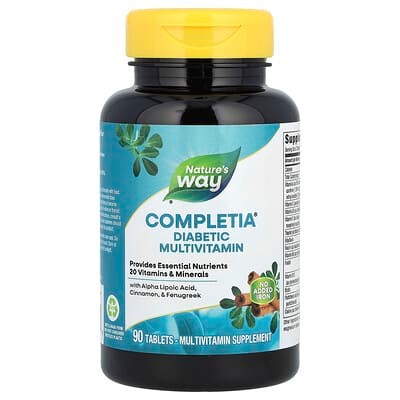

$22.69 $0.50 per serving


Product analysis
Completia Diabetic Multi-Vitamin can help cover nutrient gaps relevant to normal energy use and immune function. Undisclosed blend components and mixture proportions make its full contents harder to assess.
AI assessment of the formula, label and price. How scoring works
Nutrient Quality55
Several mineral forms compare favorably for usability, while the magnesium mixture has less favorable absorption information. Unclear blend components and missing vitamin forms limit a complete quality judgment.
Ingredient Transparency73
Listed amounts and most ingredient forms are stated. Component details are missing in the two blends and the vitamin A and magnesium mixtures.
Value For Money40
Molybdenum and vitamin B6 compare more favorably than several other ingredients. The full serving cost looks high when considered for niacin, vitamin B5 or choline, while many other comparisons remain uncertain.
Customer Satisfaction85
Customer feedback is very positive across thousands of ratings. The broad review history describes satisfaction without establishing health benefits.
Product Focus0
The intended uses span many related nutrient functions, giving the blend a broad focus. Incomplete blend details and the limits of extra nutrients when intake is adequate make its added benefits difficult to judge.
- Format
Tablet - Container
- 90 Tablet(s)
- Per serving
- $0.50
- Also available
 Completia Diabetic Multi-Vitamin$16.10
- Customer rating
- 4.7 · 2,291 ratings
Goals

Impact
Highest effect
Magnesium · 420 mgVitamin C · 250 mgZinc · 15 mgVitamin A · 3000 mcgVitamin D · 20 mcgSelenium · 200 mcg
Zinc, Vitamin D, Selenium contribute to normal immune-cell function and regulation. Vitamin A also supports protective barriers. Copper, Vitamin B6, Vitamin B12, Folate can help restore immune processes impaired by low intake, without establishing extra protection when intake is adequate. Vitamin C has modest regular-use cold-duration support, without establishing infection prevention. Higher Vitamin B6 amounts do not establish extra benefit or suitability.
How this product is rated for Immunity
Ingredient fit65
Vitamin C connects the formula to immunity. Amounts provide uneven support against the supplied comparisons; smaller or unresolved quantities limit some contributions.
Goal fit
Relevant immune nutrients are included within a broader formula with other active ingredients.
Dose adequacy
Amounts provide uneven support against the supplied comparisons; smaller or unresolved quantities limit some contributions.
Pathways100
The strongest saved finding concerns barrier and antimicrobial defense.
Depth
The strongest saved finding concerns barrier and antimicrobial defense.
Breadth
The broader saved findings cover barrier and antimicrobial defense, lymphocyte function and immune regulation, oxidative and inflammatory balance.
Evidence100
Vitamin C provides the strongest saved evidence finding. Nutritional function or modest regular-use symptom support does not establish general infection prevention.
Evidence strength
Vitamin C drives the strongest saved evidence finding; the practical support remains bounded by its specific nutritional or regular-use role.
Studied preparation
The saved finding accepts the declared forms without establishing that they outperform other forms.
Formulation logic100
No unmet ingredient partner or configured conflict was identified. The included contributors meet the saved minimum amount criterion; this does not establish clinical effectiveness.
Partner coverage
The included ingredients have no unmet partner requirement in the supplied findings.
Conflicts
No configured ingredient conflict was identified in the supplied findings.
Effective doses
The included contributors meet the saved minimum amount criterion; this does not establish clinical effectiveness.

Impact
Highest effect
Folate · 400 mcg DFEVitamin B12 · 40 mcgVitamin D · 20 mcgMagnesium · 420 mgSelenium · 200 mcgZinc · 15 mgVitamin C · 250 mg
B vitamins, folate and magnesium contribute to normal nutrient metabolism and blood formation, while vitamin D supports bone and mineral nutrition. Zinc, selenium and vitamin C contribute to normal immune or antioxidant functions. Iodine can help fill low intake linked to thyroid problems. These nutritional contributions matter most when intake is low; normal nutrient functions do not establish extra energy or disease prevention when intake is adequate.
How this product is rated for Everyday Health
Ingredient fit79
Relevant nutrients contribute to this goal alongside ingredients whose broad-health benefits are not established here. Amounts make unequal contributions under the saved comparison; smaller or undisclosed quantities limit the finding.
Goal fit
Relevant nutrients contribute to this goal alongside ingredients whose broad-health benefits are not established here.
Dose adequacy
Amounts make unequal contributions under the saved comparison; smaller or undisclosed quantities limit the finding.
Pathways100
The strongest saved area is energy metabolism cofactors. Other areas are included only where the supplied amounts and findings support them.
Depth
The strongest saved contribution concerns energy metabolism cofactors, with usefulness bounded by the relevant ingredient evidence.
Breadth
The saved findings cover energy metabolism cofactors, one-carbon metabolism and blood formation, bone and mineral metabolism, antioxidant and immune defence; this describes nutritional reach, not proven health improvements.
Evidence86
Magnesium leads the saved evidence finding. Nutrient availability can help low intake, but does not prove additional outcomes above adequacy.
Evidence strength
Magnesium provides the strongest supported contribution here, with benefits limited to the populations and nutritional roles described.
Studied preparation
The saved finding accepts the counted preparations as studied; that does not establish superiority or benefits beyond the supported use.
Formulation logic98
The counted ingredients can contribute alone or have the partner required by the saved finding; no extra combination benefit is established. Taurine’s undisclosed amount limits the amount finding.
Partner coverage
The counted ingredients can contribute alone or have the partner required by the saved finding; no extra combination benefit is established.
Conflicts
No configured ingredient conflict was matched in the supplied facts; this is a limited interaction check.
Effective doses
Taurine falls below the saved amount threshold; the other counted ingredients meet it. This does not establish taurine efficacy.

Impact
Highest effect
Folate · 400 mcg DFEVitamin B12 · 40 mcgVitamin B6 · 20 mgMolybdenum · 50 mcgSelenium · 200 mcgMagnesium · 420 mgVitamin E · 100 mgZinc · 15 mgVitamin C · 250 mgCholine · 50 mgRiboflavin · 80 mg
Folate contributes to methyl-group metabolism, and selenium supports antioxidant enzymes. Folate’s arsenic and selenium’s mercury findings concern particular exposed or low-nutrient populations. Magnesium, zinc and B vitamins have normal nutritional roles without established extra toxin clearance. Taurine’s bile-acid role does not demonstrate toxin removal, and its individual eligible amount remains unresolved.
How this product is rated for Liver & Detox
Ingredient fit61
The formula supplies nutrients connected with normal liver and enzyme functions, within a broader nutritional product. Their amounts support differing levels of nutritional comparison.
Goal fit
The formula includes relevant nutritional ingredients alongside ingredients serving other purposes, so its focus is broader than this goal.
Dose adequacy
The declared nutrient amounts contribute unevenly to the supplied comparisons; these reference amounts are not proven toxin-clearance doses.
Pathways100
Nutritional coverage is strongest for glutathione-related metabolism. Other areas have varying coverage; these findings do not demonstrate toxin removal.
Depth
The strongest retained area is glutathione-related metabolism, reflecting nutrient roles rather than demonstrated toxin removal.
Breadth
The retained areas are liver cell function and fat export, glutathione-related metabolism, enzyme-related nutrition; this describes nutritional coverage, not proven clearance of toxins.
Evidence97
Folate leads the retained evidence comparison, with important limits around arsenic exposure, nutrient status and preparation. Some nutrient preparations lack a matching comparison.
Evidence strength
Folate provides the strongest retained support, but its arsenic findings are specific to exposure, nutrient status and preparation.
Studied preparation
Most retained ingredients match the supplied preparation comparisons; Molybdenum, riboflavin, Vitamin B6 lack that match. This does not establish product-level toxin removal.
Formulation logic98
No required partner or configured conflict was identified. Taurine limit the amount findings.
Partner coverage
No required ingredient partner is missing among the retained contributions; this does not establish an added benefit from combining them.
Conflicts
No configured ingredient conflict was identified in the supplied facts.
Effective doses
Taurine fall short of the supplied amount comparison because the individual eligible amount remains unresolved; the other retained ingredients meet it.
Riboflavin Not classified
No linked studies yet.
Vitamin B6 Not classified
No linked studies yet.

Impact
High effect
Iodine · 150 mcgVitamin D · 20 mcgVitamin B5 · 50 mgMagnesium · 420 mgRiboflavin · 80 mgThiamin · 80 mgVitamin B12 · 40 mcg
Magnesium, folate, vitamin C and several B vitamins can help address nutrient shortfalls associated with fatigue. Their normal metabolic roles do not establish extra energy when intake is adequate. Vitamin D fatigue findings come from deficient adults and do not demonstrate routine fatigue relief from this serving; iodine likewise has no established unconditional energy benefit.
How this product is rated for Energy
Ingredient fit70
B vitamins account for the main relevant ingredients. The saved amount findings are partial; they do not establish a fatigue-treatment dose.
Goal fit
B vitamins provide the main connection to energy here. Other actives broaden the product beyond this goal.
Dose adequacy
The saved amount findings are partial; they do not establish a fatigue-treatment dose.
Pathways0
The saved findings do not cover a tracked alertness, exercise or fatigue pathway; nutrient-sufficiency roles are separate.
Depth
The saved findings do not cover a tracked alertness, exercise or fatigue pathway; nutrient-sufficiency roles are separate.
Breadth
No tracked pathway reaches the saved breadth threshold. This does not erase relevant nutrient-sufficiency roles.
Evidence94
Vitamin D leads the saved evidence finding, with benefit dependent on the relevant nutritional context.
Evidence strength
Vitamin D leads the saved evidence finding, with benefit dependent on the relevant nutritional context.
Studied preparation
Most qualifying entries meet the saved preparation check, but iodine does not.
Formulation logic100
The relevant ingredients have no unmet partner requirement in the saved findings; this does not establish an added combination benefit.
Partner coverage
The relevant ingredients have no unmet partner requirement in the saved findings; this does not establish an added combination benefit.
Conflicts
No configured ingredient conflict was matched in the supplied facts.
Effective doses
All counted ingredients meet the saved minimum amount check; that threshold is not proof of clinical benefit.
Vitamin B5 Not classified
No linked studies yet.

Impact
High effect
Magnesium · 420 mgVitamin B12 · 40 mcgVitamin B6 · 20 mgFolate · 400 mcg DFEVitamin D · 20 mcg
Magnesium contributes to mineral balance and vessel tone, with small and inconsistent blood-pressure effects in the supplied trials. Folate and related B vitamins support homocysteine metabolism, but lowering this marker has not generally prevented major cardiac events. Thiamin supports heart function when deficiency is responsible for disease; adequate intake does not imply further benefit. Selenium is relevant to deficiency-related heart disease, without established prevention benefits in adequately nourished adults.
How this product is rated for Heart Health
Ingredient fit53
Magnesium, Vitamin B9 (Folate), Vitamin B6, Selenium, Vitamin D, Vitamin B1 (Thiamin) provide the main connection to heart health; other active ingredients broaden the formula beyond this goal
Goal fit
Magnesium, Vitamin B9 (Folate), Vitamin B6, Selenium, Vitamin D, Vitamin B1 (Thiamin) provide the main connection to heart health; other active ingredients broaden the formula beyond this goal
Dose adequacy
The relevant amounts provide a partial contribution across the formula; higher amounts are not automatically more beneficial.
Pathways80
Homocysteine clearance is the strongest connection in the saved findings; this describes the ingredient roles, not a guaranteed effect.
Depth
Homocysteine clearance is the strongest connection in the saved findings; this describes the ingredient roles, not a guaranteed effect.
Breadth
The main areas represented are electrolyte and vascular-tone balance, homocysteine clearance; other aspects have less support in this formula.
Evidence89
Magnesium provides the strongest relevant evidence here, with the population and benefit limits described above.
Evidence strength
Magnesium provides the strongest relevant evidence here, with the population and benefit limits described above.
Studied preparation
The contributing ingredient preparations match those recognized in the supplied comparison; this does not establish efficacy of the finished product.
Formulation logic96
The relevant ingredients do not depend on a missing partner in the supplied findings. No configured ingredient conflict was identified in the supplied findings.
Partner coverage
The relevant ingredients do not depend on a missing partner in the supplied findings.
Conflicts
No configured ingredient conflict was identified in the supplied findings.
Effective doses
Most contributing ingredients have meaningful amounts, but Taurine cannot provide the same contribution.

Impact
Highest effect
Magnesium · 420 mgVitamin D · 20 mcgCopper · 1 mgManganese · 5 mgZinc · 15 mgVitamin C · 250 mg
Vitamin D supports calcium absorption and deficiency-related mineralization, without established routine fracture prevention in adequately nourished adults. Magnesium supports normal bone metabolism when intake is low; supplementation has not established reliable osteoporosis or fracture prevention.
How this product is rated for Bone Health
Ingredient fit65
The bone-related nutrients sit within a broader formula with other actives.
Goal fit
The bone-related nutrients sit within a broader formula with other actives.
Dose adequacy
The disclosed amounts only partly meet the saved comparison ranges; small or unresolved amounts limit this finding.
Pathways100
The strongest recorded connection concerns collagen matrix formation, without proving improved bone density or fewer fractures.
Depth
The strongest recorded connection concerns collagen matrix formation, without proving improved bone density or fewer fractures.
Breadth
The recorded connections span mineral supply, calcium regulation and collagen formation.
Evidence98
Zinc leads the saved evidence finding; its nutritional or preparation-specific limits still apply.
Evidence strength
Zinc leads the saved evidence finding; its nutritional or preparation-specific limits still apply.
Studied preparation
The saved findings recognize the evaluated preparations; this does not imply superiority over other nutrient forms.
Formulation logic98
Vitamin D lacks its required calcium partner in the saved findings, limiting support for the combination.
Partner coverage
Vitamin D lacks its required calcium partner in the saved findings, limiting support for the combination.
Conflicts
No matched ingredient conflict was recorded in the supplied findings.
Effective doses
All counted ingredients meet the saved minimum amount threshold; this is not a proven fracture-prevention dose.
Ingredients
| Ingredient | Amount per serving | Score |
|---|---|---|
Calories | 5 Calorie(s) | |
Total Carbohydrates | 1 Gram(s) | |
Vitamin A (Beta-Carotene, Retinyl Acetate) | 3000 mcg | |
Vitamin C (Ascorbic Acid) | 250 mg | |
Vitamin D3 (Cholecalciferol) | 20 mcg | |
Vitamin E (D-Alpha-Tocopheryl Succinate) | 100 mg | |
Thiamine | 80 mg | |
Riboflavin | 80 mg | |
Niacin (Niacinamide) | 40 mg | |
Vitamin B6 (Pyridoxine Hydrochloride) | 20 mg | |
Folate | 400 mcg DFE | |
Vitamin B12 (Cyanocobalamin) | 40 mcg | |
Biotin | 30 mcg | |
Pantothenic Acid (Calcium D-Pantothenate) | 50 mg | |
Choline (Choline Bitartrate) | 50 mg | |
Iodine (Potassium Iodide) | 150 mcg | |
Magnesium (Magnesium Citrate, Magnesium Oxide) | 420 mg | |
Zinc (Zinc Bisglycinate) | 15 mg | |
Selenium (L-Selenomethionine) | 200 mcg | |
Copper (Copper Bisglycinate Chelate) | 1 mg | |
Manganese (Manganese Bisglycinate Chelate) | 5 mg | |
Molybdenum (Sodium Molybdate) | 50 mcg | |
Diabetic Support Blend | 300 mg | |
Antioxidant Activity Support Blend | 295 mg | |
Lutein (Aztec Marigold flower extract) | 200 mcg |
Selenium (L-Selenomethionine) · 200 mcg OverallScore86
Each serving provides 200 mcg of selenium as L-selenomethionine, a well-absorbed organic form. The whole-product price works out to about $0.50 per 200 mcg of selenium.
How this ingredient is rated
Active Ingredient Quality & Bioavailability100
L-selenomethionine is an identified, well-absorbed organic form of selenium.
Selenium Chemical Form
Selenium is supplied as L-selenomethionine, a well-absorbed organic form.
Form Transparency & Isomer Specificity
The form is identified specifically as the L isomer of selenomethionine.
Dose, Safety & Label Transparency100
The 200 mcg of selenium per serving is the amount favored in the evaluation; the evaluation also finds a margin for selenium from other sources.
Dosage Efficacy Sweet Spot
Each serving provides 200 mcg of selenium, the amount favored in the evaluation.
Safety Margin & UL Adherence
At 200 mcg per serving, the evaluation finds a margin for selenium from food and other sources.
Value30
The whole-product price is about $0.50 per 200 mcg of selenium.
Price per 200 mcg Serving
The whole-product price is about $0.50 per 200 mcg of selenium.
Iodine (Potassium Iodide) · 150 mcg OverallScore90
Each serving provides 150 mcg of iodine as potassium iodide. The whole-product serving costs about $0.50.
How this ingredient is rated
Active Ingredient Quality & Bioavailability100
The evaluation favors potassium iodide as an iodine form; no marine source is indicated in the saved facts.
Iodine Form & Bioavailability
The evaluation favors potassium iodide as an iodine form.
Marine Source Purity & Sourcing
No marine source is indicated in the saved facts, so the marine-specific sourcing check does not apply.
Dose, Safety & Label Transparency100
The iodine amount is known: 150 mcg per serving. The evaluation does not flag that amount as exceeding its upper limit.
Dosage Efficacy for Daily Support
The serving provides 150 mcg of iodine, an amount favored by the evaluation.
Dosage Safety & Upper Limits
The evaluation does not flag the stated iodine amount as exceeding its upper limit.
Elemental Iodine Transparency
The iodine amount is identified as 150 mcg per serving in the saved facts.
Value50
The whole-product price is about $0.50 per serving, which is mid-range in this comparison.
Price Per Effective Serving
The whole-product serving costs about $0.50.
Manganese (Manganese Bisglycinate Chelate) · 5 mg OverallScore90
Each 2-tablet serving provides 5 mg of manganese as bisglycinate. The amino acid chelate has good absorption potential, and a whole-product serving costs about $0.50.
How this ingredient is rated
Active Ingredient Quality & Bioavailability100
Manganese bisglycinate is an amino acid chelate with good absorption potential.
Manganese Chemical Form
Manganese bisglycinate is an amino acid chelate with good absorption potential.
Dose, Safety & Label Transparency100
The 2-tablet serving provides 5 mg of manganese. The amount and source are both identified in the saved facts.
Manganese Dosage Efficacy & Safety
The serving provides 5 mg of manganese; manganese may support bone and joint health.
Elemental Weight Disclosure
The saved facts identify both the manganese amount and its source.
Value50
A whole-product serving costs about $0.50, placing it around the middle of the evaluated price range.
Price per Serving vs. Median
A whole-product serving costs about $0.50, placing it around the middle of the evaluated price range.
Alternative products
Report alternatives
Sources
Published studies used for the product analysis and the top-ranked studies for each ingredient and goal.
- The Association between Dietary and Circulating Copper Levels and Osteoporosis: a Scoping Review.
- Association between dietary copper, iron, zinc, selenium intake and osteopenia or osteoporosis in elderly hypertensive patients: a retrospective cohort study.
- Associations of dietary copper intake with total bone mineral density and lumbar spine bone mineral density in American adults.
- The association between dietary mineral intake and bone mineral density: a cross-sectional study.
- Association between dietary copper intake and bone mineral density in children and adolescents aged 8-19 years: A cross-sectional study.
- Association between RBC folate and lumbar bone mineral density in postmenopausal women, a cross-sectional study from NHANES 2009-2018.
- Genetic variants modify the associations of concentrations of methylmalonic acid, vitamin B-12, vitamin B-6, and folate with bone mineral density.
- Adequate Intake and Supplementation of B Vitamins, in Particular Folic Acid, can Play a Protective Role in Bone Health.
- Relation of homocysteine, folate, and vitamin B12 to bone mineral density of postmenopausal women.
- Dietary intake of folate, but not vitamin B2 or B12, is associated with increased bone mineral density 5 years after the menopause: results from a 10-year follow-up study in early postmenopausal women.
- Association between Serum Magnesium and Fractures: A Systematic Review and Meta-Analysis of Observational Studies.
- Bioabsorbable Magnesium-Based Materials Potential and Safety in Bone Surgery: A Systematic Review.
- Vascularized bone grafting fixed by biodegradable magnesium screw for treating osteonecrosis of the femoral head.
- An update on magnesium and bone health.
- Sex-specific differences in the association of magnesium intake with femoral neck bone mineral density among older adults.
- Risk of Environmental Chemicals on Bone Fractures Is Independent of Low Bone Mass in US Adults: Insights from 2017 to 2018 NHANES.
- The Manganese-Bone Connection: Investigating the Role of Manganese in Bone Health.
- Associations of multiple metals with bone mineral density: A population-based study in US adults.
- Sex-specific associations of urinary mixed-metal concentrations with femoral bone mineral density among older people: an NHANES (2017-2020) analysis.
- Relationship between blood manganese and bone mineral density and bone mineral content in adults: A population-based cross-sectional study.