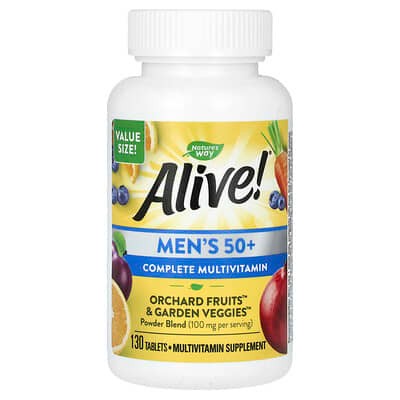
Alive! Men's 50+ Complete Multivitamin

Alive! Men's 50+ Complete Multivitamin

Nature's Way4.8 (5,538 ratings)
Format:Tablet Quantity: 130 Tablet(s) · 130 servings
Goals
$19.99 $0.15 per serving

About this product

Broad nutrient coverage at a low serving cost is the main appeal. B vitamins support normal energy use, while vitamin D at 40 mcg and the listed minerals can help fill dietary gaps. These functions do not establish extra energy, faster metabolism or longer life when intake is already adequate.

Mineral forms are a trade-off. Zinc at 19.2 mg uses oxide, a less favorable source for absorption, while iodine uses clearly identified potassium iodide. Copper is disclosed at 0.9 mg, which makes its presence clearer than in formulas with no copper information.

Bone support relies more on vitamin D than on mineral replacement. The calcium contribution is 130 mg across several source descriptions, rather than an established sum of those repeated entries, and magnesium provides a modest 105 mg. An undisclosed fruit and vegetable blend and incomplete form details limit assessment of the extras.

The formula fits broad daily nutrition more closely than targeted hair, skin, hormone or cardiovascular goals. Small carotenoid and biotin additions do not establish visible cosmetic benefits, and ordinary vitamin E cannot be treated as a different preparation associated with hair findings. The low cost is useful if broad nutrient coverage matches an actual dietary need.

Who is it for
  • Men aged 50 and over seeking broad nutrient support for gaps in their usual diet.
Best for
  • Low-cost coverage of several vitamins and trace minerals.
  • Vitamin D support alongside modest calcium and magnesium intake.

Pros

  • Low serving cost for broad nutrient coverage.
  • Iodine source and amount are clearly stated.
  • Copper is disclosed alongside zinc.
  • Vitamin D supplies a meaningful nutritional contribution.

Cons

  • Zinc oxide is a less favorable source for absorption.
  • Calcium provides limited mineral replacement.
  • The fruit and vegetable blend does not identify its components.
  • Several forms and calcium source proportions remain unclear.

Product analysis

51 out of 100

Alive! Men's 50+ Complete Multivitamin can help fill dietary gaps that affect normal energy use, immunity and bone nutrition. Some mineral forms are less favorable for absorption, and the botanical blend lacks an individual breakdown.

AI assessment of the formula, label and price. How scoring works

Nutrient Quality37

The mineral forms vary in quality, with potassium iodide and sodium molybdate more favorable than zinc oxide and some other forms. Quality for many other ingredients remains uncertain, and the botanical blend is not individually described.

Ingredient Transparency73

All amounts and most forms are stated, making much of the formula easy to identify. The calcium-source proportions and botanical blend breakdown are not disclosed, leaving parts of the composition unclear.

Value For Money53

Several named nutrients offer competitive value for the full serving cost, while niacin and selenium are less compelling. Many other ingredients lack usable comparisons, leaving value for the complete formula uncertain.

Customer Satisfaction91

Customer feedback is very positive across a large number of ratings. The volume gives a broad picture of satisfaction, without establishing effectiveness or safety.

Product Focus4

The broad formula serves several overlapping nutritional goals, especially when dietary intake is low. Its many ingredients and undisclosed botanical blend make it less focused on one specific purpose.

Format
Tablet
Container
130 Tablet(s)
Per serving
$0.15
Customer rating
4.8 · 5,538 ratings
Report analysis

Goals

Everyday Health
Impact
Highest effect
B+ Ingredient FitA+ PathwaysA- EvidenceA+ Formulation Logic
Folate · 400 mcg DFEVitamin B12 · 40 mcgVitamin D · 40 mcgMagnesium · 105 mgVitamin K · 120 mcgBoron · 150 mcgSelenium · 96 mcgZinc · 19.2 mgVitamin C · 180 mg

B vitamins contribute to normal energy metabolism, while folate supports blood formation. Vitamin D contributes to bone and mineral nutrition, and zinc and selenium contribute to normal defence functions. These nutrients can help fill dietary gaps, without establishing extra benefit above adequate intake. The smaller B12, vitamin C and calcium amounts did not meaningfully contribute.

How this product is rated for Everyday Health

Ingredient fit82

The useful contributions vary in size; Vitamin B12, Vitamin C, Boron fell below the minimum amount used here.
Goal fit
Relevant nutrients contribute to general health, alongside other actives whose routine general-health contribution is not established here.
Dose adequacy
The useful contributions vary in size; Vitamin B12, Vitamin C, Boron fell below the minimum amount used here.

Pathways100

The strongest contribution concerns normal energy metabolism. Other meaningful coverage is limited to the named nutrient roles.
Depth
The strongest finding concerns normal energy metabolism, based on the relevant ingredients and their supplied amounts.
Breadth
Meaningful coverage extends to normal energy metabolism, blood formation and related metabolism, bone and mineral nutrition, normal antioxidant and immune functions.

Evidence86

Magnesium provides the leading evidence contribution. Nutritional functions and the preparation findings do not establish broad health improvements above adequate intake.
Evidence strength
Magnesium leads the evidence contribution; its nutrient role does not establish extra benefit above adequate intake.
Studied preparation
The included preparations meet the preparation criteria; this does not establish superiority of a particular form.

Formulation logic100

The included ingredients can contribute without a missing required partner, and no configured conflict was found. Their amounts pass the saved minimum contribution check.
Partner coverage
The included ingredients can contribute independently or have their required partners; no extra benefit from combining them is established.
Conflicts
No configured ingredient conflict was identified in the supplied facts.
Effective doses
The included amounts all meet the minimum amount used here; that threshold is not a proven clinical dose.
Study evidence
Boron Supportive 6 studies
Folate Supportive 80 studies
Magnesium Supportive 114 studies
Selenium Supportive 70 studies
Vitamin C Supportive 56 studies
Vitamin D Supportive 115 studies
Vitamin K Supportive 34 studies
Zinc Supportive 60 studies
Immunity
Impact
Highest effect
C Ingredient FitA+ PathwaysA+ EvidenceA+ Formulation Logic
Magnesium · 105 mgVitamin C · 180 mgZinc · 19.2 mgVitamin A · 900 mcgVitamin D · 40 mcgSelenium · 96 mcg

Vitamin A supports protective barriers, while vitamin D contributes to normal immune-cell function. Selenium and the B vitamins support normal immunity, with folate and vitamins B6 and B12 helping when intake is low. Zinc adds a nutritional contribution. These nutritional roles do not establish extra protection from infection when intake is adequate.

How this product is rated for Immunity

Ingredient fit61

Zinc contributes to the supplied ingredient findings. The contributing amounts meet the supplied comparisons to differing degrees.
Goal fit
The relevant ingredients sit within a broader formula containing ingredients intended for other purposes.
Dose adequacy
The contributing amounts provide a partial overall match to the supplied comparisons; this does not measure the probability of benefit.

Pathways100

The strongest supplied connection is to lymphocyte function and immune regulation. This describes the ingredients' assigned roles rather than an observed clinical outcome.
Depth
The strongest assigned connection is to lymphocyte function and immune regulation, rather than a demonstrated change in infection outcomes.
Breadth
The supplied findings meaningfully cover three immune areas.

Evidence100

Zinc leads the supplied evidence finding. Established nutrient roles and limited cold-duration findings do not establish general infection prevention.
Evidence strength
Zinc leads the evidence finding, with benefits bounded by its nutritional role or regular-use context.
Studied preparation
The contributing forms pass the supplied preparation check; no additional clinical advantage from a particular form is established.

Formulation logic100

The contributing ingredients have no missing required partner, and no listed formulation conflict was triggered.
Partner coverage
The contributing ingredients can act independently, so no missing required partner reduces their contribution.
Conflicts
No listed formulation conflict was triggered by the supplied facts.
Effective doses
All contributing ingredients meet the supplied minimum amount comparison; this is not proof of a clinically effective regimen.
Study evidence
Magnesium Supportive 8 studies
Selenium Mixed 37 studies
Vitamin A Supportive 107 studies
Vitamin C Supportive 53 studies
Vitamin D Supportive 85 studies
Vitamin E Supportive 21 studies
Zinc Supportive 73 studies
Impact
Moderate effect
C- Ingredient FitF PathwaysA EvidenceA+ Formulation Logic
Iodine · 150 mcgVitamin D · 40 mcgVitamin B5 · 7.5 mgMagnesium · 105 mgRiboflavin · 2.6 mgThiamin · 3.6 mgVitamin B12 · 40 mcg

B vitamins support normal energy metabolism, while folate, vitamin B12, vitamin C and magnesium help meet nutritional needs relevant to fatigue. Vitamin D at 40 mcg may matter when low vitamin D contributes to tiredness, but the evidence does not establish extra energy from supplementation in people with adequate status.

How this product is rated for Energy

Ingredient fit60

Relevant energy-related ingredients are present alongside ingredients serving other needs. The relevant amounts provide a partial match to the supplied dose comparisons.
Goal fit
Relevant energy-related ingredients are present alongside ingredients serving other needs.
Dose adequacy
The relevant amounts provide a partial match to the supplied dose comparisons.

Pathways0

The saved findings show nutritional support without meaningful coverage of the listed energy mechanisms. The saved findings show limited reach across the different aspects of energy support.
Depth
The saved findings show nutritional support without meaningful coverage of the listed energy mechanisms.
Breadth
The saved findings show limited reach across the different aspects of energy support.

Evidence94

Vitamin D provides the strongest relevant evidence at the assessed amount, with benefits dependent on nutritional status or clinical context. Most qualifying ingredients match preparations represented in the supplied evidence; iodine did not match.
Evidence strength
Vitamin D provides the strongest relevant evidence at the assessed amount, with benefits dependent on nutritional status or clinical context.
Studied preparation
Most qualifying ingredients match preparations represented in the supplied evidence; iodine did not match.

Formulation logic100

The assessed ingredients can contribute on their own or have their required partner present. No ingredient conflicts were identified in the saved assessment. All assessed ingredients met the saved minimum amount criterion.
Partner coverage
The assessed ingredients can contribute on their own or have their required partner present.
Conflicts
No ingredient conflicts were identified in the saved assessment.
Effective doses
All assessed ingredients met the saved minimum amount criterion.
Study evidence
Iodine Adverse 3 studies
Magnesium Supportive 4 studies
Thiamin Disputed 12 studies
Vitamin D Supportive 32 studies
Impact
High effect
C Ingredient FitB+ PathwaysA+ EvidenceA+ Formulation Logic
Vitamin K · 120 mcgMagnesium · 105 mgCalcium · 130 mgVitamin D · 40 mcgCopper · 0.9 mgManganese · 4.6 mgBoron · 150 mcgZinc · 19.2 mgVitamin C · 180 mg

Vitamin D helps the body absorb calcium and supports normal mineralization when vitamin D intake or status is low; extra intake does not establish routine fracture prevention. Magnesium contributes to normal bone metabolism when intake is low, without reliable evidence of routine fracture prevention. Copper helps cross-link bone collagen when copper is deficient; additional bone benefit with adequate intake is not established. The 130 mg of calcium per serving provides little mineral replacement.

How this product is rated for Bone Health

Ingredient fit61

Bone-related nutrients sit within a broader formula containing ingredients aimed at other purposes. The serving amounts provide partial support against the saved comparison; smaller amounts limit several contributions.
Goal fit
Bone-related nutrients sit within a broader formula containing ingredients aimed at other purposes.
Dose adequacy
The serving amounts provide partial support against the saved comparison; smaller amounts limit several contributions.

Pathways80

The strongest represented area is collagen matrix formation, reflecting the supplied ingredient amounts rather than proven clinical effects.
Depth
The strongest represented area is collagen matrix formation, reflecting the supplied ingredient amounts rather than proven clinical effects.
Breadth
The more substantial represented areas are calcium absorption and regulation, collagen matrix formation; other areas receive less support.

Evidence98

Zinc leads the saved ingredient comparison, although the supplied science does not establish routine extra skeletal benefit from zinc alone.
Evidence strength
Zinc leads the saved ingredient comparison, although the supplied science does not establish routine extra skeletal benefit from zinc alone.
Studied preparation
The saved comparison recognizes the relevant preparations; this does not establish a clinical benefit for the entire product.

Formulation logic98

Vitamin D lacks a substantial credited calcium partner within this formula. No conflict was identified by the supplied checks.
Partner coverage
Vitamin D lacks a substantial credited calcium partner within this formula.
Conflicts
No conflict was identified by the supplied checks; this is not a comprehensive safety assessment.
Effective doses
All ingredients counted here clear the saved minimum amount comparison; that threshold is not a proven effective clinical dose.
Study evidence
Boron Supportive 5 studies
Calcium Supportive 144 studies
Copper Disputed 20 studies
Folate Supportive 50 studies
Magnesium Supportive 48 studies
Manganese Adverse 12 studies
Vitamin A Adverse 56 studies
Vitamin C Supportive 46 studies
Vitamin D Supportive 202 studies
Vitamin K Supportive 78 studies
Zinc Supportive 33 studies
Hair Health
Impact
High effect
C+ Ingredient FitC PathwaysA+ EvidenceA+ Formulation Logic
Biotin · 30 mcgVitamin D · 40 mcgZinc · 19.2 mgVitamin C · 180 mg

Zinc can help address low intake associated with diffuse shedding. The multivitamin also contains biotin, whose small amount was not counted in the saved findings; neither nutrient establishes extra growth when intake is adequate. Pumpkin seed material does not by itself establish the oil preparation used in hair research, and ordinary vitamin E cannot be treated as studied mixed tocotrienols.

How this product is rated for Hair Health

Ingredient fit66

The relevant nutrients are present, but some smaller amounts were excluded from the saved findings. The included amounts and the formula’s other uses determine its focus.
Goal fit
The formula includes ingredients relevant to hair nutrition alongside ingredients intended for other uses, reducing its specific focus on hair.
Dose adequacy
The declared amounts provide only partial coverage of the saved reference levels; this comparison does not establish effective hair-treatment doses.

Pathways60

The main recorded connection is follicle antioxidant protection, with limited breadth across the other tracked areas. These ingredient connections do not establish clinical outcomes.
Depth
The strongest recorded connection is follicle antioxidant protection; this describes the saved ingredient mapping, not demonstrated hair improvement.
Breadth
Only the antioxidant pathway reached the saved coverage threshold, so the recorded coverage is narrow.

Evidence97

Zinc leads the saved evidence finding. The supplied scientific limitations still determine which hair benefits can reasonably be described.
Evidence strength
Zinc leads the saved evidence finding, but its recognition does not establish routine regrowth or benefit beyond the supplied limitations.
Studied preparation
The saved preparation comparison recognizes the included forms except iodine; this does not demonstrate clinical hair benefit from the full formula.

Formulation logic100

No required partner was missing and no configured conflict was found. The retained ingredients meet the minimum amount criterion without establishing synergy or overall safety.
Partner coverage
No missing required partner was identified for the ingredients included in this finding; no added benefit from combining them is established.
Conflicts
No configured ingredient conflict was identified; this finding does not establish overall safety or individual suitability.
Effective doses
All ingredients retained in this comparison meet its minimum amount criterion; smaller or excluded ingredients do not become proven ineffective.
Study evidence
Biotin Supportive 4 studies
Copper Adverse 4 studies
Folate Mixed 15 studies
Iodine No effect 1 study
Niacin Disputed 2 studies
Selenium Disputed 7 studies
Vitamin A Disputed 13 studies
Vitamin D Disputed 34 studies
Vitamin E No effect 3 studies
Zinc Supportive 22 studies
Longevity
Impact
High effect
C Ingredient FitC PathwaysA+ EvidenceA+ Formulation Logic
Folate · 400 mcg DFEMagnesium · 105 mgVitamin B12 · 40 mcgVitamin K · 120 mcgVitamin D · 40 mcg

Vitamin D supports muscle function when deficiency is corrected. B12 supports nerve function when deficiency is corrected, while vitamin C supports normal collagen formation when intake is inadequate. Magnesium's limited functional findings concern exercising older women, especially with low intake.

How this product is rated for Longevity

Ingredient fit61

The ingredient focus and declared amounts provide a partial match to the saved references. The relevant roles remain limited to the specific outcomes described above.
Goal fit
The formula includes ingredients for other uses, leaving a mixed focus on aging-related outcomes.
Dose adequacy
The recognized amounts only partly match the saved references; these references do not define proven effective anti-aging doses.

Pathways60

The strongest saved finding concerns antioxidant defence. The recognized breadth is limited across the other aging-related processes.
Depth
The strongest saved contribution concerns antioxidant defence, describing ingredient roles rather than proven slowing of aging.
Breadth
Only one pathway reaches the saved coverage threshold, leaving the recognized reach narrow.

Evidence100

Magnesium leads the saved evidence finding. The population, outcome and preparation limits described above still apply.
Evidence strength
Magnesium supplies the leading saved evidence finding, subject to its specific population and outcome limitations.
Studied preparation
The saved findings recognize preparation matches for qualifying ingredients, without extending the evidence to broader aging outcomes.

Formulation logic97

The recognized ingredients have their required partners or work independently, and no matched conflict was recorded. Amount limitations remain relevant.
Partner coverage
The recognized ingredients work independently or have their required partner; no extra combination benefit is established.
Conflicts
No matched ingredient conflict was recorded in the supplied calculation.
Effective doses
All recognized ingredients meet the saved amount threshold, a calculation reference rather than proof of anti-aging benefit.
Study evidence
Boron Not classified

No linked studies yet.

Folate Supportive 16 studies
Lycopene Supportive 11 studies
Magnesium Supportive 12 studies
Selenium Supportive 27 studies
Vitamin C Supportive 30 studies
Vitamin D Supportive 50 studies
Vitamin E Supportive 19 studies
Vitamin K Supportive 27 studies
Zinc Supportive 10 studies

Ingredients

IngredientAmount per servingScore
Vitamin A
900 mcg
Vitamin C (Ascorbic Acid)
180 mg
Vitamin D3 (Cholecalciferol)
40 mcg
Vitamin E (DL-Alpha-Tocopheryl Acetate)
30 mg
Vitamin K (Phytonadione)
120 mcg 42
Thiamine (Thiamine Mononitrate)
3.6 mg
Riboflavin
2.6 mg
Niacin (Niacinamide)
24 mg 73
Vitamin B6 (Pyridoxine Hydrochloride)
5.1 mg
Folate
400 mcg DFE
Vitamin B12 (Cyanocobalamin)
40 mcg
Biotin
30 mcg
Pantothenic Acid (D-Calcium Pantothenate)
7.5 mg
Calcium (Calcium Carbonate, D-Calcium Pantothenate, Dicalcium Phosphate)
130 mg
Iodine (Potassium Iodide)
150 mcg 100
Magnesium (Magnesium Oxide)
105 mg
Zinc (Zinc Oxide)
19.2 mg 58
Selenium (Sodium Selenate)
96 mcg 53
Copper (Copper Sulfate)
0.9 mg 59
Manganese (Manganese Sulfate)
4.6 mg 76
Molybdenum (Sodium Molybdate)
45 mcg 64
Orchard Fruits & Garden Veggies Powder Blend
100 mg
Lycopene
600 mcg
FloraGLO (Lutein Carotenoid)
300 mcg
Boron (Sodium Borate)
150 mcg
Men 50+ Women
Report overview
A+ Active Ingredient Quality & BioavailabilityA+ Dose, Safety & Label TransparencyA+ Value
Each serving provides 150 mcg of iodine as potassium iodide. The whole product costs about $0.15 per serving.
How this ingredient is rated

Active Ingredient Quality & Bioavailability100

Iodine is supplied as potassium iodide; no marine source is recorded for the iodine.
Iodine Form & Bioavailability
The iodine comes as potassium iodide, an identified chemical form.
Marine Source Purity & Sourcing
No marine iodine source is recorded, so the marine-specific purity check does not apply.

Dose, Safety & Label Transparency100

The serving provides 150 mcg of iodine, and the saved evaluation does not flag that amount as excessive.
Dosage Efficacy for Daily Support
Each serving provides 150 mcg of iodine, a moderate amount.
Dosage Safety & Upper Limits
The saved evaluation does not flag the listed iodine amount as excessive.
Elemental Iodine Transparency
The iodine amount is stated as 150 mcg per serving.

Value100

The whole-product serving cost is low in this comparison and includes all ingredients.
Price Per Effective Serving
The whole product costs about $0.15 per serving.
A- Active Ingredient Quality & BioavailabilityC+ Dose, Safety & Label TransparencyC Value
Each serving provides 24 mg of niacin as niacinamide. The full product costs about $0.15 per serving.
How this ingredient is rated

Active Ingredient Quality & Bioavailability86

Niacinamide is the identified form of niacin.
Niacin Form & Goal Alignment
The niacin is niacinamide, a standard form in the evaluation.
Precursor Source Quality
The identified source is niacinamide, a standard form of vitamin B3.

Dose, Safety & Label Transparency67

Each serving provides 24 mg of niacin. The identified form is niacinamide.
Clarity of Chemical Form
Niacinamide is identified as the niacin source.
Form-Specific Dosage Efficacy
Each serving provides 24 mg of niacin.
Flush Risk & Safety Labeling
Niacinamide is treated as a lower-flush form; no no-flush claim is recorded in the saved facts.

Value60

The whole product costs about $0.15 per serving.
Price Per Effective Serving
The whole product costs about $0.15 per serving.
D- Active Ingredient Quality & BioavailabilityA+ Dose, Safety & Label TransparencyA+ Value
Each serving supplies 4.6 mg of manganese as manganese sulfate, an inorganic form considered less readily absorbed than some alternatives. The whole product costs about $0.15 per serving.
How this ingredient is rated

Active Ingredient Quality & Bioavailability40

Manganese sulfate is an inorganic form considered less readily absorbed than some other forms.
Manganese Chemical Form
Manganese sulfate is an inorganic form considered less readily absorbed than some other forms.

Dose, Safety & Label Transparency100

4.6 mg of manganese per serving fits the evaluation's target. The label states both the 4.6 mg manganese amount and its source.
Manganese Dosage Efficacy & Safety
4.6 mg of manganese per serving fits the evaluation's target.
Elemental Weight Disclosure
The label states both the 4.6 mg manganese amount and its source.

Value100

The whole product costs about $0.15 per serving.
Price per Serving vs. Median
The whole product costs about $0.15 per serving.
Report alternatives

Sources

Published studies used for the product analysis and the top-ranked studies for each ingredient and goal.

  1. [Comparative study of the urinary excretion of boron, calcium, magnesium and phosphorus in postmenopausal women with and without osteoporosis].
    José Ramón V; Mora Mora M; Marino Alarcón O; Hernández G; Josefina Linares L; Urdaneta Romero H; Arévalo González E · Investigacion clinica · 2013
    Case-control study45 participantsBone Health forBoron
  2. Effect of dietary boron on mineral, estrogen, and testosterone metabolism in postmenopausal women.
    Nielsen FH; Hunt CD; Mullen LM; Hunt JR · FASEB journal : official publication of the Federation of American Societies for Experimental Biology · 1987
    Single-arm trial12 participantsBone Health forBoron
  3. The relationship between boron and magnesium status and bone mineral density in the human: a review.
    Volpe SL; Taper LJ; Meacham S · Magnesium research · 1994
    Narrative reviewBone Health forBoron
  4. Effects of boron supplementation on bone mineral density and dietary, blood, and urinary calcium, phosphorus, magnesium, and boron in female athletes.
    Meacham SL; Taper LJ; Volpe SL · Environmental health perspectives · 1995
    Randomized trial28 participantsBone Health forBoron
  5. Metabolic responses of postmenopausal women to supplemental dietary boron and aluminum during usual and low magnesium intake: boron, calcium, and magnesium absorption and retention and blood mineral concentrations
    C D Hunt, J L Herbel, F H Nielsen · The American Journal of Clinical Nutrition · 1997
    Non-randomized trial11 participantsBone Health forBoron
  6. What is the impact of daily oral supplementation of vitamin D3 (cholecalciferol) plus calcium on the incidence of hip fracture in older people? A systematic review and meta-analysis.
    Manoj P; Derwin R; George S · International journal of older people nursing · 2023
    Meta-analysis12,620 participants7 studies pooledBone Health forCalcium
  7. Calcium supplementation prevents seasonal bone loss and changes in biochemical markers of bone turnover in elderly New England women: a randomized placebo-controlled trial.
    Storm D; Eslin R; Porter ES; Musgrave K; Vereault D; Patton C; Kessenich C; Mohan S; Chen T; Holick MF; Rosen CJ · The Journal of clinical endocrinology and metabolism · 1998
    Randomized trial60 participantsBone Health forCalcium
  8. The effects of calcium supplementation (milk powder or tablets) and exercise on bone density in postmenopausal women.
    Prince R; Devine A; Dick I; Criddle A; Kerr D; Kent N; Price R; Randell A · Journal of bone and mineral research : the official journal of the American Society for Bone and Mineral Research · 1995
    Randomized trial168 participantsBone Health forCalcium
  9. The efficacy of calcium supplementation alone in elderly Thai women over a 2-year period: a randomized controlled trial.
    Rajatanavin R; Chailurkit L; Saetung S; Thakkinstian A; Nimitphong H · Osteoporosis international : a journal established as result of cooperation between the European Foundation for Osteoporosis and the National Osteoporosis Foundation of the USA · 2014
    Randomized trial404 participantsBone Health forCalcium
  10. Calcium-enriched foods and bone mass growth in prepubertal girls: a randomized, double-blind, placebo-controlled trial.
    Bonjour JP; Carrie AL; Ferrari S; Clavien H; Slosman D; Theintz G; Rizzoli R · The Journal of clinical investigation · 1997
    Randomized trial149 participantsBone Health forCalcium
  11. The Association between Dietary and Circulating Copper Levels and Osteoporosis: a Scoping Review.
    Ju Y; Xiong W; Pang Y; Chen Z; Hou J; Zheng S; Li Z; Liu T; Xia H; Xia M; Zhong Y; Li J; Jiang X · Biological trace element research · 2026
    Scoping review18 studies pooledBone Health forCopper
  12. Association between dietary copper, iron, zinc, selenium intake and osteopenia or osteoporosis in elderly hypertensive patients: a retrospective cohort study.
    Chen M; Jia L; Gao R · Frontiers in nutrition · 2024
    Cohort study5,286 participantsBone Health forCopper
  13. Associations of dietary copper intake with total bone mineral density and lumbar spine bone mineral density in American adults.
    Hu M; Wang Z; Li C; Zheng Y; Hu J · Medicine · 2025
    Cross-sectional studyBone Health forCopper
  14. The association between dietary mineral intake and bone mineral density: a cross-sectional study.
    Wei M; Wei J; Huang S · Journal of health, population, and nutrition · 2025
    Cross-sectional study11,520 participantsBone Health forCopper
  15. Association between dietary copper intake and bone mineral density in children and adolescents aged 8-19 years: A cross-sectional study.
    Cui A; Yan J; Li H; Fan Z; Wei X; Wang H; Zhuang Y · PloS one · 2024
    Cross-sectional study6,965 participantsBone Health forCopper
  16. Association between RBC folate and lumbar bone mineral density in postmenopausal women, a cross-sectional study from NHANES 2009-2018.
    Wei H; Jin Z; Zhou L; Tang G; Chai S; Che X; Tan Y; Zeng W · Frontiers in endocrinology · 2025
    Cross-sectional study1,315 participantsBone Health forFolate
  17. Genetic variants modify the associations of concentrations of methylmalonic acid, vitamin B-12, vitamin B-6, and folate with bone mineral density.
    Liu CT; Karasik D; Xu H; Zhou Y; Broe K; Cupples LA; Cpgm de Groot L; Ham A; Hannan MT; Hsu YH; Jacques P; McLean RR; Paul L; Selhub J; Trajanoska K; van der Velde N; van Schoor N; Kiel DP · The American journal of clinical nutrition · 2021
    Cohort study4,310 participantsBone Health forFolate
  18. Adequate Intake and Supplementation of B Vitamins, in Particular Folic Acid, can Play a Protective Role in Bone Health.
    Rondanelli M; Tartara A; Fossari F; Vecchio V; Faliva MA; Naso M; Perna S; Nichetti M; Peroni G · Current aging science · 2022
    Narrative review35,298 participants29 studies pooledBone Health forFolate Bone Health forVitamin B6
  19. Relation of homocysteine, folate, and vitamin B12 to bone mineral density of postmenopausal women.
    Cagnacci A; Baldassari F; Rivolta G; Arangino S; Volpe A · Bone · 2004
    Cross-sectional study161 participantsBone Health forFolate
  20. Dietary intake of folate, but not vitamin B2 or B12, is associated with increased bone mineral density 5 years after the menopause: results from a 10-year follow-up study in early postmenopausal women.
    Rejnmark L; Vestergaard P; Hermann AP; Brot C; Eiken P; Mosekilde L · Calcified tissue international · 2008
    Cohort study1,869 participantsBone Health forFolate