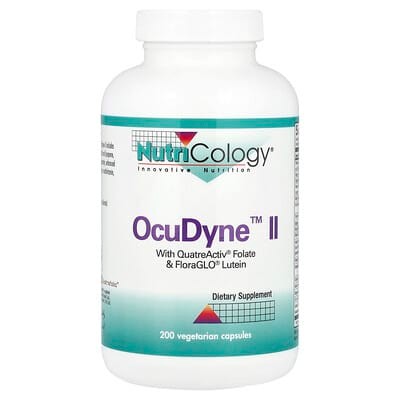
OcuDyne ll

OcuDyne ll

NutriCology4.7 (170 ratings)
Format:Capsule Quantity: 200 Capsule(s) · 50 servings
Goals
$80.99 $1.61 per serving

About this product

The eye-health rationale brings together several nutrients, but a noticeable improvement in everyday vision is not established. Lutein and zeaxanthin are listed, while incomplete carotenoid details and an insufficiently identified bilberry preparation limit confidence in specific benefits. Normal nutritional roles should not be read as a demonstrated improvement in visual performance.

Mineral sources are a relative strength, including 25 mg zinc as citrate and 1.5 mg copper as bisglycinate. The 125 mg magnesium serving can add to dietary intake, while folate and B vitamins support normal energy use when intake is low. B6 reaches 15 mg per serving, without a basis for expecting extra energy from taking more.

Quercetin, NAC, taurine and several botanicals extend the formula well beyond basic eye nutrition. Their presence does not establish routine gains in productivity, hormone levels or toxin clearance. For someone seeking one specific benefit, the broad mixture makes it harder to identify which ingredients are worth paying for.

The higher serving cost is difficult to justify for basic vitamin and mineral coverage alone. Numerous unnamed forms and mixed-form entries leave important details unresolved, including the vitamin A and D findings and the proportions of several blends. Repeated lutein, niacin or selenium declarations should not be added together to assume a larger dose.

Who is it for
  • Adults seeking combined eye-related nutrients and broad nutritional coverage
  • People comfortable with a complex formula after checking the unresolved label details
Best for
  • Combining eye-related carotenoids with general nutrient support
  • Adding citrate-form zinc and clearly identified copper alongside dietary intake

Pros

  • Zinc citrate and copper bisglycinate provide favorable mineral sources
  • Magnesium contributes a meaningful amount alongside the wider nutrient mix
  • Folate and B vitamins support normal energy-related nutritional functions
  • Combines lutein and zeaxanthin with other nutrients involved in normal eye function

Cons

  • High serving cost for basic vitamin and mineral coverage
  • Numerous unnamed forms and undisclosed blend proportions limit comparisons
  • Specific everyday vision and productivity gains are not established
  • Repeated declarations leave some total amounts unresolved

Warnings

  • The ginkgo extract has no declared ginkgolic-acid limit or named source, leaving an important extract-quality detail unconfirmed before ongoing use.

Product analysis

49 out of 100

OcuDyne ll combines broad nutritional support with ingredients aimed at eye health, with benefits most relevant when intake is low. Missing ingredient forms and blend proportions make the complex formula harder to compare.

AI assessment of the formula, label and price. How scoring works

Nutrient Quality44

Some B vitamins and minerals use favorable forms for the body to use. Many other forms are unspecified or uncertain, and the proportions of the selenium blend are unknown.

Ingredient Transparency68

Ingredient amounts are listed, but many forms and several blend proportions are missing. Those gaps make a complex formula harder to compare with simpler alternatives.

Value For Money30

Several vitamins and minerals offer limited value at the full serving cost. Uncertain value for many other ingredients makes the added expense harder to justify.

Customer Satisfaction72

Customer ratings are very positive. The smaller review base limits confidence in how widely that satisfaction is shared.

Product Focus34

The long ingredient list spreads across everyday nutrition, eye health and several other purposes. The eye-health benefits remain uncertain for several ingredients, so the broad blend should not be taken as evidence of better vision.

Format
Capsule
Container
200 Capsule(s)
Per serving
$1.61
Customer rating
4.7 · 170 ratings
Report analysis

Goals

Impact
High effect
D Ingredient FitB+ PathwaysA- EvidenceA+ Formulation Logic
Zinc · 25 mgVitamin E · 10 mgVitamin C · 200 mgCopper · 1.5 mgVitamin A · 3.2 mcg RAE

Riboflavin helps maintain normal eye health when intake is deficient, while vitamins C and E contribute antioxidant functions. Zinc and copper have roles in selected AMD formulations, without establishing everyday vision improvement here. The bilberry extract is not identified as the preparation studied for screen-related focusing fatigue. Zeaxanthin is present at only 0.6 mg per serving, far below the 20 mg daily preparation studied in preliminary visual-processing research.

How this product is rated for Eye Health

Ingredient fit49

This broad formula contains several counted nutrients, but many other actives and uneven amounts limit its vision focus.
Goal fit
Several vision-related nutrients are included, but the broad mix of other actives reduces the formula’s focus on vision.
Dose adequacy
The saved finding reflects uneven amounts across the counted ingredients, rather than proof of an effective daily regimen.

Pathways80

The saved findings emphasize antioxidant defense and visual-cycle coverage; macular pigment, focusing and circulation are not covered.
Depth
Retinal and lens antioxidant defense is the strongest saved area, driven by the counted antioxidant nutrients.
Breadth
Antioxidant defense and visual-cycle support are covered; macular pigment, focusing and circulation remain uncovered.

Evidence88

Copper leads the saved finding, but its relevant role is balancing high-dose zinc rather than independently improving vision.
Evidence strength
Copper leads the saved finding, but its supported eye-formulation role does not establish independent vision improvement.
Studied preparation
The saved finding recognizes the counted preparations; matching a preparation does not remove the population and outcome limits of its evidence.

Formulation logic97

Copper accompanies zinc and no conflict was matched; the unresolved carotenoid amount limits the amount finding.
Partner coverage
No required partner was missing among the counted ingredients; this does not establish extra benefit from combining them.
Conflicts
No configured ingredient conflict was matched in the supplied findings.
Effective doses
Seven counted ingredients meet the saved amount criterion; the unresolved carotenoid amount does not.
Study evidence
Copper Supportive 7 studies
Ginkgo Supportive 11 studies
Lycopene Supportive 5 studies
Riboflavin Supportive 69 studies
Selenium Supportive 15 studies
Taurine Supportive 1 study
Vitamin A Supportive 65 studies
Vitamin C Disputed 24 studies
Vitamin D Disputed 35 studies
Vitamin E Disputed 35 studies
Zinc Supportive 39 studies
Everyday Health
Impact
Highest effect
B- Ingredient FitA+ PathwaysB+ EvidenceA+ Formulation Logic
Folate · 667 mcg DFEVitamin B12 · 28 mcgVitamin D · 5 mcgMagnesium · 125 mgBoron · 300 mcgGlycine · 25 mgSelenium · 100 mcgTaurine · 250 mgZinc · 25 mgVitamin C · 200 mg

The B vitamins and folate provide nutritional availability when intake is low. Iodine contributes to adequate intake needed to avoid deficiency-related thyroid problems. Magnesium adds a mineral contribution, while larger vitamin amounts and special forms do not establish improved health beyond adequacy.

How this product is rated for Everyday Health

Ingredient fit70

The relevant nutrients offer conditional nutritional support. Vitamin B12, Vitamin D, Vitamin C and other small nutrient amounts are present but not counted at the declared amounts.
Goal fit
Relevant nutrients contribute to general health, while other ingredients serve purposes outside the supplied routine-health evidence.
Dose adequacy
Declared nutrient amounts make varying contributions to the saved comparison; larger quantities do not establish extra benefit when intake is adequate.

Pathways100

The strongest connection is energy metabolism cofactors. The nutrient contributions extend across several functional areas.
Depth
The strongest ingredient association is with energy metabolism cofactors, reflecting nutrient availability rather than a demonstrated change in health outcomes.
Breadth
The nutrient contributions extend across several functional areas, meeting the saved breadth target.

Evidence85

Magnesium leads the counted contribution. The supplied evidence supports a nutritional role when intake is low, without proving improved outcomes from this exact product.
Evidence strength
Magnesium provides the strongest counted contribution; its relevance remains nutritional availability when intake is low, rather than proven improvement above adequacy.
Studied preparation
The counted preparations are accepted for the nutrient comparison. This does not establish an advantage for the chemical forms, delivery method or exact product.

Formulation logic100

The counted nutrients require no missing partner, and no configured conflict was found. Their combination does not establish an extra health benefit.
Partner coverage
All counted ingredients can contribute independently or have their required partner; no added benefit from combining them is established.
Conflicts
No configured conflict was found; the applicable nutrient amounts and partner declarations do not trigger the listed concerns.
Effective doses
All counted ingredients meet the saved inclusion threshold, which is a comparison boundary rather than a proven supplement-response dose.
Study evidence
Boron Supportive 6 studies
Folate Supportive 80 studies
Glycine Supportive 4 studies
Magnesium Supportive 114 studies
Selenium Supportive 70 studies
Taurine No effect 3 studies
Vitamin C Supportive 56 studies
Vitamin D Supportive 115 studies
Zinc Supportive 60 studies
Impact
High effect
C- Ingredient FitD+ PathwaysA+ EvidenceA+ Formulation Logic
Folate · 667 mcg DFEVitamin B12 · 28 mcgVitamin B6 · 15 mgMolybdenum · 60 mcgSelenium · 100 mcgMagnesium · 125 mgVitamin E · 10 mgZinc · 25 mgVitamin C · 200 mgTaurine · 250 mgRiboflavin · 12.5 mgGlycine · 25 mg

Folate can address a dietary gap relevant to arsenic handling, but the supplied human findings concern arsenic-exposed populations and do not establish routine toxin removal. Selenium has limited findings on mercury handling in small studies involving low selenium status or mercury exposure; these do not establish generalized detoxification. Taurine can affect bile composition, but that does not establish removal of an identified toxin or a routine detoxification benefit.

How this product is rated for Liver & Detox

Ingredient fit56

Partial amount coverage; glycine, glutamic acid, B12 and C fall below their thresholds.
Goal fit
Partial amount coverage.
Dose adequacy
The credited amounts provide partial overall amount coverage; this comparison does not establish clinical detoxification doses.

Pathways55

The saved findings emphasize enzyme-related nutrient processes. This category assignment does not establish faster toxin removal.
Depth
The strongest recorded coverage is in enzyme-related nutrient processes, rather than a demonstrated clinical toxin-clearance outcome.
Breadth
One category reaches the saved breadth threshold; this does not establish combined clinical detoxification effects.

Evidence97

Folate leads the saved evidence finding, but its relevant toxin-handling evidence is limited to particular exposure and nutritional settings.
Evidence strength
Folate leads the saved evidence finding, but its relevant toxin-handling evidence is limited to particular exposure and nutritional settings.
Studied preparation
Molybdenum, riboflavin and B6 lack matching studied-preparation recognition; the remaining eligible ingredients receive it in the saved findings.

Formulation logic100

No missing required partner or configured conflict was identified; every credited ingredient passes the minimum-amount threshold.
Partner coverage
All credited ingredients can stand alone or have their required partner in the saved findings; this does not prove synergy.
Conflicts
No configured conflict was identified from the supplied ingredients and amounts.
Effective doses
All credited ingredients pass the saved minimum-amount threshold; that threshold does not establish toxin-clearance efficacy.
Study evidence
Folate Supportive 16 studies
Glycine Supportive 5 studies
Magnesium Supportive 19 studies
Selenium Supportive 10 studies
Taurine Supportive 2 studies
Vitamin C Supportive 9 studies
Vitamin E Supportive 23 studies
Zinc Supportive 30 studies
Immunity
Impact
High effect
C- Ingredient FitB+ PathwaysA+ EvidenceA+ Formulation Logic
Magnesium · 125 mgVitamin C · 200 mgZinc · 25 mgVitamin A · 3.2 mcg RAEVitamin D · 5 mcgSelenium · 100 mcg

Zinc and selenium contribute to normal immune nutrition, while copper, folate and vitamins B6 and B12 can help address low intake that impairs immune-cell function. Those nutritional roles do not demonstrate infection prevention when intake is adequate. Magnesium and vitamin E receive findings in the saved result, but the supplied context does not establish a routine clinical immune benefit from supplementing them.

How this product is rated for Immunity

Ingredient fit57

Relevant ingredients connect the product to immune support, with the strength of the amount finding depending on the selected serving.
Goal fit
Relevant ingredients contribute to the immune findings, while other active ingredients make this a broader-purpose formula.
Dose adequacy
The selected serving provides partial contributions across the relevant comparison amounts, without establishing a proven clinical response threshold.

Pathways80

The strongest saved finding concerns oxidative and inflammatory balance. Other immune areas also receive substantial coverage.
Depth
The strongest saved finding concerns oxidative and inflammatory balance; it does not by itself establish fewer infections.
Breadth
Two immune areas receive substantial coverage, providing some breadth in the saved findings.

Evidence100

Zinc provides the leading saved evidence finding. Supplied clinical qualifications determine which benefits can be expected.
Evidence strength
Zinc leads the saved evidence finding; its clinical meaning remains bounded by the supplied nutrient or preparation-specific evidence.
Studied preparation
The saved preparation criteria are met, without establishing superiority of the supplied forms or transferability of every clinical outcome.

Formulation logic100

The relevant ingredients have the partners they require, no configured conflict was found, and included amounts meet the minimum saved comparison.
Partner coverage
Relevant ingredients can contribute independently or have their required partners present; an extra combination benefit is not established.
Conflicts
No configured conflict was identified among the supplied ingredients.
Effective doses
The included ingredients meet the saved minimum amount comparison; this does not establish proven clinical efficacy at those amounts.
Study evidence
Magnesium Supportive 8 studies
Selenium Mixed 37 studies
Vitamin A Supportive 107 studies
Vitamin C Supportive 53 studies
Vitamin D Supportive 85 studies
Vitamin E Supportive 21 studies
Zinc Supportive 73 studies
Impact
Moderate effect
D+ Ingredient FitD+ PathwaysC EvidenceA+ Formulation Logic
Horsetail · 5 mgMethionine · 100 mg

Vitamin C at 200 mg supports normal collagen formation, while zinc at 25 mg supports nail-matrix cell growth. Zinc is most relevant when a shortfall contributes to nail changes; extra benefit in adequately nourished people is uncertain. Vitamin E adds antioxidant support, but evidence for an independent nail benefit remains limited.

How this product is rated for Nail Health

Ingredient fit50

The relevant vitamins and minerals offer nutritional support for nail tissue within a broader formula. The known nutrient amounts provide varying contributions; normal nutrient roles do not establish stronger or faster-growing nails.
Goal fit
The relevant vitamins and minerals offer nutritional support for nail tissue within a broader formula.
Dose adequacy
The known nutrient amounts provide varying contributions; normal nutrient roles do not establish stronger or faster-growing nails.

Pathways52

The strongest saved finding concerns nutrients involved in normal nail-cell development and keratinization. Support remains concentrated on one main route.
Depth
The strongest saved finding concerns nutrients involved in normal nail-cell development and keratinization.
Breadth
One of the assessed routes has substantial support; broad structural-protein support is absent from the saved findings.

Evidence62

Vitamin E supplies the strongest saved evidence finding, although its independent effect on nail strength or growth remains uncertain. Most relevant preparations match the saved evidence, but magnesium and selenium does not match a studied nail preparation.
Evidence strength
Vitamin E supplies the strongest saved evidence finding, although its independent effect on nail strength or growth remains uncertain.
Studied preparation
Most relevant preparations match the saved evidence, but magnesium and selenium does not match a studied nail preparation.

Formulation logic100

The relevant ingredients can contribute without a required additional partner. No ingredient conflicts were identified.
Partner coverage
The relevant ingredients can contribute without a required additional partner.
Conflicts
No ingredient conflicts were identified in the saved assessment.
Effective doses
All ingredients included in the saved dose check meet its minimum contribution threshold.
Study evidence
Calcium Supportive 1 study
Horsetail Not classified

No linked studies yet.

Magnesium Not classified

No linked studies yet.

Selenium Adverse 1 study
Vitamin C Supportive 1 study
Vitamin D Supportive 8 studies
Vitamin E Supportive 6 studies
Zinc No effect 1 study
Skin Health
Impact
High effect
D+ Ingredient FitB- PathwaysA+ EvidenceA+ Formulation Logic
Zinc · 25 mgVitamin C · 200 mgGlycine · 25 mgCopper · 1.5 mgSelenium · 100 mcgLycopene · 2.5 mgVitamin E · 10 mg

Vitamin C supports collagen formation, while zinc supports skin repair. B vitamins help maintain skin when intake is low, but larger amounts do not establish extra cosmetic benefits in adequately nourished adults. Copper supports connective-tissue cross-linking. Lycopene has modest, conflicting evidence for UV-related outcomes, and 2.5 mg per serving is below study-linked exposures; unresolved carotenoid details prevent transferring lutein findings.

How this product is rated for Skin Health

Ingredient fit54

Relevant skin nutrients are part of a broader formula. The retained amount findings reflect disclosed servings, with evidence limitations beside each ingredient’s role.
Goal fit
Skin-relevant ingredients sit within a broader formula containing other actives, so the product is only partly focused on this goal.
Dose adequacy
Disclosed serving amounts determine the retained amount findings; they do not establish an effective daily regimen or greater cosmetic benefit.

Pathways75

The saved findings are strongest for uv antioxidant defence, while actual skin benefits remain limited by the ingredient evidence.
Depth
The saved findings are strongest for uv antioxidant defence, while actual skin benefits remain limited by the ingredient evidence.
Breadth
Connective-tissue and UV-related pathways reach the saved coverage threshold; water-binding support remains absent from these findings.

Evidence100

Vitamin C drives the strongest retained evidence finding, principally for normal collagen function and low-intake correction.
Evidence strength
Vitamin C drives the strongest retained evidence finding, principally for normal collagen function and low-intake correction.
Studied preparation
The retained ingredients met the saved preparation check; that finding does not establish that the complete formula matches a skin trial.

Formulation logic98

The evaluated ingredients have no identified partner gaps or conflicts. Most retained ingredients meet the saved amount threshold; Lutein, zeaxanthin and mixed carotenoids do not.
Partner coverage
The retained ingredients can act independently or have their required partner; this does not establish extra benefit from combining them.
Conflicts
No conflicts were identified by the evaluated ingredient checks.
Effective doses
Most retained ingredients meet the saved amount threshold; Lutein, zeaxanthin and mixed carotenoids do not.
Study evidence
Copper Supportive 16 studies
Glycine Disputed 2 studies
Lycopene Supportive 20 studies
Niacin Supportive 61 studies
Selenium Supportive 22 studies
Vitamin A Supportive 106 studies
Vitamin C Supportive 53 studies
Vitamin E Supportive 38 studies
Zinc Supportive 66 studies

Ingredients

IngredientAmount per servingScore
Vitamin A
3.2 mcg RAE
Vitamin C (Ascorbic Acid)
200 mg
Vitamin D3
5 mcg
Vitamin E
67 mg
Mixed Tocopherols
50 mg
total Tocotrienols (Tocotrienol Complex Tocomin)
10 mg
Thiamine (Thiamine Hydrochloride)
10 mg 65
Riboflavin
12.5 mg 40
Niacin (Niacinamide)
30 mg NE
Vitamin B6 (Pyridoxine Hydrochloride)
15 mg 71
Folate
667 mcg DFE
Vitamin B12 (Methylcobalamin)
28 mcg
Pantothenic Acid (Calcium Pantothenate)
50 mg 70
Calcium (Calcium Citrate)
50 mg
Iodine (Potassium Iodide)
12 mcg
Magnesium (Magnesium Citrate)
125 mg
Zinc (Zinc Citrate)
25 mg 74
Selenium (Selenomethionine, Sodium Selenite)
100 mcg 52
Copper (Copper Bisglycinate)
1.5 mg 72
Manganese (Manganese Citrate)
5 mg 76
Chromium (Chromium Picolinate)
100 mcg 47
Molybdenum (Sodium Molybdate)
60 mcg 48
Potassium (Potassium Chloride)
49.5 mg
Boron (Boric Acid)
300 mcg
N-Acetyl-L-Cysteine
100 mg
Glycine
25 mg
L-Methionine
100 mg 49
Taurine
250 mg 47
L-Glutamic Acid
25 mg 60
Lutein (CWS beadlet, FloraGLO Lutein)
10 mg
Zeaxanthin
600 mcg
Quercetin
150 mg
Horsetail extract
5 mg
Ginkgo Leaf Extract (Ginkgo flavonglycosides, Terpene lactones)
30 mg 85
Bilberry (berry) extract (Anthocyanosides)
20 mg
Alpha-Lipoic Acid
75 mg
Lycopene
2.5 mg 70
Adults 18–50
Report overview
B+ Active Ingredient Quality & BioavailabilityA Dose, Safety & Label TransparencyF Value
+1
A clearly stated 25 mg of zinc from citrate makes the serving substantial and straightforward to compare. The main drawback is cost at about $1.62 per whole-product serving, which includes the rest of the formula.
How this ingredient is rated

Active Ingredient Quality & Bioavailability80

A specifically identified citrate source makes the zinc form straightforward to compare.
Zinc Form Bioavailability
Zinc citrate identifies the chemical source clearly; no blend proportions need to be inferred.

Dose, Safety & Label Transparency91

Clearly disclosed zinc and copper amounts make the mineral balance assessable.
Elemental Dose Transparency
The 25 mg amount is stated as elemental zinc, with its source form identified.
Zinc Dosage Safety & Effectiveness
The labeled serving provides a substantial 25 mg of elemental zinc.
Zinc-to-Copper Mineral Balance
The serving contains 1.5 mg copper with 25 mg zinc, a 16.7:1 ratio; both amounts are known.

Value30

At about $1.62 per whole-product serving, cost is a notable drawback for the zinc supplied. That price includes the rest of the formula.
Price Per Serving Efficiency
One whole-product serving costs about $1.62; this is not a price calculated per milligram of zinc.
A+ Active Ingredient Quality & BioavailabilityB- Dose, Safety & Label TransparencyF Value
B+ Active Ingredient Quality & BioavailabilityA+ Dose, Safety & Label TransparencyF Value
Report alternatives

Sources

Published studies used for the product analysis and the top-ranked studies for each ingredient and goal.


  1. Association of radioactive iodine treatment with survivorship symptoms and primary care utilisation in women of reproductive age with thyroid cancer: a retrospective cohort study.
    Devanarayan P; Hartman M; Partin M · Family medicine and community health · 2026
    Cohort study10,882 participantsEnergy forIodine
  2. Energy level and fatigue after surgery for thyroid cancer: A population-based study of patient-reported outcomes.
    Hughes DT; Reyes-Gastelum D; Kovatch KJ; Hamilton AS; Ward KC; Haymart MR · Surgery · 2020
    Cohort study2,584 participantsEnergy forIodine
  3. Health-Related Quality of Life in Differentiated Thyroid Cancer Survivors: A Cross-Sectional Study From Turkey.
    Gültekin A; Kahraman MY; Şengöz T; Şimşek FS · Head & neck · 2026
    Cross-sectional study202 participantsEnergy forIodine
  4. Magnesium-L-threonate improves sleep quality and daytime functioning in adults with self-reported sleep problems: A randomized controlled trial.
    Hausenblas HA; Lynch T; Hooper S; Shrestha A; Rosendale D; Gu J · Sleep medicine: X · 2025
    Randomized trial80 participantsEnergy forMagnesium
  5. Total magnesium intake and risk of frailty in older women.
    Struijk EA; Fung TT; Bischoff-Ferrari HA; Willett WC; Lopez-Garcia E · Journal of cachexia, sarcopenia and muscle · 2024
    Cohort study81,524 participantsEnergy forMagnesium
  6. Red blood cell magnesium and chronic fatigue syndrome.
    Cox IM; Campbell MJ; Dowson D · Lancet (London, England) · 1991
    Randomized trial32 participantsEnergy forMagnesium
  7. Exercise, magnesium and immune function.
    Laires MJ; Monteiro C · Magnesium research · 2008
    Narrative reviewEnergy forMagnesium
  8. [Efficacy of potassium N-acetylaminosuccinate (Cogitum) in the treatment of asthenic syndrome: results of double-blind placebo-controlled trial].
    Esin RG; Khayrullin IK; Esin OR; Fatykhova AF; Gismatullina EI; Isaeva YN · Zhurnal nevrologii i psikhiatrii imeni S.S. Korsakova · 2023
    Randomized trial37 participantsEnergy forPotassium
  9. Human resting energy expenditure in relation to dietary potassium.
    Dériaz O; Thériault G; Lavallée N; Fournier G; Nadeau A; Bouchard C · The American journal of clinical nutrition · 1991
    Randomized trial8 participantsEnergy forPotassium
  10. Physicochemical properties of and volatile compounds in riboflavin fortified cloudy apple juice; study of its effect on job fatigue among Egyptian construction workers.
    Fouad S; Ibrahim GE; Hussein AMS; Ibrahim FA; El Gendy A · Heliyon · 2021
    Non-randomized trialEnergy forRiboflavin
  11. Vitamin B status in patients with chronic fatigue syndrome.
    Heap LC; Peters TJ; Wessely S · Journal of the Royal Society of Medicine · 1999
    Case-control study30 participantsEnergy forRiboflavin
  12. B-vitamins, related vitamers, and metabolites in patients with quiescent inflammatory bowel disease and chronic fatigue treated with high dose oral thiamine.
    Bager P; Hvas CL; Hansen MM; Ueland P; Dahlerup JF · Molecular medicine (Cambridge, Mass.) · 2023
    Observational studyEnergy forRiboflavin
  13. Metabolic features of chronic fatigue syndrome.
    Naviaux RK; Naviaux JC; Li K; Bright AT; Alaynick WA; Wang L; Baxter A; Nathan N; Anderson W; Gordon E · Proceedings of the National Academy of Sciences of the United States of America · 2024
    Case-control study84 participantsEnergy forRiboflavin
  14. Effectiveness of Riboflavin in Inherited Metabolic Diseases: A Systematic Review
    Bregje Jaeger, Nina N Stolwijk, Femke Aaldering, Charlotte A Ruys, Marije Smits, Nicole I Wolf, Carla E M Hollak, Annet M Bosch · Journal of Inherited Metabolic Disease · 2026
    Systematic review381 studies pooledEnergy Metabolism Support forRiboflavin
  15. Influence of thiamin supplementation on the health and general well-being of an elderly Irish population with marginal thiamin deficiency.
    Smidt LJ; Cremin FM; Grivetti LE; Clifford AJ · Journal of gerontology · 1991
    Randomized trial80 participantsEnergy forThiamin
  16. Randomised clinical trial: high-dose oral thiamine versus placebo for chronic fatigue in patients with quiescent inflammatory bowel disease.
    Bager P; Hvas CL; Rud CL; Dahlerup JF · Alimentary pharmacology & therapeutics · 2021
    Randomized trial40 participantsEnergy forThiamin
  17. Dietary reference values for thiamin.
    EFSA Panel on Dietetic Products, Nutrition and Allergies (NDA); Turck D; Bresson JL; Burlingame B; Dean T; Fairweather-Tait S; Heinonen M; Hirsch-Ernst KI; Mangelsdorf I; McArdle HJ; Naska A; Nowicka G; Pentieva K; Sanz Y; Siani A; Sjödin A; Stern M; Tomé D; Van Loveren H; Vinceti M; Willatts P; Lamberg-Allardt C; Przyrembel H; Tetens I; Gudelj Rakic J; Ioannidou S; de Sesmaisons-Lecarré A; Forss AC; Neuhäuser-Berthold M · EFSA journal. European Food Safety Authority · 2026
    Guideline / consensusEnergy forThiamin
  18. Effects of thiamine supplementation on exercise-induced fatigue.
    Suzuki M; Itokawa Y · Metabolic brain disease · 1996
    Randomized trial16 participantsEnergy forThiamin
  19. Long-term maintenance treatment with 300 mg thiamine for fatigue in patients with inflammatory bowel disease: results from an open-label extension of the TARIF study.
    Bager P; Hvas CL; Rud CL; Dahlerup JF · Scandinavian journal of gastroenterology · 2022
    Randomized trialEnergy forThiamin
  20. A new perspective on vitamin B12 deficiency in rheumatology: a case-based review.
    Dułak NA; Rytlewska M; Jaskólska M; Chmielewski M · Rheumatology international · 2024
    Case series3 participantsEnergy forVitamin B12