
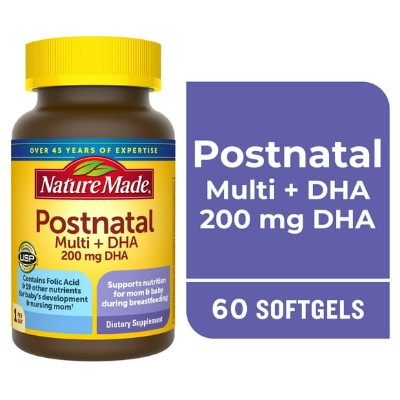

$18.98 $0.31 per serving


Product analysis
Postnatal Multi + DHA combines nutrients for normal bone nutrition and blood formation, with benefits most relevant when dietary intake is low.
AI assessment of the formula, label and price. How scoring works
Nutrient Quality39
Iodine uses a favorable form, while vitamin K uses a less favored form and omega-3 fats use ethyl esters. The quality of many other nutrient forms remains uncertain.
Ingredient Transparency73
Amounts and many forms are stated, but several preparations are unspecified. The oil mixture lacks complete component details, so its total does not reveal each part’s contribution.
Value For Money44
Vitamin K and iodine compare favorably for value, while iron and omega-3 fats offer more moderate value. The value of most remaining nutrients is uncertain.
Customer Satisfaction68
Customer feedback is positive. The modest review history gives a limited picture of satisfaction.
Product Focus49
The clearest role is nutritional support for bone maintenance and low-intake-related tiredness. The long nutrient list does not establish broad added benefits, and the DHA amount does not match the much higher exposures linked to some heart-related effects.
- Format
Softgel - Container
- 60 Softgel(s)
- Per serving
- $0.31
- Customer rating
- 4.5 · 116 ratings
Goals

Impact
High effect
Iodine · 150 mcgVitamin D · 50 mcgVitamin B5 · 7 mgMagnesium · 45 mgRiboflavin · 1.6 mgThiamin · 1.4 mgVitamin B12 · 5.8 mcgIron · 9 mg
Iron can help fatigue related to iron deficiency, and folate, riboflavin, niacin, B6, pantothenic acid and vitamin C support nutritional needs whose deficiency can cause tiredness. Benefit depends on low intake rather than surplus nutrition. Magnesium and B12 were too low for inclusion in the saved findings. Vitamin D's deficiency-specific treatment research does not establish fatigue relief from this ordinary serving.
How this product is rated for Energy
Ingredient fit71
Iron and several vitamins provide the included nutritional support. Amounts provide partial support; magnesium and B12 were too low for inclusion.
Goal fit
Iron and several vitamins provide the included nutritional support.
Dose adequacy
Amounts provide partial support; magnesium and B12 were too low for inclusion.
Pathways0
The saved findings identify no covered direct energy mechanism; the relevant contribution concerns nutrition and deficiency-related fatigue.
Depth
No direct energy mechanism is covered in the saved findings.
Breadth
No direct energy area reaches the saved coverage comparison.
Evidence97
Iron leads the saved findings, with fatigue benefit conditional on low iron status. Iodine did not match a studied preparation; the other included nutrient declarations did.
Evidence strength
Iron leads the saved findings, with fatigue benefit conditional on low iron status.
Studied preparation
Iodine did not match a studied preparation; the other included nutrient declarations did.
Formulation logic100
Included ingredients have no missing required partner or configured conflict and meet the saved minimum amount comparison.
Partner coverage
Included ingredients work without an additional required partner, or have their required partner; this does not establish an extra combination benefit.
Conflicts
No configured ingredient conflict was found in the supplied facts.
Effective doses
All included ingredients meet the saved minimum amount comparison; this is not a proven minimum effective dose.
Vitamin B5 Not classified
No linked studies yet.

Impact
High effect
Vitamin K · 90 mcgMagnesium · 45 mgVitamin B12 · 5.8 mcgVitamin B6 · 2 mgFolate · 830 mcg DFEVitamin D · 50 mcg
DHA has limited support for lipid and blood-pressure measures, but the 200 mg per serving does not establish the effects seen with higher study exposures. Folate participates in homocysteine processing without proving general cardiac protection. Thiamin helps prevent deficiency-related heart dysfunction when intake is low; extra intake offers no established cardiovascular benefit when needs are met. The small EPA amount does not establish an additional triglyceride contribution.
How this product is rated for Heart Health
Ingredient fit64
Relevant nutrients sit within a broader formula, and their amounts provide differing levels of exposure comparison.
Goal fit
The formula includes relevant nutrients alongside ingredients aimed at other goals, reducing its heart-health focus.
Dose adequacy
The counted amounts provide substantial exposure comparisons, with some below the reference range.
Pathways60
Homocysteine processing is the strongest finding, although changing this marker does not establish fewer cardiac events.
Depth
Homocysteine processing is the strongest finding, although changing this marker does not establish fewer cardiac events.
Breadth
One area reaches the saved comparison threshold, so the findings remain concentrated rather than spanning several heart-health mechanisms.
Evidence89
Folate leads the saved evidence finding, but its homocysteine effect does not establish general prevention of cardiac events.
Evidence strength
Folate leads the saved evidence finding, but its homocysteine effect does not establish general prevention of cardiac events.
Studied preparation
The counted preparations match the saved study comparison; matching a preparation alone does not establish the same benefit for every user.
Formulation logic100
The counted ingredients have no missing required partner or identified configured conflict. Their amounts meet the saved minimum comparison.
Partner coverage
No required partner is missing for the counted ingredients; this does not establish an extra benefit from combining them.
Conflicts
No configured ingredient conflict was identified in the supplied facts.
Effective doses
The counted ingredients meet the saved minimum amount comparison; this threshold does not prove clinical effectiveness.
DHA (Docosahexaenoic Acid) Not classified
No linked studies yet.

Impact
High effect
Vitamin K · 90 mcgMagnesium · 45 mgVitamin D · 50 mcgVitamin B12 · 5.8 mcgVitamin B6 · 2 mgVitamin E · 19 mgFolate · 830 mcg DFENiacin · 17 mgVitamin C · 120 mg
DHA has a connection to triglyceride markers, but the 200 mg per serving is far below the DHA amount used in the cited purified-fatty-acid trial. Folate supports normal homocysteine metabolism without establishing general cardiovascular-event prevention, while thiamin supports deficiency-related heart function when intake is low. The small EPA amount adds little here, and the mixed oil declaration cannot be treated as a studied preparation or an additional fatty-acid dose.
How this product is rated for Cardiovascular Support
Ingredient fit64
This broad postnatal nutrient formula has several cardiovascular-related roles, but many actives and small amounts limit its specific focus.
Goal fit
This broad postnatal nutrient formula has several cardiovascular-related roles, but many actives and small amounts limit its specific focus.
Dose adequacy
DHA, folate, vitamin D and thiamin meet the saved amount threshold; several other declared nutrients and EPA are below recognition here.
Pathways58
Homocysteine metabolism leads, while triglyceride and vessel-lining contributions are smaller.
Depth
Folate makes homocysteine metabolism the strongest represented route.
Breadth
Only homocysteine metabolism is substantially represented; the modest DHA amount provides a smaller triglyceride-related contribution.
Evidence83
DHA leads the evidence finding, which concerns specific markers or nutrient roles rather than proven cardiovascular-event prevention.
Evidence strength
DHA supplies the strongest recognized evidence among the ingredients at recognized amounts.
Studied preparation
The saved finding recognizes the four contributing preparations; the mixed parent oil itself does not establish a studied preparation.
Formulation logic100
No required partner is missing and no listed conflict was found.
Partner coverage
The recognized contributions do not lack a required partner.
Conflicts
No listed formulation conflict was identified.
Effective doses
4 recognized ingredients reach the amount threshold used here; it is not a proven clinical-effect threshold.

Impact
High effect
Vitamin K · 90 mcgMagnesium · 45 mgCalcium · 150 mgVitamin D · 50 mcgZinc · 12 mgVitamin C · 120 mg
Calcium supplies mineral for normal bone structure and can help fill a dietary intake gap; its 150 mg per serving is a contribution to total intake, not a daily target. Vitamin D supports calcium absorption and deficiency-related mineralization; larger amounts do not establish extra fracture protection in adults with adequate status. Vitamin C supports normal collagen formation; correcting low intake is distinct from extra bone benefit when intake is adequate.
How this product is rated for Bone Health
Ingredient fit67
Relevant ingredients sit within a broader formula, so only part of the product is specifically connected to bone health. The included amounts largely meet the saved references, with some providing only partial exposure compared with those references.
Goal fit
Relevant ingredients sit within a broader formula, so only part of the product is specifically connected to bone health.
Dose adequacy
The included amounts largely meet the saved references, with some providing only partial exposure compared with those references.
Pathways80
The main recorded connection is calcium absorption and regulation. Coverage is concentrated in a limited set of bone-related processes, leaving other aspects without substantial support.
Depth
The strongest recorded connection concerns calcium absorption and regulation, with substantial coverage from the included ingredients.
Breadth
Coverage is concentrated in a limited set of bone-related processes, leaving other aspects without substantial support.
Evidence98
Zinc provides the strongest recorded evidence. The qualifying preparations match the supplied evidence.
Evidence strength
Zinc provides the strongest recorded ingredient evidence at a qualifying amount; its population and outcome limitations still apply.
Studied preparation
The qualifying preparations match those recognized in the supplied evidence; this does not show that the finished product was tested.
Formulation logic93
A supporting partner is missing for Vitamin D. Shared rubric rule, limiting the combination’s support. No listed formulation conflict was matched in the supplied findings. This is limited to the specified checks.
Partner coverage
A supporting partner is missing for Vitamin D. Shared rubric rule, limiting the combination’s support.
Conflicts
No listed formulation conflict was matched in the supplied findings. This is limited to the specified checks.
Effective doses
Some relevant ingredients have small or unresolved amounts and do not meet the saved minimum amount threshold.
Ingredients
| Ingredient | Amount per serving | Score |
|---|---|---|
Calories | 5 Calorie(s) | |
Cholesterol | 5 mg | |
Vitamin A (Beta-Carotene) | 1299 mcg | |
Vitamin C (Ascorbic Acid) | 120 mg | |
Vitamin D3 (Cholecalciferol) | 50 mcg | |
Vitamin E (D-Alpha-Tocopherol) | 19 mg | |
Vitamin K (Phytonadione) | 90 mcg | |
Thiamine (Thiamine Mononitrate) | 1.4 mg | |
Riboflavin | 1.6 mg | |
Niacin (Niacinamide) | 17 mg | |
Vitamin B6 (Pyridoxine Hydrochloride) | 2 mg | |
Folate | 830 mcg DFE | |
Vitamin B12 (Cyanocobalamin) | 5.8 mcg | |
Biotin | 35 mcg | |
Pantothenic Acid (D-Calcium Pantothenate) | 7 mg | |
Calcium (Calcium Carbonate) | 150 mg | |
Iron (Ferrous Fumarate) | 9 mg | |
Iodine (Potassium Iodide) | 150 mcg | |
Magnesium (Magnesium Oxide) | 45 mg | |
Zinc (Zinc Oxide) | 12 mg | |
Omega-3 Fatty Acids (Ethyl Esters, Fish Oil concentrate) | 260 mg |
Iodine (Potassium Iodide) · 150 mcg OverallScore96
Each serving provides 150 mcg of iodine as potassium iodide. The whole-product serving costs about $0.32.
How this ingredient is rated
Active Ingredient Quality & Bioavailability100
Iodine is supplied as potassium iodide, a form the evaluation considers favorable for absorption.
Iodine Form & Bioavailability
Potassium iodide is the iodine source; the evaluation considers it favorable for absorption.
Marine Source Purity & Sourcing
The recorded source is potassium iodide, for which the marine sourcing check does not apply.
Dose, Safety & Label Transparency100
The recorded iodine amount is 150 mcg per serving and falls within the evaluation’s safety threshold.
Dosage Efficacy for Daily Support
Each serving provides 150 mcg of iodine. The evaluation considers this amount aligned with daily support.
Dosage Safety & Upper Limits
The 150 mcg serving amount is within the evaluation’s safety threshold.
Elemental Iodine Transparency
The iodine amount is recorded directly as 150 mcg per serving.
Value80
The whole-product serving costs about $0.32.
Price Per Effective Serving
The whole-product serving costs about $0.32.
Iron (Ferrous Fumarate) · 9 mg OverallScore51
Each serving supplies a small 9 mg of iron as ferrous fumarate. Zinc is also listed and may compete with iron absorption.
How this ingredient is rated
Active Ingredient Quality & Bioavailability31
The iron is listed as ferrous fumarate. Zinc is also listed and may compete with iron absorption, even though vitamin C is present.
Iron Chemical Form & Bioavailability
The iron is listed as ferrous fumarate.
Absorption Support & Blocker Avoidance
Zinc is also listed and may compete with iron absorption, even though vitamin C is present.
Dose, Safety & Label Transparency70
The saved serving amount is 9 mg of iron, a small amount.
Elemental Iron Label Clarity
The saved facts give an iron amount of 9 mg per serving and name its source.
Dosage Effectiveness & Safety Range
A serving provides 9 mg of iron, a small amount in this evaluation.
Value50
The whole-product serving costs about $0.32; that price covers the entire serving, not iron alone.
Price per Effective Serving
The whole-product serving costs about $0.32; that price covers the entire serving, not iron alone.
Vitamin K (Phytonadione) · 90 mcg OverallScore42
A serving provides 90 mcg of vitamin K1 as phytonadione. The saved facts identify K1 rather than an MK-7 amount, which matters when comparing K2 products.
How this ingredient is rated
Active Ingredient Quality & Bioavailability11
The identified vitamin K source is phytonadione, a form of vitamin K1. No MK-7 source is resolved in the saved facts, so its isomer cannot be assessed.
Vitamin K Form (MK-7 vs. MK-4 vs. K1)
The identified vitamin K source is phytonadione, a form of vitamin K1.
MK-7 Isomer Disclosure
No MK-7 source is resolved in the saved facts, so its isomer cannot be assessed.
Dose, Safety & Label Transparency44
The saved facts identify 90 mcg of vitamin K and its K1 source.
Vitamin K2 (MK-7) Dosage Efficacy
No MK-7 amount is established in the saved facts.
Form and Subtype Transparency
The saved facts identify 90 mcg of vitamin K and its K1 source.
Value100
A whole-product serving costs about $0.32.
Price per Effective MK-7 Serving
A whole-product serving costs about $0.32.
Alternative products
Report alternatives
Sources
Published studies used for the product analysis and the top-ranked studies for each ingredient and goal.
- What is the impact of daily oral supplementation of vitamin D3 (cholecalciferol) plus calcium on the incidence of hip fracture in older people? A systematic review and meta-analysis.
- Calcium supplementation prevents seasonal bone loss and changes in biochemical markers of bone turnover in elderly New England women: a randomized placebo-controlled trial.
- The effects of calcium supplementation (milk powder or tablets) and exercise on bone density in postmenopausal women.
- The efficacy of calcium supplementation alone in elderly Thai women over a 2-year period: a randomized controlled trial.
- Calcium-enriched foods and bone mass growth in prepubertal girls: a randomized, double-blind, placebo-controlled trial.
- Association between RBC folate and lumbar bone mineral density in postmenopausal women, a cross-sectional study from NHANES 2009-2018.
- Genetic variants modify the associations of concentrations of methylmalonic acid, vitamin B-12, vitamin B-6, and folate with bone mineral density.
- Adequate Intake and Supplementation of B Vitamins, in Particular Folic Acid, can Play a Protective Role in Bone Health.
- Relation of homocysteine, folate, and vitamin B12 to bone mineral density of postmenopausal women.
- Dietary intake of folate, but not vitamin B2 or B12, is associated with increased bone mineral density 5 years after the menopause: results from a 10-year follow-up study in early postmenopausal women.
- Association between Serum Magnesium and Fractures: A Systematic Review and Meta-Analysis of Observational Studies.
- Bioabsorbable Magnesium-Based Materials Potential and Safety in Bone Surgery: A Systematic Review.
- Vascularized bone grafting fixed by biodegradable magnesium screw for treating osteonecrosis of the femoral head.
- An update on magnesium and bone health.
- Sex-specific differences in the association of magnesium intake with femoral neck bone mineral density among older adults.
- Habitual use of fish oil supplements, genetic predisposition, and risk of fractures: a large population-based study.
- Perilla seed oil improves bone health by inhibiting bone resorption in healthy Japanese adults: A 12-month, randomized, double-blind, placebo-controlled trial.
- An increase in dietary n-3 fatty acids decreases a marker of bone resorption in humans.
- The Relationship Between Omega-3, Omega-6 and Total Polyunsaturated Fat and Musculoskeletal Health and Functional Status in Adults: A Systematic Review and Meta-analysis of RCTs.
- Dietary intake of fish, n-3 polyunsaturated fatty acids and risk of hip fracture: A systematic review and meta-analysis on observational studies.