
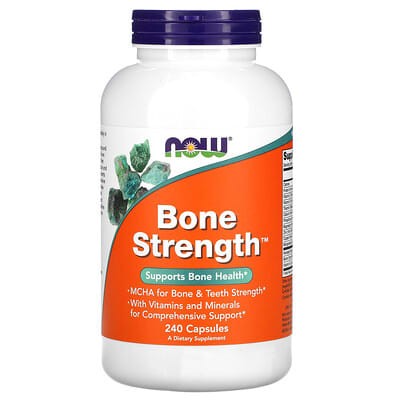

$20.80 $0.34 per serving


Product analysis
Bone Strength supplies calcium, magnesium and vitamin D to help meet the nutrient needs of bones. The magnesium mixture has undisclosed proportions and includes a less readily absorbed form, making its quality harder to judge.
AI assessment of the formula, label and price. How scoring works
Nutrient Quality49
Calcium and phosphorus are the clearest form-quality strengths. Magnesium is less convincing because its mixture includes oxide in unknown proportions, while the quality of several other forms remains uncertain.
Ingredient Transparency76
All ingredient amounts and most forms are disclosed, helping you compare the mineral content. Missing mixture proportions and the horsetail form leave some components harder to judge.
Value For Money58
Several minerals and vitamin K compare favorably on serving cost. Magnesium offers weaker value because its mixture is less clearly specified, and value for several other ingredients is uncertain.
Customer Satisfaction87
Customer ratings are strongly positive. Thousands of ratings provide a broad picture of buyer satisfaction.
Product Focus55
The main purpose is nutritional support for bone maintenance, particularly when intake is low. The broader set of uses is less consistently supported and adds complexity to the formula.
- Format
Capsule - Container
- 240 Capsule(s)
- Per serving
- $0.34
- Customer rating
- 4.7 · 3,042 ratings
Goals

Impact
Highest effect
Phosphorus · 287 mgVitamin K · 67 mcgMagnesium · 400 mgCalcium · 667 mgVitamin D · 16.68 mcgCopper · 0.7 mgManganese · 2 mgBoron · 467 mcgZinc · 7 mgVitamin C · 133 mg
Calcium and magnesium supply minerals for bone maintenance, while vitamin D supports calcium absorption and deficiency-related mineralization. Vitamin C and copper contribute to the collagen matrix when intake is inadequate. The vitamin K is MK-4 at a microgram amount, so findings from MK-7 or pharmacologic MK-4 studies do not establish the same benefit here. Boron and horsetail amounts were too small to contribute in the saved comparison.
How this product is rated for Bone Health
Ingredient fit69
The formula offers bone-related nutritional support, with the usefulness of individual amounts depending on dietary intake.
Goal fit
The formula includes bone-related nutrients alongside ingredients serving other purposes, so its focus on bone health is diluted.
Dose adequacy
The declared amounts provide differing degrees of nutritional support; reaching a comparison amount does not prove added bone benefit.
Pathways80
The findings reflect the particular aspects of bone maintenance supported by the declared ingredients.
Depth
The strongest contribution is bone mineral supply.
Breadth
The findings extend across two main aspects of bone health, with less support for the remaining aspects.
Evidence98
Nutrient functions and preparation-specific findings explain these contributions; they do not establish fracture prevention for the product.
Evidence strength
Calcium can address low intake and support mineralization, while fracture trial findings are mixed.
Studied preparation
Vitamin K preparation details limit transfer of the specific bone-study findings.
Formulation logic100
The findings consider nutrient amounts, partner support and identified conflicts.
Partner coverage
The recognized nutrients either contribute independently or have the partner support required by the saved comparison.
Conflicts
No ingredient conflict was identified in the supplied comparison.
Effective doses
The counted nutrients meet the saved contribution threshold; that threshold is not a proven clinical effective dose.
Horsetail Not classified
No linked studies yet.

Impact
Highest effect
Vitamin D · 16.68 mcgMagnesium · 400 mgVitamin K · 67 mcgBoron · 467 mcgZinc · 7 mgVitamin C · 133 mg
Magnesium and thiamin provide nutrients used in energy metabolism, while calcium and vitamins D and K contribute to bone and mineral maintenance. Calcium can help address low dietary intake, and the selected serving supplies 667 mg. These nutritional roles do not establish stronger bones or disease prevention in adults with adequate nutrient intake, nor an extra benefit from combining the ingredients.
How this product is rated for Everyday Health
Ingredient fit73
Relevant nutrients contribute to general health, while other active ingredients broaden the formula beyond this goal. The relevant amounts make a partial contribution rather than reaching all comparison levels used in the saved findings.
Goal fit
Relevant nutrients contribute to general health, while other active ingredients broaden the formula beyond this goal.
Dose adequacy
The relevant amounts make a partial contribution rather than reaching all comparison levels used in the saved findings.
Pathways80
The main contribution is to energy metabolism, with additional nutritional roles also represented.
Depth
The strongest contribution is to energy metabolism; this describes the nutritional role covered most fully by the supplied amounts.
Breadth
The saved findings cover energy metabolism, bone and mineral metabolism, giving several nutritional contributions.
Evidence86
Magnesium leads the supported contribution. Normal nutrient functions do not establish additional benefit when intake is adequate.
Evidence strength
Magnesium provides the strongest supported contribution among the included amounts, with benefits limited by the relevant nutritional context.
Studied preparation
The included preparations receive recognition in the saved findings; this does not establish superiority over other forms or benefits beyond the supplied context.
Formulation logic100
No listed ingredient conflict was triggered in the saved findings. The included amounts meet the saved minimum and have no missing required partner.
Partner coverage
The included ingredients can make their assigned contributions without a missing required partner; no added combination benefit is established.
Conflicts
No listed ingredient conflict was triggered in the saved findings.
Effective doses
All included ingredients meet the saved minimum amount threshold; this is not a proven clinical response threshold.

Impact
High effect
Vitamin K · 67 mcgMagnesium · 400 mgVitamin D · 16.68 mcg
Magnesium supports electrolyte balance and blood-vessel tone, but supplementation has shown marginal and inconsistent blood-pressure effects. The 400 mg per serving reaches the saved amount plateau. The findings focus on this one aspect of heart health. Thiamin also fills a nutritional role when intake is low; more does not add benefit once needs are met.
How this product is rated for Heart Health
Ingredient fit59
The relevant minerals supply a vascular connection within a broader formula. Magnesium reaches the saved amount plateau, while the included nutrient contributions vary.
Goal fit
The relevant minerals supply a vascular connection within a broader formula.
Dose adequacy
Magnesium reaches the saved amount plateau, while the included nutrient contributions vary.
Pathways57
The saved findings concentrate on electrolyte balance and blood-vessel tone.
Depth
Magnesium supplies the main finding for vessel tone.
Breadth
Only the electrolyte and vessel-tone aspect meets the saved coverage criterion.
Evidence89
Magnesium leads the saved evidence finding, although blood-pressure results are marginal and inconsistent. The saved preparation check is satisfied, without establishing superiority of a particular magnesium salt.
Evidence strength
Magnesium leads the saved evidence finding, although blood-pressure results are marginal and inconsistent.
Studied preparation
The saved preparation check is satisfied, without establishing superiority of a particular magnesium salt.
Formulation logic100
The counted ingredients have no missing required partner, and no specified conflict was identified. The counted amounts meet the saved minimum criterion.
Partner coverage
The counted ingredients have no missing required partner.
Conflicts
No specified ingredient conflict was identified in the supplied facts.
Effective doses
The counted nutrient contributions meet the saved minimum amount criterion.

Impact
Moderate effect
Vitamin D · 16.68 mcgMagnesium · 400 mgVitamin C · 133 mg
Magnesium may help with stress when your magnesium levels are low. Whether it brings lasting relief from everyday stress when you already get enough is unclear.
How this product is rated for Stress Relief
Ingredient fit52
Magnesium may help with stress when your magnesium levels are low. Whether it brings lasting relief from everyday stress when you already get enough is unclear.
Goal fit
Copper (zinc balance), Thiamin (B1), Zinc, Vitamin D, Vitamin C, Magnesium have a connection to this goal; that connection doesn't guarantee a noticeable benefit.
Dose adequacy
Copper (zinc balance): 0.7 mg per serving; Thiamin (B1): 3 mg per serving; Zinc: 7 mg per serving; Vitamin D: 16.68 mcg per serving; Vitamin C: 133 mg per serving; Magnesium: 400 mg per serving.
Pathways50
The main connection is neural calming, which doesn't by itself guarantee relief from everyday stress.
Depth
The main connection is neural calming, which doesn't by itself guarantee relief from everyday stress.
Breadth
The ingredients have a limited spread of connections to stress-related functions; this does not predict how much relief you will feel.
Evidence76
Magnesium may help with stress when your magnesium levels are low. Whether it brings lasting relief from everyday stress when you already get enough is unclear.
Evidence strength
Magnesium may help with stress when your magnesium levels are low. Whether it brings lasting relief from everyday stress when you already get enough is unclear.
Studied preparation
The identified ingredient forms are applicable to the ingredient context, without guaranteeing an effect on stress.
Formulation logic100
The relevant ingredients have no missing required companion or identified conflict.
Partner coverage
No required companion ingredient is missing for the relevant ingredients.
Conflicts
No particular ingredient conflict is identified.
Effective doses
Copper (zinc balance): 0.7 mg per serving; Thiamin (B1): 3 mg per serving; Zinc: 7 mg per serving; Vitamin D: 16.68 mcg per serving; Vitamin C: 133 mg per serving; Magnesium: 400 mg per serving.

Impact
High effect
Vitamin K · 67 mcgMagnesium · 400 mgVitamin D · 16.68 mcgVitamin C · 133 mg
Magnesium contributes to normal vascular tone and has limited support for some arterial-stiffness measures. Vascular and blood-pressure findings are inconsistent, and no magnesium salt has established superior cardiovascular effects. The declared elemental amount is recognized in the saved findings, without implying that higher amounts offer greater benefit. Thiamin is relevant when low intake affects normal heart function, with no established added benefit when intake is adequate.
How this product is rated for Cardiovascular Support
Ingredient fit56
Magnesium provides the main recognized connection. Partial or unresolved amounts limit resemblance to the compared exposures.
Goal fit
The relevant ingredients sit within a broader formula, so only part of its ingredient content connects to cardiovascular support.
Dose adequacy
The serving amounts provide partial exposure relative to the saved references; that comparison is not a measured dose-response.
Pathways54
The strongest recorded connection concerns vascular tone and mineral balance. The formula’s mechanism profile is narrow.
Depth
The strongest recorded connection concerns vascular tone and mineral balance; its ingredient-specific limits prevent interpreting this as proven clinical protection.
Breadth
Recorded coverage is concentrated on vascular tone and mineral balance, leaving the other mechanisms largely unrepresented.
Evidence79
Magnesium leads the recognized evidence. Vascular and blood-pressure findings are inconsistent, and no magnesium salt has established superior cardiovascular effects.
Evidence strength
Magnesium leads the recognized evidence. Vascular findings remain inconsistent.
Studied preparation
The saved finding recognizes the eligible preparations, without establishing finished-product equivalence or superior effects from a particular form.
Formulation logic100
No required partner is missing and no configured conflict was identified. The recognized ingredients meet the saved exposure threshold without implying added combination benefits.
Partner coverage
No required partner is missing for the recognized ingredients; this does not establish synergy.
Conflicts
No configured ingredient conflict was identified in the supplied facts; this is limited to the interactions evaluated.
Effective doses
All ingredients included in this finding meet the saved exposure threshold; it is not a proven clinical-effectiveness threshold.

Impact
Moderate effect
Vitamin D · 16.68 mcgMagnesium · 400 mgThiamin · 3 mg
Magnesium at 400 mg, vitamin C and thiamin relate to nutritional adequacy and normal energy metabolism. Low magnesium or vitamin C intake can contribute to fatigue, but higher intake does not imply an extra boost when needs are already met. Vitamin D fatigue findings are specific to deficiency.
How this product is rated for Energy
Ingredient fit56
Relevant ingredients sit within a broader formula with several other purposes. The counted amounts meet only part of the saved comparison criteria.
Goal fit
Relevant ingredients sit within a broader formula with several other purposes.
Dose adequacy
The counted amounts meet only part of the saved comparison criteria.
Pathways0
The saved assessment finds no coverage of the listed energy mechanisms. None of the listed pathways reaches the saved coverage threshold.
Depth
The saved assessment finds no coverage of the listed energy mechanisms.
Breadth
None of the listed pathways reaches the saved coverage threshold.
Evidence95
Vitamin D provides the strongest saved evidence contribution among ingredients at qualifying amounts. All qualifying ingredients have a saved match to the preparation criteria.
Evidence strength
Vitamin D provides the strongest saved evidence contribution among ingredients at qualifying amounts.
Studied preparation
All qualifying ingredients have a saved match to the preparation criteria.
Formulation logic100
The counted ingredients can contribute alone or have their required partner present. No configured ingredient conflict was found in the supplied assessment. 4 of 4 counted ingredients meet the saved minimum amount criterion.
Partner coverage
The counted ingredients can contribute alone or have their required partner present.
Conflicts
No configured ingredient conflict was found in the supplied assessment.
Effective doses
4 of 4 counted ingredients meet the saved minimum amount criterion.
Ingredients
| Ingredient | Amount per serving | Score |
|---|---|---|
Calories | 5 Calorie(s) | |
Protein (MCHA, Protein Amino Acid Chelates) | 1 Gram(s) | |
Vitamin C (Magnesium Ascorbate) | 133 mg | |
Vitamin D3 (Cholecalciferol) | 16.68 mcg | |
Vitamin K-2 (Menaquinone-4) | 67 mcg | |
Thiamine (Thiamine Hydrochloride) | 3 mg | |
Calcium (MCHA) | 667 mg | |
Phosphorus (MCHA) | 287 mg | |
Magnesium (Magnesium Ascorbate, Magnesium Oxide) | 400 mg | |
Zinc (Zinc Amino Acid Chelate) | 7 mg | |
Copper (Copper Amino Acid Chelate) | 0.7 mg | |
Manganese (Manganese Amino Acid Chelate) | 2 mg | |
Horsetail herb | 67 mg | |
Boron (Boron Amino Acid Chelate) | 467 mcg |
Phosphorus (MCHA) · 287 mg OverallScore100
A serving lists 287 mg of phosphorus. The identified source is calcium hydroxyapatite, and the whole-product serving costs about $0.35.
How this ingredient is rated
Active Ingredient Quality & Bioavailability100
The phosphorus source is identified as calcium hydroxyapatite.
Phosphorus Form Quality
Calcium hydroxyapatite is the identified phosphorus form.
Form Disclosure Clarity
The phosphorus entry identifies calcium hydroxyapatite as the source.
Dose, Safety & Label Transparency100
The label states 287 mg phosphorus per serving.
Dose Adequacy and Safety
The stated amount is 287 mg of phosphorus per serving.
Elemental Dose Transparency
The label states 287 mg of phosphorus per serving.
Value100
A whole-product serving costs about $0.35 and lists 287 mg of phosphorus.
Price Per Serving Efficiency
At about $0.35 per whole-product serving, the price is low in this comparison.
Calcium (MCHA) · 667 mg OverallScore75
A serving supplies 667 mg of calcium as calcium Microcrystalline Hydroxyapatite, a large amount at once. Absorption may be less efficient at that serving size.
How this ingredient is rated
Active Ingredient Quality & Bioavailability100
Calcium Microcrystalline Hydroxyapatite is the identified calcium source. The elemental calcium amount is stated per serving.
Calcium Form & Absorption Potential
Calcium Microcrystalline Hydroxyapatite is the identified calcium source.
Elemental Calcium Transparency
The elemental calcium amount is disclosed as 667 mg per serving.
Dose, Safety & Label Transparency48
The 667 mg calcium serving is large, and a smaller fraction may be absorbed at once. A flow agent is recorded.
Absorption-Optimized Serving Dose
The 667 mg calcium serving is large, and a smaller fraction may be absorbed at once.
Formulation Purity & Additives
A flow agent is recorded.
Value80
A whole-product serving costs about $0.35 and provides 667 mg of calcium.
Price Per Serving Efficiency
The whole-product serving costs about $0.35, a relatively low serving price in this comparison.
Copper (Copper Amino Acid Chelate) · 0.7 mg OverallScore57
Each serving supplies a relatively small 0.7 mg of copper as an amino acid chelate. The zinc-to-copper ratio is a favorable 10:1.
How this ingredient is rated
Active Ingredient Quality & Bioavailability58
The label gives the amount and names an amino acid chelate; the specific amino acid is not supplied in the saved facts.
Copper Form Bioavailability
Copper is described as an amino acid chelate, but the specific amino acid is not identified in the saved facts.
Elemental Copper Labeling Clarity
The copper row identifies a source and states 0.7 mg of elemental copper per serving.
Dose, Safety & Label Transparency44
Each serving provides a relatively small 0.7 mg of copper. The zinc-to-copper ratio is 10:1, which aligns with the balance favored in the assessment.
Copper Dosage Safety & Efficacy
Each serving provides a relatively small 0.7 mg of copper.
Zinc-to-Copper Balance
The zinc-to-copper ratio is 10:1, which aligns with the balance favored in the assessment.
Value80
The whole-product serving costs about $0.35, relatively inexpensive in this comparison.
Price Per Serving Efficiency
The whole-product serving costs about $0.35, relatively inexpensive in this comparison.
Alternative products
Report alternatives
Sources
Published studies used for the product analysis and the top-ranked studies for each ingredient and goal.
- [Comparative study of the urinary excretion of boron, calcium, magnesium and phosphorus in postmenopausal women with and without osteoporosis].
- Effect of dietary boron on mineral, estrogen, and testosterone metabolism in postmenopausal women.
- The relationship between boron and magnesium status and bone mineral density in the human: a review.
- Effects of boron supplementation on bone mineral density and dietary, blood, and urinary calcium, phosphorus, magnesium, and boron in female athletes.
- Metabolic responses of postmenopausal women to supplemental dietary boron and aluminum during usual and low magnesium intake: boron, calcium, and magnesium absorption and retention and blood mineral concentrations
- What is the impact of daily oral supplementation of vitamin D3 (cholecalciferol) plus calcium on the incidence of hip fracture in older people? A systematic review and meta-analysis.
- Calcium supplementation prevents seasonal bone loss and changes in biochemical markers of bone turnover in elderly New England women: a randomized placebo-controlled trial.
- The effects of calcium supplementation (milk powder or tablets) and exercise on bone density in postmenopausal women.
- The efficacy of calcium supplementation alone in elderly Thai women over a 2-year period: a randomized controlled trial.
- Calcium-enriched foods and bone mass growth in prepubertal girls: a randomized, double-blind, placebo-controlled trial.
- The Association between Dietary and Circulating Copper Levels and Osteoporosis: a Scoping Review.
- Association between dietary copper, iron, zinc, selenium intake and osteopenia or osteoporosis in elderly hypertensive patients: a retrospective cohort study.
- Associations of dietary copper intake with total bone mineral density and lumbar spine bone mineral density in American adults.
- The association between dietary mineral intake and bone mineral density: a cross-sectional study.
- Association between dietary copper intake and bone mineral density in children and adolescents aged 8-19 years: A cross-sectional study.
- Association between Serum Magnesium and Fractures: A Systematic Review and Meta-Analysis of Observational Studies.
- Bioabsorbable Magnesium-Based Materials Potential and Safety in Bone Surgery: A Systematic Review.
- Vascularized bone grafting fixed by biodegradable magnesium screw for treating osteonecrosis of the femoral head.
- An update on magnesium and bone health.
- Sex-specific differences in the association of magnesium intake with femoral neck bone mineral density among older adults.