
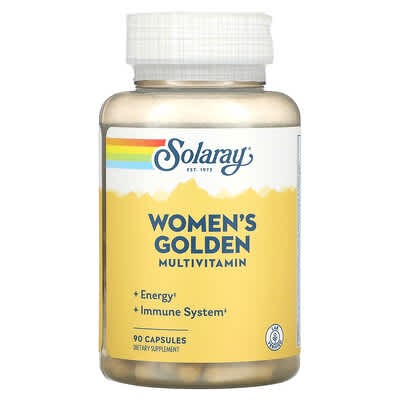

$17.29 $0.57 per serving


Product analysis
Women's Golden Multivitamin may help fill gaps in nutrients involved in normal immune function and energy use. Undisclosed blend contents make the additional ingredients harder to judge.
AI assessment of the formula, label and price. How scoring works
Nutrient Quality50
Ingredient quality varies, with favorable forms of selenium, manganese and vitamin B5 alongside less favorable forms of some other nutrients. The undisclosed blends prevent a complete comparison.
Ingredient Transparency74
All amounts and most forms are listed, making many ingredients easy to compare. The combined-source proportions and blend contents are undisclosed, leaving part of the formula unclear.
Value For Money42
Value varies between nutrients, with reasonable comparisons for B6, biotin and boron. Niacin, folate, B5 and selenium compare poorly, while several other comparisons remain uncertain.
Customer Satisfaction85
Customer ratings are consistently very positive. A substantial number of ratings provides a broad view of customer satisfaction.
Product Focus0
The clearest purpose is broad nutritional support when intake is low. The many health goals and undisclosed blends make the formula less focused, and male-population hormone findings cannot be assumed to apply to women.
- Format
Capsule - Container
- 90 Capsule(s)
- Per serving
- $0.57
- Customer rating
- 4.7 · 1,997 ratings
Goals

Impact
Highest effect
Folate · 680 mcgVitamin B12 · 200 mcgVitamin D · 10 mcgMagnesium · 40 mgBoron · 6 mgSelenium · 200 mcgZinc · 12 mgVitamin C · 400 mg

Impact
Highest effect
Magnesium · 40 mgVitamin C · 400 mgZinc · 12 mgVitamin A · 3000 mcgVitamin D · 10 mcgSelenium · 200 mcg

Impact
Moderate effect
Iodine · 150 mcgVitamin D · 10 mcgVitamin B5 · 25 mgMagnesium · 40 mgRiboflavin · 25 mgThiamin · 25 mgVitamin B12 · 200 mcgPotassium · 15 mg
Vitamin B5 Not classified
No linked studies yet.

Impact
High effect
Biotin · 300 mcgVitamin D · 10 mcgZinc · 12 mgVitamin C · 400 mg
Horsetail Not classified
No linked studies yet.

Impact
High effect
Zinc · 12 mgVitamin E · 330 mgVitamin C · 400 mgCopper · 2 mgVitamin A · 3000 mcg

Impact
High effect
Biotin · 300 mcgNiacin · 40 mgVitamin B12 · 200 mcgRiboflavin · 25 mgThiamin · 25 mgVitamin B5 · 25 mgVitamin B6 · 25 mgVitamin D · 10 mcgZinc · 12 mgMagnesium · 40 mg
Ingredients
| Ingredient | Amount per serving | Score |
|---|---|---|
Vitamin A (Beta-Carotene, Retinyl Palmitate) | 3000 mcg | |
Vitamin C (Ascorbic Acid) | 400 mg | |
Vitamin D (Cholecalciferol, Natural, Vitamin D3) | 10 mcg | |
Vitamin E (D-Alpha-Tocopheryl Succinate) | 330 mg | |
Thiamine (Thiamine Mononitrate) | 25 mg | |
Riboflavin | 25 mg | |
Niacin (Niacinamide) | 40 mg | |
Vitamin B6 (Pyridoxine Hydrochloride) | 25 mg | |
Folic Acid | 680 mcg | |
Vitamin B12 (Cyanocobalamin) | 200 mcg | |
Biotin | 300 mcg | |
Pantothenic Acid (Calcium D-Pantothenate) | 25 mg | |
Calcium (Calcium Carbonate, Calcium Citrate, Calcium Malate) | 75 mg | |
Iodine (Kelp, Potassium Iodide) | 150 mcg | |
Magnesium (Magnesium Oxide, Magnesium Citrate) | 40 mg | |
Zinc (Zinc Citrate) | 12 mg | |
Selenium (L-Selenomethionine) | 200 mcg | |
Copper (Copper Gluconate) | 2 mg | |
Manganese (Manganese Gluconate) | 5 mg | |
Chromium (Chromium Arginate) | 200 mcg | |
Potassium (Potassium Chloride) | 15 mg | |
Natural Carotenoid Complex | 20 mg | |
Boron (Boric Acid) | 6 mg | |
Bioflavonoids concentrate (Citrus limonum) | 5 mg | |
Horsetail extract | 10 mg | |
Women's Herbal Support Complex | 65 mg |
Selenium (L-Selenomethionine) · 200 mcg OverallScore86
Each serving provides 200 mcg of selenium, at a fairly high cost relative to the amount. The amount is clearly stated. The selenium is L-Selenomethionine.
How this ingredient is rated
Active Ingredient Quality & Bioavailability100
The selenium is L-Selenomethionine.
Selenium Chemical Form
The selenium is L-Selenomethionine.
Form Transparency & Isomer Specificity
The label specifically names the L form of selenomethionine.
Dose, Safety & Label Transparency100
200 mcg is an amount used in research on antioxidant and thyroid support. It is below the stated adult upper intake limit.
Dosage Efficacy Sweet Spot
200 mcg is an amount used in research on antioxidant and thyroid support.
Safety Margin & UL Adherence
200 mcg is below the stated adult upper intake limit, leaving room for selenium from food.
Value30
The cost is fairly high relative to the selenium amount.
Price per 200 mcg Serving
The cost is fairly high relative to the selenium amount.
Iodine (Kelp, Potassium Iodide) · 150 mcg OverallScore67
A serving supplies 150 mcg of iodine at a higher cost per serving. The amount fits the range for daily thyroid support. It includes potassium iodide, but another iodine form and the blend proportions are unknown. The marine source has no reported organic status or geographic origin.
How this ingredient is rated
Active Ingredient Quality & Bioavailability42
It includes potassium iodide, but another iodine form and the blend proportions are unknown. The marine source has no reported organic status or geographic origin.
Iodine Form & Bioavailability
It includes potassium iodide, but another iodine form and the blend proportions are unknown.
Marine Source Purity & Sourcing
The marine source has no reported organic status or geographic origin.
Dose, Safety & Label Transparency100
The iodine amount is listed as 150 mcg per serving. The amount fits the range for daily thyroid support.
Dosage Efficacy for Daily Support
The amount fits the range for daily thyroid support.
Dosage Safety & Upper Limits
The amount is below the adult upper intake limit.
Elemental Iodine Transparency
The iodine amount per serving is stated.
Value50
The cost per serving is higher.
Price Per Effective Serving
The cost per serving is higher.
Manganese (Manganese Gluconate) · 5 mg OverallScore82
A serving provides 5 mg of manganese. The cost per serving is mid-range. It uses Manganese Gluconate.
How this ingredient is rated
Active Ingredient Quality & Bioavailability80
It uses Manganese Gluconate.
Manganese Chemical Form
It uses Manganese Gluconate.
Dose, Safety & Label Transparency100
A serving provides 5 mg of manganese. The amount is stated separately.
Manganese Dosage Efficacy & Safety
A serving provides 5 mg of manganese.
Elemental Weight Disclosure
The manganese amount is stated separately.
Value50
The cost per serving is mid-range.
Price per Serving vs. Median
The cost per serving is mid-range.
Alternative products
Report alternatives
Sources
Published studies used for the product analysis and the top-ranked studies for each ingredient and goal.
- [Comparative study of the urinary excretion of boron, calcium, magnesium and phosphorus in postmenopausal women with and without osteoporosis].
- Effect of dietary boron on mineral, estrogen, and testosterone metabolism in postmenopausal women.
- The relationship between boron and magnesium status and bone mineral density in the human: a review.
- Effects of boron supplementation on bone mineral density and dietary, blood, and urinary calcium, phosphorus, magnesium, and boron in female athletes.
- Metabolic responses of postmenopausal women to supplemental dietary boron and aluminum during usual and low magnesium intake: boron, calcium, and magnesium absorption and retention and blood mineral concentrations
- What is the impact of daily oral supplementation of vitamin D3 (cholecalciferol) plus calcium on the incidence of hip fracture in older people? A systematic review and meta-analysis.
- Calcium supplementation prevents seasonal bone loss and changes in biochemical markers of bone turnover in elderly New England women: a randomized placebo-controlled trial.
- The effects of calcium supplementation (milk powder or tablets) and exercise on bone density in postmenopausal women.
- The efficacy of calcium supplementation alone in elderly Thai women over a 2-year period: a randomized controlled trial.
- Calcium-enriched foods and bone mass growth in prepubertal girls: a randomized, double-blind, placebo-controlled trial.
- The Association between Dietary and Circulating Copper Levels and Osteoporosis: a Scoping Review.
- Association between dietary copper, iron, zinc, selenium intake and osteopenia or osteoporosis in elderly hypertensive patients: a retrospective cohort study.
- Associations of dietary copper intake with total bone mineral density and lumbar spine bone mineral density in American adults.
- The association between dietary mineral intake and bone mineral density: a cross-sectional study.
- Association between dietary copper intake and bone mineral density in children and adolescents aged 8-19 years: A cross-sectional study.
- Association between RBC folate and lumbar bone mineral density in postmenopausal women, a cross-sectional study from NHANES 2009-2018.
- Genetic variants modify the associations of concentrations of methylmalonic acid, vitamin B-12, vitamin B-6, and folate with bone mineral density.
- Adequate Intake and Supplementation of B Vitamins, in Particular Folic Acid, can Play a Protective Role in Bone Health.
- Relation of homocysteine, folate, and vitamin B12 to bone mineral density of postmenopausal women.
- Dietary intake of folate, but not vitamin B2 or B12, is associated with increased bone mineral density 5 years after the menopause: results from a 10-year follow-up study in early postmenopausal women.