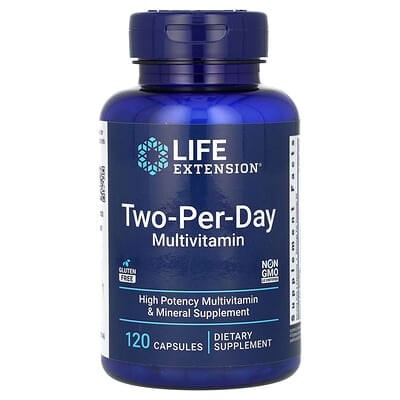
Two-Per-Day Capsules

Two-Per-Day Capsules

Life Extension4.7 (95,345 ratings)
Format:Capsule Quantity: 120 Capsule(s) · 60 servings
Goals
$17.21 $0.28 per serving

About this product

The formula can help fill several dietary gaps supporting normal energy metabolism, immune function and nerve nutrition. Named methylfolate, methylcobalamin and zinc sources help identify the main nutrient preparations. Larger amounts and active-form names do not establish sharper thinking, extra energy or hair regrowth when intake is already sufficient.

Serving size needs careful attention because the panel describes two capsules, while several goal findings use one capsule with adjusted amounts. The full panel lists 75 mg B6, which exceeds the adult daily upper limit cited in the supplied reference. It also lists 25 mg zinc with no established copper amount, while the small magnesium contribution and absence of calcium limit its use for mineral gaps.

Several mineral and vitamin mixtures lack proportions, and the precise chromium source remains unresolved despite a branded name. Marigold-extract weight does not establish lutein and zeaxanthin content, while the small alpha-lipoic acid and apigenin additions add little clear support for broader goals. The clearest value is broad nutrient gap filling when the serving and amounts fit the user's needs.

Who is it for
  • Adults needing several vitamins and trace minerals whose intake matches the chosen serving
  • People prepared to review the B6 amount before regular use
Best for
  • Broad nutrient supplementation with clearly identified core vitamin forms
  • Filling dietary gaps rather than seeking a general performance boost

Pros

  • Core nutrient amounts and many source forms are stated
  • Methylfolate and methylcobalamin are specifically identified
  • Named citrate and methionine zinc sources support comparison

Cons

  • One-capsule goal findings and two-capsule panel amounts differ
  • Limited magnesium and no calcium make bone-mineral coverage incomplete
  • Mixture proportions and precise chromium form remain unresolved
  • Small extras and uncertain carotenoid content weaken broader claims

Warnings

  • The two-capsule panel lists 75 mg B6, above the adult daily upper limit cited in the supplied reference; review ongoing use and avoid stacking B6 products.
  • The panel lists 25 mg zinc without an established copper quantity, leaving long-term mineral balance uncertain.
  • Confirm the capsule count when comparing intake; the adjusted one-capsule findings do not describe the complete two-capsule panel.


Product analysis

57 out of 100

Two-Per-Day Capsules provides broad vitamin and mineral support that can help fill dietary gaps. Several ingredient forms and mixture proportions are undisclosed, making parts of the formula harder to assess.

AI assessment of the formula, label and price. How scoring works

Nutrient Quality51

Several core vitamins and minerals use favorable forms, including vitamin B5, iodine and zinc. Unspecified forms and undisclosed mixture proportions limit confidence in other parts of the formula.

Ingredient Transparency73

All listed ingredient amounts are disclosed, making serving quantities easy to compare. Several forms and the proportions within mixtures are missing, limiting a closer quality comparison.

Value For Money53

The price is favorable for vitamin B6 and several minerals, but less favorable for vitamin B5 and apigenin. Other ingredient comparisons remain uncertain, so usefulness depends on which nutritional gaps need filling.

Customer Satisfaction92

Customer ratings are very positive across an extensive review base. The large volume gives a well-established picture of satisfaction without proving health benefits.

Product Focus19

The formula provides broad nutritional coverage across many health goals. The assessed one-capsule serving contributes smaller amounts of some nutrients, so filling dietary gaps is a clearer purpose than seeking extra performance.

Format
Capsule
Container
120 Capsule(s)
Per serving
$0.28
Customer rating
4.7 · 95,345 ratings
Report analysis

Goals

Immunity
Impact
High effect
D+ Ingredient FitA+ PathwaysA+ EvidenceA+ Formulation Logic
Magnesium · 100 mgVitamin C · 470 mgZinc · 25 mgVitamin A · 1500 mcg RAEVitamin D · 50 mcgSelenium · 200 mcg

Vitamin A supplies nutrition relevant to barrier defences, while zinc, vitamin D and B vitamins contribute to normal immune-cell function. Selenium contributes to antioxidant-enzyme nutrition. These nutrients can fill dietary gaps but do not establish infection prevention above adequate intake; additional benefit from vitamin E remains uncertain. Vitamin C and magnesium are present below the saved contribution thresholds.

How this product is rated for Immunity

Ingredient fit53

Eight nutrients provide the main contributions within a broader formula.
Goal fit
Eight nutrients provide the main contributions within a broader formula.
Dose adequacy
The counted nutrients provide mixed partial contributions; vitamin C and magnesium are below the saved threshold.

Pathways100

Oxidative and inflammatory balance receives the strongest saved coverage. Oxidative balance, lymphocyte regulation and barrier defence are covered.
Depth
Oxidative and inflammatory balance receives the strongest saved coverage.
Breadth
Oxidative balance, lymphocyte regulation and barrier defence are covered.

Evidence100

Zinc anchors the saved evidence finding; the supplied scientific limits determine what immune benefits can be expected.
Evidence strength
Zinc anchors the saved evidence finding, without establishing broad infection prevention.
Studied preparation
The counted preparations with substantial known amounts are accepted; no additional form advantage is established.

Formulation logic100

The counted nutrients work independently or have their required partner; no configured conflict was found.
Partner coverage
The counted nutrients work independently or have their required partner.
Conflicts
No configured ingredient conflict was found.
Effective doses
All 8 counted nutrients provide meaningful amounts under the saved criteria.
Study evidence
Magnesium Supportive 8 studies
Selenium Mixed 37 studies
Vitamin A Supportive 107 studies
Vitamin C Supportive 53 studies
Vitamin D Supportive 85 studies
Vitamin E Supportive 21 studies
Zinc Supportive 73 studies
Impact
Highest effect
C+ Ingredient FitA+ PathwaysB+ EvidenceA+ Formulation Logic
Folate · 680 mcg DFEVitamin B12 · 300 mcgVitamin D · 50 mcgMagnesium · 100 mgBoron · 3 mgSelenium · 200 mcgZinc · 25 mgVitamin C · 470 mg

The B vitamins provide nutrients used in normal energy metabolism, while folate and B12 contribute to nutritional availability for blood formation. This can help fill low dietary intake, without establishing extra energy or disease prevention when intake is adequate. Magnesium adds a mineral contribution, and the formula also includes nutrients involved in bone or antioxidant functions.

How this product is rated for Everyday Health

Ingredient fit70

The formula mixes counted nutritional ingredients with ingredients for other purposes, broadening its focus. The counted amounts only partly cover the saved comparison range.
Goal fit
The formula mixes counted nutritional ingredients with ingredients for other purposes, broadening its focus.
Dose adequacy
The counted amounts only partly cover the saved comparison range.

Pathways100

The strongest assigned area is energy metabolism cofactors. This describes the main nutritional connection, not demonstrated broad health improvement.
Depth
The strongest assigned area is energy metabolism cofactors. This describes the main nutritional connection, not demonstrated broad health improvement.
Breadth
The formula reaches the saved breadth requirement across multiple nutritional areas.

Evidence82

Vitamin B9 (Folate) leads the saved evidence finding. Its contribution remains conditional on the supplied context, without assuming improved outcomes above nutritional adequacy.
Evidence strength
Vitamin B9 (Folate) leads the saved evidence finding. Its contribution remains conditional on the supplied context, without assuming improved outcomes above nutritional adequacy.
Studied preparation
The counted preparations match the saved comparison; no chemical form or delivery method is established as superior.

Formulation logic100

No configured ingredient conflict was matched. No missing required partner reduces the counted contribution.
Partner coverage
No missing required partner reduces the counted ingredients’ contribution; this does not establish a combination benefit.
Conflicts
No configured ingredient conflict was matched.
Effective doses
The counted ingredients meet the saved amount requirement, which is a comparison threshold rather than a proven effective dose.
Study evidence
Boron Supportive 6 studies
Folate Supportive 80 studies
Magnesium Supportive 114 studies
Selenium Supportive 70 studies
Vitamin C Supportive 56 studies
Vitamin D Supportive 115 studies
Zinc Supportive 60 studies
Impact
Moderate effect
D- Ingredient FitD+ PathwaysA EvidenceA+ Formulation Logic
Magnesium · 100 mgZinc · 25 mgVitamin D · 50 mcgBoron · 3 mg

Zinc may help restore testosterone when low zinc is the cause of reduced levels. The useful distinction is between correcting a shortage and raising testosterone when you already get enough zinc; extra zinc hasn't shown the latter benefit. Vitamin D adds a possible benefit in people with low vitamin D, but a general testosterone increase in people with adequate levels is unclear.

How this product is rated for Testosterone Support

Ingredient fit42

Zinc can help with testosterone reduced by zinc deficiency. Several other nutrients are present, but their presence alone does not add a testosterone benefit.
Goal fit
Zinc can help with testosterone reduced by zinc deficiency.
Dose adequacy
The serving supplies 12.5 mg zinc and 50 mg magnesium. Amounts alone do not predict a hormone increase.

Pathways52

Zinc and magnesium relate to different hormone processes, but their presence does not guarantee broader testosterone benefits.
Depth
Zinc deficiency can lower testosterone; replacing zinc concerns that nutritional condition.
Breadth
Zinc and magnesium relate to different hormone processes, but their presence does not guarantee broader testosterone benefits.

Evidence91

Zinc can help with testosterone reduced by zinc deficiency. Vitamin D has a narrower possible benefit in initially deficient overweight men.
Evidence strength
Zinc can help with testosterone reduced by zinc deficiency. Vitamin D benefits also depend on the population and nutrient status.
Studied preparation
The declared nutrient forms do not demonstrate an isolated testosterone benefit from vitamin B6.

Formulation logic100

No particular ingredient conflict or missing required partner is identified. Combining the ingredients does not itself show an added testosterone benefit.
Partner coverage
No additional ingredient partner is required for the individual contributions described here.
Conflicts
No particular ingredient conflict is identified for this goal.
Effective doses
The serving contains 12.5 mg zinc. This amount does not guarantee a hormone increase.
Study evidence
Boron Disputed 3 studies
Magnesium Disputed 5 studies
Selenium No effect 16 studies
Vitamin D Supportive 56 studies
Vitamin E Disputed 3 studies
Zinc Disputed 7 studies
Impact
Moderate effect
C- Ingredient FitF PathwaysA EvidenceA+ Formulation Logic
Iodine · 150 mcgVitamin D · 50 mcgVitamin B5 · 50 mgMagnesium · 100 mgRiboflavin · 50 mgThiamin · 75 mgVitamin B12 · 300 mcg

B vitamins including riboflavin, niacin, B5, B6, folate and B12 support normal metabolism and may help with tiredness caused by inadequate intake. Vitamin C and 50 mg magnesium add nutritional support; higher vitamin amounts do not establish extra energy beyond adequacy.

How this product is rated for Energy

Ingredient fit59

The saved assessment identifies 10 relevant ingredients and 14 other active ingredients (Alpha Lipoic Acid, Apigenin, Boron, Chromium, Inositol, Lycopene, Manganese, Marigold (unspecified), Molybdenum, Quercetin, Selenium, Vitamin A, Vitamin E, Zinc). Other linked uses also affect focus. The evaluated amounts partly meet the saved dose benchmarks.
Goal fit
The saved assessment identifies 10 relevant ingredients and 14 other active ingredients (Alpha Lipoic Acid, Apigenin, Boron, Chromium, Inositol, Lycopene, Manganese, Marigold (unspecified), Molybdenum, Quercetin, Selenium, Vitamin A, Vitamin E, Zinc). Other linked uses also affect focus.
Dose adequacy
The evaluated amounts partly meet the saved dose benchmarks.

Pathways0

No contribution to the listed energy processes was recorded. None of the listed processes reaches the saved coverage threshold.
Depth
No contribution to the listed energy processes was recorded.
Breadth
None of the listed processes reaches the saved coverage threshold.

Evidence94

Vitamin D supplies the strongest recorded evidence contribution; its practical relevance depends on the studied population and outcome. Most evaluated preparations match the saved research criteria, with some preparation uncertainty.
Evidence strength
Vitamin D supplies the strongest recorded evidence contribution; its practical relevance depends on the studied population and outcome.
Studied preparation
Most evaluated preparations match the saved research criteria, with some preparation uncertainty.

Formulation logic100

The evaluated ingredients work alone or have their relevant partners present. All evaluated ingredients reach the saved minimum dose threshold.
Partner coverage
The evaluated ingredients work alone or have their relevant partners present.
Conflicts
No ingredient conflicts were recorded.
Effective doses
All evaluated ingredients reach the saved minimum dose threshold.
Study evidence
Iodine Adverse 3 studies
Magnesium Supportive 4 studies
Thiamin Disputed 12 studies
Vitamin D Supportive 32 studies
Impact
Moderate effect
C Ingredient FitF PathwaysA+ EvidenceA+ Formulation Logic
Biotin · 300 mcgNiacin · 50 mg NEVitamin B12 · 300 mcgRiboflavin · 50 mgThiamin · 75 mgVitamin B5 · 50 mgVitamin B6 · 75 mgVitamin D · 50 mcgZinc · 25 mgMagnesium · 100 mg

Iodine helps your body make thyroid hormones, which set the pace of metabolism. If too little iodine is limiting that process, getting enough may help restore normal function. It doesn't stimulate an already normal thyroid or provide an extra metabolism boost when intake is adequate.

How this product is rated for Metabolism Support

Ingredient fit63

Iodine 75 mcg per serving; the amount alone does not predict a metabolism increase. The mix also serves purposes beyond a direct increase in calorie use.
Goal fit
Iodine relates to metabolism, but its normal role and a calorie-burning effect are distinct.
Dose adequacy
Iodine 75 mcg per serving; the amount alone does not predict a metabolism increase.

Pathways4

Chromium relates to insulin and blood-sugar handling, rather than a demonstrated calorie-burning effect.
Depth
Chromium relates to insulin and blood-sugar handling, rather than a demonstrated calorie-burning effect.
Breadth
Chromium relates to insulin and blood-sugar handling, rather than a demonstrated calorie-burning effect.

Evidence100

Iodine may help when low intake limits thyroid hormone production; it does not boost a normal thyroid.
Evidence strength
Iodine may help when low intake limits thyroid hormone production; it does not boost a normal thyroid.
Studied preparation
The ingredient forms do not by themselves resolve whether ordinary users will burn more calories.

Formulation logic100

No particular ingredient conflict or missing required partner is identified.
Partner coverage
No missing required partner is identified for the relevant ingredients.
Conflicts
No particular ingredient conflict is identified.
Effective doses
The declared amounts meet the ingredient-specific comparisons; this does not guarantee increased energy expenditure.
Study evidence
Biotin Supportive 5 studies
Chromium Supportive 47 studies
Iodine Mixed 17 studies
Magnesium Supportive 61 studies
Niacin Supportive 17 studies
Selenium Mixed 28 studies
Thiamin Supportive 11 studies
Vitamin B6 Supportive 16 studies
Vitamin D Supportive 65 studies
Zinc Supportive 12 studies
Impact
High effect
D+ Ingredient FitD PathwaysA+ EvidenceA+ Formulation Logic
Folate · 680 mcg DFEVitamin B12 · 300 mcgVitamin B6 · 75 mgMolybdenum · 100 mcgSelenium · 200 mcgMagnesium · 100 mgVitamin E · 20 mgZinc · 25 mgVitamin C · 470 mgRiboflavin · 50 mg

Folate and selenium provide a limited nutritional connection to toxic-metal handling when low intake or relevant exposure matters. Methylfolate does not automatically inherit folic-acid arsenic-trial findings. The 340 mcg DFE folate serving receives partial amount recognition; the other B vitamins, minerals and antioxidants do not establish broad toxin clearance simply by supporting normal metabolism.

How this product is rated for Liver & Detox

Ingredient fit51

Folate and selenium supplies relevant metabolic roles within a broader formula. The relevant amounts receive partial recognition overall; biochemical roles do not turn those servings into proven toxin-clearance doses.
Goal fit
Folate and selenium supplies relevant metabolic roles within a broader formula.
Dose adequacy
The relevant amounts receive partial recognition overall; biochemical roles do not turn those servings into proven toxin-clearance doses.

Pathways47

Methyl-group supply is the main represented route. Only one route reaches the saved breadth threshold, so coverage remains narrow.
Depth
Methyl-group supply is the main represented route.
Breadth
Only one route reaches the saved breadth threshold, so coverage remains narrow.

Evidence97

The strongest relevant evidence is limited to nutritional needs or selected metal-exposed populations, rather than generalized detoxification. Preparation matching is incomplete.
Evidence strength
The strongest relevant evidence is limited to nutritional needs or selected metal-exposed populations, rather than generalized detoxification.
Studied preparation
Molybdenum, riboflavin and B6 were not matched to a studied preparation; other counted preparations were accepted.

Formulation logic100

No required partner is missing among the counted ingredients, and no configured conflict was identified. All counted ingredients meet the saved amount threshold, which is not proof of clinical effectiveness.
Partner coverage
The counted ingredients work independently or have their required partner.
Conflicts
No configured ingredient conflict was identified; this does not assess every possible interaction.
Effective doses
All counted ingredients meet the saved amount threshold, which is not proof of clinical effectiveness.
Study evidence
Folate Supportive 16 studies
Magnesium Supportive 19 studies
Selenium Supportive 10 studies
Vitamin C Supportive 9 studies
Vitamin E Supportive 23 studies
Zinc Supportive 30 studies

Ingredients

IngredientAmount per servingScore
Vitamin A (Beta-Carotene, Vitamin A Acetate)
1500 mcg RAE
Vitamin C (Ascorbic Acid, Calcium Ascorbate, Niacinamide Ascorbate)
470 mg
Vitamin D3 (Cholecalciferol)
50 mcg
Vitamin E (D-Alpha-Tocopherol, D-Alpha-Tocopheryl Succinate)
67 mg
Thiamine (Thiamine Hydrochloride)
75 mg 76
Riboflavin (Riboflavin 5-Phosphate)
50 mg 84
Niacin (Niacinamide, Niacinamide Ascorbate)
50 mg NE
Vitamin B6 (Pyridoxal 5-Phosphate, Pyridoxine Hydrochloride)
75 mg 73
Folate (L-5-Methyltetrahydrofolate)
680 mcg DFE
Vitamin B12 (Methylcobalamin)
300 mcg 67
Biotin
300 mcg 59
Pantothenic Acid (D-Calcium Pantothenate)
50 mg 70
Iodine (Potassium Iodide)
150 mcg 96
Magnesium (Magnesium Oxide)
100 mg
Zinc (L-OptiZinc Zinc Mono-L-Methionine Sulfate, Zinc Citrate)
25 mg 72
Selenium (Se-Methyl L-Selenocysteine, SelenoExcell High Selenium Yeast, Sodium Selenite)
200 mcg 74
Manganese (Manganese Citrate, Manganese Gluconate)
2 mg 82
Chromium (Crominex 3+ Chromium)
200 mcg 61
Molybdenum (Molybdenum Amino Acid Chelate)
100 mcg 70
Inositol
50 mg
Alpha Lipoic Acid
25 mg
natural Mixed Tocopherols (Alpha-Tocopherol, Beta-Tocopherol, Delta Tocopherol, Gamma-Tocopherol)
20 mg
Bio-Quercetin Phytosome
15 mg
Marigold extract
11.12 mg
Apigenin
5 mg 39
Boron (Boron Amino Acid Chelate)
3 mg 69
Lycopene (LycoBeads natural Tomato extract)
1 mg 70
Gluten Free Adults 18–50
Report overview
A+ Active Ingredient Quality & BioavailabilityA+ Dose, Safety & Label TransparencyB+ Value
C- Active Ingredient Quality & BioavailabilityA+ Dose, Safety & Label TransparencyC Value
+1
F Active Ingredient Quality & BioavailabilityA- Dose, Safety & Label TransparencyB Value
Report alternatives

Sources

Published studies used for the product analysis and the top-ranked studies for each ingredient and goal.

  1. [Comparative study of the urinary excretion of boron, calcium, magnesium and phosphorus in postmenopausal women with and without osteoporosis].
    José Ramón V; Mora Mora M; Marino Alarcón O; Hernández G; Josefina Linares L; Urdaneta Romero H; Arévalo González E · Investigacion clinica · 2013
    Case-control study45 participantsBone Health forBoron
  2. Effect of dietary boron on mineral, estrogen, and testosterone metabolism in postmenopausal women.
    Nielsen FH; Hunt CD; Mullen LM; Hunt JR · FASEB journal : official publication of the Federation of American Societies for Experimental Biology · 1987
    Single-arm trial12 participantsBone Health forBoron
  3. The relationship between boron and magnesium status and bone mineral density in the human: a review.
    Volpe SL; Taper LJ; Meacham S · Magnesium research · 1994
    Narrative reviewBone Health forBoron
  4. Effects of boron supplementation on bone mineral density and dietary, blood, and urinary calcium, phosphorus, magnesium, and boron in female athletes.
    Meacham SL; Taper LJ; Volpe SL · Environmental health perspectives · 1995
    Randomized trial28 participantsBone Health forBoron
  5. Metabolic responses of postmenopausal women to supplemental dietary boron and aluminum during usual and low magnesium intake: boron, calcium, and magnesium absorption and retention and blood mineral concentrations
    C D Hunt, J L Herbel, F H Nielsen · The American Journal of Clinical Nutrition · 1997
    Non-randomized trial11 participantsBone Health forBoron
  6. Association between RBC folate and lumbar bone mineral density in postmenopausal women, a cross-sectional study from NHANES 2009-2018.
    Wei H; Jin Z; Zhou L; Tang G; Chai S; Che X; Tan Y; Zeng W · Frontiers in endocrinology · 2025
    Cross-sectional study1,315 participantsBone Health forFolate
  7. Genetic variants modify the associations of concentrations of methylmalonic acid, vitamin B-12, vitamin B-6, and folate with bone mineral density.
    Liu CT; Karasik D; Xu H; Zhou Y; Broe K; Cupples LA; Cpgm de Groot L; Ham A; Hannan MT; Hsu YH; Jacques P; McLean RR; Paul L; Selhub J; Trajanoska K; van der Velde N; van Schoor N; Kiel DP · The American journal of clinical nutrition · 2021
    Cohort study4,310 participantsBone Health forFolate
  8. Adequate Intake and Supplementation of B Vitamins, in Particular Folic Acid, can Play a Protective Role in Bone Health.
    Rondanelli M; Tartara A; Fossari F; Vecchio V; Faliva MA; Naso M; Perna S; Nichetti M; Peroni G · Current aging science · 2022
    Narrative review35,298 participants29 studies pooledBone Health forFolate Bone Health forVitamin B6
  9. Relation of homocysteine, folate, and vitamin B12 to bone mineral density of postmenopausal women.
    Cagnacci A; Baldassari F; Rivolta G; Arangino S; Volpe A · Bone · 2004
    Cross-sectional study161 participantsBone Health forFolate
  10. Dietary intake of folate, but not vitamin B2 or B12, is associated with increased bone mineral density 5 years after the menopause: results from a 10-year follow-up study in early postmenopausal women.
    Rejnmark L; Vestergaard P; Hermann AP; Brot C; Eiken P; Mosekilde L · Calcified tissue international · 2008
    Cohort study1,869 participantsBone Health forFolate
  11. Association between Serum Magnesium and Fractures: A Systematic Review and Meta-Analysis of Observational Studies.
    Dominguez LJ; Veronese N; Ciriminna S; Pérez-Albela JL; Vásquez-López VF; Rodas-Regalado S; Di Bella G; Parisi A; Tagliaferri F; Barbagallo M · Nutrients · 2023
    Meta-analysis119,755 participants4 studies pooledBone Health forMagnesium
  12. Bioabsorbable Magnesium-Based Materials Potential and Safety in Bone Surgery: A Systematic Review.
    Hung CH; Kwok YC; Yip J; Wong HH; Leung YY · Craniomaxillofacial trauma & reconstruction · 2025
    Systematic review386 participants8 studies pooledBone Health forMagnesium
  13. Vascularized bone grafting fixed by biodegradable magnesium screw for treating osteonecrosis of the femoral head.
    Zhao D; Huang S; Lu F; Wang B; Yang L; Qin L; Yang K; Li Y; Li W; Wang W; Tian S; Zhang X; Gao W; Wang Z; Zhang Y; Xie X; Wang J; Li J · Biomaterials · 2016
    Randomized trial48 participantsBone Health forMagnesium
  14. An update on magnesium and bone health.
    Rondanelli M; Faliva MA; Tartara A; Gasparri C; Perna S; Infantino V; Riva A; Petrangolini G; Peroni G · Biometals : an international journal on the role of metal ions in biology, biochemistry, and medicine · 2022
    Narrative reviewBone Health forMagnesium
  15. Sex-specific differences in the association of magnesium intake with femoral neck bone mineral density among older adults.
    Wang B; Tan X; Yao X; Zhu Z · Endocrine connections · 2025
    Cross-sectional study1,343 participantsBone Health forMagnesium
  16. Risk of Environmental Chemicals on Bone Fractures Is Independent of Low Bone Mass in US Adults: Insights from 2017 to 2018 NHANES.
    Ling R; Ai Y; Chen C; Zhang J; Zou Z; Cheng S; Li C; Li X; Wang B · Metabolites · 2023
    Cross-sectional study2,640 participantsBone Health forManganese
  17. The Manganese-Bone Connection: Investigating the Role of Manganese in Bone Health.
    Taskozhina G; Batyrova G; Umarova G; Issanguzhina Z; Kereyeva N · Journal of clinical medicine · 2024
    Narrative reviewBone Health forManganese
  18. Associations of multiple metals with bone mineral density: A population-based study in US adults.
    Wei MH; Cui Y; Zhou HL; Song WJ; Di DS; Zhang RY; Huang Q; Liu JA; Wang Q · Chemosphere · 2021
    Cross-sectional studyBone Health forManganese
  19. Sex-specific associations of urinary mixed-metal concentrations with femoral bone mineral density among older people: an NHANES (2017-2020) analysis.
    Li H; Li G; Yi M; Zhou J; Deng Y; Huang Y; He S; Meng X; Liu L · Frontiers in public health · 2024
    Cross-sectional study31 participantsBone Health forManganese
  20. Relationship between blood manganese and bone mineral density and bone mineral content in adults: A population-based cross-sectional study.
    Wang C; Zhu Y; Long H; Ou M; Zhao S · PloS one · 2022
    Cross-sectional study9,732 participantsBone Health forManganese