

$10.00 $0.33 per serving


Product analysis
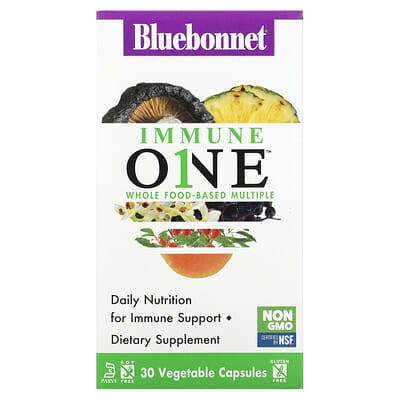
Immune One supports normal immune function and energy use when its nutrients fill dietary gaps. Unidentified blend components and undisclosed source proportions make the more complex parts harder to compare.
AI assessment of the formula, label and price. How scoring works
Nutrient Quality54
Some minerals use favorable sources, including copper and manganese bisglycinate. Comparative quality for many other nutrients remains unresolved, and the unidentified blends prevent assessment of their individual components.
Ingredient Transparency78
Listed amounts and most forms are stated, making much of the formula easier to compare. The blend totals and mixed-source amounts still leave important composition details unresolved.
Value For Money48
Value is favorable for several trace minerals and riboflavin, but much weaker for selenium. Missing comparisons for many other nutrients keep the whole formula's value uncertain.
Customer Satisfaction71
The available ratings are favorable. The small rating pool leaves a limited view of wider satisfaction.
Product Focus10
The clearest purpose is nutritional support for normal immune function and energy use. Broader hair, eye and detoxification aims depend on nutritional need or preparation details that remain unresolved.
- Format
Capsule - Container
- 30 Capsule(s)
- Per serving
- $0.33
- Customer rating
- 4.7 · 85 ratings
Goals

Impact
Highest effect
Folate · 400 mcg DFEVitamin B12 · 25 mcgVitamin D · 50 mcgMagnesium · 25 mgVitamin K · 20 mcgSelenium · 70 mcgZinc · 15 mgVitamin C · 250 mg
B vitamins contribute to normal energy metabolism, while folate supports blood formation. Vitamin D supplies a nutrient involved in bone and mineral functions, and zinc and selenium contribute to normal immune and antioxidant functions. Iodine can also help fill a dietary gap relevant to thyroid function. These nutritional roles do not establish additional benefits when intake is already adequate. Ashwagandha is declared, but its individual amount is unresolved; stress-specific evidence does not establish routine benefit in unstressed adults.
How this product is rated for Everyday Health
Ingredient fit81
The B vitamins and relevant minerals provide the relevant nutritional focus. The relevant amounts make a partial contribution to the saved comparison; smaller or unresolved amounts limit the overall contribution.
Goal fit
The B vitamins and relevant minerals provide the relevant nutritional focus.
Dose adequacy
The relevant amounts make a partial contribution to the saved comparison; smaller or unresolved amounts limit the overall contribution.
Pathways100
The strongest covered area is energy metabolism cofactors, with substantial support from the relevant ingredients.
Depth
The strongest covered area is energy metabolism cofactors, with substantial support from the relevant ingredients.
Breadth
Coverage reaches the comparison threshold for energy metabolism cofactors, one-carbon metabolism and blood formation, bone and mineral metabolism, antioxidant and immune defence.
Evidence82
Vitamin B9 (Folate) is the main evidence contributor at an eligible amount; the supplied context limits what can be expected from routine supplementation.
Evidence strength
Vitamin B9 (Folate) is the main evidence contributor at an eligible amount; the supplied context limits what can be expected from routine supplementation.
Studied preparation
The eligible preparations match those accepted in the saved findings; this does not establish superior forms or broad clinical benefits.
Formulation logic98
The relevant ingredients can contribute independently or have their required partner present; no additional combined effect is established.
Partner coverage
The relevant ingredients can contribute independently or have their required partner present; no additional combined effect is established.
Conflicts
None of the evaluated ingredient conflicts was triggered.
Effective doses
Ashwagandha has an unresolved eligible amount; the remaining included ingredients meet the saved minimum amount comparison.

Impact
Highest effect
Magnesium · 25 mgVitamin C · 250 mgZinc · 15 mgVitamin A · 900 mcgVitamin D · 50 mcgSelenium · 70 mcg
Zinc, Vitamin D, Selenium contribute to normal immune-cell function and regulation. Vitamin A also supports protective barriers. Copper, Vitamin B6, Vitamin B12, Folate can help restore immune processes impaired by low intake, without establishing extra protection when intake is adequate. Vitamin C has modest regular-use cold-duration support, without establishing infection prevention. Higher Vitamin B6 amounts do not establish extra benefit or suitability.
How this product is rated for Immunity
Ingredient fit63
Vitamin C connects the formula to immunity. Amounts provide uneven support against the supplied comparisons; smaller or unresolved quantities limit some contributions.
Goal fit
Relevant immune nutrients are included within a broader formula with other active ingredients.
Dose adequacy
Amounts provide uneven support against the supplied comparisons; smaller or unresolved quantities limit some contributions.
Pathways100
The strongest saved finding concerns lymphocyte function and immune regulation.
Depth
The strongest saved finding concerns lymphocyte function and immune regulation.
Breadth
The broader saved findings cover barrier and antimicrobial defense, lymphocyte function and immune regulation, oxidative and inflammatory balance.
Evidence100
Vitamin C provides the strongest saved evidence finding. Nutritional function or modest regular-use symptom support does not establish general infection prevention.
Evidence strength
Vitamin C drives the strongest saved evidence finding; the practical support remains bounded by its specific nutritional or regular-use role.
Studied preparation
The saved finding accepts the declared forms without establishing that they outperform other forms.
Formulation logic100
No unmet ingredient partner or configured conflict was identified. The included contributors meet the saved minimum amount criterion; this does not establish clinical effectiveness.
Partner coverage
The included ingredients have no unmet partner requirement in the supplied findings.
Conflicts
No configured ingredient conflict was identified in the supplied findings.
Effective doses
The included contributors meet the saved minimum amount criterion; this does not establish clinical effectiveness.

Impact
High effect
Biotin · 50 mcgVitamin D · 50 mcgZinc · 15 mgVitamin C · 250 mg
Zinc can help address diffuse shedding when zinc intake is deficient. Biotin has a similar role when biotin is deficient; extra regrowth is not established with adequate intake. Vitamin C supports normal collagen synthesis and iron absorption, without an established independent regrowth effect. Selenium contributes antioxidant biology, but routine hair benefit is unproven.
How this product is rated for Hair Health
Ingredient fit61
Relevant nutritional ingredients are present, with the amount findings determining how much they contribute.
Goal fit
The formula includes relevant nutrients alongside ingredients serving broader purposes.
Dose adequacy
The declared amounts provide uneven support against the supplied comparison anchors; some contributions are limited or unresolved.
Pathways54
Antioxidant-related nutrient contributions are the strongest finding, without establishing a clinical hair-growth effect.
Depth
Antioxidant-related nutrient contributions are the strongest finding, without establishing a clinical hair-growth effect.
Breadth
Follicle antioxidant protection meet the supplied coverage requirement; this does not establish comprehensive hair-loss benefit.
Evidence97
Zinc provides the strongest relevant support, specifically for deficiency-related shedding.
Evidence strength
Zinc provides the strongest relevant support, specifically for deficiency-related shedding.
Studied preparation
Most relevant preparations are accepted for comparison, while iodine lacks a matched studied preparation.
Formulation logic95
The supplied findings identify no missing required partners or configured conflicts. Amount comparisons do not establish a combined hair-growth effect.
Partner coverage
No required ingredient partner is missing from the supplied findings.
Conflicts
No configured ingredient conflict was found in the supplied findings.
Effective doses
Ashwagandha, Vitamin D fall below the supplied minimum amount comparison; other counted ingredients meet it.

Impact
Moderate effect
Iodine · 150 mcgVitamin D · 50 mcgVitamin B5 · 10 mgMagnesium · 25 mgRiboflavin · 20 mgThiamin · 20 mgVitamin B12 · 25 mcg
B vitamins support normal energy metabolism, while B12 at 25 mcg and folate contribute to normal blood formation. Their practical value for tiredness is mainly in filling a nutritional gap; extra intake does not reliably increase energy when needs are already met. Magnesium adds 25 mg toward normal nutritional needs.
How this product is rated for Energy
Ingredient fit69
Several nutrients relate to energy through normal nutritional functions, alongside ingredients serving other goals.
Goal fit
Relevant energy-related nutrients sit alongside ingredients intended for other health uses.
Dose adequacy
The amounts provide a partial contribution against the saved comparisons; larger doses do not imply proportionally greater energy.
Pathways0
The saved assessment finds no meaningful coverage of its specified direct energy pathways; the contribution is nutritional.
Depth
None of the specified direct energy pathways receives a supported contribution in the saved finding.
Breadth
None of the specified direct energy pathways reaches the saved coverage threshold.
Evidence94
The strongest saved finding concerns vitamin d, with practical usefulness depending on nutritional status.
Evidence strength
Vitamin D supplies the strongest saved finding at an assessed amount; benefit still depends on nutritional need.
Studied preparation
Most assessed preparations meet the saved comparison, while iodine does not.
Formulation logic98
The assessed ingredients have no missing required partner or matched conflict.
Partner coverage
No required supporting ingredient is missing for the assessed contributions.
Conflicts
No listed conflict was matched in the supplied assessment.
Effective doses
Most assessed ingredients clear the saved minimum amount threshold; some amounts make a smaller contribution.
Vitamin B5 Not classified
No linked studies yet.

Impact
High effect
Folate · 400 mcg DFEVitamin B12 · 25 mcgVitamin B6 · 20 mgMolybdenum · 45 mcgSelenium · 70 mcgMagnesium · 25 mgVitamin E · 15 mgZinc · 15 mgVitamin C · 250 mgRiboflavin · 20 mg
Folate and selenium have limited toxin-related findings in specific exposed populations, rather than broad routine detoxification. This formula's mixed folate identities cannot be assumed to reproduce the folic-acid arsenic trials. Broccoli and NAC presence is retained from source labels with unresolved configured amounts; generic broccoli cannot establish the defined pollutant-excretion preparation, and NAC's clinical antidote use does not validate routine supplement clearance.
How this product is rated for Liver & Detox
Ingredient fit55
Seven nutrients are retained; several source-declared botanical and NAC amounts remain unresolved.
Goal fit
Seven nutrients are retained; several source-declared botanical and NAC amounts remain unresolved.
Dose adequacy
B12, magnesium and vitamin E fall below inclusion thresholds; retained amounts receive partial recognition.
Pathways41
The retained findings concentrate on enzyme support. These category findings do not demonstrate measured toxin removal.
Depth
Enzyme support is the best-covered category in the saved findings.
Breadth
Coverage reaches the threshold for enzyme support; gut binding and elimination receives no coverage.
Evidence96
Folate leads the retained evidence finding, but its toxin-related studies concern arsenic exposure and specific folic-acid regimens.
Evidence strength
Folate leads the retained evidence finding, but its toxin-related studies concern arsenic exposure and specific folic-acid regimens.
Studied preparation
Molybdenum, riboflavin and B6 are not accepted as studied in the saved preparation finding; other retained preparations are accepted.
Formulation logic100
No required partner is missing and no configured conflict is triggered. Amount findings do not establish clinical toxin-clearance doses.
Partner coverage
The retained ingredients require no missing partner; combined presence does not establish added detoxification benefit.
Conflicts
No configured conflict is triggered, without establishing overall safety.
Effective doses
All 7 retained ingredients meet the comparison amount threshold, which does not establish a clinically effective detoxification dose.
Riboflavin Not classified
No linked studies yet.
Vitamin B6 Not classified
No linked studies yet.

Impact
High effect
Zinc · 15 mgVitamin E · 15 mgVitamin C · 250 mgCopper · 0.9 mgVitamin A · 900 mcg
Vitamin A supports the visual cycle and dark adaptation when intake is inadequate; extra vision benefits with adequate intake are not established. Vitamin C supports antioxidant functions, while the eye-disease findings concern a defined combination in selected AMD populations rather than vitamin C alone improving routine vision. Zinc’s eye-health findings likewise concern the complete AREDS regimen, without establishing standalone visual improvement.
How this product is rated for Eye Health
Ingredient fit59
Copper, Vitamin A and Vitamin C provide the saved connections, with usable serving amounts determining the extent of the comparison.
Goal fit
Relevant nutrients sit within a broader formula containing ingredients directed at other goals.
Dose adequacy
The declared serving amounts provide uneven contributions; the amount comparison does not establish a proven vision-support dose.
Pathways60
The represented areas describe the supplied eye-related ingredient roles, without establishing prevention or treatment of eye disease.
Depth
The strongest represented area is retinal and lens antioxidant defense. This describes ingredient roles rather than demonstrated improvement in vision.
Breadth
The represented areas meeting the comparison threshold are retinal and lens antioxidant defense.
Evidence88
The supplied human findings concern selected visual-performance outcomes or defined clinical combinations, limiting transfer to routine adult vision support.
Evidence strength
Copper supplies the leading evidence contribution, with benefits limited by the populations and outcomes studied.
Studied preparation
The qualifying ingredient preparations match the saved comparison; this does not extend results to routine adult vision improvement.
Formulation logic100
The supplied partner and ingredient-conflict checks concern formulation compatibility rather than clinical eligibility for an eye-health regimen.
Partner coverage
The contributing ingredients can act independently or have the partners required by the supplied findings.
Conflicts
No configured ingredient conflict was identified; this is a limited interaction check.
Effective doses
All contributing ingredients meet the amount threshold used for this comparison, which is not a proven vision-support dose.
Ingredients
| Ingredient | Amount per serving | Score |
|---|---|---|
Vitamin A (Beta-Carotene, Vitamin A Palmitate) | 900 mcg | |
Vitamin C (L-Ascorbic Acid) | 250 mg | |
Vitamin D3 (Cholecalciferol) | 50 mcg | |
Vitamin E (D-Alpha-Tocopheryl Succinate) | 15 mg | |
Thiamine (Thiamine Mononitrate) | 20 mg | |
Riboflavin (Riboflavin 5-Phosphate) | 20 mg | |
Niacin (Niacinamide) | 20 mg | |
Vitamin B6 (Pyridoxal 5-Phosphate, Pyridoxine Hydrochloride) | 20 mg | |
Folate ((6S)-5-Methyltetrahydrofolic Acid, Glucosamine Salt, Folic Acid) | 400 mcg DFE | |
Vitamin B12 (Methylcobalamin) | 25 mcg | |
Biotin (D-Biotin) | 50 mcg | |
Pantothenic Acid (Calcium D-Pantothenate) | 10 mg | |
Calcium (Calcium Citrate) | 25 mg | |
Iodine (Potassium Iodide) | 150 mcg | |
Magnesium (Magnesium Aspartate) | 25 mg | |
Zinc (Zinc Bisglycinate Chelate) | 15 mg | |
Selenium (Selenium Glycinate Complex) | 70 mcg | |
Copper (Copper Bisglycinate Chelate) | 0.9 mg | |
Manganese (Manganese Bisglycinate Chelate) | 2.3 mg | |
Chromium (Chromium Nicotinate Glycinate Chelate) | 35 mcg | |
Molybdenum (Molybdenum Glycinate Chelate) | 45 mcg | |
Vitamin K (Vitamin K2, Menaquinone-7, Natto) | 20 mcg | |
Immune Support Blend | 100 mg | |
Organic Whole Food Vegetable Blend | 10 mg | |
Plant Source Digestive Enzyme Blend | 10 mg |
Iodine (Potassium Iodide) · 150 mcg OverallScore96
A serving provides 150 mcg of iodine as potassium iodide, an amount suited to routine daily support. The whole-product serving costs about $0.33.
How this ingredient is rated
Active Ingredient Quality & Bioavailability100
Potassium iodide is the specified iodine form; no marine source is identified in the available facts.
Iodine Form & Bioavailability
The iodine is supplied as potassium iodide, a specified chemical form.
Marine Source Purity & Sourcing
No marine source is identified in the available facts, so the seaweed-sourcing criterion does not apply.
Dose, Safety & Label Transparency100
The stated 150 mcg of iodine per serving fits the evaluation for routine daily support and does not exceed its upper limit.
Dosage Efficacy for Daily Support
The serving provides 150 mcg of iodine, an amount suited to routine daily support in the evaluation.
Dosage Safety & Upper Limits
The 150 mcg serving does not exceed the evaluated iodine upper limit.
Elemental Iodine Transparency
The iodine amount is stated as 150 mcg per serving, along with its source.
Value80
A whole-product serving costs about $0.33.
Price Per Effective Serving
A whole-product serving costs about $0.33.
Each serving supplies 20 mg of vitamin B6, exceeding the European adult daily upper limit. The sources are pyridoxal 5-phosphate and pyridoxine hydrochloride; their proportions are undisclosed.
How this ingredient is rated
Ingredient Form & Label Quality100
Pyridoxal 5-phosphate and pyridoxine hydrochloride are the identified B6 sources; their proportions are undisclosed. The saved label evidence flags no artificial dyes, titanium dioxide or talc.
Vitamin B6 Form Identification
The identified B6 sources are pyridoxal 5-phosphate and pyridoxine hydrochloride; their proportions are undisclosed.
Clean Label and Excipient Purity
The saved label evidence flags no artificial dyes, titanium dioxide or talc.
Dose, Safety & Label Transparency65
Each serving supplies 20 mg of B6, exceeding the European adult daily upper limit. The identified B6 sources are pyridoxal 5-phosphate and pyridoxine hydrochloride.
Vitamin B6 Dose & Safety Policy
Each serving provides 20 mg of B6, exceeding the European adult daily upper limit.
Label Transparency
The B6 sources are identified as pyridoxal 5-phosphate and pyridoxine hydrochloride.
Value78
The whole-product serving price works out to about $0.017 per mg of B6.
Vitamin B6 Price Efficiency
The whole-product serving price works out to about $0.017 per mg of B6.
Manganese (Manganese Bisglycinate Chelate) · 2.3 mg OverallScore90
A serving lists 2.3 mg of manganese as bisglycinate. The whole-product serving costs about $0.33.
How this ingredient is rated
Active Ingredient Quality & Bioavailability100
The declared form is manganese bisglycinate.
Manganese Chemical Form
The declared form is manganese bisglycinate.
Dose, Safety & Label Transparency86
A serving lists 2.3 mg of elemental manganese.
Manganese Dosage Efficacy & Safety
The declared serving contains 2.3 mg of manganese.
Elemental Weight Disclosure
The elemental manganese amount is declared as 2.3 mg per serving.
Value80
About $0.33 per whole-product serving covers the entire product, not manganese alone.
Price per Serving vs. Median
The price comparison uses about $0.33 per whole-product serving.
Alternative products
Report alternatives
Sources
Published studies used for the product analysis and the top-ranked studies for each ingredient and goal.
- Effects of multi-herb and ashwagandha root formulas on stress modulation: a randomized, double-blind, placebo-controlled clinical study.
- Efficacy and Safety of Low-Dose Ashwagandha Supplementation on Exercise Endurance: A Randomized, Placebo-Controlled, Double-Blind, Clinical Trial.
- Acute and Repeated Ashwagandha Supplementation Improves Markers of Cognitive Function and Mood.
- Enhancing healthspan with Ashwagandha (Withania somnifera): a comprehensive review of its multifaceted geroprotective benefits.
- Safety and Efficacy of Ashwagandha Root Extract on Cognition, Energy and Mood Problems in Adults: Prospective, Randomized, Placebo-Controlled Study.
- Association of radioactive iodine treatment with survivorship symptoms and primary care utilisation in women of reproductive age with thyroid cancer: a retrospective cohort study.
- Energy level and fatigue after surgery for thyroid cancer: A population-based study of patient-reported outcomes.
- Health-Related Quality of Life in Differentiated Thyroid Cancer Survivors: A Cross-Sectional Study From Turkey.
- Magnesium-L-threonate improves sleep quality and daytime functioning in adults with self-reported sleep problems: A randomized controlled trial.
- Total magnesium intake and risk of frailty in older women.
- Red blood cell magnesium and chronic fatigue syndrome.
- Exercise, magnesium and immune function.
- Physicochemical properties of and volatile compounds in riboflavin fortified cloudy apple juice; study of its effect on job fatigue among Egyptian construction workers.
- Vitamin B status in patients with chronic fatigue syndrome.
- B-vitamins, related vitamers, and metabolites in patients with quiescent inflammatory bowel disease and chronic fatigue treated with high dose oral thiamine.
- Metabolic features of chronic fatigue syndrome.
- Effectiveness of Riboflavin in Inherited Metabolic Diseases: A Systematic Review
- Influence of thiamin supplementation on the health and general well-being of an elderly Irish population with marginal thiamin deficiency.
- Randomised clinical trial: high-dose oral thiamine versus placebo for chronic fatigue in patients with quiescent inflammatory bowel disease.
- Dietary reference values for thiamin.