
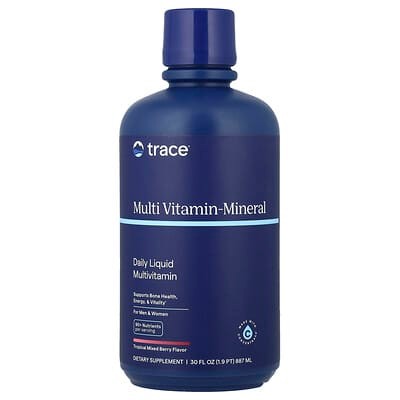
Liquid Multi Vitamin-Mineral Berry

Goals
$41.99 $1.39 per serving


Product analysis
Liquid Multi Vitamin-Mineral Berry supplies a broad mix of nutrients that support normal metabolism and bone nutrition, particularly when intake is low. Numerous additions, incomplete mixture details and relatively high costs across several nutrients weaken its appeal as a focused daily supplement.
AI assessment of the formula, label and price. How scoring works
Nutrient Quality49
Vitamin D3, natural-form vitamin E and several named mineral forms are favorable parts of the mixture. Unspecified forms and undisclosed source proportions, especially for magnesium, limit confidence in the complete formula.
Ingredient Transparency69
All listed ingredient amounts are disclosed, but many forms and mixture proportions are not. A long ingredient list therefore gives a clearer view of total amounts than of the complete composition.
Value For Money25
Many of the nutrients are relatively expensive for what the serving supplies, particularly several minerals. A few fairer comparisons do not outweigh that pattern, and value remains uncertain for other ingredients.
Customer Satisfaction65
Customer feedback is generally positive, but the review pool is modest. It offers a limited picture of satisfaction and cannot establish health benefits.
Product Focus0
The formula covers many nutritional purposes, with its clearest role in helping fill dietary gaps. Its extensive ingredient mixture and broad range of uses make it poorly targeted for one specific goal.
- Format
Liquid - Container
- 30 Liquid(s)
- Per serving
- $1.39
- Customer rating
- 4.4 · 55 ratings
Goals

Impact
High effect
Magnesium · 300 mgVitamin C · 300 mgZinc · 15 mgVitamin A · 10000 IUVitamin D · 400 IUSelenium · 200 mcg
Vitamin C supports immune-cell activity and protective barriers, with modest cold-duration benefits from regular supplementation. Zinc and vitamin D contribute to normal immune function, while selenium supports selenium-dependent systems involved in oxidative balance. Copper, B vitamins and folate can help restore normal immune-cell function when intake is low or deficiency impairs it. These nutritional roles do not establish extra infection protection once needs are met.
How this product is rated for Immunity
Ingredient fit48
The ingredients provide a connection to immunity through the roles described above. The saved amount finding is partial, with unresolved nutrient amounts limiting interpretation.
Goal fit
The formulation combines immunity-related ingredients with a broader set of ingredients for other purposes.
Dose adequacy
The saved amount finding is partial, with unresolved nutrient amounts limiting interpretation.
Pathways75
The saved finding is strongest for oxidative and inflammatory balance, based on Zinc, Selenium, Iron, Vitamin D, Vitamin C. These mapped roles do not establish a product-level infection-prevention effect.
Depth
The saved finding is strongest for oxidative and inflammatory balance, based on Zinc, Selenium, Iron, Vitamin D, Vitamin C.
Breadth
2 immune mechanisms reach the saved coverage threshold; this describes the ingredients' mapped roles, not infection prevention.
Evidence100
The strongest supported interpretation is a nutritional role or the specific symptom benefit described above.
Evidence strength
Vitamin C leads the saved evidence finding. The supplied context limits what this means for routine infection protection.
Studied preparation
The saved finding recognizes the relevant preparations. This does not establish a clinical advantage for these forms or this complete product.
Formulation logic95
No configured ingredient conflict was identified; this is a limited formulation check. The recognized ingredients have no unmet partner requirement in the saved findings.
Partner coverage
The recognized ingredients have no unmet partner requirement in the saved findings.
Conflicts
No configured ingredient conflict was identified; this is a limited formulation check.
Effective doses
Vitamin A, Vitamin E falls below the saved amount threshold because the relevant amount is unresolved.

Impact
Highest effect
Folate · 400 mcgVitamin B12 · 6 mcgVitamin D · 400 IUMagnesium · 300 mgVitamin K · 70 mcgBoron · 1 mgSelenium · 200 mcgZinc · 15 mgVitamin C · 300 mg
Magnesium and calcium contribute to mineral nutrition, while folate and B vitamins add nutrients used in normal metabolism and blood formation. Iodine can help fill an intake gap affecting thyroid function, and zinc and selenium provide additional nutritional availability. These roles do not establish extra benefit when intake is adequate. B12, vitamin D, boron and iron fall below the saved inclusion thresholds, and the liquid delivery does not establish superior outcomes.
How this product is rated for Everyday Health
Ingredient fit75
Several nutrients receive credit in a broad formula serving multiple goals.
Goal fit
Several nutrients receive credit in a broad formula serving multiple goals.
Dose adequacy
Magnesium and several vitamins reach their upper comparison ranges; calcium contributes partially, while B12, vitamin D, boron and iron fall below inclusion.
Pathways100
The strongest assigned coverage concerns nutrient roles in energy metabolism.
Depth
The strongest assigned coverage concerns nutrient roles in energy metabolism. This biological coverage does not establish better health outcomes.
Breadth
Energy metabolism, blood formation, mineral nutrition and antioxidant roles reach the coverage threshold.
Evidence86
Magnesium receives the strongest assigned evidence weight for a conditional nutritional contribution, without establishing benefit above adequate intake.
Evidence strength
Magnesium receives the strongest assigned evidence weight for a conditional nutritional contribution, without establishing benefit above adequate intake.
Studied preparation
The credited preparations are recognized in the saved findings; no chemical form or delivery method receives an added benefit claim.
Formulation logic100
Credited ingredients have no missing required partner, and no configured ingredient conflict was identified.
Partner coverage
Every credited ingredient works independently or has its required nutritional partner.
Conflicts
No configured ingredient conflict was identified.
Effective doses
Every credited ingredient meets the comparison's amount threshold; this is not a proven health-outcome dose.

Impact
Moderate effect
Iodine · 150 mcgVitamin D · 400 IUVitamin B5 · 20 mgMagnesium · 300 mgRiboflavin · 3 mgThiamin · 3 mgVitamin B12 · 6 mcgIron · 0.5 mgPotassium · 75 mg
B vitamins support the normal use of energy from food, with magnesium at 300 mg making a substantial nutritional contribution in the supplied comparison. Potassium supports muscle and nerve function, alongside vitamin C and iodine support. Iron, B12 and vitamin D provide smaller contributions at these serving amounts.
How this product is rated for Energy
Ingredient fit58
The formula mainly addresses broader nutritional needs, with a limited focus on energy. The counted amounts provide substantial support, with some smaller contributions.
Goal fit
The formula mainly addresses broader nutritional needs, with a limited focus on energy.
Dose adequacy
The counted amounts provide substantial support, with some smaller contributions.
Pathways0
The saved contribution is nutritional, without meaningful coverage of the specific alertness or performance mechanisms assessed. No specific energy mechanism reaches the saved coverage threshold.
Depth
The saved contribution is nutritional, without meaningful coverage of the specific alertness or performance mechanisms assessed.
Breadth
No specific energy mechanism reaches the saved coverage threshold.
Evidence87
Magnesium supplies the strongest relevant evidence at a counted amount, with benefits limited to the particular contexts and outcomes assessed. Most counted preparations match trial materials, while some retain preparation uncertainty.
Evidence strength
Magnesium supplies the strongest relevant evidence at a counted amount, with benefits limited to the particular contexts and outcomes assessed.
Studied preparation
Most counted preparations match trial materials, while some retain preparation uncertainty.
Formulation logic100
The counted ingredients can contribute independently or have their needed partner. No configured ingredient conflict was identified. All ingredients counted here reach a meaningful amount in the saved comparison.
Partner coverage
The counted ingredients can contribute independently or have their needed partner.
Conflicts
No configured ingredient conflict was identified.
Effective doses
All ingredients counted here reach a meaningful amount in the saved comparison.
Vitamin B5 Not classified
No linked studies yet.

Impact
Moderate effect
Vitamin D · 400 IUMagnesium · 300 mgFolate · 400 mcgVitamin B12 · 6 mcgVitamin B6 · 4 mgVitamin C · 300 mg
Magnesium may help with stress when your magnesium levels are low. Whether it brings lasting relief from everyday stress when you already get enough is unclear. Vitamin C has a possible connection to feelings of stress too, but nutritional status and preparation affect how broadly that benefit applies. These are conditional benefits rather than a reliable way to control everyday stress.
How this product is rated for Stress Relief
Ingredient fit40
Magnesium supplies 300 mg, vitamin C 300 mg, zinc 15 mg and folate 400 mcg per serving, with different amounts relative to their comparison ranges.
Goal fit
Several ingredients relate to stress, alongside ingredients with other nutritional roles.
Dose adequacy
Magnesium supplies 300 mg, vitamin C 300 mg, zinc 15 mg and folate 400 mcg per serving, with different amounts relative to their comparison ranges.
Pathways45
Magnesium's connection is mainly to calming, with stress benefit depending on nutritional status.
Depth
Magnesium's connection is mainly to calming, with stress benefit depending on nutritional status.
Breadth
Calming or mood-related processes provide the main connection; wider stress benefits remain uncertain.
Evidence76
Magnesium may help with stress when your magnesium levels are low. Whether it brings lasting relief from everyday stress when you already get enough is unclear.
Evidence strength
Magnesium may help with stress when your magnesium levels are low. Whether it brings lasting relief from everyday stress when you already get enough is unclear.
Studied preparation
No particular preparation mismatch is identified for the ingredients with usable amounts; this doesn't make stress relief certain.
Formulation logic100
The relevant ingredients can act alone or have their required partners present. No particular ingredient conflict is identified.
Partner coverage
The relevant ingredients can act alone or have their required partners present.
Conflicts
No particular ingredient conflict is identified.
Effective doses
The relevant ingredients have usable declared amounts, though this doesn't predict the size of a stress benefit.
Vitamin B5 Not classified
No linked studies yet.

Impact
High effect
Folate · 400 mcgVitamin B12 · 6 mcgVitamin B6 · 4 mgMolybdenum · 60 mcgSelenium · 200 mcgMagnesium · 300 mgVitamin E · 55 IUZinc · 15 mgVitamin C · 300 mgCholine · 20 mgRiboflavin · 3 mg
Folate supports methyl-group metabolism, with relevant arsenic findings in exposed adults, especially when folate status is low. This supports a conditional nutritional connection rather than generalized toxin removal. Selenium has small, exposure-specific mercury studies, including people with low selenium, rather than established extra benefit in replete adults. B vitamins and antioxidant nutrients support normal metabolism without establishing faster toxin clearance.
How this product is rated for Liver & Detox
Ingredient fit46
Vitamin B9 (Folate) provides the main recorded connection. Amount limitations reduce the contribution.
Goal fit
Vitamin B9 (Folate) leads the relevant mix, while the formula also serves many other purposes.
Dose adequacy
The serving receives a partial amount-based contribution; this does not identify an effective toxin-clearance dose.
Pathways75
The recorded connection centers on glutathione and conjugation. This does not demonstrate clearance of an identified toxin.
Depth
The strongest recorded connection is to glutathione and conjugation; this is a metabolic relationship rather than demonstrated toxin clearance.
Breadth
Two metabolic areas carry the recorded contributions; broad toxin elimination is not established.
Evidence98
Vitamin B9 (Folate) leads the saved evidence findings, with population, preparation and outcome limits on routine detoxification claims.
Evidence strength
Vitamin B9 (Folate) leads the saved evidence findings, but the supplied studies are conditional or do not establish routine detoxification.
Studied preparation
Some retained nutrient forms lack a matched studied preparation; recognized forms still do not establish routine toxin clearance.
Formulation logic97
The retained ingredients have no missing configured partner or identified conflict.
Partner coverage
The retained contributions have no missing configured partner in the supplied findings.
Conflicts
No configured ingredient conflict was identified in the supplied calculation.
Effective doses
Most retained contributions clear the saved amount threshold, while vitamin E remains below it.
Riboflavin Not classified
No linked studies yet.
Vitamin B6 Not classified
No linked studies yet.

Impact
Highest effect
Phosphorus · 275 mgVitamin K · 70 mcgMagnesium · 300 mgCalcium · 600 mgVitamin D · 400 IUCopper · 2 mgManganese · 4 mgBoron · 1 mgZinc · 15 mgVitamin C · 300 mg
Calcium provides bone mineral, vitamin D helps calcium absorption, and magnesium supports normal bone metabolism when intake is low. Vitamin C and copper contribute to the collagen framework; phosphorus also supplies bone mineral when deficient, although dietary deficiency is rare. These roles do not establish extra benefit when intake is adequate. The declared K1 and unspecified potassium do not establish the preparation-specific bone benefits described for MK-7 and potassium citrate.
How this product is rated for Bone Health
Ingredient fit57
This broad formula supplies several bone-related nutrients alongside many ingredients serving other goals.
Goal fit
This broad formula supplies several bone-related nutrients alongside many ingredients serving other goals.
Dose adequacy
Calcium and magnesium contribute substantial mineral amounts; vitamin D is more modest and vitamin A's usable amount is unresolved.
Pathways100
Mineral supply, calcium regulation and collagen matrix formation are all represented.
Depth
Mineral supply, calcium regulation and collagen matrix formation are all represented.
Breadth
Mineral supply, calcium regulation and collagen matrix formation meet the saved coverage threshold.
Evidence99
Calcium leads the saved evidence finding; nutrient roles do not establish routine fracture prevention.
Evidence strength
Calcium provides the strongest included evidence finding at its declared amount; this does not establish extra benefit when intake is adequate.
Studied preparation
Potassium lacks the preparation match used in the supplied bone evidence; other included preparations meet the saved comparison.
Formulation logic98
All included ingredients have their required partners. Thirteen included ingredients meet the saved amount threshold; vitamin A's usable amount is unresolved.
Partner coverage
All included ingredients have their required partners.
Conflicts
No configured ingredient conflict was identified; this finding does not assess every possible interaction.
Effective doses
Thirteen included ingredients meet the saved amount threshold; vitamin A's usable amount is unresolved.
Ingredients
| Ingredient | Amount per serving | Score |
|---|---|---|
Calories | 35 {Calories} | |
Total Fat | 2 Gram(s) | |
Total Carbohydrates | 12 Gram(s) | |
Vitamin A (Beta-Carotene, Vitamin A Palmitate) | 10000 IU | |
Vitamin C (Ascorbic Acid) | 300 mg | |
Vitamin D3 (Cholecalciferol) | 400 IU | |
Vitamin E (D-Alpha-Tocopherol Acetate) | 55 IU | |
Vitamin K (Phytonadione) | 70 mcg | |
Thiamine (Thiamine Hydrochloride) | 3 mg | |
Riboflavin | 3 mg | |
Niacin (Niacinamide) | 35 mg | |
Vitamin B6 (Pyridoxine Hydrochloride) | 4 mg | |
Folic Acid | 400 mcg | |
Vitamin B12 (Cyanocobalamin) | 6 mcg | |
Biotin | 300 mcg | |
Pantothenic Acid (Calcium D-Pantothenate) | 20 mg | |
Calcium (Calcium Citrate, Tricalcium Phosphate) | 600 mg | |
Iron | 0.5 mg | |
Phosphorus (Tricalcium Phosphate) | 275 mg | |
Iodine (Potassium Iodide) | 150 mcg | |
Magnesium (ConcenTrace, Mag. Citrate, Magnesium Gluconate) | 300 mg | |
Zinc (Zinc Citrate) | 15 mg | |
Selenium (Selenomethionine) | 200 mcg | |
Copper (Copper Gluconate) | 2 mg | |
Manganese (Manganese Gluconate) | 4 mg | |
Chromium (Chromium Amino Acid Chelate) | 120 mcg | |
Molybdenum (Sodium Molybdate) | 60 mcg | |
Chloride (ConcenTrace) | 550 mg | |
Sodium | 5 mg | |
Potassium | 75 mg | |
ConcenTrace | 455 mg | |
Inositol | 45 mg | |
Citrus Bioflavonoids | 25 mg | |
Choline (Choline Bitartrate) | 20 mg | |
Sulfate (from ConcenTrace) | 8 mg | |
Aloe vera extract | 2 mg | |
Boron (Boron Glycinate) | 1 mg |
Chloride (ConcenTrace) · 550 mg OverallScore48
A serving provides 550 mg of chloride, a high amount. The saved information does not identify its chemical source; a whole-product serving costs about $1.40.
How this ingredient is rated
Active Ingredient Quality & Bioavailability20
The saved information does not identify the chemical source of the chloride.
Chloride source quality
The saved information does not identify the chemical source of the chloride.
Dose, Safety & Label Transparency91
A serving lists 550 mg of chloride, a high amount. The chloride amount is listed, but its chemical source is not identified in the saved information.
Chloride amount per serving
A serving lists 550 mg of chloride, a high amount.
Amount and source disclosure
The chloride amount is listed, but its chemical source is not identified in the saved information.
Value20
At about $1.40 per whole-product serving, the price is high among the evaluated products.
Price per serving
At about $1.40 per whole-product serving, the price is high among the evaluated products.
Iodine (Potassium Iodide) · 150 mcg OverallScore84
Selenium (Selenomethionine) · 200 mcg OverallScore63
Alternative products
Report alternatives
Sources
Published studies used for the product analysis and the top-ranked studies for each ingredient and goal.
- [Comparative study of the urinary excretion of boron, calcium, magnesium and phosphorus in postmenopausal women with and without osteoporosis].
- Effect of dietary boron on mineral, estrogen, and testosterone metabolism in postmenopausal women.
- The relationship between boron and magnesium status and bone mineral density in the human: a review.
- Effects of boron supplementation on bone mineral density and dietary, blood, and urinary calcium, phosphorus, magnesium, and boron in female athletes.
- Metabolic responses of postmenopausal women to supplemental dietary boron and aluminum during usual and low magnesium intake: boron, calcium, and magnesium absorption and retention and blood mineral concentrations
- What is the impact of daily oral supplementation of vitamin D3 (cholecalciferol) plus calcium on the incidence of hip fracture in older people? A systematic review and meta-analysis.
- Calcium supplementation prevents seasonal bone loss and changes in biochemical markers of bone turnover in elderly New England women: a randomized placebo-controlled trial.
- The effects of calcium supplementation (milk powder or tablets) and exercise on bone density in postmenopausal women.
- The efficacy of calcium supplementation alone in elderly Thai women over a 2-year period: a randomized controlled trial.
- Calcium-enriched foods and bone mass growth in prepubertal girls: a randomized, double-blind, placebo-controlled trial.
- The Association between Dietary and Circulating Copper Levels and Osteoporosis: a Scoping Review.
- Association between dietary copper, iron, zinc, selenium intake and osteopenia or osteoporosis in elderly hypertensive patients: a retrospective cohort study.
- Associations of dietary copper intake with total bone mineral density and lumbar spine bone mineral density in American adults.
- The association between dietary mineral intake and bone mineral density: a cross-sectional study.
- Association between dietary copper intake and bone mineral density in children and adolescents aged 8-19 years: A cross-sectional study.
- Association between RBC folate and lumbar bone mineral density in postmenopausal women, a cross-sectional study from NHANES 2009-2018.
- Genetic variants modify the associations of concentrations of methylmalonic acid, vitamin B-12, vitamin B-6, and folate with bone mineral density.
- Adequate Intake and Supplementation of B Vitamins, in Particular Folic Acid, can Play a Protective Role in Bone Health.
- Relation of homocysteine, folate, and vitamin B12 to bone mineral density of postmenopausal women.
- Dietary intake of folate, but not vitamin B2 or B12, is associated with increased bone mineral density 5 years after the menopause: results from a 10-year follow-up study in early postmenopausal women.