
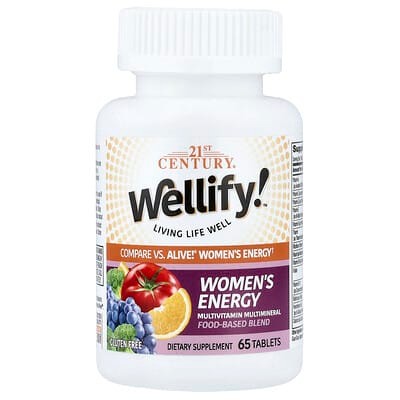

$10.49 $0.16 per serving


Product analysis
Women's Energy supplies nutrients for normal energy use and blood formation, with iron most relevant to tiredness linked to low iron. It also offers calcium for dietary gaps affecting bone nutrition, although several mineral forms are less favorable choices.
AI assessment of the formula, label and price. How scoring works
Nutrient Quality41
Biotin, iodine and molybdenum use favorable forms, with calcium offering a moderate choice. Zinc, selenium and copper use weaker forms, so quality varies across the mixture.
Ingredient Transparency76
All listed amounts and most forms are disclosed, making serving comparisons straightforward. A few forms and the botanical blend composition remain unspecified.
Value For Money59
Calcium, iodine, manganese and vitamin K are economical, with iron also offering favorable value. Biotin and selenium are more middling, while value for many other ingredients remains uncertain.
Customer Satisfaction87
Customer ratings are strongly positive across a large review pool. They provide evidence of satisfaction without confirming an energy boost.
Product Focus3
The clearest role is filling nutritional gaps that can affect energy, blood formation and bones. The broad mixture and incomplete blend detail make some additional contributions uncertain.
- Format
Tablet - Container
- 65 Tablet(s)
- Per serving
- $0.16
- Customer rating
- 4.7 · 3,155 ratings
Goals

Impact
Highest effect
Folate · 667 mcg DFEVitamin B12 · 12 mcgVitamin D · 25 mcgMagnesium · 50 mgVitamin K · 80 mcgBoron · 150 mcgSelenium · 70 mcgZinc · 15 mgVitamin C · 60 mg

Impact
Moderate effect
Biotin · 300 mcg
Magnesium Not classified
No linked studies yet.

Impact
High effect
Biotin · 300 mcgVitamin D · 25 mcgZinc · 15 mgIron · 18 mgVitamin C · 60 mg

Impact
Highest effect
Magnesium · 50 mgVitamin C · 60 mgZinc · 15 mgVitamin A · 1500 mcgVitamin D · 25 mcgSelenium · 70 mcg

Impact
Highest effect
Vitamin K · 80 mcgMagnesium · 50 mgCalcium · 500 mgVitamin D · 25 mcgCopper · 2 mgManganese · 2 mgBoron · 150 mcgZinc · 15 mgVitamin C · 60 mg

Impact
High effect
Folate · 667 mcg DFEVitamin B12 · 12 mcgVitamin B6 · 4 mgMolybdenum · 75 mcgSelenium · 70 mcgMagnesium · 50 mgVitamin E · 14 mgZinc · 15 mgVitamin C · 60 mgRiboflavin · 3.4 mg
Riboflavin Not classified
No linked studies yet.
Vitamin B6 Not classified
No linked studies yet.
Ingredients
| Ingredient | Amount per serving | Score |
|---|---|---|
Vitamin A (Beta-Carotene) | 1500 mcg | |
Vitamin C (Ascorbic Acid) | 60 mg | |
Vitamin D3 (Cholecalciferol) | 25 mcg | |
Vitamin E (DL-Alpha-Tocopheryl Acetate) | 14 mg | |
Vitamin K (Phytonadione) | 80 mcg | |
Thiamine (Thiamine Mononitrate) | 3 mg | |
Riboflavin | 3.4 mg | |
Niacin (Niacinamide) | 20 mg | |
Vitamin B6 (Pyridoxine Hydrochloride) | 4 mg | |
Folate | 667 mcg DFE | |
Vitamin B12 (Cyanocobalamin) | 12 mcg | |
Biotin (D-Biotin) | 300 mcg | |
Pantothenic Acid (D-Calcium Pantothenate) | 15 mg | |
Calcium (Calcium Carbonate) | 500 mg | |
Iron (Ferrous Fumarate) | 18 mg | |
Iodine (Potassium Iodide) | 150 mcg | |
Magnesium (Magnesium Oxide) | 50 mg | |
Zinc (Zinc Oxide) | 15 mg | |
Selenium (Sodium Selenate) | 70 mcg | |
Copper (Copper Sulfate) | 2 mg | |
Manganese (Manganese Sulfate) | 2 mg | |
Molybdenum (Sodium Molybdate) | 75 mcg | |
Fruit & Vegetable Blend | 100 mg | |
Boron (Boron Amino Acid Chelate) | 150 mcg | |
Lutein | 100 mcg |
Iodine (Potassium Iodide) · 150 mcg OverallScore100
Each serving provides 150 mcg of iodine at a low cost per serving. The amount fits the stated range for daily thyroid support. The iodine is supplied as potassium iodide.
How this ingredient is rated
Active Ingredient Quality & Bioavailability100
The iodine is supplied as potassium iodide. No marine source is indicated, so seaweed-specific contamination concerns do not apply.
Iodine Form & Bioavailability
The iodine is supplied as potassium iodide.
Marine Source Purity & Sourcing
No marine source is indicated, so seaweed-specific contamination concerns do not apply.
Dose, Safety & Label Transparency100
150 mcg of iodine per serving fits the stated range for daily thyroid support. The stated amount is below the adult upper intake level.
Dosage Efficacy for Daily Support
150 mcg of iodine per serving fits the stated range for daily thyroid support.
Dosage Safety & Upper Limits
150 mcg is below the 1,100 mcg adult upper intake level.
Elemental Iodine Transparency
The iodine amount is stated as 150 mcg per serving.
Value100
The cost per labeled serving is low.
Price Per Effective Serving
The cost per labeled serving is low.
Calcium (Calcium Carbonate) · 500 mg OverallScore80
The serving provides 500 mg of calcium at a low cost per serving. The calcium comes from calcium carbonate.
How this ingredient is rated
Active Ingredient Quality & Bioavailability65
The calcium comes from calcium carbonate. The serving declares 500 mg of elemental calcium.
Calcium Form & Absorption Potential
The calcium comes from calcium carbonate.
Elemental Calcium Transparency
The serving declares 500 mg of elemental calcium.
Dose, Safety & Label Transparency84
The serving declares 500 mg of elemental calcium. A flow agent is present.
Absorption-Optimized Serving Dose
The serving declares 500 mg of elemental calcium.
Formulation Purity & Additives
A flow agent is present.
Value100
The cost per serving is low.
Price Per Serving Efficiency
The cost per serving is low.
Molybdenum (Sodium Molybdate) · 75 mcg OverallScore74
Each serving supplies 75 mcg of molybdenum. The cost per serving is relatively low. The source is Sodium Molybdate, a soluble molybdate form.
How this ingredient is rated
Active Ingredient Quality & Bioavailability56
The source is Sodium Molybdate, a soluble molybdate form. No branded molybdenum source is specified in the available information.
Molybdenum Chemical Form
The source is Sodium Molybdate, a soluble molybdate form.
Branded or Patented Source
No branded molybdenum source is specified in the available information.
Dose, Safety & Label Transparency88
Each serving supplies 75 mcg of molybdenum. It is below the adult upper intake limit, although total intake includes other sources.
Elemental Dose Optimization
Each serving supplies 75 mcg of molybdenum.
Upper Limit (UL) Safety Compliance
The 75 mcg serving is below the adult upper intake limit of 2,000 mcg; total intake also includes other sources.
Value80
The cost per serving is relatively low.
Price per Effective Serving
The cost per serving is relatively low.
Alternative products
Report alternatives
Sources
Published studies used for the product analysis and the top-ranked studies for each ingredient and goal.
- [Comparative study of the urinary excretion of boron, calcium, magnesium and phosphorus in postmenopausal women with and without osteoporosis].
- Effect of dietary boron on mineral, estrogen, and testosterone metabolism in postmenopausal women.
- The relationship between boron and magnesium status and bone mineral density in the human: a review.
- Effects of boron supplementation on bone mineral density and dietary, blood, and urinary calcium, phosphorus, magnesium, and boron in female athletes.
- Metabolic responses of postmenopausal women to supplemental dietary boron and aluminum during usual and low magnesium intake: boron, calcium, and magnesium absorption and retention and blood mineral concentrations
- What is the impact of daily oral supplementation of vitamin D3 (cholecalciferol) plus calcium on the incidence of hip fracture in older people? A systematic review and meta-analysis.
- Calcium supplementation prevents seasonal bone loss and changes in biochemical markers of bone turnover in elderly New England women: a randomized placebo-controlled trial.
- The effects of calcium supplementation (milk powder or tablets) and exercise on bone density in postmenopausal women.
- The efficacy of calcium supplementation alone in elderly Thai women over a 2-year period: a randomized controlled trial.
- Calcium-enriched foods and bone mass growth in prepubertal girls: a randomized, double-blind, placebo-controlled trial.
- The Association between Dietary and Circulating Copper Levels and Osteoporosis: a Scoping Review.
- Association between dietary copper, iron, zinc, selenium intake and osteopenia or osteoporosis in elderly hypertensive patients: a retrospective cohort study.
- Associations of dietary copper intake with total bone mineral density and lumbar spine bone mineral density in American adults.
- The association between dietary mineral intake and bone mineral density: a cross-sectional study.
- Association between dietary copper intake and bone mineral density in children and adolescents aged 8-19 years: A cross-sectional study.
- Association between RBC folate and lumbar bone mineral density in postmenopausal women, a cross-sectional study from NHANES 2009-2018.
- Genetic variants modify the associations of concentrations of methylmalonic acid, vitamin B-12, vitamin B-6, and folate with bone mineral density.
- Adequate Intake and Supplementation of B Vitamins, in Particular Folic Acid, can Play a Protective Role in Bone Health.
- Relation of homocysteine, folate, and vitamin B12 to bone mineral density of postmenopausal women.
- Dietary intake of folate, but not vitamin B2 or B12, is associated with increased bone mineral density 5 years after the menopause: results from a 10-year follow-up study in early postmenopausal women.