
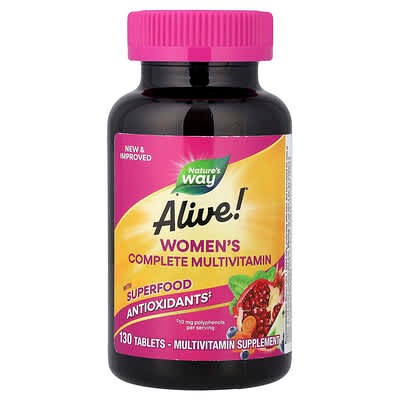
Alive! Women's Energy Complete Multivitamin

Goals
$23.00 $0.17 per serving


Product analysis
Alive! Women's Energy Complete Multivitamin offers an economical way to fill nutrient gaps linked to tiredness and normal immune function. An unidentified herbal blend makes the extra ingredients harder to judge.
AI assessment of the formula, label and price. How scoring works
Nutrient Quality38
The mineral forms vary in quality, with iodine and molybdenum more favorable than the selenium and copper choices. Unidentified plant-blend contents add uncertainty about the complete formula.
Ingredient Transparency75
All ingredient amounts and most forms are listed. The herbal blend contents and some mixed-form proportions are not disclosed, limiting detailed comparison.
Value For Money54
The low serving cost favors several vitamin and mineral components. Selenium is less economical for its amount, while reliable comparisons remain unavailable for many other nutrients.
Customer Satisfaction94
Customer ratings are very positive across a large number of reviews. They offer broad satisfaction feedback without confirming extra energy or immune benefits.
Product Focus8
The clearest role is filling nutrient gaps relevant to normal energy use, blood formation and immune function. Calcium makes a partial bone-mineral contribution, while the low magnesium amount adds little clear support and extra performance benefits remain uncertain.
- Format
Tablet - Container
- 130 Tablet(s)
- Per serving
- $0.17
- Customer rating
- 4.8 · 17,552 ratings
Goals

Impact
Highest effect
Folate · 400 mcg DFEVitamin B12 · 12 mcgVitamin D · 50 mcgMagnesium · 50 mgVitamin K · 120 mcgBoron · 150 mcgSelenium · 55 mcgZinc · 11 mgVitamin C · 90 mg
B vitamins and folate contribute nutrients used in normal energy and one-carbon metabolism, helping fill dietary gaps. Their presence does not establish a boost in energy or additional benefit once nutritional needs are met. Iron and iodine address distinct dietary gaps, while vitamin D and vitamin K add mineral-metabolism support. The small magnesium amount receives no contribution in the saved result.
How this product is rated for Everyday Health
Ingredient fit83
Relevant nutrients share the formula with other actives, so its focus extends beyond general nutritional support. The serving provides uneven nutrient amounts, with some contributing more toward the comparison references than others.
Goal fit
Relevant nutrients share the formula with other actives, so its focus extends beyond general nutritional support.
Dose adequacy
The serving provides uneven nutrient amounts, with some contributing more toward the comparison references than others.
Pathways100
The strongest assigned connection is energy metabolism cofactors, reflecting a specific role rather than broad improvement in health.
Depth
The strongest assigned connection is energy metabolism cofactors, reflecting a specific role rather than broad improvement in health.
Breadth
Several nutritional areas have substantial assigned coverage, without establishing extra benefit in adequately nourished adults.
Evidence82
Vitamin B9 (Folate) anchors this finding; the supplied evidence supports conditional nutritional or population-specific relevance rather than universal benefit.
Evidence strength
Vitamin B9 (Folate) anchors this finding; the supplied evidence supports conditional nutritional or population-specific relevance rather than universal benefit.
Studied preparation
The evaluated preparations meet the saved criteria; no chemical form or delivery advantage is established.
Formulation logic100
No conflict is identified by the evaluated rules. Partner requirements are satisfied; the included serving amounts have differing nutritional relevance.
Partner coverage
The included ingredients work alone or have required partners, without establishing additional combination benefit.
Conflicts
No conflict is identified by the evaluated rules.
Effective doses
The counted ingredients meet the configured amount threshold; that does not establish a treatment dose or greater benefit above adequacy.

Impact
High effect
Vitamin K · 120 mcgMagnesium · 50 mgCalcium · 260 mgVitamin D · 50 mcgCopper · 0.9 mgManganese · 2.3 mgBoron · 150 mcgZinc · 11 mgVitamin C · 90 mg
Calcium supplies bone mineral and vitamin D supports calcium absorption and deficiency-related mineralization. Copper helps cross-link the collagen framework when intake is inadequate, while the 260 mg calcium serving offers a partial mineral contribution. The vitamin D amount does not imply extra fracture protection in generally healthy adults with adequate status. This product's vitamin K is K1, so the supplied MK-7-specific bone-density findings cannot be transferred to it.
How this product is rated for Bone Health
Ingredient fit57
Calcium and vitamin D supply the clearest bone-related roles within this broad multivitamin.
Goal fit
The formula includes bone-related nutrients alongside many actives intended for other functions.
Dose adequacy
Calcium provides a partial mineral contribution; magnesium is small, and K1 does not qualify for the MK-7-specific findings.
Pathways80
Calcium regulation and collagen-matrix functions are most represented; mineral supply is more limited.
Depth
Vitamin D makes calcium regulation the strongest represented route.
Breadth
Calcium regulation and collagen-matrix functions are substantially represented; direct mineral supply is weaker and K1 adds no MK-7-specific coverage.
Evidence100
Calcium anchors the nutritional evidence; several other credited nutrients lack established independent extra skeletal benefit.
Evidence strength
Calcium supplies the strongest recognized evidence for intake-gap support.
Studied preparation
The included preparations match the supplied findings; K1 is excluded from the MK-7-specific contribution.
Formulation logic100
Calcium and vitamin D satisfy the supplied pairing, with no configured conflict.
Partner coverage
Calcium and vitamin D are present at amounts satisfying their supplied pairing.
Conflicts
No configured conflict was identified; the vitamin D amount does not trigger the high-amount condition.
Effective doses
All ingredients retained for this finding meet its amount threshold; magnesium, boron and vitamin C fall below it.

Impact
High effect
Biotin · 30 mcgVitamin D · 50 mcgZinc · 11 mgIron · 18 mgVitamin C · 90 mg
Iron and zinc can help address dietary gaps that contribute to diffuse shedding. Biotin has a similar deficiency-related role even though its amount falls below the comparison threshold. Adequate nutrient intake does not establish extra regrowth, and the nutritional roles of other vitamins and minerals do not demonstrate independent hair outcomes. The alpha-tocopherol form of vitamin E does not match the small mixed-tocotrienol hair-count trial.
How this product is rated for Hair Health
Ingredient fit62
Zinc anchors the ingredient fit, with smaller or unresolved amounts limiting some contributions.
Goal fit
The formula includes nutrients considered for hair alongside ingredients serving broader purposes.
Dose adequacy
The relevant amounts provide partial coverage of the comparison ranges, with differing contributions between ingredients.
Pathways18
The represented contribution centres on follicle antioxidant protection, with coverage below the required level.
Depth
Follicle antioxidant protection is the strongest represented route; nutritional mechanisms do not by themselves demonstrate regrowth.
Breadth
None of the specified routes reaches the required coverage; this does not negate a deficiency-correction role.
Evidence97
Zinc anchors the evidence finding. Nutritional roles and accepted preparations do not by themselves establish extra regrowth in adults with adequate intake.
Evidence strength
Zinc provides the strongest included evidence finding, with the ingredient-specific limits on hair outcomes still applying.
Studied preparation
Iodine is not matched to a studied preparation; the other included preparations are accepted in the supplied findings.
Formulation logic100
The included ingredients meet the amount and partner checks, with no specified ingredient conflict triggered.
Partner coverage
No required supporting partner is missing for the included ingredients.
Conflicts
None of the specified ingredient conflict checks was triggered.
Effective doses
The included ingredients meet the minimum amount comparison; that threshold is not a proven hair-growth dose.

Impact
Moderate effect
Iodine · 150 mcgVitamin D · 50 mcgVitamin B5 · 7.5 mgMagnesium · 50 mgRiboflavin · 2.6 mgThiamin · 2.4 mgVitamin B12 · 12 mcgIron · 18 mg
Iron, magnesium, riboflavin, B5, B6, B12, folate, niacin and vitamin C offer nutritional support relevant to tiredness and fatigue. Thiamin supports carbohydrate metabolism, while the expected contribution depends on filling a dietary gap rather than supplying extra energy above adequacy.
How this product is rated for Energy
Ingredient fit64
The selection spans several purposes, with part of its ingredients relevant to nutritional energy support. The assessed amounts largely match the saved ingredient comparisons.
Goal fit
The selection spans several purposes, with part of its ingredients relevant to nutritional energy support.
Dose adequacy
The assessed amounts largely match the saved ingredient comparisons.
Pathways0
The saved findings identify no contribution across the reviewed energy mechanisms. No reviewed mechanism reaches the saved coverage threshold.
Depth
The saved findings identify no contribution across the reviewed energy mechanisms.
Breadth
No reviewed mechanism reaches the saved coverage threshold.
Evidence97
Iron provides the strongest saved ingredient finding, with the practical benefit dependent on nutritional need. Most qualifying preparations match the saved reviewed comparisons, with some preparation uncertainty.
Evidence strength
Iron provides the strongest saved ingredient finding, with the practical benefit dependent on nutritional need.
Studied preparation
Most qualifying preparations match the saved reviewed comparisons, with some preparation uncertainty.
Formulation logic100
No missing required ingredient partner was identified. No configured ingredient conflict was identified in the saved findings. All ingredients assessed for amounts reach the saved minimum comparison level.
Partner coverage
No missing required ingredient partner was identified.
Conflicts
No configured ingredient conflict was identified in the saved findings.
Effective doses
All ingredients assessed for amounts reach the saved minimum comparison level.
Vitamin B5 Not classified
No linked studies yet.

Impact
Highest effect
Magnesium · 50 mgVitamin C · 90 mgZinc · 11 mgVitamin A · 900 mcgVitamin D · 50 mcgSelenium · 55 mcg
Vitamin A supports normal immune function and protective barriers, while zinc, selenium and vitamin D contribute to immune nutrition. Iron, copper, folate and vitamins B6 and B12 can help address deficiencies that impair immune cells. These roles do not establish infection prevention in adults with adequate intake. Vitamin C is present in a smaller amount that does not contribute to the saved findings.
How this product is rated for Immunity
Ingredient fit61
Relevant ingredients connect the product to immune support, with the strength of the amount finding depending on the selected serving.
Goal fit
Relevant ingredients contribute to the immune findings, while other active ingredients make this a broader-purpose formula.
Dose adequacy
The selected serving provides partial contributions across the relevant comparison amounts, without establishing a proven clinical response threshold.
Pathways100
The strongest saved finding concerns lymphocyte function and immune regulation. Other immune areas also receive substantial coverage.
Depth
The strongest saved finding concerns lymphocyte function and immune regulation; it does not by itself establish fewer infections.
Breadth
Several immune areas receive substantial coverage, although this does not establish broad clinical protection.
Evidence100
Zinc provides the leading saved evidence finding. Supplied clinical qualifications determine which benefits can be expected.
Evidence strength
Zinc leads the saved evidence finding; its clinical meaning remains bounded by the supplied nutrient or preparation-specific evidence.
Studied preparation
The saved preparation criteria are met, without establishing superiority of the supplied forms or transferability of every clinical outcome.
Formulation logic100
The relevant ingredients have the partners they require, no configured conflict was found, and included amounts meet the minimum saved comparison.
Partner coverage
Relevant ingredients can contribute independently or have their required partners present; an extra combination benefit is not established.
Conflicts
No configured conflict was identified among the supplied ingredients.
Effective doses
The included ingredients meet the saved minimum amount comparison; this does not establish proven clinical efficacy at those amounts.

Impact
Moderate effect
Biotin · 30 mcgNiacin · 16 mgVitamin B12 · 12 mcgRiboflavin · 2.6 mgThiamin · 2.4 mgVitamin B5 · 7.5 mgVitamin B6 · 4.25 mgVitamin D · 50 mcgZinc · 11 mgMagnesium · 50 mg
Iodine is needed to make thyroid hormones, which regulate the rate at which your body uses energy. Getting enough may help restore normal function when iodine intake is low. The B vitamins also help normal energy metabolism, but those necessary functions don't mean extra vitamins and minerals will make an adequately nourished body burn more energy.
How this product is rated for Metabolism Support
Ingredient fit61
The vitamins and minerals have roles in normal metabolism. Their presence is different from a direct increase in whole-body energy expenditure.
Goal fit
Iodine contributes to thyroid hormone production, and the B vitamins participate in normal energy metabolism.
Dose adequacy
Iodine is 150 mcg per serving; the declared amount alone does not show an increase in metabolic rate.
Pathways0
Normal nutrient-dependent energy processes are relevant here. They do not necessarily translate into more heat production or faster energy use.
Depth
The nutrient roles concern normal energy metabolism; direct stimulation of heat production remains unclear.
Breadth
Several distinct ways of directly increasing energy expenditure are not clearly supported by these normal nutrient roles.
Evidence100
Normal metabolic functions explain why these nutrients matter. Whether extra amounts increase energy expenditure when needs are already met remains unclear.
Evidence strength
Thiamin is required for normal carbohydrate metabolism; this does not mean extra thiamin raises metabolic rate.
Studied preparation
No particular preparation mismatch is identified for the relevant nutrients; their normal functions do not imply extra stimulation of metabolism.
Formulation logic100
No particular ingredient conflict or missing required partner is identified.
Partner coverage
No missing required ingredient partner is identified.
Conflicts
No particular ingredient conflict is identified.
Effective doses
Relevant nutrient quantities are declared; their numerical dose comparisons do not by themselves demonstrate increased energy expenditure.
Ingredients
| Ingredient | Amount per serving | Score |
|---|---|---|
Vitamin A (Beta-Carotene, Retinyl Acetate) | 900 mcg | |
Vitamin C (Ascorbic Acid) | 90 mg | |
Vitamin D3 (Cholecalciferol) | 50 mcg | |
Vitamin E (DL-Alpha-Tocopheryl Acetate) | 15 mg | |
Vitamin K (Phytonadione) | 120 mcg | |
Thiamine (Thiamine Mononitrate) | 2.4 mg | |
Riboflavin | 2.6 mg | |
Niacin (Niacinamide) | 16 mg | |
Vitamin B6 (Pyridoxine Hydrochloride) | 4.25 mg | |
Folate | 400 mcg DFE | |
Vitamin B12 (Cyanocobalamin) | 12 mcg | |
Biotin | 30 mcg | |
Pantothenic Acid (D-Calcium Pantothenate) | 7.5 mg | |
Calcium (Calcium Carbonate, Calcium D-Pantothenate, Dicalcium Phosphate) | 260 mg | |
Iron (Ferrous Fumarate) | 18 mg | |
Iodine (Potassium Iodide) | 150 mcg | |
Magnesium (Magnesium Oxide) | 50 mg | |
Zinc (Zinc Oxide) | 11 mg | |
Selenium (Sodium Selenate) | 55 mcg | |
Copper (Copper Sulfate) | 0.9 mg | |
Manganese (Manganese Sulfate) | 2.3 mg | |
Molybdenum (Sodium Molybdate) | 45 mcg | |
Orchard Fruits & Garden Veggies Powder Blend | 100 mg | |
Boron (Sodium Borate) | 150 mcg | |
Lutein Carotenoid (FloraGLO Aztec Marigold extract) | 100 mcg |
Iodine (Potassium Iodide) · 150 mcg OverallScore100
The serving provides 150 mcg of iodine at a low cost per serving. The amount falls within the range for daily thyroid maintenance. It uses potassium iodide.
How this ingredient is rated
Active Ingredient Quality & Bioavailability100
The iodine is potassium iodide. Marine-source contamination is not a relevant concern for the listed source.
Iodine Form & Bioavailability
The iodine is potassium iodide.
Marine Source Purity & Sourcing
Marine-source contamination is not a relevant concern for the listed source.
Dose, Safety & Label Transparency100
The label states 150 mcg of iodine per serving. That falls within the range for daily thyroid maintenance and below the upper intake level.
Dosage Efficacy for Daily Support
The 150 mcg serving falls within the range used for daily thyroid maintenance.
Dosage Safety & Upper Limits
The 150 mcg serving is below the 1,100 mcg upper intake level.
Elemental Iodine Transparency
The iodine amount is stated on the label.
Value100
The cost per serving is low.
Price Per Effective Serving
The cost per serving is low.
Iron (Ferrous Fumarate) · 18 mg OverallScore69
Each serving provides 18 mg of iron at a modest whole-product price. The iron amount is clearly listed. The iron comes from ferrous fumarate. Zinc is also listed and may compete for absorption.
How this ingredient is rated
Active Ingredient Quality & Bioavailability31
The iron comes from ferrous fumarate. Zinc is also listed and may compete with iron for absorption.
Iron Chemical Form & Bioavailability
The iron comes from ferrous fumarate.
Absorption Support & Blocker Avoidance
Zinc is also listed and may compete with iron for absorption.
Dose, Safety & Label Transparency100
The serving provides 18 mg of iron.
Elemental Iron Label Clarity
The label lists 18 mg iron per serving.
Dosage Effectiveness & Safety Range
The serving provides 18 mg of iron.
Value80
The whole-product price per serving is modest.
Price per Effective Serving
The whole-product price per serving is modest.
Each serving provides 260 mg of calcium, a moderate calcium contribution, at a low cost per serving. Calcium comes from Calcium Carbonate, Calcium D-Pantothenate and Dicalcium Phosphate, in undisclosed proportions. An artificial additive is listed.
How this ingredient is rated
Active Ingredient Quality & Bioavailability65
Calcium comes from Calcium Carbonate, Calcium D-Pantothenate and Dicalcium Phosphate, in undisclosed proportions. The calcium amount is stated on the label.
Calcium Form & Absorption Potential
Calcium comes from Calcium Carbonate, Calcium D-Pantothenate and Dicalcium Phosphate, in undisclosed proportions.
Elemental Calcium Transparency
The label states the elemental calcium amount.
Dose, Safety & Label Transparency42
A serving supplies 260 mg of calcium. A listed artificial additive is present.
Absorption-Optimized Serving Dose
A serving supplies 260 mg of calcium.
Formulation Purity & Additives
A listed artificial additive is present.
Value100
The cost per serving is low.
Price Per Serving Efficiency
The cost per serving is low.
Alternative products
Report alternatives
Sources
Published studies used for the product analysis and the top-ranked studies for each ingredient and goal.
- [Comparative study of the urinary excretion of boron, calcium, magnesium and phosphorus in postmenopausal women with and without osteoporosis].
- Effect of dietary boron on mineral, estrogen, and testosterone metabolism in postmenopausal women.
- The relationship between boron and magnesium status and bone mineral density in the human: a review.
- Effects of boron supplementation on bone mineral density and dietary, blood, and urinary calcium, phosphorus, magnesium, and boron in female athletes.
- Metabolic responses of postmenopausal women to supplemental dietary boron and aluminum during usual and low magnesium intake: boron, calcium, and magnesium absorption and retention and blood mineral concentrations
- What is the impact of daily oral supplementation of vitamin D3 (cholecalciferol) plus calcium on the incidence of hip fracture in older people? A systematic review and meta-analysis.
- Calcium supplementation prevents seasonal bone loss and changes in biochemical markers of bone turnover in elderly New England women: a randomized placebo-controlled trial.
- The effects of calcium supplementation (milk powder or tablets) and exercise on bone density in postmenopausal women.
- The efficacy of calcium supplementation alone in elderly Thai women over a 2-year period: a randomized controlled trial.
- Calcium-enriched foods and bone mass growth in prepubertal girls: a randomized, double-blind, placebo-controlled trial.
- The Association between Dietary and Circulating Copper Levels and Osteoporosis: a Scoping Review.
- Association between dietary copper, iron, zinc, selenium intake and osteopenia or osteoporosis in elderly hypertensive patients: a retrospective cohort study.
- Associations of dietary copper intake with total bone mineral density and lumbar spine bone mineral density in American adults.
- The association between dietary mineral intake and bone mineral density: a cross-sectional study.
- Association between dietary copper intake and bone mineral density in children and adolescents aged 8-19 years: A cross-sectional study.
- Association between RBC folate and lumbar bone mineral density in postmenopausal women, a cross-sectional study from NHANES 2009-2018.
- Genetic variants modify the associations of concentrations of methylmalonic acid, vitamin B-12, vitamin B-6, and folate with bone mineral density.
- Adequate Intake and Supplementation of B Vitamins, in Particular Folic Acid, can Play a Protective Role in Bone Health.
- Relation of homocysteine, folate, and vitamin B12 to bone mineral density of postmenopausal women.
- Dietary intake of folate, but not vitamin B2 or B12, is associated with increased bone mineral density 5 years after the menopause: results from a 10-year follow-up study in early postmenopausal women.