
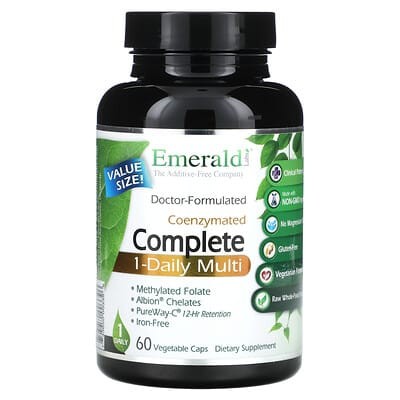

$34.16 $0.56 per serving


Product analysis
CoEnzymated Complete 1-Daily Multi may help fill dietary gaps in nutrients used for normal energy use, immune function and bone health. Its many extras and unclear blend details make it more complex to compare with a simpler multivitamin.
AI assessment of the formula, label and price. How scoring works
Nutrient Quality54
Vitamin D3, natural vitamin E and several well identified nutrient forms are favourable features. Missing form details and unclear mixture proportions prevent a complete quality comparison.
Ingredient Transparency74
All listed amounts are stated, and most forms are named. Several mixed-source proportions and the proprietary blend contents remain unclear, while another mixture’s composition is unresolved.
Value For Money43
Some nutrients, including folate and several trace minerals, have favourable price comparisons. Others look relatively costly, and many comparisons remain unresolved, so the broad formula has mixed value.
Customer Satisfaction78
Customers are strongly positive about the multivitamin. Several hundred ratings provide a useful satisfaction picture, without proving extra benefits from its many ingredients.
Product Focus3
The multivitamin covers many nutritional functions, with the clearest role in filling dietary gaps. Its large ingredient mix and broad purpose make it less targeted, and coenzymated forms do not establish extra energy benefits.
- Format
Capsule - Container
- 60 Capsule(s)
- Per serving
- $0.56
- Customer rating
- 4.7 · 639 ratings
Goals

Impact
High effect
Folate · 200 mcgVitamin B12 · 100 mcgVitamin D · 1000 IUMagnesium · 20 mgVitamin K · 25 mcgBoron · 1 mgSelenium · 25 mcgZinc · 10 mgVitamin C · 50 mg
B vitamins contribute to normal energy metabolism, while folate and B12 support normal blood formation. Magnesium can help fill a dietary gap and supports normal energy and mineral metabolism. Vitamin D and vitamin K contribute to bone and mineral nutrition when intake is inadequate. These nutritional roles do not establish extra health benefits when intake is already adequate.
How this product is rated for Everyday Health
Ingredient fit63
The recognized nutritional ingredients share the formula with actives serving other purposes, so its focus on routine general health is mixed. The recognized amounts cover part of the saved comparison ranges; these ranges do not define personal requirements or a clinical response.
Goal fit
The recognized nutritional ingredients share the formula with actives serving other purposes, so its focus on routine general health is mixed.
Dose adequacy
The recognized amounts cover part of the saved comparison ranges; these ranges do not define personal requirements or a clinical response.
Pathways80
The strongest saved connection is normal energy metabolism; this describes ingredient roles rather than demonstrated improvement in overall health.
Depth
The strongest saved connection is normal energy metabolism; this describes ingredient roles rather than demonstrated improvement in overall health.
Breadth
2 evaluated areas reach the saved coverage threshold, led by normal energy metabolism.
Evidence82
Vitamin D leads the saved evidence finding; its nutritional contribution is conditional on inadequate intake.
Evidence strength
Vitamin D leads the saved evidence finding; its nutritional contribution is conditional on inadequate intake.
Studied preparation
The saved finding accepts the evaluated preparations; it does not establish superiority of a particular chemical form or delivery method.
Formulation logic97
No unmet partner requirement or configured conflict was detected. Some recognized ingredients remain below the saved amount threshold.
Partner coverage
No recognized ingredient has an unmet partner requirement; an additional benefit from combining the ingredients is not established.
Conflicts
No configured ingredient conflict was detected in the supplied facts.
Effective doses
Most recognized ingredients reach the saved amount threshold; folate does not because its eligible amount remains unresolved.

Impact
Moderate effect
Iodine · 25 mcgVitamin D · 1000 IUVitamin B5 · 25 mgMagnesium · 20 mgRiboflavin · 25 mgThiamin · 25 mgVitamin B12 · 100 mcgPotassium · 10 mg
B vitamins support normal energy metabolism, while vitamin C can be relevant when a nutritional gap contributes to fatigue. The folate amount remains unresolved. Coenzymated forms do not by themselves establish a stronger energy benefit.
How this product is rated for Energy
Ingredient fit56
8 assessed ingredients relate to energy alongside 17 other active ingredients, giving the formula a broader focus. The assessed amounts meet part of the saved dose benchmarks.
Goal fit
8 assessed ingredients relate to energy alongside 17 other active ingredients, giving the formula a broader focus.
Dose adequacy
The assessed amounts meet part of the saved dose benchmarks.
Pathways0
The saved findings identify no coverage of the assessed alertness, muscle-energy, mitochondrial, stress-fatigue or circulation mechanisms. None of the three target areas reaches the saved threshold for substantial coverage.
Depth
The saved findings identify no coverage of the assessed alertness, muscle-energy, mitochondrial, stress-fatigue or circulation mechanisms.
Breadth
None of the three target areas reaches the saved threshold for substantial coverage.
Evidence95
Vitamin D provides the strongest saved evidence among ingredients meeting the amount benchmark. That finding does not establish extra energy from the whole formula. The assessed ingredients meeting the amount benchmark are recorded as matching studied preparations.
Evidence strength
Vitamin D provides the strongest saved evidence among ingredients meeting the amount benchmark. That finding does not establish extra energy from the whole formula.
Studied preparation
The assessed ingredients meeting the amount benchmark are recorded as matching studied preparations.
Formulation logic97
The assessed ingredients can act independently or have their required partner present. No configured ingredient conflicts were identified in the saved findings. 7 of 8 assessed ingredients meet the saved minimum amount benchmark. Folate fall below it or have unresolved amounts.
Partner coverage
The assessed ingredients can act independently or have their required partner present.
Conflicts
No configured ingredient conflicts were identified in the saved findings.
Effective doses
7 of 8 assessed ingredients meet the saved minimum amount benchmark. Folate fall below it or have unresolved amounts.
Vitamin B5 Not classified
No linked studies yet.

Impact
Moderate effect
Magnesium · 20 mgVitamin C · 50 mgZinc · 10 mgVitamin A · 500 IUVitamin D · 1000 IUSelenium · 25 mcg
Zinc and vitamin D support normal immune regulation, while vitamin C contributes to immune-cell function. Copper and B vitamins add nutritional support; the amounts of folate, vitamins A and E are unresolved.
How this product is rated for Immunity
Ingredient fit40
Relevant immune nutrients are part of a broader blend serving several purposes. Unresolved or smaller amounts limit the combined contribution.
Goal fit
Relevant immune nutrients are part of a broader blend serving several purposes.
Dose adequacy
Unresolved or smaller amounts limit the combined contribution.
Pathways47
The strongest saved contribution concerns lymphocyte function. One immune area reaches the saved coverage threshold; coverage remains selective.
Depth
The strongest saved contribution concerns lymphocyte function.
Breadth
One immune area reaches the saved coverage threshold; coverage remains selective.
Evidence100
Zinc provides the strongest evidence contribution in the saved assessment. The main practical benefit is supporting normal function rather than guaranteeing protection from infection. The assessed effective ingredients are accepted in the saved preparation assessment.
Evidence strength
Zinc provides the strongest evidence contribution in the saved assessment. The main practical benefit is supporting normal function rather than guaranteeing protection from infection.
Studied preparation
The assessed effective ingredients are accepted in the saved preparation assessment.
Formulation logic91
No configured ingredient conflict was identified. Vitamin A, vitamin E and folate fall below the saved amount threshold because their amounts are unresolved.
Partner coverage
The assessed ingredients can contribute alone or have their required partner.
Conflicts
No configured ingredient conflict was identified.
Effective doses
Vitamin A, vitamin E and folate fall below the saved amount threshold because their amounts are unresolved.

Impact
Moderate effect
Biotin · 150 mcgNiacin · 15 mgVitamin B12 · 100 mcgRiboflavin · 25 mgThiamin · 25 mgVitamin B5 · 25 mgVitamin B6 · 25 mgVitamin D · 1000 IUZinc · 10 mgMagnesium · 20 mg
Iodine is needed to make thyroid hormones, which help set how much energy your body uses at rest. Getting enough may help when low iodine intake has reduced thyroid function. Additional iodine doesn't boost an already normal thyroid, and the B vitamins here help normal energy use rather than reliably increasing the amount of energy you burn.
How this product is rated for Metabolism Support
Ingredient fit59
Iodine relates to normal metabolic processes, but that does not predict a faster metabolic rate.
Goal fit
Iodine relates to normal metabolic processes, but that does not predict a faster metabolic rate.
Dose adequacy
Vitamin B12: 100 mcg; Alpha-lipoic acid: 10 mg per serving. These quantities are not proven amounts for increasing energy expenditure.
Pathways8
Iodine helps thyroid hormone production when intake is low; extra iodine does not stimulate an already normal thyroid.
Depth
Iodine helps thyroid hormone production when intake is low; extra iodine does not stimulate an already normal thyroid.
Breadth
The ingredients do not provide a clear expectation of increasing energy expenditure through several distinct routes.
Evidence100
Normal nutrient functions and correction of low intake differ from increasing metabolic rate when intake is adequate.
Evidence strength
Normal nutrient functions and correction of low intake differ from increasing metabolic rate when intake is adequate.
Studied preparation
Iodine is identified for the preparation comparison; this does not imply a routine increase in energy expenditure.
Formulation logic100
No particular ingredient conflict or missing required partner is identified.
Partner coverage
No missing required ingredient partner is identified.
Conflicts
No particular ingredient conflict is identified.
Effective doses
Vitamin B12: 100 mcg; Alpha-lipoic acid: 10 mg per serving. A quantity comparison does not show that the serving raises metabolic rate.

Impact
Moderate effect
Folate · 200 mcgMagnesium · 20 mgVitamin B12 · 100 mcgVitamin K · 25 mcgVitamin D · 1000 IU
Vitamin C supports collagen formation, while vitamin D supports muscle and bone function and B12 supports normal nerves. These nutrients relate to maintaining function with age mainly when they help fill dietary gaps; the smaller amounts of magnesium and other ingredients provide limited additional support.
How this product is rated for Longevity
Ingredient fit41
Relevant ingredients share the formula with ingredients aimed at other purposes. The amounts assessed provide a limited match to the saved comparison levels.
Goal fit
Relevant ingredients share the formula with ingredients aimed at other purposes.
Dose adequacy
The amounts assessed provide a limited match to the saved comparison levels.
Pathways10
The strongest connection is antioxidant defence, with limited coverage. Coverage does not reach the saved threshold across direct aging-related mechanisms.
Depth
The strongest connection is antioxidant defence, with limited coverage.
Breadth
Coverage does not reach the saved threshold across direct aging-related mechanisms.
Evidence83
Vitamin D provides the strongest evidence connection among ingredients counted at relevant amounts, with limited scope for everyday aging-related benefits. The ingredients counted at relevant amounts match the preparations accepted in the saved findings.
Evidence strength
Vitamin D provides the strongest evidence connection among ingredients counted at relevant amounts, with limited scope for everyday aging-related benefits.
Studied preparation
The ingredients counted at relevant amounts match the preparations accepted in the saved findings.
Formulation logic96
The assessed ingredients can work alone or have their relevant partner present. No ingredient conflict was found in the supplied checks. Most ingredients counted meet the minimum amount threshold; Vitamin E remains below it.
Partner coverage
The assessed ingredients can work alone or have their relevant partner present.
Conflicts
No ingredient conflict was found in the supplied checks.
Effective doses
Most ingredients counted meet the minimum amount threshold; Vitamin E remains below it.
Boron Not classified
No linked studies yet.

Impact
Moderate effect
Biotin · 150 mcgVitamin D · 1000 IUZinc · 10 mgVitamin C · 50 mg
Zinc may help diffuse shedding linked to low zinc, and biotin's hair benefit mainly concerns deficiency or rare hair-shaft disorders. Copper has a role in pigmentation and connective tissue, while vitamin C helps normal collagen formation. Those functions don't imply that taking the combination will produce routine regrowth. Amounts for folate and vitamins A and D remain unresolved.
How this product is rated for Hair Health
Ingredient fit39
Vitamin B7 (Biotin), Copper, Vitamin B3 (Niacin) connects the serving to hair-related nutrition. Unresolved amounts limit some serving-specific expectations.
Goal fit
Vitamin B7 (Biotin), Copper, Vitamin B3 (Niacin) provides a connection to hair biology or nutrient sufficiency.
Dose adequacy
Vitamin B7 (Biotin) 150 mcg, Copper 1 mg, Vitamin B3 (Niacin) 25 mg per selected serving. Some other relevant amounts remain unresolved.
Pathways4
The relevant connection concerns hair-fibre building materials; this does not by itself imply follicular regrowth.
Depth
The relevant connection concerns hair-fibre building materials; this does not by itself imply follicular regrowth.
Breadth
The connection is concentrated in hair-fibre building materials.
Evidence98
Zinc's hair relevance has practical limits; an ingredient's normal biological role is not a promise of regrowth.
Evidence strength
Zinc has a relevant hair connection, but the expected benefit depends on the ingredient's limits and the cause of the hair problem.
Studied preparation
The ingredient forms provide relevant context, but matching a form does not guarantee a hair-growth benefit.
Formulation logic89
No missing required partner or particular ingredient conflict is identified. Declared amounts do not by themselves establish a hair-growth effect.
Partner coverage
No missing required ingredient partner is identified for the relevant ingredients.
Conflicts
No particular ingredient conflict is identified.
Effective doses
Vitamin E, Vitamin B9 (Folate), Vitamin A have unresolved amounts, which limits serving-specific expectations.
Ingredients
| Ingredient | Amount per serving | Score |
|---|---|---|
Beta-Carotene | 1000 IU | |
Vitamin A (Vitamin A Palmitate) | 500 IU | |
Vitamin C (Citrus Bioflavonoids, Pureway-C, Vegetable Fatty Acids) | 50 mg | |
Vitamin D3 (Cholecalciferol) | 1000 IU | |
Vitamin E (D-Alpha-Tocopherol) | 15 IU | |
Vitamin K1 | 25 mcg | |
Vitamin B1 (Thiamine Mononitrate) | 25 mg | |
Vitamin B2 (R-5-P) | 25 mg | |
Vitamin B3 (Niacin) | 10 mg | |
Vitamin B3 (Niacinamide) | 15 mg | |
Vitamin B6 (P-5-P, Pyridoxine Hydrochloride) | 25 mg | |
(6S)-5-Methyltetrahydrofolate | 200 mcg | |
Vitamin B12 (Methylcobalamin) | 100 mcg | |
Vitamin B5 (D-Calcium Pantothenate) | 25 mg | |
Biotin | 150 mcg | |
Calcium (TRAACS Calcium Bisglycinate Chelate) | 40 mg | |
Magnesium (TRAACS Magnesium Bisglycinate Chelate) | 20 mg | |
Zinc (TRAACS Zinc Bisglycinate Chelate) | 10 mg | |
Selenium (Selenium Glycinate) | 25 mcg | |
Iodine (Atlantic Kelp) | 25 mcg | |
Copper (TRAACS Copper Bisglycinate Chelate) | 1 mg | |
Manganese (TRAACS Manganese Bisglycinate Chelate) | 1.5 mg | |
Chromium (TRAACS Chromium Nicotinate Glycinate Chelate) | 200 mcg | |
Molybdenum (TRAACS Molybdenum Glycinate Chelate) | 25 mcg | |
Potassium (Potassium Glycinate Complex) | 10 mg | |
Alpha Lipoic Acid | 10 mg | |
Inositol | 25 mg | |
Rutin | 10 mg | |
Boron (Boroganic Glycine) | 1 mg | |
Lutein | 250 mcg | |
Lycopene | 250 mcg | |
Vanadium (TRAACS Vanadium Nicotinate Glycinate Chelate) | 200 mcg | |
European Grapeseed extract (OPC's) | 10 mg | |
Raw Whole Food Proprietary Blend | 25 mg |
Vitamin B6 (P-5-P, Pyridoxine Hydrochloride) · 25 mg OverallScore78
Copper (TRAACS Copper Bisglycinate Chelate) · 1 mg OverallScore84
Alternative products
Report alternatives
Sources
Published studies used for the product analysis and the top-ranked studies for each ingredient and goal.
- [Comparative study of the urinary excretion of boron, calcium, magnesium and phosphorus in postmenopausal women with and without osteoporosis].
- Effect of dietary boron on mineral, estrogen, and testosterone metabolism in postmenopausal women.
- The relationship between boron and magnesium status and bone mineral density in the human: a review.
- Effects of boron supplementation on bone mineral density and dietary, blood, and urinary calcium, phosphorus, magnesium, and boron in female athletes.
- Metabolic responses of postmenopausal women to supplemental dietary boron and aluminum during usual and low magnesium intake: boron, calcium, and magnesium absorption and retention and blood mineral concentrations
- What is the impact of daily oral supplementation of vitamin D3 (cholecalciferol) plus calcium on the incidence of hip fracture in older people? A systematic review and meta-analysis.
- Calcium supplementation prevents seasonal bone loss and changes in biochemical markers of bone turnover in elderly New England women: a randomized placebo-controlled trial.
- The effects of calcium supplementation (milk powder or tablets) and exercise on bone density in postmenopausal women.
- The efficacy of calcium supplementation alone in elderly Thai women over a 2-year period: a randomized controlled trial.
- Calcium-enriched foods and bone mass growth in prepubertal girls: a randomized, double-blind, placebo-controlled trial.
- The Association between Dietary and Circulating Copper Levels and Osteoporosis: a Scoping Review.
- Association between dietary copper, iron, zinc, selenium intake and osteopenia or osteoporosis in elderly hypertensive patients: a retrospective cohort study.
- Associations of dietary copper intake with total bone mineral density and lumbar spine bone mineral density in American adults.
- The association between dietary mineral intake and bone mineral density: a cross-sectional study.
- Association between dietary copper intake and bone mineral density in children and adolescents aged 8-19 years: A cross-sectional study.
- Association between RBC folate and lumbar bone mineral density in postmenopausal women, a cross-sectional study from NHANES 2009-2018.
- Genetic variants modify the associations of concentrations of methylmalonic acid, vitamin B-12, vitamin B-6, and folate with bone mineral density.
- Adequate Intake and Supplementation of B Vitamins, in Particular Folic Acid, can Play a Protective Role in Bone Health.
- Relation of homocysteine, folate, and vitamin B12 to bone mineral density of postmenopausal women.
- Dietary intake of folate, but not vitamin B2 or B12, is associated with increased bone mineral density 5 years after the menopause: results from a 10-year follow-up study in early postmenopausal women.