
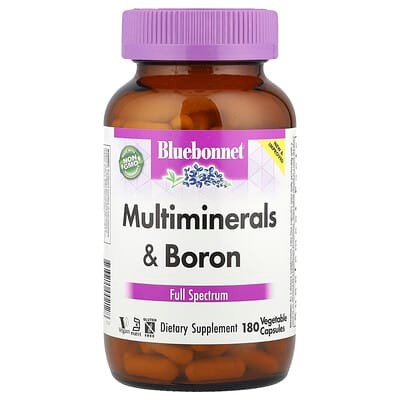

$31.96 $0.71 per serving


Product analysis
Multminerals Plus Boron provides a broad range of minerals for people seeking nutritional gap coverage. Unknown proportions in the calcium, magnesium and boron mixtures make the combined sources harder to judge.
AI assessment of the formula, label and price. How scoring works
Nutrient Quality75
Several trace minerals have favorable identified sources, including iodine, zinc and selenium. Calcium and magnesium use mixed forms with unknown proportions, while manganese quality remains uncertain.
Ingredient Transparency80
The mineral amounts and source names are disclosed, allowing serving comparisons. The proportions within the calcium, magnesium and boron mixtures are omitted.
Value For Money40
Potassium compares favorably, but boron, iron, zinc and selenium are relatively costly for their contributions. Other minerals offer moderate or limited value, so the wider blend is not uniformly economical.
Customer Satisfaction75
Customer ratings are favorable. Several hundred ratings give a useful picture of satisfaction.
Product Focus49
The broad mineral range serves many nutritional purposes. Its many intended uses make it less concentrated on a single need.
- Format
Capsule - Container
- 180 Capsule(s)
- Per serving
- $0.71
- Also available
 Iron-Free Multminerals Plus Boron$31.96
- Customer rating
- 4.6 · 531 ratings
Goals

Impact
Highest effect
Magnesium · 500 mgCalcium · 1000 mgCopper · 2 mgManganese · 10 mgBoron · 3 mgZinc · 30 mg
Calcium supplies bone mineral, and magnesium supports normal bone metabolism when dietary intake falls short. The serving provides 1000 mg calcium and 500 mg magnesium; larger amounts do not establish greater skeletal benefit once needs are met. Copper contributes to collagen cross-linking in deficiency. Boron, zinc and manganese do not have established independent supplemental bone benefits here, and potassium aspartate does not match the studied potassium citrate preparation.
How this product is rated for Bone Health
Ingredient fit76
Calcium and magnesium provide substantial declared mineral amounts, while several other active ingredients broaden the formula's focus.
Goal fit
The formula includes several bone-related minerals alongside other active ingredients aimed beyond bone health.
Dose adequacy
Known mineral amounts give a strong saved amount finding; this does not imply added benefit from exceeding nutritional needs.
Pathways100
The saved findings cover mineral supply, calcium regulation and collagen matrix formation, with calcium, magnesium and copper having relevant nutritional roles.
Depth
Mineral supply is the strongest saved finding, led by calcium and magnesium.
Breadth
Mineral supply, calcium regulation and collagen matrix formation meet the saved coverage criterion; bone-protein activation does not.
Evidence98
Calcium leads the saved evidence finding, with support focused on filling dietary gaps and mixed fracture outcomes. Potassium's preparation does not match the supplied study context.
Evidence strength
Calcium leads this finding through its mineralization role; the supplied evidence does not establish dependable fracture prevention.
Studied preparation
Potassium aspartate does not match the potassium citrate used in the supplied bone-density study.
Formulation logic97
All evaluated minerals meet the saved amount criterion, but calcium lacks its required partner contribution. No evaluated conflict was identified.
Partner coverage
Calcium lacks the vitamin D partner required by the saved calculation.
Conflicts
No evaluated conflict was identified; the very-high-vitamin-D adjustment is inapplicable.
Effective doses
All seven evaluated minerals meet the saved amount criterion, which does not establish clinical effectiveness.

Impact
Highest effect
Magnesium · 500 mgBoron · 3 mgSelenium · 200 mcgZinc · 30 mg
Magnesium supports energy metabolism, calcium contributes to bone nutrition, and zinc and selenium support normal immune and antioxidant functions. Iron and iodine can help fill dietary gaps relevant to blood formation and thyroid health. These roles are most useful with inadequate intake; the large mineral amounts do not establish additional benefit or suitability for everyone.
How this product is rated for Everyday Health
Ingredient fit84
The contributing ingredients relate directly to the supplied general health functions. The contributing amounts vary, with some falling below the upper comparisons used in the saved result.
Goal fit
The contributing ingredients relate directly to the supplied general health functions.
Dose adequacy
The contributing amounts vary, with some falling below the upper comparisons used in the saved result.
Pathways100
The strongest recorded contribution concerns energy metabolism, with the breadth finding covering energy metabolism, bone and mineral functions, antioxidant and immune functions.
Depth
The strongest recorded contribution concerns energy metabolism.
Breadth
The recorded contributions extend to energy metabolism, bone and mineral functions, antioxidant and immune functions.
Evidence86
Magnesium leads the saved evidence finding. Preparation eligibility does not establish extra benefit beyond the supplied context.
Evidence strength
Magnesium provides the strongest eligible contribution; the supported health claim remains limited by its supplied nutritional or population context.
Studied preparation
The eligible contributing preparations match the saved preparation criteria; this does not establish superiority over other forms.
Formulation logic100
The contributing ingredients work independently or have their required partners present. No configured ingredient conflict was found in the supplied facts.
Partner coverage
The contributing ingredients work independently or have their required partners present.
Conflicts
No configured ingredient conflict was found in the supplied facts.
Effective doses
All ingredients retained for this finding meet its minimum amount comparison; this does not make every listed ingredient effective.

Impact
Moderate effect
Iodine · 150 mcgMagnesium · 500 mgIron · 18 mgPotassium · 99 mg
Iron and magnesium can help fill dietary gaps associated with fatigue and weakness. The serving contains 18 mg iron and 500 mg magnesium, but larger amounts do not imply additional energy once needs are met.
How this product is rated for Energy
Ingredient fit59
The saved findings consider 4 relevant ingredients alongside 8 other actives.
Goal fit
4 ingredients contribute to the saved finding, while 8 other actives and links to other goals broaden its focus.
Dose adequacy
The saved amount finding considers 4 ingredients against their individual references.
Pathways0
The saved assessment records nutritional contributions without assigning a contribution to its specific energy mechanisms.
Depth
No assessed energy mechanism receives a saved contribution.
Breadth
No assessed area reaches the saved coverage threshold.
Evidence96
Iron leads the saved evidence finding. The supplied references distinguish nutritional adequacy or limited fatigue findings from a general energy boost.
Evidence strength
Iron has the strongest saved evidence finding among ingredients meeting the amount reference.
Studied preparation
The saved assessment records preparation matches for part of the formula, but not for Iodine.
Formulation logic100
The saved checks account for required partners and record no matched conflict.
Partner coverage
Each counted ingredient can contribute independently under the saved assessment or has its required partner.
Conflicts
No configured ingredient conflict is recorded.
Effective doses
All 4 counted ingredients meet the saved minimum amount threshold.

Impact
High effect
Zinc · 30 mgMagnesium · 500 mg
Iodine supports thyroid hormone production, and correcting iodine deficiency can restore a reduced metabolic rate. Magnesium and zinc support normal energy chemistry and enzyme function, while selenium participates in thyroid hormone processing. These normal roles do not establish increased energy expenditure in adults with adequate nutrient status. Iron repletion may partly restore cold-induced heat production in iron-deficiency anaemia.
How this product is rated for Metabolism Support
Ingredient fit70
Several minerals are recognized within a broader formula. Most recognized minerals meet the comparison; iodine and chromium receive partial recognition.
Goal fit
Several minerals are recognized within a broader formula.
Dose adequacy
Most recognized minerals meet the comparison; iodine and chromium receive partial recognition.
Pathways8
Hormonal and insulin-related coverage is limited.
Depth
Hormonal and insulin-related coverage is limited.
Breadth
No listed pathway reaches the breadth threshold.
Evidence100
Zinc drives the saved evidence finding; its normal enzyme role does not establish increased expenditure above adequate status.
Evidence strength
Zinc drives the saved evidence finding; its normal enzyme role does not establish increased expenditure above adequate status.
Studied preparation
The recognized preparations match the saved criteria, without establishing broader outcomes than the supplied human findings.
Formulation logic100
Recognized ingredients can work alone or have their required partners. No configured conflicts were matched, and counted ingredients meet the saved minimum amount threshold.
Partner coverage
Recognized ingredients can work alone or have their required partners; this does not establish an added combination effect.
Conflicts
No configured ingredient conflict was matched.
Effective doses
All ingredients included in this amount check meet its minimum threshold; that does not itself demonstrate increased metabolic rate.

Impact
High effect
Magnesium · 500 mgZinc · 30 mgBoron · 3 mg
Zinc supports normal testosterone when low zinc intake or deficiency has reduced it; extra zinc does not establish a boost when intake is adequate. Magnesium is an essential nutrient, but the hormone findings came from exercise-specific conditions and do not establish a routine testosterone increase. Boron’s small, inconsistent studies do not establish durable hormone benefits. Selenium’s hormone findings concern infertility treatment, rather than general testosterone enhancement.
How this product is rated for Testosterone Support
Ingredient fit63
Zinc is a relevant component. The retained amounts provide partial coverage of the comparison anchors, which are not established testosterone-boosting doses.
Goal fit
The relevant nutrients sit within a broader formula, so its focus extends beyond testosterone support.
Dose adequacy
The retained amounts provide partial coverage of the comparison anchors, which are not established testosterone-boosting doses.
Pathways70
Free-testosterone availability is the strongest recorded mechanism, although magnesium’s clinical evidence remains specific to exercise conditions. Coverage is confined to that mechanism.
Depth
Free-testosterone availability is the strongest recorded mechanism, although magnesium’s clinical evidence remains specific to exercise conditions.
Breadth
Only free-testosterone availability reached the coverage threshold; the findings do not establish broad hormone effects.
Evidence93
Zinc leads the evidence findings, but the supplied clinical context limits expectations of routine testosterone enhancement.
Evidence strength
Zinc provides the strongest eligible evidence contribution, subject to the population and outcome limitations of its studies.
Studied preparation
The eligible preparations matched the supplied comparisons; this match does not establish a testosterone increase in unselected users.
Formulation logic100
No configured ingredient conflict was found. All retained ingredients meet the minimum comparison threshold; this is not a proven effective testosterone dose.
Partner coverage
The retained ingredients have no unmet partner requirement in the supplied findings.
Conflicts
No configured ingredient conflict was found.
Effective doses
All retained ingredients meet the minimum comparison threshold; this is not a proven effective testosterone dose.

Impact
High effect
Zinc · 30 mgIron · 18 mg
Zinc helps address diffuse shedding when zinc intake is deficient, while iron can help when iron deficiency contributes to shedding. Selenium supports antioxidant biology, although this does not establish routine hair benefit and excessive intake may worsen hair loss. Copper contributes to pigmentation and connective-tissue biology, without establishing routine regrowth.
How this product is rated for Hair Health
Ingredient fit65
The formula includes relevant nutrients alongside other actives, making its focus broader than hair health. Most assessed amounts make substantial contributions against the comparison anchors, while some contribute less.
Goal fit
The formula includes relevant nutrients alongside other actives, making its focus broader than hair health.
Dose adequacy
Most assessed amounts make substantial contributions against the comparison anchors, while some contribute less.
Pathways55
Antioxidant protection around follicles is the strongest recorded mechanism; this does not establish a hair-growth outcome.
Depth
Antioxidant protection around follicles is the strongest recorded mechanism; this does not establish a hair-growth outcome.
Breadth
Only follicle antioxidant protection reached the coverage threshold; androgen and stress-hormone mechanisms received no contribution.
Evidence96
Zinc leads the eligible evidence contribution. Normal nutrient roles and preparation matches do not by themselves prove routine hair regrowth.
Evidence strength
Zinc provides the strongest eligible evidence contribution, with the limitations of its specific hair-health role still applying.
Studied preparation
Most eligible preparations matched the supplied comparisons, while iodine did not have a studied-preparation match.
Formulation logic100
The relevant ingredients have no unmet partner requirement or configured conflict. Their retained amounts meet the minimum comparison threshold.
Partner coverage
The relevant ingredients have no unmet partner requirement in the supplied findings.
Conflicts
No configured ingredient conflict was found; this is not a comprehensive safety assessment.
Effective doses
All ingredients retained for this check meet its minimum amount threshold; that threshold is not a proven effective hair-growth dose.
Ingredients
| Ingredient | Amount per serving | Score |
|---|---|---|
Calcium (Calcium Carbonate, Calcium Citrate) | 1000 mg | |
Iron (Iron Ferrous Bisglycinate) | 18 mg | |
Iodine (Potassium Iodide) | 150 mcg | |
Magnesium (Magnesium Aspartate, Magnesium Oxide) | 500 mg | |
Zinc (Zinc Picolinate) | 30 mg | |
Selenium (L-Selenomethionine) | 200 mcg | |
Copper (Copper Histidinate) | 2 mg | |
Manganese (Manganese L-Histidinate) | 10 mg | |
Chromium (Chromium Picolinate) | 200 mcg | |
Molybdenum (Molybdenum Glycinate Chelate) | 100 mcg | |
Potassium (Potassium Aspartate) | 99 mg | |
Boron (Boron Aspartate, Boron Citrate, Boron Glycinate) | 3 mg |
Iodine (Potassium Iodide) · 150 mcg OverallScore90
A serving provides 150 mcg iodine as potassium iodide, a form assessed favorably for absorption. The whole-product serving costs about $0.71.
How this ingredient is rated
Active Ingredient Quality & Bioavailability100
Potassium iodide supplies the iodine and is assessed favorably for absorption.
Iodine Form & Bioavailability
Iodine is supplied as potassium iodide, a form the evaluation considers favorable for absorption.
Marine Source Purity & Sourcing
The iodine source is potassium iodide, so the marine-source purity consideration does not apply.
Dose, Safety & Label Transparency100
The serving provides 150 mcg iodine, a moderate amount. The amount is stated and does not exceed the limit used in the evaluation.
Dosage Efficacy for Daily Support
The serving provides 150 mcg iodine, a moderate amount.
Dosage Safety & Upper Limits
The serving amount does not exceed the evaluation's upper limit; iodine from other sources also contributes to total intake.
Elemental Iodine Transparency
The saved facts state 150 mcg iodine per serving and identify potassium iodide as its source.
Value50
A whole-product serving costs about $0.71.
Price Per Effective Serving
The price is about $0.71 per whole-product serving.
Manganese (Manganese L-Histidinate) · 10 mg OverallScore50
Each serving lists 10 mg of manganese. Its chemical form is unavailable in the saved facts, which limits form comparisons.
How this ingredient is rated
Active Ingredient Quality & Bioavailability0
The saved facts identify the manganese amount but not its chemical form.
Manganese Chemical Form
The chemical form is unknown in the saved facts.
Dose, Safety & Label Transparency100
The serving lists 10 mg of elemental manganese. The stated mineral amount can be compared across servings.
Manganese Dosage Efficacy & Safety
The 10 mg per serving falls within the evaluation’s preferred comparison band.
Elemental Weight Disclosure
The elemental manganese amount is stated as 10 mg per serving.
Value50
The whole-product serving costs about $0.71; that price covers the full product serving, not manganese alone.
Price per Serving vs. Median
The evaluated price is about $0.71 per whole-product serving.
Copper (Copper Histidinate) · 2 mg OverallScore90
The serving provides 2 mg of copper as copper histidinate. It also contains 30 mg zinc, a ratio that fits the evaluation’s balance criterion.
How this ingredient is rated
Active Ingredient Quality & Bioavailability100
Copper histidinate is an amino acid chelate that the evaluation favors for absorption potential.
Copper Form Bioavailability
Copper histidinate is an amino acid chelate favored for absorption potential in the evaluation.
Elemental Copper Labeling Clarity
The copper amount of 2 mg per serving and the source name are both identified.
Dose, Safety & Label Transparency100
2 mg of copper and 30 mg of zinc are provided per selected serving. The zinc-to-copper ratio fits the evaluation’s balance criterion.
Copper Dosage Safety & Efficacy
The selected serving provides 2 mg of copper, matching the evaluation’s target amount.
Zinc-to-Copper Balance
The serving also provides 30 mg zinc; the zinc-to-copper ratio fits the evaluation’s balance criterion.
Value50
The whole product costs about $0.71 per serving; that price is not for copper alone.
Price Per Serving Efficiency
The whole product costs about $0.71 per serving; that price is not for copper alone.
Alternative products
Report alternatives
Sources
Published studies used for the product analysis and the top-ranked studies for each ingredient and goal.
- [Comparative study of the urinary excretion of boron, calcium, magnesium and phosphorus in postmenopausal women with and without osteoporosis].
- Effect of dietary boron on mineral, estrogen, and testosterone metabolism in postmenopausal women.
- The relationship between boron and magnesium status and bone mineral density in the human: a review.
- Effects of boron supplementation on bone mineral density and dietary, blood, and urinary calcium, phosphorus, magnesium, and boron in female athletes.
- Metabolic responses of postmenopausal women to supplemental dietary boron and aluminum during usual and low magnesium intake: boron, calcium, and magnesium absorption and retention and blood mineral concentrations
- What is the impact of daily oral supplementation of vitamin D3 (cholecalciferol) plus calcium on the incidence of hip fracture in older people? A systematic review and meta-analysis.
- Calcium supplementation prevents seasonal bone loss and changes in biochemical markers of bone turnover in elderly New England women: a randomized placebo-controlled trial.
- The effects of calcium supplementation (milk powder or tablets) and exercise on bone density in postmenopausal women.
- The efficacy of calcium supplementation alone in elderly Thai women over a 2-year period: a randomized controlled trial.
- Calcium-enriched foods and bone mass growth in prepubertal girls: a randomized, double-blind, placebo-controlled trial.
- The Association between Dietary and Circulating Copper Levels and Osteoporosis: a Scoping Review.
- Association between dietary copper, iron, zinc, selenium intake and osteopenia or osteoporosis in elderly hypertensive patients: a retrospective cohort study.
- Associations of dietary copper intake with total bone mineral density and lumbar spine bone mineral density in American adults.
- The association between dietary mineral intake and bone mineral density: a cross-sectional study.
- Association between dietary copper intake and bone mineral density in children and adolescents aged 8-19 years: A cross-sectional study.
- Association between Serum Magnesium and Fractures: A Systematic Review and Meta-Analysis of Observational Studies.
- Bioabsorbable Magnesium-Based Materials Potential and Safety in Bone Surgery: A Systematic Review.
- Vascularized bone grafting fixed by biodegradable magnesium screw for treating osteonecrosis of the femoral head.
- An update on magnesium and bone health.
- Sex-specific differences in the association of magnesium intake with femoral neck bone mineral density among older adults.