
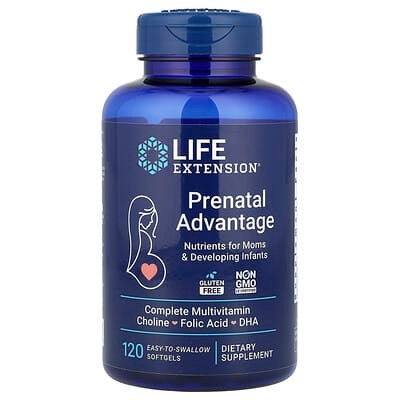

$21.00 $0.70 per serving


Product analysis
Prenatal Advantage combines nutrients that support normal blood formation and can help fill dietary gaps. Incomplete amounts and ingredient descriptions make the full formula harder to compare.
AI assessment of the formula, label and price. How scoring works
Nutrient Quality21
The grouped nutrient mixture is not clear enough for a confident preparation-quality judgment. The separately named biotin, lutein and zeaxanthin also lack specific form details.
Ingredient Transparency61
The contents are only partly described. Some amounts and forms are missing, while the composition of the grouped nutrient mixture remains unclear.
Value For Money40
Value for money remains uncertain. The details do not allow reliable comparisons for the separately listed ingredients.
Customer Satisfaction91
Customer ratings are very positive. Thousands of ratings provide a substantial base of feedback.
Product Focus62
The formula covers many nutritional roles, with blood formation and filling dietary gaps the clearest purposes. Its broader energy, focus and other connections depend on nutritional status, and some ingredient amounts remain unresolved.
- Format
Softgel - Container
- 120 Softgel(s)
- Per serving
- $0.70
- Customer rating
- 4.8 · 6,214 ratings
Goals

Impact
Highest effect
Folate · 1020 mcg DFEVitamin B12 · 8 mcgVitamin D · 25 mcgVitamin K · 90 mcgSelenium · 70 mcgZinc · 13 mgVitamin C · 120 mg

Impact
High effect
Vitamin K · 90 mcgVitamin B12 · 8 mcgVitamin B6 · 2 mgFolate · 1020 mcg DFEVitamin D · 25 mcg

Impact
Highest effect
Vitamin C · 120 mgZinc · 13 mgVitamin A · 1300 mcg RAEVitamin D · 25 mcgSelenium · 70 mcg

Impact
Moderate effect
Iodine · 290 mcgVitamin D · 25 mcgVitamin B5 · 7 mgRiboflavin · 1.6 mgThiamin · 1.4 mgVitamin B12 · 8 mcgIron · 27 mgPotassium · 99 mg
Vitamin B5 Not classified
No linked studies yet.

Impact
High effect
Choline · 275 mgThiamin · 1.4 mgVitamin B6 · 2 mgFolate · 1020 mcg DFEVitamin B12 · 8 mcgVitamin D · 25 mcg

Impact
High effect
Biotin · 35 mcgVitamin D · 25 mcgZinc · 13 mgIron · 27 mgVitamin C · 120 mg
Ingredients
| Ingredient | Amount per serving | Score |
|---|---|---|
Vitamin A (Beta-Carotene) | 1300 mcg RAE | |
Vitamin C (Ascorbic Acid, Calcium Ascorbate, Niacinamide Ascorbate) | 120 mg | |
Vitamin D3 (Cholecalciferol) | 25 mcg | |
Vitamin E (D-Alpha-Tocopherol Succinate) | 15 mg | |
Vitamin K (Menaquinone-4, Menaquinone-7, Phytonadione) | 90 mcg | |
Thiamine (Thiamine Hydrochloride, Vitamin B1) | 1.4 mg | |
Riboflavin (Riboflavin 5-Phosphate, Vitamin B2) | 1.6 mg | |
Niacin (Niacinamide, Niacinamide Ascorbate) | 18 mg NE | |
Vitamin B6 (Pyridoxal 5-Phosphate) | 2 mg | |
Folate (Metafolin L-5-Methyltetrahydrofolate Calcium Salt) | 1020 mcg DFE | |
Vitamin B12 (Methylcobalamin) | 8 mcg | |
Biotin | 35 mcg | |
Pantothenic Acid (D-Calcium Pantothenate) | 7 mg | |
Iron (Ferrous Fumarate) | 27 mg | |
Iodine (Potassium Iodide) | 290 mcg | |
Zinc (L-OptiZinc Zinc Mono-L-Methionine Sulfate, Zinc Citrate) | 13 mg | |
Selenium (SelenoExcell High Selenium Yeast, Sodium Selenite) | 70 mcg | |
Copper (Copper Bisglycinate Chelate) | 1.3 mg | |
Manganese (Manganese Citrate, Manganese Gluconate) | 2.6 mg | |
Chromium (Chromium Nicotinate Glycinate) | 45 mcg | |
Molybdenum (Molybdenum Glycinate) | 50 mcg | |
Choline (Choline Bitartrate) | 275 mg | |
Potassium (Potassium Chloride) | 99 mg | |
Docosahexaenoic Acid (Algae Oil) | 200 mg | |
Marigold extract | 17.5 mg | |
Lutein | 3.5 mg | |
Zeaxanthin | 700 mcg |
Copper (Copper Bisglycinate Chelate) · 1.3 mg OverallScore84
Each serving provides 1.3 mg of copper at a fairly high cost per serving. It uses Copper Bisglycinate. The serving contains 13 mg zinc and 1.3 mg copper, a 10:1 ratio.
How this ingredient is rated
Active Ingredient Quality & Bioavailability100
It uses Copper Bisglycinate. The label states 1.3 mg of copper per serving from Copper Bisglycinate.
Copper Form Bioavailability
It uses Copper Bisglycinate.
Elemental Copper Labeling Clarity
The label states 1.3 mg of copper per serving from Copper Bisglycinate.
Dose, Safety & Label Transparency86
The 1.3 mg serving provides copper. The serving contains 13 mg zinc and 1.3 mg copper, a 10:1 ratio.
Copper Dosage Safety & Efficacy
The 1.3 mg serving provides copper.
Zinc-to-Copper Balance
The serving contains 13 mg zinc and 1.3 mg copper, a 10:1 ratio.
Value50
The cost per serving is fairly high.
Price Per Serving Efficiency
The cost per serving is fairly high.
Manganese (Manganese Citrate, Manganese Gluconate) · 2.6 mg OverallScore76
A serving provides 2.6 mg of manganese at a moderately high cost per serving. The proportions of the two forms are unknown.
How this ingredient is rated
Active Ingredient Quality & Bioavailability80
Manganese citrate and manganese gluconate are listed, but their proportions are unknown.
Manganese Chemical Form
Manganese citrate and manganese gluconate are listed, but their proportions are unknown.
Dose, Safety & Label Transparency86
The serving lists 2.6 mg of manganese.
Manganese Dosage Efficacy & Safety
A serving provides 2.6 mg of manganese.
Elemental Weight Disclosure
The manganese amount is stated.
Value50
The cost per serving is moderately high.
Price per Serving vs. Median
The cost per serving is moderately high.
Iodine (Potassium Iodide) · 290 mcg OverallScore90
Each serving provides 290 mcg of iodine from potassium iodide at a moderate cost per serving. The amount supports daily iodine intake. The amount and source are clearly stated.
How this ingredient is rated
Active Ingredient Quality & Bioavailability100
Potassium iodide supplies the iodine. The marine-specific purity concern does not apply.
Iodine Form & Bioavailability
The iodine comes from potassium iodide.
Marine Source Purity & Sourcing
The iodine is not identified as coming from a marine source, so the marine-specific purity concern does not apply.
Dose, Safety & Label Transparency100
The serving provides 290 mcg of iodine. The source is stated.
Dosage Efficacy for Daily Support
The 290 mcg serving provides iodine for daily thyroid and metabolic support.
Dosage Safety & Upper Limits
The 290 mcg serving is below the general adult upper intake level; individual needs can differ.
Elemental Iodine Transparency
Both the iodine amount and its potassium iodide source are stated.
Value50
The cost per serving is moderate.
Price Per Effective Serving
The cost per serving is moderate.
Alternative products
Report alternatives
Sources
Published studies used for the product analysis and the top-ranked studies for each ingredient and goal.
- The Association between Dietary and Circulating Copper Levels and Osteoporosis: a Scoping Review.
- Association between dietary copper, iron, zinc, selenium intake and osteopenia or osteoporosis in elderly hypertensive patients: a retrospective cohort study.
- Associations of dietary copper intake with total bone mineral density and lumbar spine bone mineral density in American adults.
- The association between dietary mineral intake and bone mineral density: a cross-sectional study.
- Association between dietary copper intake and bone mineral density in children and adolescents aged 8-19 years: A cross-sectional study.
- Association between RBC folate and lumbar bone mineral density in postmenopausal women, a cross-sectional study from NHANES 2009-2018.
- Genetic variants modify the associations of concentrations of methylmalonic acid, vitamin B-12, vitamin B-6, and folate with bone mineral density.
- Adequate Intake and Supplementation of B Vitamins, in Particular Folic Acid, can Play a Protective Role in Bone Health.
- Relation of homocysteine, folate, and vitamin B12 to bone mineral density of postmenopausal women.
- Dietary intake of folate, but not vitamin B2 or B12, is associated with increased bone mineral density 5 years after the menopause: results from a 10-year follow-up study in early postmenopausal women.
- Risk of Environmental Chemicals on Bone Fractures Is Independent of Low Bone Mass in US Adults: Insights from 2017 to 2018 NHANES.
- The Manganese-Bone Connection: Investigating the Role of Manganese in Bone Health.
- Associations of multiple metals with bone mineral density: A population-based study in US adults.
- Sex-specific associations of urinary mixed-metal concentrations with femoral bone mineral density among older people: an NHANES (2017-2020) analysis.
- Relationship between blood manganese and bone mineral density and bone mineral content in adults: A population-based cross-sectional study.
- Effect of potassium citrate on bone density, microarchitecture, and fracture risk in healthy older adults without osteoporosis: a randomized controlled trial.
- Long-term persistence of the urine calcium-lowering effect of potassium bicarbonate in postmenopausal women.
- Partial neutralization of the acidogenic Western diet with potassium citrate increases bone mass in postmenopausal women with osteopenia.
- Potassium citrate supplementation results in sustained improvement in calcium balance in older men and women.
- Effects of potassium chloride and potassium bicarbonate on endothelial function, cardiovascular risk factors, and bone turnover in mild hypertensives.