
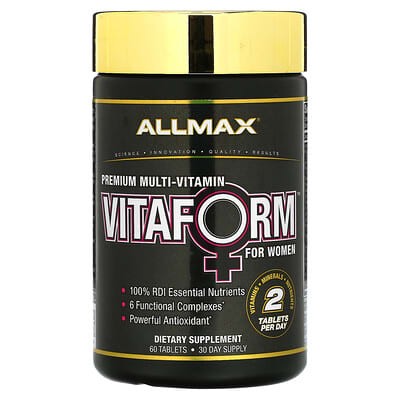

$13.99 $0.46 per serving



Product analysis
VITAFORM for Women provides broad vitamin and mineral support for nutrient gaps, with bone nutrition as its clearest supported use. Missing blend details make the additional ingredients harder to judge.
AI assessment of the formula, label and price. How scoring works
Nutrient Quality42
Ingredient quality varies, with favorable iodine and chromium forms alongside less clear parts of the formula. Unspecified calcium proportions and an unidentified blend limit a fuller comparison.
Ingredient Transparency73
Most nutrient amounts and forms are disclosed, helping you compare the core vitamins and minerals. Several mixed-source proportions and the blend’s ingredients and amount are missing, leaving part of the formula unclear.
Value For Money47
Value is mixed, with favorable comparisons for several minerals but a less favorable chromium cost. The uncertain value of many other nutrients prevents a confident judgment of the whole formula.
Customer Satisfaction89
Customer feedback is very positive across several thousand ratings. That provides a broad view of satisfaction without confirming effects on energy, hair or metabolism.
Product Focus16
The clearest role is filling nutrient gaps, especially for bone nutrition and normal energy use. The broad blend and unresolved botanical details make extra benefits beyond adequate nutrition uncertain.
- Format
Tablet - Container
- 60 Tablet(s)
- Per serving
- $0.46
- Customer rating
- 4.8 · 3,419 ratings
Goals

Impact
Highest effect
Vitamin K · 80 mcgCalcium · 500 mgVitamin D · 20 mcgCopper · 2 mgManganese · 2 mgZinc · 15 mgVitamin C · 90 mg
Calcium supplies bone mineral, paired here with vitamin D for absorption. Zinc and manganese support processes involved in building bone matrix, while copper supports collagen cross-linking when intake is deficient. These normal roles do not establish additional bone-density or fracture benefits when intake is adequate. Vitamin K has a role in bone-protein activation, but the clinical relevance depends on the identified preparation rather than vitamin K presence alone.
How this product is rated for Bone Health
Ingredient fit68
Bone-related nutrients are part of a broader formula containing ingredients directed at other needs.
Goal fit
Bone-related nutrients are part of a broader formula containing ingredients directed at other needs.
Dose adequacy
The included nutrients provide varying amounts of nutritional support; small or unresolved quantities limit their contribution.
Pathways100
The strongest saved coverage is collagen matrix formation. The saved coverage spans bone mineral supply, calcium absorption and regulation, collagen matrix formation. coverage: bone mineral supply 50.0, calcium absorption and regulation 50.0, bone-protein activation 0.0, collagen matrix formation 100.0, remodeling balance 36.4.
Depth
The strongest saved coverage is collagen matrix formation.
Breadth
The saved coverage spans bone mineral supply, calcium absorption and regulation, collagen matrix formation. coverage: bone mineral supply 50.0, calcium absorption and regulation 50.0, bone-protein activation 0.0, collagen matrix formation 100.0, remodeling balance 36.4.
Evidence100
The included nutrients have nutritional or preparation-specific support; this does not establish routine fracture prevention. Their preparations meet the saved matching criteria.
Evidence strength
Calcium supplies the strongest included support, subject to its nutritional and population limits.
Studied preparation
The included preparations meet the saved study-match criteria; this does not prove fracture prevention.
Formulation logic100
The included nutrients work independently or have their required partner present. No configured ingredient conflict was identified.
Partner coverage
The included nutrients work independently or have their required partner present.
Conflicts
No configured ingredient conflict was identified.
Effective doses
The included nutrients reach the saved minimum comparison; this is not a clinically proven benefit threshold.

Impact
Moderate effect
Iodine · 150 mcgVitamin D · 20 mcgVitamin B5 · 10 mgRiboflavin · 1.7 mgThiamin · 1.5 mgVitamin B12 · 6 mcg
B vitamins support normal energy metabolism, with B12 and folate helping meet needs associated with fatigue when intake is low. Vitamin C adds nutritional support. Caffeine-bearing botanicals have no resolved caffeine amount, so an alertness effect cannot be estimated.
How this product is rated for Energy
Ingredient fit64
Relevant nutrients share the formula with ingredients serving other purposes, reducing its saved focus on energy. The assessed amounts provide partial support against the saved dose references (59.8 out of 100).
Goal fit
Relevant nutrients share the formula with ingredients serving other purposes, reducing its saved focus on energy.
Dose adequacy
The assessed amounts provide partial support against the saved dose references (59.8 out of 100).
Pathways0
No direct energy mechanism has recorded coverage; the assessed contribution is nutritional. No direct energy mechanism reaches the saved coverage threshold.
Depth
No direct energy mechanism has recorded coverage; the assessed contribution is nutritional.
Breadth
No direct energy mechanism reaches the saved coverage threshold.
Evidence94
Vitamin D leads the saved evidence comparison at an assessed amount. Most qualifying ingredients match the saved studied-preparation category; exceptions are Iodine.
Evidence strength
Vitamin D leads the saved evidence comparison at an assessed amount.
Studied preparation
Most qualifying ingredients match the saved studied-preparation category; exceptions are Iodine.
Formulation logic100
The assessed ingredients work independently or have their listed partner. No ingredient conflict is recorded in the saved assessment.
Partner coverage
The assessed ingredients work independently or have their listed partner.
Conflicts
No ingredient conflict is recorded in the saved assessment.
Effective doses
All assessed ingredients reach the saved minimum dose threshold.
Vitamin B5 Not classified
No linked studies yet.

Impact
High effect
Folate · 668 mcg DFEVitamin B12 · 6 mcgVitamin B6 · 2 mgMolybdenum · 75 mcgVitamin E · 13.5 mgZinc · 15 mgVitamin C · 90 mgRiboflavin · 1.7 mg
Folate has limited relevance to arsenic elimination when folate intake is low and arsenic exposure is present; the supplied findings do not establish a general cleanse benefit.
How this product is rated for Liver & Detox
Ingredient fit57
The recognized ingredients and their declared amounts shape the formula’s focus; routine toxin removal is not established.
Goal fit
This broad formula also includes ingredients aimed at other uses, reducing its focus on this goal.
Dose adequacy
The declared amounts partly meet the saved amount comparison; that comparison does not establish a clinical detoxification dose.
Pathways42
The saved findings describe biochemical routes rather than demonstrated clearance of toxins. Their depth and breadth are distinguished below.
Depth
Detox-enzyme induction is the strongest saved route; this biochemical finding does not demonstrate toxin clearance.
Breadth
One route reached the coverage criterion; this describes breadth of composition, without proving broader toxin removal.
Evidence99
The saved evidence findings recognize ingredients and preparations, while the human research remains limited to nutritional or specific clinical settings.
Evidence strength
Vitamin B9 (Folate) leads the saved evidence finding; the supplied research does not establish generalized detoxification in unselected adults.
Studied preparation
Preparation matching is incomplete for Molybdenum.
Formulation logic100
No required partner is missing, and none of the specified conflicts was triggered.
Partner coverage
No required partner is missing for the recognized ingredients; this does not establish synergistic toxin clearance.
Conflicts
None of the specified conflicts was triggered in the supplied findings.
Effective doses
All recognized ingredients meet the minimum amount criterion; this does not establish an effective clinical detoxification dose.
Riboflavin Not classified
No linked studies yet.
Vitamin B6 Not classified
No linked studies yet.

Impact
High effect
Biotin · 300 mcgNiacin · 20 mgVitamin B12 · 6 mcgRiboflavin · 1.7 mgThiamin · 1.5 mgVitamin B5 · 10 mgVitamin B6 · 2 mgVitamin D · 20 mcgZinc · 15 mg
Iodine supports normal thyroid hormone production, while B vitamins help the body use energy from food. These roles do not establish an extra metabolic-rate increase when intake is adequate. Green tea is mentioned in stored label material, but its imported facts remain unresolved, so its amount and contribution cannot be established here.
How this product is rated for Metabolism Support
Ingredient fit65
The formula combines nutrients involved in normal metabolism; their counted amounts vary.
Goal fit
Several nutrients are counted, but green tea remains unresolved because its imported facts do not match the stored label reference.
Dose adequacy
Declared amounts receive partial allowance against the comparison amounts; this does not identify a proven effective dose.
Pathways5
The saved findings mainly concern insulin sensitivity and metabolic hormones, with limited breadth across other routes.
Depth
The strongest represented route is insulin sensitivity and metabolic hormones; this describes the saved ingredient mapping, not a measured rise in energy expenditure.
Breadth
No route reaches the comparison's coverage threshold.
Evidence100
The retained findings must be interpreted alongside the distinction between ordinary metabolic roles and a demonstrated increase in energy expenditure.
Evidence strength
The strongest retained findings concern nutrient functions, which do not establish extra energy expenditure above adequate intake.
Studied preparation
The saved findings accept the counted preparations; this does not establish that this exact product or combination increased energy expenditure.
Formulation logic100
The retained ingredients meet the amount check and have no missing required partners. No evaluated ingredient conflict was triggered.
Partner coverage
No required partner is missing among the counted ingredients; this does not establish extra benefit from combining them.
Conflicts
None of the evaluated ingredient conflicts was triggered.
Effective doses
All ingredients retained for this check meet its amount threshold; the threshold is not a proven clinical minimum.

Impact
High effect
Biotin · 300 mcgVitamin D · 20 mcgZinc · 15 mgVitamin C · 90 mg
Zinc and biotin can help address nutrient gaps associated with diffuse shedding. This nutritional role does not establish extra regrowth when intake is adequate. The supplied information does not establish independent hair improvement from the wider vitamin mixture or sulfur-containing ingredients.
How this product is rated for Hair Health
Ingredient fit68
Hair-related ingredients sit alongside components intended for broader nutritional goals. The qualifying amounts provide a partial match to the saved reference ranges; unresolved amounts contribute no known exposure.
Goal fit
Hair-related ingredients sit alongside components intended for broader nutritional goals.
Dose adequacy
The qualifying amounts provide a partial match to the saved reference ranges; unresolved amounts contribute no known exposure.
Pathways9
Hair-fibre building blocks is the leading represented area; this does not establish a measured hair outcome. No biological area reaches the saved comparison's coverage level.
Depth
Hair-fibre building blocks is the leading represented area; this does not establish a measured hair outcome.
Breadth
No biological area reaches the saved comparison's coverage level.
Evidence97
Zinc leads the saved evidence comparison; the supplied limits on hair outcomes still apply.
Evidence strength
Zinc leads the saved evidence comparison; the supplied limits on hair outcomes still apply.
Studied preparation
Iodine does not match a reviewed preparation; the remaining qualifying ingredients match the saved preparation criteria.
Formulation logic100
No specified conflict or missing required partner was identified. The counted ingredients meet the saved amount criterion; this is not a proven hair-outcome dose.
Partner coverage
No required partner is missing among the ingredients considered.
Conflicts
None of the specified ingredient conflicts was identified.
Effective doses
The counted ingredients meet the saved amount criterion; this is not a proven hair-outcome dose.
Ingredients
| Ingredient | Amount per serving | Score |
|---|---|---|
Vitamin A (Beta-Carotene) | 1500 mcg | |
Vitamin C (Ascorbic Acid, Calcium Ascorbate) | 90 mg | |
Vitamin D (Cholecalciferol) | 20 mcg | |
Vitamin E (DL-Alpha-Tocopheryl Acetate) | 13.5 mg | |
Vitamin K (Phytonadione) | 80 mcg | |
Thiamin (Thiamine Hydrochloride) | 1.5 mg | |
Riboflavin | 1.7 mg | |
Niacin (Niacinamide) | 20 mg | |
Vitamin B6 (Pyridoxine Hydrochloride) | 2 mg | |
Folate | 668 mcg DFE | |
Vitamin B12 (Methylcobalamin) | 6 mcg | |
Biotin | 300 mcg | |
Pantothenic Acid (D-Calcium Pantothenate) | 10 mg | |
Calcium (Calcium Ascorbate, Calcium Carbonate, Calcium Hydrolyzed Vegetable Protein) | 500 mg | |
Iodine (Potassium Iodide) | 150 mcg | |
Zinc (Zinc HVP Chelate) | 15 mg | |
Copper (Copper Amino Acid Chelate) | 2 mg | |
Manganese (Manganese Amino Acid Chelate) | 2 mg | |
Chromium (Chromium Polynicotinate) | 120 mcg | |
Molybdenum (Molybdenum Amino Acid Chelate) | 75 mcg | |
FEMESSENCE: Femme Essential Complex | 0 NP | |
AGENTACT: Femme Anti-Aging Blend | 0 NP | |
COGNISENSE: Femme Active Mind Support | 0 NP | |
METAFEMME: Femme Metabolism Support | 0 NP | |
IMMUBOOST: Femme Immune Support | 0 NP | |
LIBRAFLEX: Femme Joint Support | 0 NP |
Iodine (Potassium Iodide) · 150 mcg OverallScore96
A serving provides 150 mcg of iodine as potassium iodide. The whole product costs about $0.47 per serving.
How this ingredient is rated
Active Ingredient Quality & Bioavailability100
Iodine is listed as potassium iodide. No marine source is recorded.
Iodine Form & Bioavailability
Iodine is listed as potassium iodide.
Marine Source Purity & Sourcing
No marine source is recorded in the saved facts, so the marine-specific check does not apply; it does not establish contaminant absence.
Dose, Safety & Label Transparency100
A serving provides 150 mcg of iodine. That amount did not trigger the evaluation’s excess-iodine caution.
Dosage Efficacy for Daily Support
A serving provides 150 mcg of iodine.
Dosage Safety & Upper Limits
The 150 mcg per serving did not trigger the evaluation’s excess-iodine caution.
Elemental Iodine Transparency
The iodine amount is identified as 150 mcg per serving.
Value80
The whole product costs about $0.47 per serving.
Price Per Effective Serving
The whole product costs about $0.47 per serving.
Copper (Copper Amino Acid Chelate) · 2 mg OverallScore67
A serving supplies 2 mg of copper from copper amino acid chelate. The serving also has 15 mg zinc, so its zinc-to-copper balance falls outside the evaluation's favored balance.
How this ingredient is rated
Active Ingredient Quality & Bioavailability58
Copper amino acid chelate is named, but the specific chelating compound is not identified in the saved facts.
Copper Form Bioavailability
Copper amino acid chelate is named, but the specific chelating compound is not identified in the saved facts.
Elemental Copper Labeling Clarity
The 2 mg copper amount and copper amino acid chelate source are identified on the nutrient entry.
Dose, Safety & Label Transparency85
The 2 mg of copper per serving matches the amount favored by the evaluation. The serving also provides 15 mg zinc; its balance with copper falls outside the evaluation's favored balance.
Copper Dosage Safety & Efficacy
The 2 mg of copper per serving matches the amount favored by the evaluation.
Zinc-to-Copper Balance
The serving also provides 15 mg zinc; its balance with copper falls outside the evaluation's favored balance.
Value50
A whole-product serving costs about $0.47.
Price Per Serving Efficiency
The whole-product price is about $0.47 per serving.
Manganese (Manganese Amino Acid Chelate) · 2 mg OverallScore78
Each serving declares 2 mg of manganese as an amino acid chelate. The specific amino acid is not identified in the supplied facts.
How this ingredient is rated
Active Ingredient Quality & Bioavailability70
The recorded source is manganese amino acid chelate. The particular amino acid is not identified in the supplied facts.
Manganese Chemical Form
The recorded source is manganese amino acid chelate. The particular amino acid is not identified in the supplied facts.
Dose, Safety & Label Transparency86
The serving declares 2 mg of elemental manganese.
Manganese Dosage Efficacy & Safety
The serving declares 2 mg of elemental manganese.
Elemental Weight Disclosure
The serving declares 2 mg of elemental manganese.
Value80
A whole-product serving costs about $0.47.
Price per Serving vs. Median
A whole-product serving costs about $0.47.
Alternative products
Report alternatives
Sources
Published studies used for the product analysis and the top-ranked studies for each ingredient and goal.
- What is the impact of daily oral supplementation of vitamin D3 (cholecalciferol) plus calcium on the incidence of hip fracture in older people? A systematic review and meta-analysis.
- Calcium supplementation prevents seasonal bone loss and changes in biochemical markers of bone turnover in elderly New England women: a randomized placebo-controlled trial.
- The effects of calcium supplementation (milk powder or tablets) and exercise on bone density in postmenopausal women.
- The efficacy of calcium supplementation alone in elderly Thai women over a 2-year period: a randomized controlled trial.
- Calcium-enriched foods and bone mass growth in prepubertal girls: a randomized, double-blind, placebo-controlled trial.
- The Association between Dietary and Circulating Copper Levels and Osteoporosis: a Scoping Review.
- Association between dietary copper, iron, zinc, selenium intake and osteopenia or osteoporosis in elderly hypertensive patients: a retrospective cohort study.
- Associations of dietary copper intake with total bone mineral density and lumbar spine bone mineral density in American adults.
- The association between dietary mineral intake and bone mineral density: a cross-sectional study.
- Association between dietary copper intake and bone mineral density in children and adolescents aged 8-19 years: A cross-sectional study.
- Association between RBC folate and lumbar bone mineral density in postmenopausal women, a cross-sectional study from NHANES 2009-2018.
- Genetic variants modify the associations of concentrations of methylmalonic acid, vitamin B-12, vitamin B-6, and folate with bone mineral density.
- Adequate Intake and Supplementation of B Vitamins, in Particular Folic Acid, can Play a Protective Role in Bone Health.
- Relation of homocysteine, folate, and vitamin B12 to bone mineral density of postmenopausal women.
- Dietary intake of folate, but not vitamin B2 or B12, is associated with increased bone mineral density 5 years after the menopause: results from a 10-year follow-up study in early postmenopausal women.
- Risk of Environmental Chemicals on Bone Fractures Is Independent of Low Bone Mass in US Adults: Insights from 2017 to 2018 NHANES.
- The Manganese-Bone Connection: Investigating the Role of Manganese in Bone Health.
- Associations of multiple metals with bone mineral density: A population-based study in US adults.
- Sex-specific associations of urinary mixed-metal concentrations with femoral bone mineral density among older people: an NHANES (2017-2020) analysis.
- Relationship between blood manganese and bone mineral density and bone mineral content in adults: A population-based cross-sectional study.