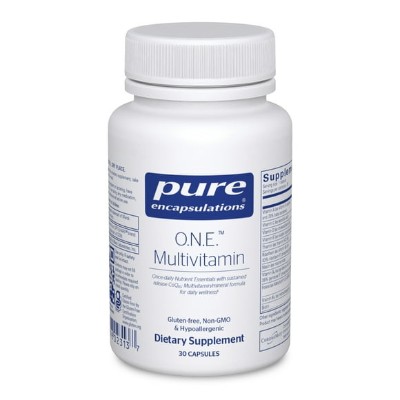
O.N.E. Multivitamin

O.N.E. Multivitamin

Pure Encapsulations4.5 (160 ratings)
Format:Capsule Quantity: 30 Capsule(s) · 30 servings
Goals
$25.00 $0.83 per serving

About this product

Broad nutrient coverage is the main strength, especially for someone with several dietary gaps. Methylcobalamin B12, folate, iodine, zinc and vitamin D support normal nutritional needs associated with energy metabolism and daily function. Their amounts do not establish increased productivity, weight loss or sharper focus when intake is already adequate.

Several clearly named forms help with ingredient comparison, including zinc citrate and molybdenum glycinate. The 500 mcg B12 amount is clear, while some repeated nutrient-source rows leave blend proportions unresolved. Choline at 25 mg and boron at 1 mg make small contributions rather than filling substantial gaps.

The added cofactors and carotenoids are less compelling reasons to pay the higher cost. The declared CoQ10 complex does not establish all details of its active exposure, and small lutein and alpha-lipoic-acid additions do not support broad eye, skin or metabolic promises. The formula fits nutritional coverage more clearly than any one of its many suggested goals.

Who is it for
  • Adults who need several listed vitamins and minerals together
  • People seeking clearly named B12 and zinc forms in a broad formula
Best for
  • Filling multiple dietary gaps
  • Broad nutritional support without a targeted performance goal

Pros

  • Clearly declares methylcobalamin B12 and its amount
  • Uses named zinc citrate and molybdenum glycinate sources
  • Provides iodine from potassium iodide

Cons

  • Choline and boron amounts are small
  • CoQ10 active-exposure details remain incomplete
  • Carotenoid additions do not establish a targeted eye regimen
  • High cost for the contribution of many individual nutrients
  • Copper amount is not established alongside 25 mg zinc

Warnings

  • Repeated vitamin and nutrient-source rows should be checked against the current label before adding their amounts or combining another multivitamin.


Product analysis

47 out of 100

O.N.E. Multivitamin provides broad nutritional coverage for normal immune function, energy metabolism and bone maintenance when intake is low. Missing component breakdowns make parts of the formula difficult to compare precisely.

AI assessment of the formula, label and price. How scoring works

Nutrient Quality50

Several mineral forms have favorable absorption potential, while others have more limited support. Missing form and component details still limit a complete quality comparison.

Ingredient Transparency74

All listed amounts and most forms are stated, making the main nutrients easier to check. Several component breakdowns are missing, so the exact mixtures cannot all be compared closely.

Value For Money35

Many mineral-related comparisons are relatively costly, while a few offer middling or moderate value. The broad ingredient list does not establish good value for the complete multivitamin.

Customer Satisfaction69

Customer ratings are favorable, with a modest number of reviews. They offer some insight into satisfaction without proving the many intended health benefits.

Product Focus0

The clearest role is helping cover nutritional shortfalls that can affect normal immune, nerve and energy functions. The many ingredients and wide range of intended uses do not establish extra performance or cosmetic benefits when intake is adequate.

Format
Capsule
Container
30 Capsule(s)
Per serving
$0.83
Customer rating
4.5 · 160 ratings
Report analysis

Goals

Impact
Highest effect
B Ingredient FitA+ PathwaysB+ EvidenceA+ Formulation Logic
Folate · 667 mcg DFEVitamin B12 · 500 mcgVitamin D · 50 mcgBoron · 1 mgSelenium · 70 mcgZinc · 25 mgVitamin C · 180 mg

B vitamins supply nutrients used in normal energy metabolism and blood formation. Zinc, Selenium supply nutrients involved in normal immune and antioxidant functions. Vitamin D contributes to mineral nutrition and bone maintenance. Iodine can help fill a dietary gap relevant to thyroid function. The nutritional contributions are most useful when intake is low; extra benefit with adequate intake is not established.

How this product is rated for Everyday Health

Ingredient fit80

Vitamin B9 (Folate) and the other relevant nutrients provide the main connection to general health. Additional actives make the formula less focused on this goal.
Goal fit
Relevant nutrients contribute to general health, alongside other actives with less direct support for this goal.
Dose adequacy
Most relevant amounts reach the saved comparison endpoints, with some smaller contributions.

Pathways100

The strongest area is energy metabolism cofactors. Contributions also reach the saved coverage level across energy metabolism cofactors, one-carbon metabolism and blood formation, bone and mineral metabolism, antioxidant and immune defence.
Depth
The strongest supported area is energy metabolism cofactors, through the relevant nutrient contributions.
Breadth
The supported areas reaching the saved coverage level are energy metabolism cofactors, one-carbon metabolism and blood formation, bone and mineral metabolism, antioxidant and immune defence.

Evidence81

Vitamin B9 (Folate) provides the strongest supported contribution. The supplied context limits routine expectations to filling nutritional gaps rather than improving outcomes in adequately nourished adults.
Evidence strength
Vitamin B9 (Folate) provides the strongest supported contribution here; usefulness remains conditional on the relevant nutritional or population context.
Studied preparation
Some relevant preparations match the saved findings, while these do not: Coenzyme Q10.

Formulation logic100

The relevant ingredients can contribute independently, and no configured conflict was found. Their presence together does not establish an added combination benefit.
Partner coverage
The relevant ingredients can contribute independently or have their required partners present; no extra combination benefit is established.
Conflicts
No configured ingredient conflict was identified in the supplied findings.
Effective doses
All ingredients retained for contribution meet the saved amount threshold; that threshold does not prove a clinical benefit.
Study evidence
Boron Supportive 6 studies
Folate Supportive 80 studies
Selenium Supportive 70 studies
Vitamin C Supportive 56 studies
Vitamin D Supportive 115 studies
Zinc Supportive 60 studies
Immunity
Impact
Highest effect
C- Ingredient FitA+ PathwaysA+ EvidenceA+ Formulation Logic
Vitamin C · 180 mgZinc · 25 mgVitamin A · 1125 mcgVitamin D · 50 mcgSelenium · 70 mcg

Zinc, vitamin D and selenium contribute to normal immune function, with vitamin A supporting barrier nutrition. B6, B12 and folate can help when intake is low enough to impair immune cells. These nutritional contributions do not establish extra infection protection above adequate intake. Vitamin E receives saved credit despite mixed outcome evidence from specific older populations, while the vitamin C amount did not qualify in the saved findings.

How this product is rated for Immunity

Ingredient fit60

Relevant nutrients provide substantial contributions, but many other actives broaden the formula's focus.
Goal fit
Many actives outside the assessed immune roles reduce the formula's focus.
Dose adequacy
Most credited amounts are substantial; vitamin C falls below the saved contribution threshold.

Pathways100

Lymphocyte function and immune regulation is the strongest covered area. Barrier defense, immune regulation and oxidative balance reach substantial coverage.
Depth
Lymphocyte function and immune regulation has the strongest combined coverage.
Breadth
Barrier defense, immune regulation and oxidative balance reach substantial coverage.

Evidence100

Zinc leads the saved support finding. Credited preparations meet the saved criteria, within the specific evidence limits described for their roles.
Evidence strength
Zinc provides the strongest saved support; that position does not establish a probability of protection.
Studied preparation
Credited preparations meet the saved criteria, without establishing superiority of individual nutrient forms.

Formulation logic100

Credited ingredients clear the saved amount threshold and have no assessed missing partner or conflict.
Partner coverage
Credited ingredients work alone or have their relevant partners.
Conflicts
No assessed ingredient conflict was triggered.
Effective doses
All credited ingredients clear the saved minimum amount threshold, which is not proof of clinical effectiveness.
Study evidence
Selenium Mixed 37 studies
Vitamin A Supportive 107 studies
Vitamin C Supportive 53 studies
Vitamin D Supportive 85 studies
Vitamin E Supportive 21 studies
Zinc Supportive 73 studies
Impact
Moderate effect
C Ingredient FitF PathwaysA EvidenceA+ Formulation Logic
Iodine · 150 mcgVitamin D · 50 mcgVitamin B5 · 10 mgRiboflavin · 3 mgThiamin · 3 mgVitamin B12 · 500 mcgCoenzyme Q-10 · 50 mg

B12, folate, riboflavin, B5 and vitamin C help cover nutritional needs that can influence fatigue when intake is low. CoQ10 at 50 mg adds a smaller fatigue-related angle, with limited evidence and uncertainty about its exact form. Higher nutrient amounts do not automatically mean more energy.

How this product is rated for Energy

Ingredient fit62

Energy-related ingredients sit within a broader-purpose formula. Many relevant amounts are well represented against the saved reference levels, with some lower or unresolved amounts.
Goal fit
Energy-related ingredients sit within a broader-purpose formula.
Dose adequacy
Many relevant amounts are well represented against the saved reference levels, with some lower or unresolved amounts.

Pathways4

The strongest saved connection is mitochondrial energy production, with limited coverage. No energy mechanism reaches the saved coverage threshold.
Depth
The strongest saved connection is mitochondrial energy production, with limited coverage.
Breadth
No energy mechanism reaches the saved coverage threshold.

Evidence92

Vitamin D provides the strongest saved evidence at a qualifying amount. Nutrient status and ingredient-specific evidence limits still affect the practical benefit. The saved preparation match is incomplete for Coenzyme Q-10, Iodine; the other qualifying ingredients satisfy that check.
Evidence strength
Vitamin D provides the strongest saved evidence at a qualifying amount. Nutrient status and ingredient-specific evidence limits still affect the practical benefit.
Studied preparation
The saved preparation match is incomplete for Coenzyme Q-10, Iodine; the other qualifying ingredients satisfy that check.

Formulation logic100

The saved findings identify no missing required ingredient partner. All ingredients counted in the saved amount check meet its minimum threshold; this does not guarantee a noticeable energy benefit.
Partner coverage
The saved findings identify no missing required ingredient partner.
Conflicts
No configured ingredient conflict was found in the supplied record.
Effective doses
All ingredients counted in the saved amount check meet its minimum threshold; this does not guarantee a noticeable energy benefit.
Study evidence
Iodine Adverse 3 studies
Thiamin Disputed 12 studies
Vitamin D Supportive 32 studies
Impact
High effect
C Ingredient FitF PathwaysA+ EvidenceA+ Formulation Logic
Biotin · 300 mcgNiacin · 20 mgVitamin B12 · 500 mcgRiboflavin · 3 mgThiamin · 3 mgVitamin B5 · 10 mgVitamin B6 · 4 mgVitamin D · 50 mcgZinc · 25 mgCoenzyme Q-10 · 50 mg

Iodine supports thyroid hormone production and can help restore normal heat production when iodine deficiency impairs thyroid function. Extra iodine does not establish a boost when intake and thyroid function are adequate. B vitamins support normal energy metabolism, while chromium's glucose-related findings do not establish increased calorie expenditure. CoQ10's cellular energy role also does not demonstrate a thermogenic benefit.

How this product is rated for Metabolism Support

Ingredient fit65

Vitamin B1 (Thiamin) contributes to the saved ingredient and amount findings. The supplied scientific context limits expectations for a direct metabolism boost.
Goal fit
The formula includes ingredients serving other purposes, reducing its specific focus on the included metabolism-related ingredients.
Dose adequacy
Some included amounts provide partial comparison contributions, without establishing how much energy expenditure would change.

Pathways8

The included routes emphasize mitochondrial energy and fat oxidation. None reaches the coverage threshold.
Depth
The strongest included route concerns mitochondrial energy and fat oxidation; this does not establish a direct rise in calorie expenditure.
Breadth
No route meets the coverage threshold, leaving limited breadth across energy-expenditure mechanisms.

Evidence100

Vitamin B1 (Thiamin) leads the included evidence finding. Cellular energy roles and metabolic biomarkers do not by themselves demonstrate higher whole-body energy expenditure.
Evidence strength
Vitamin B1 (Thiamin) leads the saved evidence comparison, while its supplied findings do not establish a routine energy-expenditure boost.
Studied preparation
The included preparations are accepted for comparison; this does not establish that the product reproduces a thermogenesis trial.

Formulation logic100

No missing partner or configured conflict is identified. Meeting comparison amounts does not establish added thermogenesis from the formula.
Partner coverage
The supplied findings identify no missing partner needed by the included ingredients.
Conflicts
No configured ingredient conflict is identified in the supplied formula; this is a limited interaction check.
Effective doses
The included ingredients meet the minimum amount threshold, which does not establish an effective thermogenic dose.
Study evidence
Biotin Supportive 5 studies
Chromium Supportive 47 studies
Iodine Mixed 17 studies
Niacin Supportive 17 studies
Selenium Mixed 28 studies
Thiamin Supportive 11 studies
Vitamin B6 Supportive 16 studies
Vitamin D Supportive 65 studies
Zinc Supportive 12 studies
Hair Health
Impact
High effect
C Ingredient FitD+ PathwaysA+ EvidenceA+ Formulation Logic
Biotin · 300 mcgVitamin D · 50 mcgZinc · 25 mgVitamin C · 180 mg

Zinc can help with deficiency-related diffuse shedding, while biotin is relevant when biotin deficiency affects hair. Selenium participates in antioxidant biology and vitamin C supports normal collagen synthesis, without establishing extra regrowth with adequate intake. Folate is present but its usable amount is unresolved in the saved comparison. Vitamin D's associations with alopecia do not establish a general oral regrowth effect.

How this product is rated for Hair Health

Ingredient fit64

The formula includes relevant nutrients alongside broader ingredients; unresolved folate amount limits its amount-based findings.
Goal fit
Relevant nutrients share the formula with ingredients serving broader purposes, so its focus on hair is limited.
Dose adequacy
Most included amounts approach the saved comparison range, although some contributions remain limited by amount.

Pathways51

Antioxidant-related nutrient roles dominate the saved findings, with limited or absent coverage of other evaluated routes.
Depth
Antioxidant-related nutrient roles provide the strongest connection among the evaluated routes, without establishing an additional hair-growth effect.
Breadth
Antioxidant-related roles are the only evaluated route reaching the saved coverage threshold; coverage of other routes remains limited or absent.

Evidence97

Zinc supplies the strongest relevant support, specifically for correcting deficiency-related shedding.
Evidence strength
Zinc supplies the strongest relevant support, specifically for correcting deficiency-related shedding.
Studied preparation
Most included preparations match the saved comparison, with iodine the exception.

Formulation logic97

Required partners are accounted for and no configured conflict was found, but unresolved folate amount limits the amount-based finding.
Partner coverage
No required ingredient partner is missing among the included contributions.
Conflicts
No configured ingredient conflict was identified; this finding does not establish overall product safety.
Effective doses
Folate's unresolved amount prevents it from clearing the saved minimum amount threshold; the other included contributions clear it.
Study evidence
Biotin Supportive 4 studies
Folate Mixed 15 studies
Iodine No effect 1 study
Niacin Disputed 2 studies
Selenium Disputed 7 studies
Vitamin A Disputed 13 studies
Vitamin D Disputed 34 studies
Vitamin E No effect 3 studies
Zinc Supportive 22 studies
Impact
Moderate effect
C- Ingredient FitF PathwaysA EvidenceA+ Formulation Logic
Zinc · 25 mgVitamin D · 50 mcgBoron · 1 mg

The most practical connection is zinc: it may help restore testosterone when low zinc is contributing to low levels. A shortage can disrupt normal hormone function, which makes nutritional need central to the possible benefit. Vitamin D also has a possible connection when levels are low, but taking it isn't a reliable way to raise testosterone in people who already get enough.

How this product is rated for Testosterone Support

Ingredient fit56

Zinc has a conditional connection to testosterone through correcting low zinc.
Goal fit
Zinc has a conditional connection to testosterone through correcting low zinc.
Dose adequacy
Boron is declared at 1 mg per serving; Zinc is declared at 25 mg per serving.

Pathways13

The useful connection is nutrient sufficiency, rather than a demonstrated direct hormone-boosting mechanism.
Depth
Vitamin D has a conditional connection to testosterone production when levels are low.
Breadth
No broad direct effect across hormone mechanisms is identified; the zinc benefit concerns nutritional need.

Evidence93

Zinc may help restore testosterone in people with low zinc; this does not imply a benefit above adequate intake.
Evidence strength
Zinc may help restore testosterone in people with low zinc; this does not imply a benefit above adequate intake.
Studied preparation
The declared zinc form does not imply greater testosterone benefit than other zinc forms.

Formulation logic100

Zinc can serve its nutritional role without an added partner, and no particular ingredient conflict is identified.
Partner coverage
Zinc does not require an added partner for its conditional nutritional role.
Conflicts
No particular ingredient conflict is identified.
Effective doses
Boron is declared at 1 mg per serving; Zinc is declared at 25 mg per serving.
Study evidence
Boron Disputed 3 studies
Selenium No effect 16 studies
Vitamin D Supportive 56 studies
Vitamin E Disputed 3 studies
Zinc Disputed 7 studies

Ingredients

IngredientAmount per servingScore
Vitamin A (Vitamin A Acetate, Beta-Carotene)
1125 mcg
Vitamin C (Ascorbic Acid)
180 mg
Vitamin D (Cholecalciferol)
50 mcg
Vitamin E (D-Alpha-Tocopherol Succinate)
20 mg
Thiamine (Thiamine Hydrochloride)
3 mg
Riboflavin (Riboflavin 5-Phosphate, Vitamin B2, Activated)
3 mg
Niacin (Niacinamide)
20 mg
Vitamin B6 (Pyridoxine Hydrochloride, Pyridoxal 5-Phosphate)
4 mg
Metafolin (Folate)
667 mcg DFE
Vitamin B12 (Methylcobalamin)
500 mcg 76
Biotin
300 mcg 59
Pantothenic Acid (Calcium Pantothenate, Vitamin B5)
10 mg
Choline (Choline Bitartrate)
25 mg 54
Iodine (Potassium Iodide)
150 mcg 90
Zinc (Zinc Citrate)
25 mg 65
Selenium (Selenomethionine)
70 mcg 51
Manganese (Manganese Citrate)
2 mg 70
Chromium (Chromium Polynicotinate)
200 mcg 76
Molybdenum (Molybdenum Glycinate Chelate)
75 mcg 85
Boron (Boron Glycinate)
1 mg 60
Inositol
25 mg
MicroActive CoQ10-cyclodextrin Complex (Coenzyme Q10)
50 mg 38
Alpha-Lipoic Acid
50 mg
FloraGlo (Lutein)
3 mg
Zeaxanthin
500 mcg
Lycopene
500 mcg
Gluten Free Adults 18–50
Report overview
A+ Active Ingredient Quality & BioavailabilityA+ Dose, Safety & Label TransparencyD+ Value
A serving provides 150 mcg iodine as potassium iodide, an amount the evaluation regards as suitable for maintenance. The whole-product serving costs about $0.83.
How this ingredient is rated

Active Ingredient Quality & Bioavailability100

The iodine is supplied as potassium iodide, a form favored in this evaluation.
Iodine Form & Bioavailability
Potassium iodide is the named iodine source and is favored in the form assessment.
Marine Source Purity & Sourcing
No marine source is recorded, so the seaweed-specific purity concern is not identified here.

Dose, Safety & Label Transparency100

The serving supplies 150 mcg iodine, an amount the evaluation regards as suitable for maintenance.
Dosage Efficacy for Daily Support
The evaluation regards 150 mcg iodine per serving as a maintenance-level amount.
Dosage Safety & Upper Limits
The 150 mcg per serving falls within the evaluation's safety reference; it does not account for iodine from other sources.
Elemental Iodine Transparency
The stated amount is 150 mcg of iodine per serving.

Value50

The whole-product serving costs about $0.83.
Price Per Effective Serving
A whole-product serving costs about $0.83.
A+ Active Ingredient Quality & BioavailabilityA- Dose, Safety & Label TransparencyD+ Value
Each serving supplies 75 mcg of molybdenum as glycinate. The saved facts identify a TRAACS branded source.
How this ingredient is rated

Active Ingredient Quality & Bioavailability100

The named molybdenum form is glycinate. The saved facts identify a TRAACS branded source; that claim is not independently verified.
Molybdenum Chemical Form
Molybdenum glycinate is the identified source.
Branded or Patented Source
The saved facts identify a TRAACS branded source; that claim is not independently verified.

Dose, Safety & Label Transparency88

The serving provides 75 mcg of molybdenum. The serving is below the upper limit used by the evaluation, which does not include intake from other sources.
Elemental Dose Optimization
The serving provides 75 mcg of molybdenum.
Upper Limit (UL) Safety Compliance
The serving is below the upper limit used by the evaluation, which does not include intake from other sources.

Value50

The whole-product serving costs about $0.83.
Price per Effective Serving
The selected whole-product serving costs about $0.83.
B+ Active Ingredient Quality & BioavailabilityC+ Dose, Safety & Label TransparencyF Value
+3
Each serving provides 25 mg of zinc as zinc citrate, a form the evaluation views favorably for absorption. The copper amount is unknown, so the zinc-to-copper balance cannot be assessed.
How this ingredient is rated

Active Ingredient Quality & Bioavailability80

The zinc is zinc citrate, a form the evaluation views favorably for absorption.
Zinc Form Bioavailability
The evaluation views zinc citrate favorably for absorption.

Dose, Safety & Label Transparency67

The labeled 25 mg of zinc per serving is a substantial amount in the evaluation; the copper amount is unknown.
Elemental Dose Transparency
The label gives 25 mg of elemental zinc per serving and identifies its source.
Zinc Dosage Safety & Effectiveness
Each serving provides 25 mg zinc, a substantial amount in the evaluation.
Zinc-to-Copper Mineral Balance
The copper amount is unknown, so the zinc-to-copper ratio cannot be assessed.

Value30

The whole product costs about $0.83 per serving, relatively high in the evaluation.
Price Per Serving Efficiency
The price is about $0.83 per whole-product serving.
Report alternatives

Sources

Published studies used for the product analysis and the top-ranked studies for each ingredient and goal.

  1. [Comparative study of the urinary excretion of boron, calcium, magnesium and phosphorus in postmenopausal women with and without osteoporosis].
    José Ramón V; Mora Mora M; Marino Alarcón O; Hernández G; Josefina Linares L; Urdaneta Romero H; Arévalo González E · Investigacion clinica · 2013
    Case-control study45 participantsBone Health forBoron
  2. Effect of dietary boron on mineral, estrogen, and testosterone metabolism in postmenopausal women.
    Nielsen FH; Hunt CD; Mullen LM; Hunt JR · FASEB journal : official publication of the Federation of American Societies for Experimental Biology · 1987
    Single-arm trial12 participantsBone Health forBoron
  3. The relationship between boron and magnesium status and bone mineral density in the human: a review.
    Volpe SL; Taper LJ; Meacham S · Magnesium research · 1994
    Narrative reviewBone Health forBoron
  4. Effects of boron supplementation on bone mineral density and dietary, blood, and urinary calcium, phosphorus, magnesium, and boron in female athletes.
    Meacham SL; Taper LJ; Volpe SL · Environmental health perspectives · 1995
    Randomized trial28 participantsBone Health forBoron
  5. Metabolic responses of postmenopausal women to supplemental dietary boron and aluminum during usual and low magnesium intake: boron, calcium, and magnesium absorption and retention and blood mineral concentrations
    C D Hunt, J L Herbel, F H Nielsen · The American Journal of Clinical Nutrition · 1997
    Non-randomized trial11 participantsBone Health forBoron
  6. Association between RBC folate and lumbar bone mineral density in postmenopausal women, a cross-sectional study from NHANES 2009-2018.
    Wei H; Jin Z; Zhou L; Tang G; Chai S; Che X; Tan Y; Zeng W · Frontiers in endocrinology · 2025
    Cross-sectional study1,315 participantsBone Health forFolate
  7. Genetic variants modify the associations of concentrations of methylmalonic acid, vitamin B-12, vitamin B-6, and folate with bone mineral density.
    Liu CT; Karasik D; Xu H; Zhou Y; Broe K; Cupples LA; Cpgm de Groot L; Ham A; Hannan MT; Hsu YH; Jacques P; McLean RR; Paul L; Selhub J; Trajanoska K; van der Velde N; van Schoor N; Kiel DP · The American journal of clinical nutrition · 2021
    Cohort study4,310 participantsBone Health forFolate
  8. Adequate Intake and Supplementation of B Vitamins, in Particular Folic Acid, can Play a Protective Role in Bone Health.
    Rondanelli M; Tartara A; Fossari F; Vecchio V; Faliva MA; Naso M; Perna S; Nichetti M; Peroni G · Current aging science · 2022
    Narrative review35,298 participants29 studies pooledBone Health forFolate Bone Health forVitamin B6
  9. Relation of homocysteine, folate, and vitamin B12 to bone mineral density of postmenopausal women.
    Cagnacci A; Baldassari F; Rivolta G; Arangino S; Volpe A · Bone · 2004
    Cross-sectional study161 participantsBone Health forFolate
  10. Dietary intake of folate, but not vitamin B2 or B12, is associated with increased bone mineral density 5 years after the menopause: results from a 10-year follow-up study in early postmenopausal women.
    Rejnmark L; Vestergaard P; Hermann AP; Brot C; Eiken P; Mosekilde L · Calcified tissue international · 2008
    Cohort study1,869 participantsBone Health forFolate
  11. Risk of Environmental Chemicals on Bone Fractures Is Independent of Low Bone Mass in US Adults: Insights from 2017 to 2018 NHANES.
    Ling R; Ai Y; Chen C; Zhang J; Zou Z; Cheng S; Li C; Li X; Wang B · Metabolites · 2023
    Cross-sectional study2,640 participantsBone Health forManganese
  12. The Manganese-Bone Connection: Investigating the Role of Manganese in Bone Health.
    Taskozhina G; Batyrova G; Umarova G; Issanguzhina Z; Kereyeva N · Journal of clinical medicine · 2024
    Narrative reviewBone Health forManganese
  13. Associations of multiple metals with bone mineral density: A population-based study in US adults.
    Wei MH; Cui Y; Zhou HL; Song WJ; Di DS; Zhang RY; Huang Q; Liu JA; Wang Q · Chemosphere · 2021
    Cross-sectional studyBone Health forManganese
  14. Sex-specific associations of urinary mixed-metal concentrations with femoral bone mineral density among older people: an NHANES (2017-2020) analysis.
    Li H; Li G; Yi M; Zhou J; Deng Y; Huang Y; He S; Meng X; Liu L · Frontiers in public health · 2024
    Cross-sectional study31 participantsBone Health forManganese
  15. Relationship between blood manganese and bone mineral density and bone mineral content in adults: A population-based cross-sectional study.
    Wang C; Zhu Y; Long H; Ou M; Zhao S · PloS one · 2022
    Cross-sectional study9,732 participantsBone Health forManganese
  16. Evaluating the Protective Role of Vitamin A Supplementation in Periodontal Health: A Comprehensive Systematic Review and Meta-Analysis.
    Luca MM; Buzatu R; Bumbu BA · Journal of clinical medicine · 2024
    Meta-analysisBone Health forVitamin A
  17. Dietary vitamin A intake and bone health in the elderly: the Rotterdam Study.
    de Jonge EA; Kiefte-de Jong JC; Campos-Obando N; Booij L; Franco OH; Hofman A; Uitterlinden AG; Rivadeneira F; Zillikens MC · European journal of clinical nutrition · 2016
    Cohort study5,288 participantsBone Health forVitamin A
  18. Vitamin A and its dervatives effect on bone mineral density, a systematic review.
    Khojah Q; AlRumaihi S; AlRajeh G; Aburas A; AlOthman A; Ferwana M · Journal of family medicine and primary care · 2022
    Systematic review8 studies pooledBone Health forVitamin A
  19. Association of vitamins with bone mineral density and osteoporosis measured by dual-energy x-ray absorptiometry: a cross-sectional study.
    Wang Q; Yu H; Kong Y · BMC musculoskeletal disorders · 2024
    Cross-sectional study1,536 participantsBone Health forVitamin A
  20. Association of dietary consumption and serum levels of vitamin A and β-carotene with bone mineral density in Chinese adults.
    Chen GD; Zhu YY; Cao Y; Liu J; Shi WQ; Liu ZM; Chen YM · Bone · 2016
    Cohort study3,154 participantsBone Health forVitamin A