
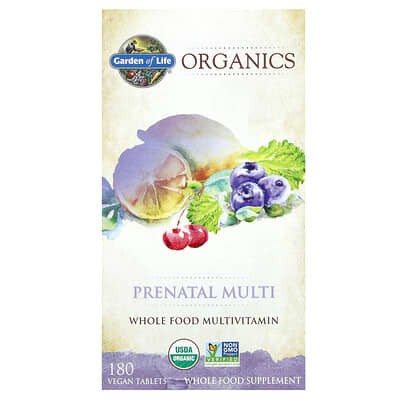
Prenatal Multi

Goals
$61.84 $1.03 per serving


Product analysis
Prenatal Multi brings together nutrients that help fill dietary gaps and support normal energy and bone functions. Its added blends are not fully described, making their contribution harder to judge.
AI assessment of the formula, label and price. How scoring works
Nutrient Quality39
MK-7 is specifically identified, while many other nutrients are described only through a food-blend source. Those descriptions do not establish precise forms or how well the whole combination is absorbed.
Ingredient Transparency82
Amounts and most nutrient sources are disclosed, helping with serving comparisons. Several mixed-source proportions and added blend contents remain unclear.
Value For Money34
The serving price is relatively high when considered for iron, iodine, chromium or MK-7. Value for many other nutrients remains uncertain, limiting a complete comparison.
Customer Satisfaction87
Customer ratings are strongly favorable across a substantial feedback base. Satisfaction does not establish pregnancy-specific health outcomes.
Product Focus16
The nutrients have related roles in filling dietary gaps and supporting normal body functions. The broad ingredient list and unidentified blend contents make individual contributions less clear.
- Format
Tablet - Container
- 180 Tablet(s)
- Per serving
- $1.03
- Also available
 Prenatal Multi$35.69
- Customer rating
- 4.8 · 1,841 ratings
Goals

Impact
High effect
Biotin · 210 mcgVitamin D · 25 mcgZinc · 13 mgIron · 27 mgVitamin C · 150 mg
Iron and zinc can help address low intake that contributes to diffuse shedding. Extra regrowth benefit when intake is adequate is not established. Biotin is present at a small amount relative to the saved hair comparison. Other nutrient functions do not establish routine hair regrowth.
How this product is rated for Hair Health
Ingredient fit71
The included ingredients sit within a broader formula with other actives and several intended uses. Some amounts make only partial contributions.
Goal fit
The included ingredients sit within a broader formula with other actives and several intended uses.
Dose adequacy
The included amounts provide a partial match to the comparison references, with smaller or unresolved amounts limiting the finding.
Pathways42
The strongest saved pathway connection is follicle antioxidant protection, with a partial contribution.
Depth
The strongest saved pathway connection is follicle antioxidant protection, with a partial contribution.
Breadth
1 of 3 target areas meet the comparison's coverage level; this does not establish clinical benefit.
Evidence97
Zinc provides the leading included evidence reference, with the ingredient's specific limitations still applying.
Evidence strength
Zinc provides the leading included evidence reference, with the ingredient's specific limitations still applying.
Studied preparation
Iodine does not match the reviewed preparation findings; the other included declarations meet the saved preparation check.
Formulation logic100
No unmet partner requirement or specified conflict was found. All included amounts meet the minimum comparison level.
Partner coverage
The included ingredients have no unmet partner requirement in the supplied findings.
Conflicts
No specified ingredient conflict was found; this check does not establish overall safety.
Effective doses
All included ingredients meet the comparison's minimum amount level; this is not a proven effective dose.

Impact
High effect
Iodine · 290 mcgVitamin D · 25 mcgVitamin B5 · 8.05 mgRiboflavin · 1.84 mgThiamin · 1.61 mgVitamin B12 · 14 mcgIron · 27 mg
Iron can help fatigue related to iron deficiency, and folate, riboflavin, niacin, B6, pantothenic acid and vitamin C support nutritional needs whose deficiency can cause tiredness. These nutrients do not establish extra energy once needs are met. B12's declared amount was too low for inclusion in the saved findings, and vitamin D's fatigue evidence concerns deficient adults given a different regimen.
How this product is rated for Energy
Ingredient fit71
Iron and several vitamins provide nutritional support within a broad formula. Amounts provide partial support; B12 was below the saved inclusion comparison.
Goal fit
Iron and several vitamins provide nutritional support within a broad formula.
Dose adequacy
Amounts provide partial support; B12 was below the saved inclusion comparison.
Pathways0
The saved findings identify no covered direct energy mechanism; the relevant contribution concerns nutrition and deficiency-related fatigue.
Depth
No direct energy mechanism is covered in the saved findings.
Breadth
No direct energy area reaches the saved coverage comparison.
Evidence97
Iron leads the saved findings, with fatigue benefit conditional on iron deficiency. Iodine did not match a studied preparation; the other included nutrient declarations did.
Evidence strength
Iron leads the saved findings, with fatigue benefit conditional on iron deficiency.
Studied preparation
Iodine did not match a studied preparation; the other included nutrient declarations did.
Formulation logic100
Included ingredients have no missing required partner or configured conflict and meet the saved minimum amount comparison.
Partner coverage
Included ingredients work without an additional required partner, or have their required partner; this does not establish an extra combination benefit.
Conflicts
No configured ingredient conflict was found in the supplied facts.
Effective doses
All included ingredients meet the saved minimum amount comparison; this is not a proven minimum effective dose.
Vitamin B5 Not classified
No linked studies yet.

Impact
Moderate effect
Iron · 27 mgVitamin B12 · 14 mcgVitamin B12 · 14 mcgVitamin B6 · 9 mgZinc · 13 mg
Iron, folate and B12 support normal nutrition and can matter for fatigue and concentration when a deficiency is present. The B vitamins also contribute to energy metabolism, and zinc adds nutritional support. These roles do not imply improved productivity in an adequately nourished person.
How this product is rated for Productivity Boost
Ingredient fit56
Only part of this broader formula aligns specifically with productivity support. The amounts provide partial alignment with the saved exposure comparison.
Goal fit
Only part of this broader formula aligns specifically with productivity support.
Dose adequacy
The amounts provide partial alignment with the saved exposure comparison.
Pathways15
The main saved contribution concerns nerve-cell support. The findings show limited breadth across the assessed mechanisms.
Depth
The main saved contribution concerns nerve-cell support.
Breadth
The findings show limited breadth across the assessed mechanisms.
Evidence91
Zinc provides the strongest assessed evidence contribution at its amount. The ingredients counted at adequate amounts match the saved preparation criteria.
Evidence strength
Zinc provides the strongest assessed evidence contribution at its amount.
Studied preparation
The ingredients counted at adequate amounts match the saved preparation criteria.
Formulation logic100
All 4 assessed ingredients meet the saved minimum amount comparison. No conflict was identified by the supplied ingredient checks.
Partner coverage
The assessed ingredients work independently or have their required partner.
Conflicts
No conflict was identified by the supplied ingredient checks.
Effective doses
All 4 assessed ingredients meet the saved minimum amount comparison.

Impact
High effect
Vitamin K · 20 mcgVitamin D · 25 mcgManganese · 0.75 mgZinc · 13 mgVitamin C · 150 mg
Vitamin D supports calcium absorption and deficiency-related mineralization, while vitamin C supports the bone collagen matrix when deficient. The separately declared 20 mcg MK-7 is a small exposure compared with the 180 mcg daily postmenopausal bone-density study. The additional unidentified vitamin K cannot be pooled as MK-7, and these findings do not establish pregnancy-specific skeletal outcomes.
How this product is rated for Bone Health
Ingredient fit63
Vitamin D and limited MK-7 provide relevant connections within the prenatal formula.
Goal fit
Vitamin D and limited MK-7 provide relevant connections within the prenatal formula.
Dose adequacy
Several nutrients provide partial exposure; MK-7 is small and unidentified vitamin K remains preparation-limited.
Pathways80
Collagen matrix formation is the strongest represented area in the saved findings. Calcium absorption and collagen matrix meet the saved coverage requirement; other areas have more limited representation.
Depth
Collagen matrix formation is the strongest represented area in the saved findings.
Breadth
Calcium absorption and collagen matrix meet the saved coverage requirement; other areas have more limited representation.
Evidence95
Zinc leads the saved evidence finding, although its normal role does not establish an independent supplemental bone benefit. Vitamin K does not establish a studied preparation; the other included preparations receive recognition.
Evidence strength
Zinc leads the saved evidence finding, although its normal role does not establish an independent supplemental bone benefit.
Studied preparation
Vitamin K does not establish a studied preparation; the other included preparations receive recognition.
Formulation logic97
Vitamin D lacks a qualifying partner in the saved findings, limiting its supported role within this serving. No listed conflict is triggered.
Partner coverage
Vitamin D lacks a qualifying partner in the saved findings, limiting its supported role within this serving.
Conflicts
No listed ingredient conflict was triggered by the supplied facts.
Effective doses
The included nutrients meet the saved minimum amount comparison; this is not a proven fracture-prevention dose.

Impact
High effect
Vitamin K · 20 mcgVitamin D · 25 mcgSelenium · 50 mcgVitamin B12 · 14 mcgVitamin B6 · 9 mgVitamin E · 19 mgFolate · 800 mcg DFENiacin · 20.7 mgVitamin C · 150 mg
Folate contributes to homocysteine metabolism, but lowering this marker does not establish prevention of cardiovascular events. Thiamin and selenium have a cardiovascular role when correcting deficiencies associated with heart disease, with no established extra benefit in replete adults. B6 also contributes to homocysteine metabolism; vitamin C receives a saved contribution without establishing routine event prevention. Vitamin K's amount is unresolved.
How this product is rated for Cardiovascular Support
Ingredient fit58
Relevant nutrients sit within a broader formula; several declarations receive limited or no amount contribution.
Goal fit
The formula includes relevant nutrients alongside many actives serving other purposes.
Dose adequacy
Retained nutrients provide differing amount coverage; low amounts are excluded rather than treated as absent.
Pathways60
Homocysteine clearance dominates the saved findings.
Depth
Homocysteine clearance has the strongest saved coverage.
Breadth
Only homocysteine clearance reaches the saved coverage threshold.
Evidence72
The saved evidence finding reflects retained nutrients, while marker changes and deficiency correction remain distinct from routine cardiovascular prevention.
Evidence strength
Vitamin C leads the saved evidence finding; this does not establish routine prevention of cardiovascular events.
Studied preparation
The saved finding accepts the retained preparations; unqualified vitamin K declarations do not establish reviewed MK-7 eligibility.
Formulation logic100
The retained nutrients have their configured partners or can stand alone, with no configured conflict.
Partner coverage
All retained ingredients either work alone or have their configured partner.
Conflicts
No configured conflict was found in the supplied facts.
Effective doses
Six retained ingredients meet the saved amount threshold; excluded low amounts are not treated as qualifying.

Impact
High effect
Vitamin K · 20 mcgVitamin B12 · 14 mcgVitamin B6 · 9 mgFolate · 800 mcg DFEVitamin D · 25 mcg
Folate and B6 support homocysteine metabolism, but improvement in that blood marker does not establish general prevention of cardiac events. Selenium and thiamin relate to rare deficiency-related heart disease, without added cardiovascular benefit when intake is adequate. Vitamin D has not demonstrated fewer major cardiovascular events. The MK-7 portion, niacin and B12 are too small for inclusion in the saved findings.
How this product is rated for Heart Health
Ingredient fit58
The included connections come from Vitamin B9 (Folate), Vitamin B6, Selenium, Vitamin D, Vitamin B1 (Thiamin). Their exposure support does not establish a proven cardiovascular treatment.
Goal fit
Heart-related ingredients sit alongside ingredients aimed at other purposes, reducing the formulation’s focus on this goal.
Dose adequacy
The included amounts receive partial support against the saved exposure references; these comparisons do not establish proven treatment doses.
Pathways60
The saved findings focus on homocysteine metabolism. They do not establish broad support across the other heart-health pathways.
Depth
The strongest configured connection is to homocysteine metabolism, rather than evidence of a clinical outcome.
Breadth
Only homocysteine metabolism reaches the saved breadth requirement; the other configured pathways do not.
Evidence89
The strongest included evidence contribution comes from Vitamin B9 (Folate). Matching a studied preparation does not remove population limits or establish event prevention.
Evidence strength
Vitamin B9 (Folate) supplies the strongest included evidence contribution, without establishing cardiovascular-event prevention.
Studied preparation
The included preparations meet the saved study-matching check, which does not establish that this finished product or serving prevents cardiovascular events.
Formulation logic100
The counted ingredients meet the minimum amount requirement, with no missing required partner or matched conflict.
Partner coverage
No counted ingredient lacks a required partner; this finding does not imply an additional combination benefit.
Conflicts
No configured ingredient conflict was matched in the supplied facts.
Effective doses
All counted ingredients meet the saved minimum amount requirement, which is distinct from a proven clinical treatment dose.
Ingredients
| Ingredient | Amount per serving | Score |
|---|---|---|
Vitamin A (Beta-Carotene, Organic Food Blend) | 1300 mcg | |
Vitamin C (Organic Food Blend) | 150 mg | |
Vitamin D (D3) | 25 mcg | |
Vitamin E (Organic Food Blend) | 19 mg | |
Vitamin K (Saccharomyces cerevisae) | 90 mcg | |
Thiamin (Organic Food Blend) | 1.61 mg | |
Riboflavin (Organic Food Blend) | 1.84 mg | |
Niacin (Organic Food Blend) | 20.7 mg | |
Vitamin B6 (Organic Food Blend) | 9 mg | |
Folate (Organic Food Blend) | 800 mcg DFE | |
Vitamin B12 (Methylcobalamin) | 14 mcg | |
Biotin (Organic Food Blend) | 210 mcg | |
Pantothenic Acid (Organic Food Blend) | 8.05 mg | |
Iron (Organic Food Blend) | 27 mg | |
Iodine (Organic Food Blend) | 290 mcg | |
Zinc (Organic Food Blend) | 13 mg | |
Selenium (Organic Food Blend) | 50 mcg | |
Manganese (Organic Food Blend) | 0.75 mg | |
Chromium (Organic Food Blend) | 90 mcg | |
Vitamin K2 (Menaquinone-7) | 20 mcg | |
Organic Food Blend | 1.4 Gram(s) | |
Organic Stomach Soothing Blend | 100 mg |
Iodine (Organic Food Blend) · 290 mcg OverallScore68
Each serving provides 290 mcg of iodine, but its chemical form is unknown. That makes it harder to compare absorption with products that identify a form.
How this ingredient is rated
Active Ingredient Quality & Bioavailability61
The chemical form of iodine is unknown in the saved facts.
Iodine Form & Bioavailability
The chemical form is unknown, so absorption cannot be compared on that basis.
Marine Source Purity & Sourcing
The evaluation does not identify a marine source, so the seaweed sourcing check does not apply; this does not establish purity.
Dose, Safety & Label Transparency100
The iodine amount is stated as 290 mcg per serving.
Dosage Efficacy for Daily Support
The serving provides 290 mcg of iodine.
Dosage Safety & Upper Limits
The 290 mcg in one serving is below the adult daily upper limit; iodine from other sources contributes to total intake.
Elemental Iodine Transparency
The saved facts identify 290 mcg of iodine per serving.
Value20
The whole-product serving price is toward the higher end of the prices evaluated.
Price Per Effective Serving
A whole-product serving costs about $1.03.
Iron (Organic Food Blend) · 27 mg OverallScore44
A serving provides 27 mg of iron, a higher amount in this comparison. The serving also contains zinc, which may compete with iron absorption.
How this ingredient is rated
Active Ingredient Quality & Bioavailability0
The available information does not establish the chemical form of the iron. The serving also contains zinc, which may compete with iron absorption.
Iron Chemical Form & Bioavailability
The iron compound is not established in the available information.
Absorption Support & Blocker Avoidance
The serving also contains zinc, which may compete with iron absorption.
Dose, Safety & Label Transparency100
The serving lists 27 mg of iron, giving a usable amount for comparison.
Elemental Iron Label Clarity
The amount of iron is stated as 27 mg per serving.
Dosage Effectiveness & Safety Range
The stated serving provides 27 mg of iron, a higher amount in this comparison.
Value20
The price is about $1.03 per serving of the whole product.
Price per Effective Serving
A whole-product serving costs about $1.03.
Vitamin K (Saccharomyces cerevisae) · 90 mcg OverallScore46
Each serving lists 110 mcg of vitamin K, including 20 mcg of MK-7, a small amount of that form. The other vitamin K form is not identified in the saved information.
How this ingredient is rated
Active Ingredient Quality & Bioavailability82
The recorded vitamin K includes MK-7, a longer-lasting K2 form; its trans isomer is not specified in the saved facts.
Vitamin K Form (MK-7 vs. MK-4 vs. K1)
MK-7 is a form of vitamin K2 that remains in the bloodstream longer than some other vitamin K forms.
MK-7 Isomer Disclosure
The saved information does not specify whether the MK-7 is a trans form.
Dose, Safety & Label Transparency32
A serving lists 20 mcg of MK-7 within 110 mcg of total vitamin K, but another form remains unidentified in the saved facts.
Vitamin K2 (MK-7) Dosage Efficacy
Each serving lists 20 mcg of MK-7, a small amount.
Form and Subtype Transparency
The saved information identifies the MK-7 amount, while another vitamin K form remains unidentified.
Value0
The price is high in this comparison: about $1.03 per serving of the whole product.
Price per Effective MK-7 Serving
A whole-product serving costs about $1.03, a high price in this comparison; it covers all ingredients.
Alternative products
Report alternatives
Sources
Published studies used for the product analysis and the top-ranked studies for each ingredient and goal.
- Association between RBC folate and lumbar bone mineral density in postmenopausal women, a cross-sectional study from NHANES 2009-2018.
- Genetic variants modify the associations of concentrations of methylmalonic acid, vitamin B-12, vitamin B-6, and folate with bone mineral density.
- Adequate Intake and Supplementation of B Vitamins, in Particular Folic Acid, can Play a Protective Role in Bone Health.
- Relation of homocysteine, folate, and vitamin B12 to bone mineral density of postmenopausal women.
- Dietary intake of folate, but not vitamin B2 or B12, is associated with increased bone mineral density 5 years after the menopause: results from a 10-year follow-up study in early postmenopausal women.
- Risk of Environmental Chemicals on Bone Fractures Is Independent of Low Bone Mass in US Adults: Insights from 2017 to 2018 NHANES.
- The Manganese-Bone Connection: Investigating the Role of Manganese in Bone Health.
- Associations of multiple metals with bone mineral density: A population-based study in US adults.
- Sex-specific associations of urinary mixed-metal concentrations with femoral bone mineral density among older people: an NHANES (2017-2020) analysis.
- Relationship between blood manganese and bone mineral density and bone mineral content in adults: A population-based cross-sectional study.
- Evaluating the Protective Role of Vitamin A Supplementation in Periodontal Health: A Comprehensive Systematic Review and Meta-Analysis.
- Dietary vitamin A intake and bone health in the elderly: the Rotterdam Study.
- Vitamin A and its dervatives effect on bone mineral density, a systematic review.
- Association of vitamins with bone mineral density and osteoporosis measured by dual-energy x-ray absorptiometry: a cross-sectional study.
- Association of dietary consumption and serum levels of vitamin A and β-carotene with bone mineral density in Chinese adults.
- Effect of Vitamin B12 and Folic Acid Supplementation on Bone Mineral Density and Quantitative Ultrasound Parameters in Older People with an Elevated Plasma Homocysteine Level: B-PROOF, a Randomized Controlled Trial.
- Plasma B vitamins, homocysteine, and their relation with bone loss and hip fracture in elderly men and women.
- Relation between homocysteine and B-vitamin status indicators and bone mineral density in older Americans.
- The role of B-vitamin intake, B-vitamin-rich dietary patterns, the B-vitamin deficiency index in bone mineral density among school-aged children.
- Hyperhomocysteinemia is Associated with Inflammation, Bone Resorption, Vitamin B12 and Folate Deficiency and MTHFR C677T Polymorphism in Postmenopausal Women with Decreased Bone Mineral Density.