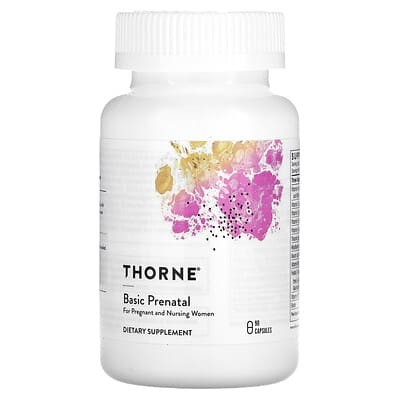
Basic Prenatal

Basic Prenatal

Thorne4.6 (18,917 ratings)
Format:Capsule Quantity: 90 Capsule(s) · 30 servings
Goals

About this product

Iron, folate and several favorable mineral forms give this prenatal a clear nutritional role. Its 45 mg iron serving uses ferrous bisglycinate, a form favored for absorption and stomach tolerance. Folate and B vitamins contribute to blood formation and normal energy use when dietary intake or nutrient status is low.

Zinc, copper and manganese use well-defined chelated forms. Vitamin A, folate, biotin, calcium and magnesium have no identified forms, leaving important differences between prenatal formulas unresolved. The 110 mg choline contribution is clearly stated, while calcium and magnesium provide limited coverage.

The 45 mg iron amount is a material suitability concern and should match an individual prenatal plan. Larger iron or folate amounts do not establish greater energy benefits, and zinc in the same serving may compete with iron absorption. The relatively high serving cost is harder to justify through many individual nutrients alone.

Who is it for
  • People whose prenatal nutrition plan calls for this iron amount
  • Those seeking a broad mix with clearly identified chelated minerals
Best for
  • Supporting blood formation when nutritional needs warrant it
  • Covering several prenatal nutrient gaps

Pros

  • Iron uses a form favored for absorption and stomach tolerance
  • Zinc, copper and manganese have favorable identified forms
  • Choline amount and citrate form are disclosed

Cons

  • Several important nutrient forms are unspecified
  • Calcium and magnesium coverage is limited
  • The full serving cost is high for many individual nutrients

Warnings

  • The 45 mg iron serving needs to match individual prenatal requirements; avoid assuming that more iron provides greater benefit or adding further iron without reviewing total intake.
  • Zinc in the same serving may compete with iron absorption.

Product analysis

58 out of 100

Basic Prenatal supplies vitamins and minerals that can help fill dietary gaps and support normal energy and immune functions. Several ingredients offer weak value when judged against the full serving cost.

AI assessment of the formula, label and price. How scoring works

Nutrient Quality52

Several minerals use clearly identified forms with favorable absorption characteristics. Quality advantages remain uncertain for many other nutrients, and some preparations are unspecified.

Ingredient Transparency92

Ingredient amounts and most forms are stated, making the main nutrients easier to compare. Some vitamin and mineral preparations remain unspecified.

Value For Money32

Several minerals and other assessed nutrients are expensive at the full serving cost. Value for much of the remaining vitamin mixture is uncertain.

Customer Satisfaction89

Customer ratings are strongly positive across a very large number of reviews. The broad satisfaction picture does not establish benefits or suitability for an individual pregnancy.

Product Focus29

The strongest support is for filling nutritional gaps across normal body functions. The many general-health connections do not establish pregnancy-specific benefits or a need for larger nutrient amounts.

Format
Capsule
Container
90 Capsule(s)
Per serving
$1.23
Customer rating
4.6 · 18,917 ratings
Report analysis

Goals

Impact
Highest effect
B+ Ingredient FitA+ PathwaysB+ EvidenceA Formulation Logic
Folate · 1.7 mg DFEVitamin B12 · 200 mcgVitamin D · 25 mcgMagnesium · 90 mgVitamin K · 100 mcgBoron · 1 mgSelenium · 50 mcgZinc · 25 mgVitamin C · 150 mg
Study evidence
Boron Supportive 6 studies
Folate Supportive 80 studies
Magnesium Supportive 114 studies
Selenium Supportive 70 studies
Vitamin C Supportive 56 studies
Vitamin D Supportive 115 studies
Vitamin K Supportive 34 studies
Zinc Supportive 60 studies
Immunity
Impact
Highest effect
C Ingredient FitA+ PathwaysA+ EvidenceA+ Formulation Logic
Magnesium · 90 mgVitamin C · 150 mgZinc · 25 mgVitamin A · 1.05 mgVitamin D · 25 mcgSelenium · 50 mcg
Study evidence
Iron Supportive 23 studies
Magnesium Supportive 8 studies
Selenium Mixed 37 studies
Vitamin A Supportive 107 studies
Vitamin C Supportive 53 studies
Vitamin D Supportive 85 studies
Vitamin E Supportive 21 studies
Zinc Supportive 73 studies
Impact
High effect
C+ Ingredient FitD- PathwaysA+ EvidenceA+ Formulation Logic
Biotin · 50 mcgVitamin D · 25 mcgZinc · 25 mgIron · 45 mgVitamin C · 150 mg
Study evidence
Biotin Supportive 4 studies
Copper Adverse 4 studies
Folate Mixed 15 studies
Iodine No effect 1 study
Iron Disputed 25 studies
Niacin Disputed 2 studies
Selenium Disputed 7 studies
Vitamin A Disputed 13 studies
Vitamin D Disputed 34 studies
Vitamin E No effect 3 studies
Zinc Supportive 22 studies
Impact
Moderate effect
C Ingredient FitF PathwaysA+ EvidenceA+ Formulation Logic
Iodine · 150 mcgVitamin D · 25 mcgVitamin B5 · 18 mgMagnesium · 90 mgRiboflavin · 5 mgThiamin · 5 mgVitamin B12 · 200 mcgIron · 45 mg
Study evidence
Iodine Adverse 3 studies
Iron Supportive 74 studies
Magnesium Supportive 4 studies
Thiamin Disputed 12 studies
Vitamin D Supportive 32 studies
Productivity Boost
Impact
High effect
C- Ingredient FitD PathwaysA EvidenceA+ Formulation Logic
Iron · 45 mgVitamin B12 · 200 mcgVitamin B12 · 200 mcgVitamin B6 · 12 mgZinc · 25 mgMagnesium · 90 mg
Study evidence
Iron Supportive 69 studies
Magnesium Supportive 10 studies
Zinc Supportive 11 studies
Heart Health
Impact
High effect
C- Ingredient FitC PathwaysA- EvidenceA+ Formulation Logic
Vitamin K · 100 mcgMagnesium · 90 mgVitamin B12 · 200 mcgVitamin B6 · 12 mgFolate · 1.7 mg DFEVitamin D · 25 mcg
Study evidence
Folate Supportive 116 studies
Magnesium Supportive 158 studies
Niacin Supportive 105 studies
Selenium Mixed 89 studies
Vitamin B6 Supportive 44 studies
Vitamin D Mixed 164 studies
Vitamin K Mixed 62 studies

Ingredients

IngredientAmount per servingScore
Vitamin A
1.05 mg
Vitamin C (Ascorbic Acid)
150 mg
Vitamin D (Vitamin D3)
25 mcg
Vitamin E (D-Alpha-Tocopheryl)
33.5 mg
Vitamin K (Vitamin K1)
100 mcg 22
Thiamine (Thiamine Hydrochloride)
5 mg
Riboflavin (Riboflavin 5-Phosphate)
5 mg
Niacin (Niacinamide)
30 mg 65
Vitamin B6 (Pyridoxal 5-Phosphate)
12 mg
Folate
1.7 mg DFE
Vitamin B12 (Methylcobalamin)
200 mcg 59
Biotin
50 mcg
Pantothenic Acid (Calcium Pantothenate)
18 mg
Choline (Choline Citrate)
110 mg 65
Calcium
180 mg
Iron (Ferrochel)
45 mg 69
Iodine (Potassium Iodide)
150 mcg 84
Magnesium
90 mg
Zinc (TRAACS Zinc Bisglycinate Chelate)
25 mg 85
Selenium (L-Selenomethionine)
50 mcg
Copper (TRAACS Copper Bisglycinate Chelate)
2 mg 84
Manganese (TRAACS Manganese Bisglycinate Chelate)
5 mg 84
Chromium (TRAACS Chromium Nicotinate Glycinate Chelate)
100 mcg 59
Boron (Bororganic Boron Glycinate Complex)
1 mg 74
Gluten Free Pregnant Women 18–50
Report overview
A+ Active Ingredient Quality & BioavailabilityA+ Dose, Safety & Label TransparencyF Value
It supplies a stated 5 mg of manganese per serving at a high cost per serving. It uses manganese bisglycinate.
How this ingredient is rated

Active Ingredient Quality & Bioavailability100

The manganese source is manganese bisglycinate.
Manganese Chemical Form
The manganese source is manganese bisglycinate.

Dose, Safety & Label Transparency100

The label states 5 mg of manganese per serving. It is below the adult upper limit of 11 mg.
Manganese Dosage Efficacy & Safety
Each serving supplies 5 mg of manganese.
Elemental Weight Disclosure
The manganese amount is stated as 5 mg per serving.

Value20

The cost per serving is high.
Price per Serving vs. Median
The cost per serving is high.
A+ Active Ingredient Quality & BioavailabilityA+ Dose, Safety & Label TransparencyF Value
The serving provides 150 mcg of iodine at a high cost per serving. It uses potassium iodide.
How this ingredient is rated

Active Ingredient Quality & Bioavailability100

The iodine comes from potassium iodide. No marine source is indicated, so seaweed-specific sourcing concerns do not apply.
Iodine Form & Bioavailability
The iodine comes from potassium iodide.
Marine Source Purity & Sourcing
No marine source is indicated, so seaweed-specific sourcing concerns do not apply.

Dose, Safety & Label Transparency100

150 mcg per serving supports daily iodine needs. The iodine amount and source are stated.
Dosage Efficacy for Daily Support
150 mcg per serving supports daily iodine needs.
Dosage Safety & Upper Limits
The 150 mcg serving is below the general adult upper intake level of 1,100 mcg.
Elemental Iodine Transparency
The iodine amount and source are stated.

Value20

The cost per serving is high.
Price Per Effective Serving
The cost per serving is high.
A+ Active Ingredient Quality & BioavailabilityA+ Dose, Safety & Label TransparencyF Value
Each serving provides 2 mg of copper at a high cost per serving. Copper bisglycinate is an amino acid chelate. It also supplies 25 mg of zinc; the zinc-to-copper ratio is about 12.5 to 1.
How this ingredient is rated

Active Ingredient Quality & Bioavailability100

Copper bisglycinate is an amino acid chelate. The label states the copper amount and names copper bisglycinate as its source.
Copper Form Bioavailability
Copper bisglycinate is an amino acid chelate.
Elemental Copper Labeling Clarity
The label states the copper amount and names copper bisglycinate as its source.

Dose, Safety & Label Transparency100

The serving supplies 2 mg of copper. It also supplies 25 mg of zinc; the zinc-to-copper ratio is about 12.5 to 1.
Copper Dosage Safety & Efficacy
The serving supplies 2 mg of copper.
Zinc-to-Copper Balance
It also supplies 25 mg of zinc; the zinc-to-copper ratio is about 12.5 to 1.

Value20

The cost per serving is high.
Price Per Serving Efficiency
The cost per serving is high.
Report alternatives

Sources

Published studies used for the product analysis and the top-ranked studies for each ingredient and goal.

  1. [Comparative study of the urinary excretion of boron, calcium, magnesium and phosphorus in postmenopausal women with and without osteoporosis].
    José Ramón V; Mora Mora M; Marino Alarcón O; Hernández G; Josefina Linares L; Urdaneta Romero H; Arévalo González E · Investigacion clinica · 2013
    Case-control study45 participantsBone Health forBoron
  2. Effect of dietary boron on mineral, estrogen, and testosterone metabolism in postmenopausal women.
    Nielsen FH; Hunt CD; Mullen LM; Hunt JR · FASEB journal : official publication of the Federation of American Societies for Experimental Biology · 1987
    Single-arm trial12 participantsBone Health forBoron
  3. The relationship between boron and magnesium status and bone mineral density in the human: a review.
    Volpe SL; Taper LJ; Meacham S · Magnesium research · 1994
    Narrative reviewBone Health forBoron
  4. Effects of boron supplementation on bone mineral density and dietary, blood, and urinary calcium, phosphorus, magnesium, and boron in female athletes.
    Meacham SL; Taper LJ; Volpe SL · Environmental health perspectives · 1995
    Randomized trial28 participantsBone Health forBoron
  5. Metabolic responses of postmenopausal women to supplemental dietary boron and aluminum during usual and low magnesium intake: boron, calcium, and magnesium absorption and retention and blood mineral concentrations
    C D Hunt, J L Herbel, F H Nielsen · The American Journal of Clinical Nutrition · 1997
    Non-randomized trial11 participantsBone Health forBoron
  6. What is the impact of daily oral supplementation of vitamin D3 (cholecalciferol) plus calcium on the incidence of hip fracture in older people? A systematic review and meta-analysis.
    Manoj P; Derwin R; George S · International journal of older people nursing · 2023
    Meta-analysis12,620 participants7 studies pooledBone Health forCalcium
  7. Calcium supplementation prevents seasonal bone loss and changes in biochemical markers of bone turnover in elderly New England women: a randomized placebo-controlled trial.
    Storm D; Eslin R; Porter ES; Musgrave K; Vereault D; Patton C; Kessenich C; Mohan S; Chen T; Holick MF; Rosen CJ · The Journal of clinical endocrinology and metabolism · 1998
    Randomized trial60 participantsBone Health forCalcium
  8. The effects of calcium supplementation (milk powder or tablets) and exercise on bone density in postmenopausal women.
    Prince R; Devine A; Dick I; Criddle A; Kerr D; Kent N; Price R; Randell A · Journal of bone and mineral research : the official journal of the American Society for Bone and Mineral Research · 1995
    Randomized trial168 participantsBone Health forCalcium
  9. The efficacy of calcium supplementation alone in elderly Thai women over a 2-year period: a randomized controlled trial.
    Rajatanavin R; Chailurkit L; Saetung S; Thakkinstian A; Nimitphong H · Osteoporosis international : a journal established as result of cooperation between the European Foundation for Osteoporosis and the National Osteoporosis Foundation of the USA · 2014
    Randomized trial404 participantsBone Health forCalcium
  10. Calcium-enriched foods and bone mass growth in prepubertal girls: a randomized, double-blind, placebo-controlled trial.
    Bonjour JP; Carrie AL; Ferrari S; Clavien H; Slosman D; Theintz G; Rizzoli R · The Journal of clinical investigation · 1997
    Randomized trial149 participantsBone Health forCalcium
  11. The Association between Dietary and Circulating Copper Levels and Osteoporosis: a Scoping Review.
    Ju Y; Xiong W; Pang Y; Chen Z; Hou J; Zheng S; Li Z; Liu T; Xia H; Xia M; Zhong Y; Li J; Jiang X · Biological trace element research · 2026
    Scoping review18 studies pooledBone Health forCopper
  12. Association between dietary copper, iron, zinc, selenium intake and osteopenia or osteoporosis in elderly hypertensive patients: a retrospective cohort study.
    Chen M; Jia L; Gao R · Frontiers in nutrition · 2024
    Cohort study5,286 participantsBone Health forCopper
  13. Associations of dietary copper intake with total bone mineral density and lumbar spine bone mineral density in American adults.
    Hu M; Wang Z; Li C; Zheng Y; Hu J · Medicine · 2025
    Cross-sectional studyBone Health forCopper
  14. The association between dietary mineral intake and bone mineral density: a cross-sectional study.
    Wei M; Wei J; Huang S · Journal of health, population, and nutrition · 2025
    Cross-sectional study11,520 participantsBone Health forCopper
  15. Association between dietary copper intake and bone mineral density in children and adolescents aged 8-19 years: A cross-sectional study.
    Cui A; Yan J; Li H; Fan Z; Wei X; Wang H; Zhuang Y · PloS one · 2024
    Cross-sectional study6,965 participantsBone Health forCopper
  16. Association between RBC folate and lumbar bone mineral density in postmenopausal women, a cross-sectional study from NHANES 2009-2018.
    Wei H; Jin Z; Zhou L; Tang G; Chai S; Che X; Tan Y; Zeng W · Frontiers in endocrinology · 2025
    Cross-sectional study1,315 participantsBone Health forFolate
  17. Genetic variants modify the associations of concentrations of methylmalonic acid, vitamin B-12, vitamin B-6, and folate with bone mineral density.
    Liu CT; Karasik D; Xu H; Zhou Y; Broe K; Cupples LA; Cpgm de Groot L; Ham A; Hannan MT; Hsu YH; Jacques P; McLean RR; Paul L; Selhub J; Trajanoska K; van der Velde N; van Schoor N; Kiel DP · The American journal of clinical nutrition · 2021
    Cohort study4,310 participantsBone Health forFolate
  18. Adequate Intake and Supplementation of B Vitamins, in Particular Folic Acid, can Play a Protective Role in Bone Health.
    Rondanelli M; Tartara A; Fossari F; Vecchio V; Faliva MA; Naso M; Perna S; Nichetti M; Peroni G · Current aging science · 2022
    Narrative review35,298 participants29 studies pooledBone Health forFolate Bone Health forVitamin B6
  19. Relation of homocysteine, folate, and vitamin B12 to bone mineral density of postmenopausal women.
    Cagnacci A; Baldassari F; Rivolta G; Arangino S; Volpe A · Bone · 2004
    Cross-sectional study161 participantsBone Health forFolate
  20. Dietary intake of folate, but not vitamin B2 or B12, is associated with increased bone mineral density 5 years after the menopause: results from a 10-year follow-up study in early postmenopausal women.
    Rejnmark L; Vestergaard P; Hermann AP; Brot C; Eiken P; Mosekilde L · Calcified tissue international · 2008
    Cohort study1,869 participantsBone Health forFolate