
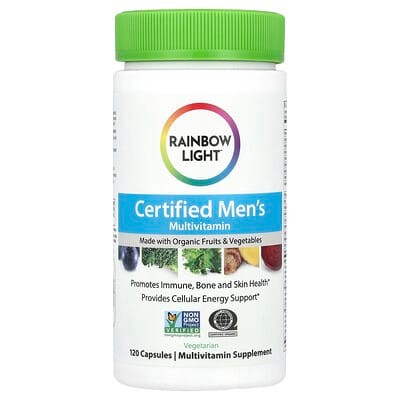

$35.99 $1.19 per serving


Product analysis
Men's Multivitamin supplies nutrients used in normal metabolism, immune function and bone nutrition, particularly when intake is low. Its undisclosed blends and relatively high costs across several nutrients weaken its appeal as a daily supplement.
AI assessment of the formula, label and price. How scoring works
Nutrient Quality49
Vitamin D3 and natural-form vitamin E are favorable parts of the mixture. Several other forms are unspecified or less clearly characterized, and hidden blends leave the complete quality picture uncertain.
Ingredient Transparency75
All listed amounts and most forms are disclosed. Several forms and blend details remain missing, limiting a full comparison of the formula.
Value For Money29
Many nutrients are relatively expensive for what the serving supplies. Value for the remaining ingredients is mixed or uncertain, so the complete formula has limited demonstrated value.
Customer Satisfaction83
Customer feedback is generally positive across thousands of ratings. The large review pool describes satisfaction without demonstrating health benefits.
Product Focus8
The formula mainly supplies nutrients when dietary intake falls short. A broad ingredient mixture and many suggested uses make it less targeted, while undisclosed blends obscure the full makeup.
- Format
Capsule - Container
- 120 Capsule(s)
- Per serving
- $1.19
- Customer rating
- 4.5 · 3,031 ratings
Goals

Impact
Highest effect
Folate · 400 mcgVitamin B12 · 67 mcgVitamin D · 1000 IUSelenium · 75 mcgZinc · 7 mgVitamin C · 60 mg

Impact
High effect
Vitamin C · 60 mgZinc · 7 mgVitamin A · 2500 IUVitamin D · 1000 IUSelenium · 75 mcg

Impact
Moderate effect
Iodine · 55 mcgVitamin D · 1000 IUVitamin B5 · 10 mgRiboflavin · 25 mgThiamin · 27 mgVitamin B12 · 67 mcg
Vitamin B5 Not classified
No linked studies yet.

Impact
High effect
Vitamin D · 1000 IUCopper · 0.7 mgManganese · 2 mgZinc · 7 mgVitamin C · 60 mg

Impact
Moderate effect
Folate · 400 mcgVitamin B12 · 67 mcgVitamin B6 · 18 mgMolybdenum · 75 mcgSelenium · 75 mcgVitamin E · 30 IUZinc · 7 mgVitamin C · 60 mgRiboflavin · 25 mg
Riboflavin Not classified
No linked studies yet.
Vitamin B6 Not classified
No linked studies yet.

Impact
Moderate effect
Biotin · 500 mcgVitamin D · 1000 IUZinc · 7 mgVitamin C · 60 mg
Ingredients
| Ingredient | Amount per serving | Score |
|---|---|---|
Vitamin A (Beta-Carotene) | 2500 IU | |
Vitamin C (Ascorbic Acid) | 60 mg | |
Vitamin D (Cholecalciferol, Vitamin D3) | 1000 IU | |
Vitamin E (D-Alpha-Tocopheryl Succinate) | 30 IU | |
Thiamine | 27 mg | |
Riboflavin | 25 mg | |
Niacin (Niacinamide) | 30 mg | |
Vitamin B6 (Pyridoxine) | 18 mg | |
Folic Acid | 400 mcg | |
Vitamin B12 (Methylcobalamin) | 67 mcg | |
Biotin | 500 mcg | |
Pantothenic Acid (Calcium Pantothenate) | 10 mg | |
Iodine (Kelp) | 55 mcg | |
Zinc (Zinc Citrate) | 7 mg | |
Selenium (Selenomethionine) | 75 mcg | |
Copper (Copper Amino Acid Chelate) | 0.7 mg | |
Manganese (Manganese Citrate) | 2 mg | |
Chromium (Chromium Aminonicotinate) | 75 mcg | |
Molybdenum (Molybdenum Amino Acid Chelate) | 75 mcg | |
Resveratrol Complex (Polygonum) | 8 mg | |
organic Strength & Energy blend | 280 mg | |
organic Antioxidant Fruit & Vegetable Blend | 1056 mg | |
organic Liver Support blend | 124 mg | |
Gentle Digestive Support | 714 mg |
Niacin (Niacinamide) · 30 mg OverallScore65
A serving provides 30 mg of niacin as niacinamide at a high cost per serving. Niacinamide is a non-flushing form, and the amount and source are stated.
How this ingredient is rated
Active Ingredient Quality & Bioavailability86
Niacinamide provides a standard form of niacin.
Niacin Form & Goal Alignment
Niacinamide is a form used for general niacin support.
Precursor Source Quality
The niacin source is niacinamide.
Dose, Safety & Label Transparency67
The serving contains 30 mg of niacin. The niacinamide form is non-flushing.
Clarity of Chemical Form
Both the niacin amount and niacinamide form are stated.
Form-Specific Dosage Efficacy
The serving contains 30 mg of niacin.
Flush Risk & Safety Labeling
Niacinamide is a non-flushing form.
Value20
The cost per serving is high for the niacin contribution.
Price Per Effective Serving
The cost per serving is high for the niacin contribution.
Vitamin B6 (Pyridoxine) · 18 mg OverallScore72
Each serving provides 18 mg of vitamin B6, at a high cost per milligram. The source is pyridoxine.
How this ingredient is rated
Ingredient Form & Label Quality100
The source is pyridoxine. The listed ingredients do not include artificial colors, titanium dioxide, or talc.
Vitamin B6 Form Identification
The source is pyridoxine.
Clean Label and Excipient Purity
The listed ingredients do not include artificial colors, titanium dioxide, or talc.
Dose, Safety & Label Transparency67
The label states 18 mg of B6 per serving. The source is also named.
Vitamin B6 Dose & Safety Policy
Each serving provides 18 mg of vitamin B6. It is a relatively high amount.
Label Transparency
The label states the amount and source.
Value26
The cost per milligram of B6 is high.
Vitamin B6 Price Efficiency
The cost per milligram of B6 is high.
Manganese (Manganese Citrate) · 2 mg OverallScore70
Each serving provides 2 mg of manganese at a high cost per serving. The amount may support nutritional maintenance. It uses manganese citrate, an organic salt with good solubility.
How this ingredient is rated
Active Ingredient Quality & Bioavailability80
Manganese Citrate is an organic salt with good solubility.
Manganese Chemical Form
Manganese Citrate is an organic salt with good solubility.
Dose, Safety & Label Transparency86
The label clearly states 2 mg of manganese per serving. It may support nutritional maintenance but is less suited to targeted bone support.
Manganese Dosage Efficacy & Safety
2 mg may support nutritional maintenance, though it may be less suited to targeted bone support.
Elemental Weight Disclosure
The label clearly states the manganese amount and source.
Value20
The cost per serving is high.
Price per Serving vs. Median
The cost per serving is high.
Alternative products
Report alternatives
Sources
Published studies used for the product analysis and the top-ranked studies for each ingredient and goal.
- The Association between Dietary and Circulating Copper Levels and Osteoporosis: a Scoping Review.
- Association between dietary copper, iron, zinc, selenium intake and osteopenia or osteoporosis in elderly hypertensive patients: a retrospective cohort study.
- Associations of dietary copper intake with total bone mineral density and lumbar spine bone mineral density in American adults.
- The association between dietary mineral intake and bone mineral density: a cross-sectional study.
- Association between dietary copper intake and bone mineral density in children and adolescents aged 8-19 years: A cross-sectional study.
- Association between RBC folate and lumbar bone mineral density in postmenopausal women, a cross-sectional study from NHANES 2009-2018.
- Genetic variants modify the associations of concentrations of methylmalonic acid, vitamin B-12, vitamin B-6, and folate with bone mineral density.
- Adequate Intake and Supplementation of B Vitamins, in Particular Folic Acid, can Play a Protective Role in Bone Health.
- Relation of homocysteine, folate, and vitamin B12 to bone mineral density of postmenopausal women.
- Dietary intake of folate, but not vitamin B2 or B12, is associated with increased bone mineral density 5 years after the menopause: results from a 10-year follow-up study in early postmenopausal women.
- Risk of Environmental Chemicals on Bone Fractures Is Independent of Low Bone Mass in US Adults: Insights from 2017 to 2018 NHANES.
- The Manganese-Bone Connection: Investigating the Role of Manganese in Bone Health.
- Associations of multiple metals with bone mineral density: A population-based study in US adults.
- Sex-specific associations of urinary mixed-metal concentrations with femoral bone mineral density among older people: an NHANES (2017-2020) analysis.
- Relationship between blood manganese and bone mineral density and bone mineral content in adults: A population-based cross-sectional study.
- Evaluating the Protective Role of Vitamin A Supplementation in Periodontal Health: A Comprehensive Systematic Review and Meta-Analysis.
- Dietary vitamin A intake and bone health in the elderly: the Rotterdam Study.
- Vitamin A and its dervatives effect on bone mineral density, a systematic review.
- Association of vitamins with bone mineral density and osteoporosis measured by dual-energy x-ray absorptiometry: a cross-sectional study.
- Association of dietary consumption and serum levels of vitamin A and β-carotene with bone mineral density in Chinese adults.