
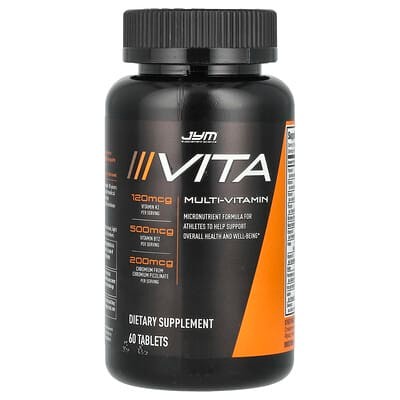

$29.99 $0.99 per serving


Product analysis
Vita provides broad nutritional support for normal energy use, blood formation and immune function when intake is low. Uneven mineral sources and weak value for several nutrients are practical drawbacks.
AI assessment of the formula, label and price. How scoring works
Nutrient Quality56
Some minerals use favorable sources, including potassium iodide and chromium picolinate. Selenium, copper and silicon sources are less appealing, while other comparisons remain unresolved.
Ingredient Transparency76
Listed nutrient amounts and most forms are stated, making much of the formula easier to compare. The vitamin K mixture does not separate the amounts of MK-4 and MK-7.
Value For Money36
Value is favorable for B6 and potassium, but weak for several other vitamins and minerals. Missing comparisons for some nutrients also limit a firm whole-formula value conclusion.
Customer Satisfaction72
The available ratings are favorable. The small rating pool leaves a limited view of wider buyer satisfaction.
Product Focus22
The clearest role is broad nutritional gap filling for normal energy use, blood formation and immune function. The many other aims extend well beyond a narrowly targeted supplement.
- Format
Tablet - Container
- 60 Tablet(s)
- Per serving
- $0.99
- Customer rating
- 4.7 · 106 ratings
Goals

Impact
High effect
Iodine · 150 mcgVitamin B5 · 100 mgRiboflavin · 100 mgThiamin · 100 mgVitamin B12 · 500 mcgIron · 18 mgPotassium · 100 mg
Vitamin B5 Not classified
No linked studies yet.

Impact
High effect
Biotin · 300 mcgIron · 18 mgVitamin C · 250 mg

Impact
High effect
Vitamin K · 120 mcgVitamin B12 · 500 mcgVitamin B6 · 100 mgFolate · 667 mcg DFE

Impact
Highest effect
Folate · 667 mcg DFEVitamin B12 · 500 mcgVitamin K · 120 mcgBoron · 3 mgSelenium · 200 mcgVitamin C · 250 mg

Impact
High effect
Biotin · 300 mcgNiacin · 100 mgVitamin B12 · 500 mcgRiboflavin · 100 mgThiamin · 100 mgVitamin B5 · 100 mgVitamin B6 · 100 mg

Impact
Highest effect
Vitamin C · 250 mgVitamin A · 3000 mcgSelenium · 200 mcg
Ingredients
| Ingredient | Amount per serving | Score |
|---|---|---|
Vitamin A (Beta-Carotene) | 3000 mcg | |
Vitamin C (Ascorbic Acid) | 250 mg | |
Vitamin E (D-Alpha-Tocopheryl Succinate) | 268.5 mg | |
Thiamine (Thiamine Mononitrate) | 100 mg | |
Riboflavin | 100 mg | |
Niacin (Niacinamide) | 100 mg | |
Vitamin B6 (Pyridoxine Hydrochloride) | 100 mg | |
Folate | 667 mcg DFE | |
Vitamin B12 (Cyanocobalamin) | 500 mcg | |
Biotin | 300 mcg | |
Pantothenic Acid (Calcium D-Pantothenate) | 100 mg | |
Iron (Ferrous Fumarate) | 18 mg | |
Iodine (Potassium Iodide) | 150 mcg | |
Selenium (Sodium Selenate) | 200 mcg | |
Copper (Copper Gluconate) | 3 mg | |
Manganese (Manganese Gluconate) | 2.3 mg | |
Chromium (Chromium Picolinate) | 200 mcg | |
Molybdenum (Sodium Molybdate) | 45 mcg | |
Potassium (Potassium Citrate) | 100 mg | |
Black Pepper (Piper nigrum) fruit extract | 5 mg | |
Boron (Boron Amino Acid Chelate) | 3 mg | |
Silica (Silicon Dioxide) | 2 mg | |
Vitamin K2 (Menaquinone-4, Menaquinone-7) | 120 mcg | |
Vanadium (Vanadium Amino Acid Chelate) | 10 mcg | |
Nickel (Nickel Sulfate) | 5 mcg |
Iodine (Potassium Iodide) · 150 mcg OverallScore88
Vitamin K (Menaquinone-4, Menaquinone-7) · 120 mcg OverallScore54
Niacin (Niacinamide) · 100 mg OverallScore85
Alternative products
Report alternatives
Sources
Published studies used for the product analysis and the top-ranked studies for each ingredient and goal.
- [Comparative study of the urinary excretion of boron, calcium, magnesium and phosphorus in postmenopausal women with and without osteoporosis].
- Effect of dietary boron on mineral, estrogen, and testosterone metabolism in postmenopausal women.
- The relationship between boron and magnesium status and bone mineral density in the human: a review.
- Effects of boron supplementation on bone mineral density and dietary, blood, and urinary calcium, phosphorus, magnesium, and boron in female athletes.
- Metabolic responses of postmenopausal women to supplemental dietary boron and aluminum during usual and low magnesium intake: boron, calcium, and magnesium absorption and retention and blood mineral concentrations
- The Association between Dietary and Circulating Copper Levels and Osteoporosis: a Scoping Review.
- Association between dietary copper, iron, zinc, selenium intake and osteopenia or osteoporosis in elderly hypertensive patients: a retrospective cohort study.
- Associations of dietary copper intake with total bone mineral density and lumbar spine bone mineral density in American adults.
- The association between dietary mineral intake and bone mineral density: a cross-sectional study.
- Association between dietary copper intake and bone mineral density in children and adolescents aged 8-19 years: A cross-sectional study.
- Association between RBC folate and lumbar bone mineral density in postmenopausal women, a cross-sectional study from NHANES 2009-2018.
- Genetic variants modify the associations of concentrations of methylmalonic acid, vitamin B-12, vitamin B-6, and folate with bone mineral density.
- Adequate Intake and Supplementation of B Vitamins, in Particular Folic Acid, can Play a Protective Role in Bone Health.
- Relation of homocysteine, folate, and vitamin B12 to bone mineral density of postmenopausal women.
- Dietary intake of folate, but not vitamin B2 or B12, is associated with increased bone mineral density 5 years after the menopause: results from a 10-year follow-up study in early postmenopausal women.
- Risk of Environmental Chemicals on Bone Fractures Is Independent of Low Bone Mass in US Adults: Insights from 2017 to 2018 NHANES.
- The Manganese-Bone Connection: Investigating the Role of Manganese in Bone Health.
- Associations of multiple metals with bone mineral density: A population-based study in US adults.
- Sex-specific associations of urinary mixed-metal concentrations with femoral bone mineral density among older people: an NHANES (2017-2020) analysis.
- Relationship between blood manganese and bone mineral density and bone mineral content in adults: A population-based cross-sectional study.