
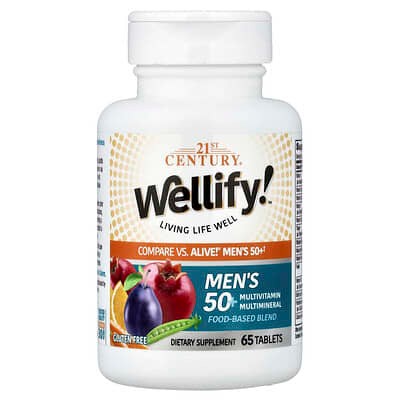
Men's 50+ Multivitamin Multimineral

Goals
$10.49 $0.16 per serving


Product analysis
Men's 50+ Multivitamin Multimineral offers everyday nutritional support for normal energy use, immune function and skin maintenance. Zinc oxide and copper sulfate are less readily absorbed sources, which matters if those minerals are your main priority.
AI assessment of the formula, label and price. How scoring works
Nutrient Quality39
Biotin uses its biologically active form, and molybdenum has a clearly identified, favorable source. Zinc oxide, copper sulfate and sodium selenite are weaker choices for absorption.
Ingredient Transparency75
Amounts and most ingredient forms are stated, which helps compare servings. The makeup or proportions of mixtures are not fully disclosed, so total amounts leave some detail unresolved.
Value For Money54
The serving cost is favorable for vitamin K and several minerals, including zinc and manganese. Niacin, biotin and selenium give a more moderate value comparison, while several other ingredients lack a usable cost comparison.
Customer Satisfaction85
Customer feedback is strongly positive. The smaller review pool gives less certainty about how widely that view is shared, without establishing health benefits.
Product Focus5
The formula mainly covers everyday nutritional needs across several body functions. A broad set of goals and an unidentified botanical blend make it less focused on any single concern.
- Format
Tablet - Container
- 65 Tablet(s)
- Per serving
- $0.16
- Customer rating
- 4.8 · 1,544 ratings
Goals

Impact
Highest effect
Folate · 667 mcg DFEVitamin B12 · 100 mcgVitamin D · 20 mcgMagnesium · 100 mgVitamin K · 80 mcgBoron · 150 mcgSelenium · 122.5 mcgZinc · 26.3 mgVitamin C · 120 mg
The B vitamins contribute nutrients used in energy metabolism, while folate and B12 add to the formula's nutritional coverage. Magnesium supplies a nutritional contribution when dietary intake falls short; its amount does not establish treatment of sleep or stress. Vitamin D adds to nutrient availability, with usefulness depending on the total diet. Iodine contributes to adequacy relevant to thyroid function when intake is low.
How this product is rated for Everyday Health
Ingredient fit78
The ingredient focus and declared amounts provide a partial match to the saved references. The relevant roles remain limited to the specific outcomes described above.
Goal fit
The formula includes ingredients for other uses, leaving a mixed focus on general-health needs.
Dose adequacy
The recognized amounts broadly approach the saved references, with remaining limitations in amount or preparation.
Pathways100
The strongest saved finding concerns energy metabolism cofactors. The recognized breadth is limited across the other nutritional processes.
Depth
The strongest saved contribution concerns energy metabolism cofactors, describing ingredient roles rather than proven improvement in health.
Breadth
More than one pathway reaches the saved coverage threshold, without establishing benefits across every aging-related process.
Evidence86
Magnesium leads the saved evidence finding. The population, outcome and preparation limits described above still apply.
Evidence strength
Magnesium supplies the leading saved evidence finding, subject to its specific population and outcome limitations.
Studied preparation
The saved findings recognize preparation matches for qualifying ingredients, without extending the evidence to broader aging outcomes.
Formulation logic100
The recognized ingredients have their required partners or work independently, and no matched conflict was recorded. Amount limitations remain relevant.
Partner coverage
The recognized ingredients work independently or have their required partner; no extra combination benefit is established.
Conflicts
No matched ingredient conflict was recorded in the supplied calculation.
Effective doses
All recognized ingredients meet the saved amount threshold, a calculation reference rather than proof of general-health benefit.

Impact
Highest effect
Magnesium · 100 mgVitamin C · 120 mgZinc · 26.3 mgVitamin A · 1500 mcgVitamin D · 20 mcgSelenium · 122.5 mcg
Zinc and relevant vitamins contribute to normal immune-cell function, while vitamin A supplies a nutrient involved in protective barriers. Folate, copper and B vitamins can help when low intake impairs immune processes. The ingredients make differing contributions at the selected serving, and normal nutrient functions do not establish extra protection against infection in adults whose needs are already met.
How this product is rated for Immunity
Ingredient fit62
Relevant nutrients contribute to immune function, while additional actives broaden the formula beyond the supported contributions.
Goal fit
Relevant nutrients contribute to immune function, while additional actives broaden the formula beyond the supported contributions.
Dose adequacy
The serving supplies partial amounts against the saved references; this comparison does not establish an optimal dose or a clinical response.
Pathways100
Barrier functions, lymphocyte-related functions and oxidative balance reach the saved threshold; innate immune-cell coverage remains smaller.
Depth
The strongest recognized area is protective barrier functions; this describes functional coverage rather than observed infection prevention.
Breadth
Barrier functions, lymphocyte-related functions and oxidative balance reach the saved threshold; innate immune-cell coverage remains smaller.
Evidence100
Zinc drives the strongest saved evidence finding, within the supplied limits on normal immune function and respiratory outcomes.
Evidence strength
Zinc drives the strongest saved evidence finding, within the supplied limits on normal immune function and respiratory outcomes.
Studied preparation
The saved result recognizes the preparations meeting its amount threshold; no superiority of particular forms is established.
Formulation logic100
No configured ingredient conflict was triggered; the finding covers only the evaluated combinations. All recognized ingredients meet the saved minimum amount threshold; this does not establish a clinical response.
Partner coverage
Recognized ingredients work independently or have their required partners; this does not establish added combination benefit.
Conflicts
No configured ingredient conflict was triggered; the finding covers only the evaluated combinations.
Effective doses
All recognized ingredients meet the saved minimum amount threshold; this does not establish a clinical response.

Impact
High effect
Folate · 667 mcg DFEVitamin B12 · 100 mcgVitamin B6 · 6 mgMolybdenum · 75 mcgSelenium · 122.5 mcgMagnesium · 100 mgVitamin E · 27 mgZinc · 26.3 mgVitamin C · 120 mgRiboflavin · 3.4 mg
Folate can address a dietary gap relevant to arsenic handling, but the supplied human findings concern arsenic-exposed populations and do not establish routine toxin removal. Selenium has limited findings on mercury handling in small studies involving low selenium status or mercury exposure; these do not establish generalized detoxification. Generic broccoli declarations do not establish the assayed glucoraphanin and sulforaphane exposure used in pollutant-excretion research.
How this product is rated for Liver & Detox
Ingredient fit58
Partial amount coverage across credited nutrients; vitamins C and E fall below their thresholds.
Goal fit
Partial amount coverage across credited nutrients.
Dose adequacy
The credited amounts provide partial overall amount coverage; this comparison does not establish clinical detoxification doses.
Pathways77
The saved findings emphasize enzyme-related nutrient processes. This category assignment does not establish faster toxin removal.
Depth
The strongest recorded coverage is in enzyme-related nutrient processes, rather than a demonstrated clinical toxin-clearance outcome.
Breadth
Two categories reach the saved breadth threshold; this does not establish combined clinical detoxification effects.
Evidence97
Folate leads the saved evidence finding, but its relevant toxin-handling evidence is limited to particular exposure and nutritional settings.
Evidence strength
Folate leads the saved evidence finding, but its relevant toxin-handling evidence is limited to particular exposure and nutritional settings.
Studied preparation
Molybdenum, riboflavin and B6 lack matching studied-preparation recognition; the remaining eligible ingredients receive it in the saved findings.
Formulation logic100
No missing required partner or configured conflict was identified; every credited ingredient passes the minimum-amount threshold.
Partner coverage
All credited ingredients can stand alone or have their required partner in the saved findings; this does not prove synergy.
Conflicts
No configured conflict was identified from the supplied ingredients and amounts.
Effective doses
All credited ingredients pass the saved minimum-amount threshold; that threshold does not establish toxin-clearance efficacy.
Riboflavin Not classified
No linked studies yet.
Vitamin B6 Not classified
No linked studies yet.

Impact
Moderate effect
Biotin · 300 mcg
Zinc may support nail health when low status affects nail formation. Biotin at 300 mcg is below the amounts used in the supplied nail research. Magnesium and vitamins D and E contribute through normal physiology, with limited evidence for an independent improvement in nail growth or brittleness.
How this product is rated for Nail Health
Ingredient fit55
Only part of the broad ingredient mix is directly relevant to nail health. The assessed amounts provide partial support, with smaller or unresolved quantities limiting the finding.
Goal fit
Only part of the broad ingredient mix is directly relevant to nail health.
Dose adequacy
The assessed amounts provide partial support, with smaller or unresolved quantities limiting the finding.
Pathways19
Structural protein supply is the strongest connection to nail health. The findings do not show substantial coverage of several distinct nail-health processes.
Depth
Structural protein supply is the strongest connection to nail health.
Breadth
The findings do not show substantial coverage of several distinct nail-health processes.
Evidence62
Vitamin E provides the strongest evidence contribution in the saved findings, though the supplied nail-specific evidence remains limited. Preparation support is incomplete for Magnesium, Selenium.
Evidence strength
Vitamin E provides the strongest evidence contribution in the saved findings, though the supplied nail-specific evidence remains limited.
Studied preparation
Preparation support is incomplete for Magnesium, Selenium.
Formulation logic100
No listed formulation conflict was matched in the saved findings. All ingredients counted in this finding meet the saved minimum amount benchmark.
Partner coverage
No required ingredient partner is missing in the saved findings.
Conflicts
No listed formulation conflict was matched in the saved findings.
Effective doses
All ingredients counted in this finding meet the saved minimum amount benchmark.
Magnesium Not classified
No linked studies yet.

Impact
High effect
Biotin · 300 mcgVitamin D · 20 mcgZinc · 26.3 mgVitamin C · 120 mg
Zinc can help with diffuse shedding when zinc intake is deficient. Vitamin C supports normal collagen formation and iron absorption, without establishing extra hair growth. The broader nutrient formula receives recognition for several ingredients, but their normal functions do not establish routine regrowth when nutrient intake is adequate.
How this product is rated for Hair Health
Ingredient fit64
Zinc provides a relevant nutrient connection to hair health, within a broader formula.
Goal fit
This broader formula includes ingredients outside hair health, reducing its focus on this goal.
Dose adequacy
Vitamin B9 (Folate) has an unresolved amount, limiting how its contribution can be assessed.
Pathways55
Antioxidant protection receives the strongest assigned coverage; the formula does not broadly cover the named hair mechanisms.
Depth
The strongest assigned coverage concerns antioxidant protection around follicles, although normal nutrient roles do not establish hair regrowth.
Breadth
Only follicle antioxidant protection reaches the saved coverage threshold; broad coverage across the named mechanisms is absent.
Evidence97
Zinc leads the recognized evidence contribution, subject to the ingredient-specific limits on hair outcomes.
Evidence strength
Zinc provides the strongest recognized evidence contribution here; this does not establish routine hair regrowth.
Studied preparation
Most counted ingredients receive preparation recognition, while iodine does not have that support for hair outcomes.
Formulation logic97
Vitamin B9 (Folate) has unresolved amount information; no unmet partner requirement or ingredient conflict was identified.
Partner coverage
The counted ingredients have no unmet partner requirement in the supplied comparison.
Conflicts
No ingredient conflict was identified in the supplied comparison.
Effective doses
Vitamin B9 (Folate) falls below the saved amount threshold; the other counted ingredients meet it.

Impact
Moderate effect
Iodine · 150 mcgVitamin D · 20 mcgVitamin B5 · 15 mgMagnesium · 100 mgRiboflavin · 3.4 mgThiamin · 4.5 mgVitamin B12 · 100 mcg
B vitamins and folate support normal energy metabolism, while magnesium and vitamin C contribute to adequate nutrition relevant to fatigue. Vitamin D has a conditional link in people with low status, and B12's smaller amount contributes little in the saved findings. Higher intake does not imply extra energy once needs are met.
How this product is rated for Energy
Ingredient fit56
Only part of the broad formula directly supports the assessed energy goal. Relevant quantities provide partial support, with smaller or unresolved amounts limiting the finding.
Goal fit
Only part of the broad formula directly supports the assessed energy goal.
Dose adequacy
Relevant quantities provide partial support, with smaller or unresolved amounts limiting the finding.
Pathways0
The saved findings show nutritional support without a separately covered direct energy pathway. The findings do not show substantial coverage across several distinct energy-related processes.
Depth
The saved findings show nutritional support without a separately covered direct energy pathway.
Breadth
The findings do not show substantial coverage across several distinct energy-related processes.
Evidence94
Vitamin D supplies the strongest evidence contribution in the saved findings, subject to the supplied nutritional or fatigue-specific limitations. Preparation support is incomplete for Iodine.
Evidence strength
Vitamin D supplies the strongest evidence contribution in the saved findings, subject to the supplied nutritional or fatigue-specific limitations.
Studied preparation
Preparation support is incomplete for Iodine.
Formulation logic100
No listed formulation conflict was matched in the saved findings. All ingredients counted in this finding meet the saved minimum amount benchmark.
Partner coverage
The relevant ingredients have no missing required partner in the saved findings.
Conflicts
No listed formulation conflict was matched in the saved findings.
Effective doses
All ingredients counted in this finding meet the saved minimum amount benchmark.
Vitamin B5 Not classified
No linked studies yet.
Ingredients
| Ingredient | Amount per serving | Score |
|---|---|---|
Vitamin A (Beta-Carotene) | 1500 mcg | |
Vitamin C (Ascorbic Acid) | 120 mg | |
Vitamin D3 (Cholecalciferol) | 20 mcg | |
Vitamin E (DL-Alpha-Tocopheryl Acetate) | 27 mg | |
Vitamin K (Phytonadione) | 80 mcg | |
Thiamine (Thiamine Mononitrate) | 4.5 mg | |
Riboflavin | 3.4 mg | |
Niacin (Niacinamide) | 30 mg | |
Vitamin B6 (Pyridoxine Hydrochloride) | 6 mg | |
Folate | 667 mcg DFE | |
Vitamin B12 (Cyanocobalamin) | 100 mcg | |
Biotin (D-Biotin) | 300 mcg | |
Pantothenic Acid (D-Calcium Pantothenate) | 15 mg | |
Calcium (Calcium Carbonate) | 200 mg | |
Iodine (Potassium Iodine) | 150 mcg | |
Magnesium (Magnesium Oxide) | 100 mg | |
Zinc (Zinc Oxide) | 26.3 mg | |
Selenium (Sodium Selenite) | 122.5 mcg | |
Copper (Copper Sulfate) | 2 mg | |
Manganese (Manganese Sulfate) | 4 mg | |
Molybdenum (Sodium Molybdate) | 75 mcg | |
Fruit & Vegetable Blend | 100 mg | |
Lycopene | 600 mcg | |
Lutein | 300 mcg | |
Boron (Boron Amino Acid Chelate) | 150 mcg |
Iodine (Potassium Iodine) · 150 mcg OverallScore84
Each serving supplies 150 mcg of iodine, an amount aligned with the evaluation’s daily-support criterion. The iodine’s chemical form remains unresolved, and a whole-product serving costs about $0.16.
How this ingredient is rated
Active Ingredient Quality & Bioavailability61
The saved facts do not establish the iodine’s chemical form, so the form cannot be compared confidently. No marine source is recorded, so marine-specific sourcing is not assessed.
Iodine Form & Bioavailability
The saved facts do not establish the iodine’s chemical form, so the form cannot be compared confidently.
Marine Source Purity & Sourcing
No marine source is recorded, so the marine-specific check does not apply; this does not establish that contaminants are absent.
Dose, Safety & Label Transparency100
The label records 150 mcg of iodine per serving, an amount aligned with the evaluation’s daily-support criterion. The general safety check flags no excess.
Dosage Efficacy for Daily Support
The 150 mcg serving aligns with the evaluation’s daily-support criterion.
Dosage Safety & Upper Limits
The evaluation flags no excess for the 150 mcg serving under its general safety check.
Elemental Iodine Transparency
The saved facts record 150 mcg of iodine per serving, while its chemical form remains unresolved.
Value100
A whole-product serving costs about $0.16.
Price Per Effective Serving
A whole-product serving costs about $0.16.
Niacin (Niacinamide) · 30 mg OverallScore62
A serving provides 30 mg of niacin as niacinamide. For the stated heart-health goal, niacinamide does not have the specific lipid effects associated with nicotinic acid.
How this ingredient is rated
Active Ingredient Quality & Bioavailability57
Niacinamide is a standard vitamin B3 form, but it lacks the specific lipid effects of nicotinic acid considered for the stated cardiovascular goal.
Niacin Form & Goal Alignment
For the stated cardiovascular goal, niacinamide lacks the specific lipid effects associated with nicotinic acid.
Precursor Source Quality
Niacinamide is a standard form of vitamin B3; no advanced NAD+ claim is established in the saved facts.
Dose, Safety & Label Transparency67
The serving provides 30 mg niacin as niacinamide, a form generally less associated with flushing.
Clarity of Chemical Form
The vitamin B3 form is identified as niacinamide.
Form-Specific Dosage Efficacy
Each serving provides 30 mg niacin as niacinamide.
Flush Risk & Safety Labeling
Niacinamide is generally less associated with niacin flushing; no specific no-flush claim is established in the saved facts.
Value60
A whole-product serving costs about $0.16.
Price Per Effective Serving
A whole-product serving costs about $0.16.
Manganese (Manganese Sulfate) · 4 mg OverallScore76
Each serving provides 4 mg of manganese from manganese sulfate. The labeled serving is 1 tablet.
How this ingredient is rated
Active Ingredient Quality & Bioavailability40
The manganese source is manganese sulfate.
Manganese Chemical Form
The manganese source is manganese sulfate.
Dose, Safety & Label Transparency100
The labeled serving declares 4 mg of elemental manganese. One serving is below the adult upper limit used in the evaluation; total intake from other sources is not included.
Manganese Dosage Efficacy & Safety
A serving provides 4 mg of manganese and does not exceed the adult upper limit used in the evaluation on its own.
Elemental Weight Disclosure
The labeled serving declares 4 mg of elemental manganese.
Value100
The whole-product serving costs about $0.16.
Price per Serving vs. Median
The whole-product serving costs about $0.16.
Alternative products
Report alternatives
Sources
Published studies used for the product analysis and the top-ranked studies for each ingredient and goal.
- Association of radioactive iodine treatment with survivorship symptoms and primary care utilisation in women of reproductive age with thyroid cancer: a retrospective cohort study.
- Energy level and fatigue after surgery for thyroid cancer: A population-based study of patient-reported outcomes.
- Health-Related Quality of Life in Differentiated Thyroid Cancer Survivors: A Cross-Sectional Study From Turkey.
- Magnesium-L-threonate improves sleep quality and daytime functioning in adults with self-reported sleep problems: A randomized controlled trial.
- Total magnesium intake and risk of frailty in older women.
- Red blood cell magnesium and chronic fatigue syndrome.
- Exercise, magnesium and immune function.
- Physicochemical properties of and volatile compounds in riboflavin fortified cloudy apple juice; study of its effect on job fatigue among Egyptian construction workers.
- Vitamin B status in patients with chronic fatigue syndrome.
- B-vitamins, related vitamers, and metabolites in patients with quiescent inflammatory bowel disease and chronic fatigue treated with high dose oral thiamine.
- Metabolic features of chronic fatigue syndrome.
- Effectiveness of Riboflavin in Inherited Metabolic Diseases: A Systematic Review
- Influence of thiamin supplementation on the health and general well-being of an elderly Irish population with marginal thiamin deficiency.
- Randomised clinical trial: high-dose oral thiamine versus placebo for chronic fatigue in patients with quiescent inflammatory bowel disease.
- Dietary reference values for thiamin.
- Effects of thiamine supplementation on exercise-induced fatigue.
- Long-term maintenance treatment with 300 mg thiamine for fatigue in patients with inflammatory bowel disease: results from an open-label extension of the TARIF study.
- A new perspective on vitamin B12 deficiency in rheumatology: a case-based review.
- Effects of Vitamin B12 Supplementation on Cognitive Function, Depressive Symptoms, and Fatigue: A Systematic Review, Meta-Analysis, and Meta-Regression.
- Patients' experiences with methylcobalamin injections in amyotrophic lateral sclerosis.