
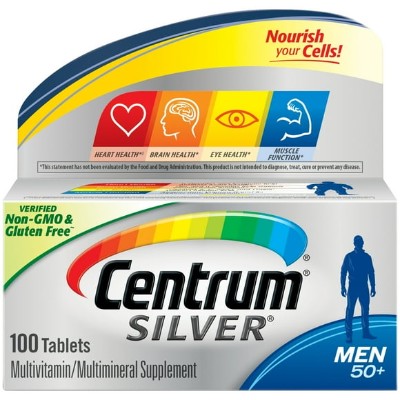

$10.42 $0.10 per serving

Product analysis
Centrum Silver Men 50+ offers broad nutritional support for normal metabolism and immune function when your diet falls short.
AI assessment of the formula, label and price. How scoring works
Nutrient Quality20
Most nutrient forms are not clearly identified alongside their amounts, limiting straightforward quality comparisons. Some mineral sources also remain unresolved, so the wide nutrient list does not establish consistently high quality.
Ingredient Transparency64
Amounts are disclosed throughout the nutrient listing, helping you compare quantities. Only one form is specified alongside its amount, leaving most nutrients less clearly described.
Value For Money61
Several nutrients compare favorably on cost, but the value is uneven across the formula. Vitamin D compares less favorably, and many other nutrient-specific comparisons remain uncertain.
Customer Satisfaction80
Customer ratings are very positive across several hundred reviews. The feedback gives useful insight into satisfaction, without proving nutritional benefits.
Product Focus28
The clearest purpose is filling dietary gaps that affect normal metabolism and immune function. The broad mix and many health aims make it less focused than a supplement for one nutritional need.
- Format
Tablet - Container
- 100 Tablet(s)
- Per serving
- $0.10
- Also available
 Centrum Silver Men 50+$8.79
- Customer rating
- 4.8 · 592 ratings
Goals

Impact
High effect
Folate · 300 mcgVitamin B12 · 100 mcgVitamin D · 600 IUMagnesium · 75 mgVitamin K · 60 mcgSelenium · 21 mcgZinc · 15 mgVitamin C · 120 mg
The B vitamins provide nutritional building blocks for normal metabolism, with folate contributing to blood formation. Iodine can fill a dietary gap that otherwise disrupts thyroid function. Magnesium adds a contribution toward mineral needs. These contributions concern nutrient availability when intake is low; larger amounts and special forms do not establish added health benefits when intake is adequate.
How this product is rated for Everyday Health
Ingredient fit69
Vitamin B1 (Thiamin), Vitamin B2 (Riboflavin), Vitamin B3 (Niacin) provide the recorded nutritional connection. The amounts match those references unevenly.
Goal fit
The formula includes relevant nutrients alongside ingredients serving other purposes, giving it a broader focus.
Dose adequacy
Amounts vary in how fully they match the nutritional comparison references; unresolved quantities cannot establish a contribution.
Pathways80
The strongest connection is to energy metabolism cofactors. Recorded coverage also depends on the amounts available for each function.
Depth
The strongest recorded coverage concerns energy metabolism cofactors, reflecting ingredient availability rather than a measured health improvement.
Breadth
The recorded coverage includes energy metabolism cofactors, one-carbon metabolism and blood formation.
Evidence82
Vitamin B9 (Folate) anchors the recorded evidence finding. Benefits remain conditional on nutritional need rather than proving improved general health in adequately nourished adults.
Evidence strength
Vitamin B9 (Folate) provides the strongest recorded evidence finding; the supplied context supports conditional nutritional usefulness rather than broad disease prevention.
Studied preparation
The counted preparations match those recognized in the saved findings, without establishing that any chemical form or delivery method is superior.
Formulation logic98
No missing partners or configured conflicts were identified. Vitamin D remains below the comparison’s amount threshold.
Partner coverage
No required ingredient partner is missing from the counted contributions; this does not imply extra benefit from combining nutrients.
Conflicts
No configured ingredient conflict was identified in the supplied findings.
Effective doses
Vitamin D does not meet the comparison’s amount threshold; the other counted ingredients do.

Impact
Moderate effect
Magnesium · 75 mgVitamin C · 120 mgZinc · 15 mgVitamin A · 3500 IUVitamin D · 600 IUSelenium · 21 mcg
Zinc and vitamin C support normal immune function, while B6, B12, folate and copper help maintain immune-cell function when nutritional needs are not met. The contribution is nutritional support rather than a promise of fewer infections. Unresolved vitamin A, D and E amounts limit their individual assessment.
How this product is rated for Immunity
Ingredient fit38
8 assessed ingredients relate to immunity alongside 19 other active ingredients, giving the formula a broader focus. The assessed amounts offer limited support against the saved benchmarks; unresolved amounts cannot add support.
Goal fit
8 assessed ingredients relate to immunity alongside 19 other active ingredients, giving the formula a broader focus.
Dose adequacy
The assessed amounts offer limited support against the saved benchmarks; unresolved amounts cannot add support.
Pathways40
The strongest saved connection is to lymphocyte function and immune regulation, with substantial coverage. One of the three target areas reaches substantial coverage.
Depth
The strongest saved connection is to lymphocyte function and immune regulation, with substantial coverage.
Breadth
One of the three target areas reaches substantial coverage.
Evidence100
Zinc provides the strongest saved evidence among ingredients meeting the amount benchmark. That finding does not establish fewer infections from the whole formula. The assessed ingredients meeting the amount benchmark are recorded as matching studied preparations.
Evidence strength
Zinc provides the strongest saved evidence among ingredients meeting the amount benchmark. That finding does not establish fewer infections from the whole formula.
Studied preparation
The assessed ingredients meeting the amount benchmark are recorded as matching studied preparations.
Formulation logic91
The assessed ingredients can act independently or have their required partner present. No configured ingredient conflicts were identified in the saved findings. 5 of 8 assessed ingredients meet the saved minimum amount benchmark. Vitamin D, Vitamin A, Vitamin E fall below it or have unresolved amounts.
Partner coverage
The assessed ingredients can act independently or have their required partner present.
Conflicts
No configured ingredient conflicts were identified in the saved findings.
Effective doses
5 of 8 assessed ingredients meet the saved minimum amount benchmark. Vitamin D, Vitamin A, Vitamin E fall below it or have unresolved amounts.

Impact
Moderate effect
Iodine · 150 mcgVitamin D · 600 IUVitamin B5 · 10 mgMagnesium · 75 mgRiboflavin · 1.7 mgThiamin · 1.5 mgVitamin B12 · 100 mcgPotassium · 80 mg
B vitamins support normal energy metabolism, while folate and B12 help maintain normal blood-cell function. Magnesium and vitamin C add nutritional support relevant to tiredness when intake is low; higher B-vitamin amounts do not imply extra energy once needs are met.
How this product is rated for Energy
Ingredient fit53
Energy-related ingredients form part of a broader mixture of actives. The assessed amounts provide partial dose support.
Goal fit
Energy-related ingredients form part of a broader mixture of actives.
Dose adequacy
The assessed amounts provide partial dose support.
Pathways0
No contribution to the defined performance-related pathways is recorded, despite the nutrients’ normal metabolic roles. No assessed pathway reaches the saved threshold for substantial coverage.
Depth
No contribution to the defined performance-related pathways is recorded, despite the nutrients’ normal metabolic roles.
Breadth
No assessed pathway reaches the saved threshold for substantial coverage.
Evidence77
Vitamin B2 (Riboflavin) supplies the strongest effective-dose evidence in the saved findings, within the ingredient’s stated limits. Preparation matching is incomplete; Iodine lacks a match in the saved findings.
Evidence strength
Vitamin B2 (Riboflavin) supplies the strongest effective-dose evidence in the saved findings, within the ingredient’s stated limits.
Studied preparation
Preparation matching is incomplete; Iodine lacks a match in the saved findings.
Formulation logic98
The assessed ingredients can contribute alone or have their required partner. No configured ingredient conflict was identified. 9 of 10 assessed ingredients reach the saved minimum dose threshold. Below that threshold: Vitamin D.
Partner coverage
The assessed ingredients can contribute alone or have their required partner.
Conflicts
No configured ingredient conflict was identified.
Effective doses
9 of 10 assessed ingredients reach the saved minimum dose threshold. Below that threshold: Vitamin D.
Vitamin B5 Not classified
No linked studies yet.

Impact
Moderate effect
Zinc · 15 mgVitamin C · 120 mgCopper · 0.5 mgSelenium · 21 mcgSilicon · 2 mgLycopene · 600 mcgVitamin E · 60 IU
Copper supports normal collagen and elastin cross-linking, while zinc contributes to epidermal repair. Riboflavin and biotin help meet nutrient needs whose deficiency can affect skin. The saved findings show limited structural support, with unresolved vitamin A and E amounts restricting their contribution.
How this product is rated for Skin Health
Ingredient fit38
6 ingredients relate to skin health, alongside 16 other actives that broaden the formula beyond this goal. Low or undisclosed amounts limit the assessed contribution.
Goal fit
6 ingredients relate to skin health, alongside 16 other actives that broaden the formula beyond this goal.
Dose adequacy
Low or undisclosed amounts limit the assessed contribution.
Pathways9
The clearest connection is dermal collagen matrix, with limited support in the saved findings.
Depth
The clearest connection is dermal collagen matrix, with limited support in the saved findings.
Breadth
The assessed contributions remain too limited to show meaningful breadth across the goal pathways.
Evidence89
Copper provides the strongest evidence contribution in the saved assessment, with practical benefits dependent on the relevant nutritional or trial context. The ingredients contributing at assessed amounts meet the saved preparation criteria.
Evidence strength
Copper provides the strongest evidence contribution in the saved assessment, with practical benefits dependent on the relevant nutritional or trial context.
Studied preparation
The ingredients contributing at assessed amounts meet the saved preparation criteria.
Formulation logic92
The relevant ingredients can contribute alone or have the partners required by the saved findings. No conflict was identified in the supplied checks. 4 of 6 relevant ingredients meet the saved minimum amount criterion; Vitamin A, Vitamin E falls short or has an undisclosed amount.
Partner coverage
The relevant ingredients can contribute alone or have the partners required by the saved findings.
Conflicts
No conflict was identified in the supplied checks.
Effective doses
4 of 6 relevant ingredients meet the saved minimum amount criterion; Vitamin A, Vitamin E falls short or has an undisclosed amount.

Impact
High effect
Phosphorus · 20 mgVitamin K · 60 mcgMagnesium · 75 mgCalcium · 210 mgVitamin D · 600 IUCopper · 0.5 mgManganese · 4 mgZinc · 15 mgVitamin C · 120 mg
Copper supports the collagen framework of bone, with a relevant benefit when intake is deficient. Calcium and magnesium are present but too low to count in the saved findings, and vitamin D lacks a usable amount. Vitamin K and potassium are not identified as the specific preparations used in bone studies. The remaining nutrient functions do not establish routine improvements in bone density or fracture prevention.
How this product is rated for Bone Health
Ingredient fit53
The formula includes bone-related nutrients, but its broader ingredients and uses reduce its focus on bone health.
Goal fit
The formula includes bone-related nutrients, but its broader ingredients and uses reduce its focus on bone health.
Dose adequacy
The declared amounts provide partial overall recognition, without making a serving a complete daily nutritional regimen.
Pathways60
The sufficiently covered areas are collagen matrix formation; the remaining areas have less support.
Depth
The strongest recorded area is collagen matrix formation, with full coverage from the counted nutrients.
Breadth
The sufficiently covered areas are collagen matrix formation; the remaining areas have less support.
Evidence92
Zinc leads the saved evidence finding, but its normal bone roles do not establish an independent supplemental bone benefit.
Evidence strength
Zinc leads the saved evidence finding, but its normal bone roles do not establish an independent supplemental bone benefit.
Studied preparation
Vitamin K, Potassium does not match the required studied preparation; the other qualifying preparations are recognized.
Formulation logic92
Vitamin D lacks the required qualifying partner, limiting support from the formula as a whole.
Partner coverage
Vitamin D lacks the required qualifying partner, limiting support from the formula as a whole.
Conflicts
No configured ingredient conflict was triggered in the saved findings.
Effective doses
Vitamin D, Vitamin A does not meet the saved amount threshold, including any unresolved amounts; the other counted ingredients qualify.

Impact
Moderate effect
Biotin · 30 mcgVitamin D · 600 IUZinc · 15 mgVitamin C · 120 mg
Zinc may help with diffuse shedding if low zinc intake is the cause. Biotin has a similarly conditional role, while getting more of these nutrients doesn't imply extra growth when intake is already adequate. The silicon preparation and amount also matter: benefits for fine-hair strength and thickness from a specific silicon form can't be assumed for any silicon ingredient.
How this product is rated for Hair Health
Ingredient fit45
Zinc may help when low intake contributes to shedding.
Goal fit
Zinc may help when low intake contributes to shedding.
Dose adequacy
Zinc supplies 15 mg per serving; the amount alone doesn't predict hair growth.
Pathways2
Nutrient functions and hair-related mechanisms do not by themselves demonstrate regrowth or improvement across different causes of hair loss.
Depth
Antioxidant-related ingredients are present, but their normal roles do not by themselves show hair regrowth.
Breadth
A broad effect across distinct causes of hair loss is unclear.
Evidence96
Zinc may help when low intake contributes to shedding. Ingredient form and the cause of hair loss affect how relevant a possible benefit is.
Evidence strength
Zinc may help when low intake contributes to shedding. Benefits when nutrient intake is adequate are unclear.
Studied preparation
Some preparations differ from named preparations linked with hair outcomes, limiting how directly those effects apply.
Formulation logic94
No particular ingredient conflict or missing required partner is identified. Ingredient amounts alone do not show that the combination improves hair growth.
Partner coverage
No required ingredient partner is identified as missing; this does not imply an added benefit from combining ingredients.
Conflicts
No particular ingredient conflict is identified.
Effective doses
Some ingredients have low or unresolved amounts, which limits how their contribution can be interpreted.
Ingredients
| Ingredient | Amount per serving | Score |
|---|---|---|
Vitamin A (Beta-Carotene) | 3500 IU | |
Vitamin C | 120 mg | |
Vitamin D | 600 IU | |
Vitamin E | 60 IU | |
Vitamin K | 60 mcg | |
Thiamine | 1.5 mg | |
Riboflavin | 1.7 mg | |
Niacin | 20 mg | |
Vitamin B6 | 6 mg | |
Folic Acid | 300 mcg | |
Vitamin B12 | 100 mcg | |
Biotin | 30 mcg | |
Pantothenic Acid | 10 mg | |
Calcium | 210 mg | |
Phosphorus | 20 mg | |
Iodine | 150 mcg | |
Magnesium | 75 mg | |
Zinc | 15 mg | |
Selenium | 21 mcg | |
Copper | 0.5 mg | |
Manganese | 4 mg | |
Chromium | 60 mcg | |
Molybdenum | 50 mcg | |
Chloride | 72 mg | |
Potassium | 80 mg | |
Nickel | 5 mcg | |
Silicon | 2 mg | |
Vanadium | 10 mcg | |
Lutein | 300 mcg | |
Lycopene | 600 mcg |
Vitamin A (Beta-Carotene) · 3500 IU OverallScore62
A serving supplies 3,500 IU of vitamin A, with 29% from beta-carotene. The remaining source is identified as preformed retinyl acetate in Other Ingredients.
How this ingredient is rated
Active Ingredient Quality & Bioavailability36
Beta-carotene supplies 29% of the vitamin A; the remaining source is identified as retinyl acetate in Other Ingredients.
Vitamin A Chemical Form & Source
Beta-carotene supplies 29% of the vitamin A; the remaining source is identified as retinyl acetate in Other Ingredients.
Dose, Safety & Label Transparency70
A serving supplies 3,500 IU of vitamin A. The row identifies 29% as beta-carotene; retinyl acetate is identified in Other Ingredients as the remaining source.
Dosage Efficacy & Safety Thresholds
A serving supplies 3,500 IU of vitamin A.
Label Transparency of Specific Forms
The row identifies 29% as beta-carotene; retinyl acetate is identified in Other Ingredients as the remaining source.
Value100
The cost works out to about $0.15 per 5,000 IU of vitamin A, based on the whole-product serving price.
Price per 5,000 IU Dose
The cost works out to about $0.15 per 5,000 IU of vitamin A, based on the whole-product serving price.
Iodine · 150 mcg OverallScore88
Each serving provides 150 mcg of iodine. Potassium iodide appears among other ingredients, but its contribution to the stated amount is unknown.
How this ingredient is rated
Active Ingredient Quality & Bioavailability69
The labeled iodine source remains unresolved, although potassium iodide is listed among other ingredients.
Iodine Form & Bioavailability
The iodine source is unresolved; potassium iodide appears among other ingredients, but its contribution to the labeled amount is unknown.
Marine Source Purity & Sourcing
The saved assessment records no marine iodine source; it does not establish a seaweed sourcing claim.
Dose, Safety & Label Transparency100
The serving provides 150 mcg of iodine.
Dosage Efficacy for Daily Support
The serving provides 150 mcg iodine for daily support.
Dosage Safety & Upper Limits
The 150 mcg per serving is below the adult daily upper limit before iodine from other sources is counted.
Elemental Iodine Transparency
The stated amount is 150 mcg of iodine per serving.
Value100
A whole-product serving costs about $0.10.
Price Per Effective Serving
A whole-product serving costs about $0.10.
Calcium · 210 mg OverallScore52
A serving provides 210 mg of calcium. calcium carbonate, dicalcium phosphate, and calcium pantothenate are listed among other ingredients, but their contributions to that calcium amount are unknown.
How this ingredient is rated
Active Ingredient Quality & Bioavailability37
calcium carbonate, dicalcium phosphate, and calcium pantothenate appear among other ingredients; their contributions to the declared calcium amount are unknown.
Calcium Form & Absorption Potential
calcium carbonate, dicalcium phosphate, and calcium pantothenate appear among other ingredients; their contributions to the declared calcium amount are unknown.
Elemental Calcium Transparency
The saved facts record 210 mg of elemental calcium per serving.
Dose, Safety & Label Transparency42
A serving provides 210 mg of calcium. The saved facts record an artificial additive.
Absorption-Optimized Serving Dose
A serving provides 210 mg of calcium.
Formulation Purity & Additives
The saved facts record an artificial additive.
Value100
A whole-product serving costs about $0.10.
Price Per Serving Efficiency
A whole-product serving costs about $0.10.
Alternative products
Report alternatives
Sources
Published studies used for the product analysis and the top-ranked studies for each ingredient and goal.
- What is the impact of daily oral supplementation of vitamin D3 (cholecalciferol) plus calcium on the incidence of hip fracture in older people? A systematic review and meta-analysis.
- Calcium supplementation prevents seasonal bone loss and changes in biochemical markers of bone turnover in elderly New England women: a randomized placebo-controlled trial.
- The effects of calcium supplementation (milk powder or tablets) and exercise on bone density in postmenopausal women.
- The efficacy of calcium supplementation alone in elderly Thai women over a 2-year period: a randomized controlled trial.
- Calcium-enriched foods and bone mass growth in prepubertal girls: a randomized, double-blind, placebo-controlled trial.
- The Association between Dietary and Circulating Copper Levels and Osteoporosis: a Scoping Review.
- Association between dietary copper, iron, zinc, selenium intake and osteopenia or osteoporosis in elderly hypertensive patients: a retrospective cohort study.
- Associations of dietary copper intake with total bone mineral density and lumbar spine bone mineral density in American adults.
- The association between dietary mineral intake and bone mineral density: a cross-sectional study.
- Association between dietary copper intake and bone mineral density in children and adolescents aged 8-19 years: A cross-sectional study.
- Association between RBC folate and lumbar bone mineral density in postmenopausal women, a cross-sectional study from NHANES 2009-2018.
- Genetic variants modify the associations of concentrations of methylmalonic acid, vitamin B-12, vitamin B-6, and folate with bone mineral density.
- Adequate Intake and Supplementation of B Vitamins, in Particular Folic Acid, can Play a Protective Role in Bone Health.
- Relation of homocysteine, folate, and vitamin B12 to bone mineral density of postmenopausal women.
- Dietary intake of folate, but not vitamin B2 or B12, is associated with increased bone mineral density 5 years after the menopause: results from a 10-year follow-up study in early postmenopausal women.
- Association between Serum Magnesium and Fractures: A Systematic Review and Meta-Analysis of Observational Studies.
- Bioabsorbable Magnesium-Based Materials Potential and Safety in Bone Surgery: A Systematic Review.
- Vascularized bone grafting fixed by biodegradable magnesium screw for treating osteonecrosis of the femoral head.
- An update on magnesium and bone health.
- Sex-specific differences in the association of magnesium intake with femoral neck bone mineral density among older adults.