
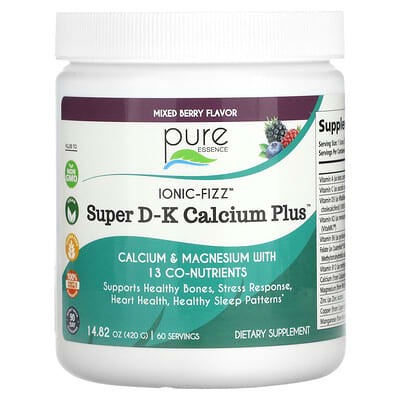
Super D-K Calcium Plus Mixed Berry Flavor

Goals
$50.98 $0.84 per serving


Product analysis
Super D-K Calcium Plus Mixed Berry Flavor can help fill mineral gaps and support normal bone maintenance. Its unidentified blend contents make the full formula harder to judge.
AI assessment of the formula, label and price. How scoring works
Nutrient Quality46
MK-7, the folate preparation and potassium bicarbonate are favorable features of the nutrient mix. The calcium and magnesium preparations are less favorable for absorption, while several other quality details remain uncertain.
Ingredient Transparency73
Ingredient amounts and most forms are disclosed, including the vitamin D source. The unidentified blend contents and remaining unspecified forms still limit a complete comparison.
Value For Money38
Potassium contributes favorable value, but calcium, magnesium and vitamin K offer weak value for the serving cost. Value for many of the other nutrients remains uncertain.
Customer Satisfaction70
Customer feedback is positive, but only a small number of ratings supports it. That leaves more uncertainty about typical satisfaction.
Product Focus21
The minerals and vitamin D mainly help fill nutritional gaps relevant to normal bone and energy functions. Broader heart, stress and hormone benefits remain conditional, while unidentified blend contents limit a complete judgment.
- Format
Powder - Container
- 14 Ounce(s)
- Per serving
- $0.84
- Customer rating
- 4.7 · 69 ratings
Goals

Impact
High effect
Vitamin K · 45 mcgMagnesium · 300 mgCalcium · 250 mgVitamin D · 25 mcgCopper · 0.25 mgManganese · 1 mgBoron · 500 mcgZinc · 2 mgVitamin C · 250 mg
Calcium and magnesium supply minerals used in bone, while vitamin D helps calcium absorption when intake or status is low. Vitamin C supports normal collagen formation, chiefly by correcting inadequate intake. The declared MK-7 contributes to bone-protein activation, although its amount is below the principal postmenopausal study exposure; potassium bicarbonate and bamboo cannot inherit evidence for different studied preparations.
How this product is rated for Bone Health
Ingredient fit65
The formula’s relevance depends on its bone-related nutrient roles and how much the declared serving supplies.
Goal fit
Bone-related nutrients sit within a broader formula, so only part of the ingredient mixture is focused on this goal.
Dose adequacy
The counted amounts provide a partial match to the comparison anchors; their nutritional contribution varies by ingredient.
Pathways76
The supplied findings describe which aspects of mineral handling, bone-protein activity and matrix support are represented.
Depth
The strongest supplied finding concerns bone mineral supply, based on the declared ingredients and amounts.
Breadth
The broader findings chiefly cover bone mineral supply, calcium absorption and regulation, with other bone-related processes less represented.
Evidence98
The counted evidence reflects the supplied ingredients and preparation matching, with clinical benefits limited by the context described above.
Evidence strength
Calcium provides the strongest counted evidence, subject to its nutritional or preparation-specific limits described for this product.
Studied preparation
Preparation matching is incomplete for Potassium, limiting transfer of preparation-specific findings.
Formulation logic100
Partner coverage and declared amounts explain the formulation findings; no configured conflict was found.
Partner coverage
The counted ingredients either stand alone in this comparison or have their relevant partner present.
Conflicts
No configured ingredient conflict was identified in the supplied findings.
Effective doses
The counted ingredients meet the comparison’s minimum amount benchmark; that does not establish a proven bone-treatment dose.

Impact
High effect
Vitamin K · 45 mcgMagnesium · 300 mgVitamin B12 · 30 mcgVitamin B6 · 1 mgFolate · 50 mcgVitamin D · 25 mcg
Magnesium provides limited support for blood-pressure regulation; the supplied trials show small, inconsistent effects. Folate and the relevant B vitamins support homocysteine metabolism, but lowering this marker does not generally reduce major cardiac events. Vitamin D has not demonstrated routine prevention of major cardiovascular events.
How this product is rated for Heart Health
Ingredient fit53
Magnesium, Potassium, Vitamin D provide the main connection to heart health; other active ingredients broaden the formula beyond this goal
Goal fit
Magnesium, Potassium, Vitamin D provide the main connection to heart health; other active ingredients broaden the formula beyond this goal
Dose adequacy
The relevant amounts provide a partial contribution across the formula; higher amounts are not automatically more beneficial.
Pathways56
Electrolyte and vascular-tone balance is the strongest connection in the saved findings; this describes the ingredient roles, not a guaranteed effect.
Depth
Electrolyte and vascular-tone balance is the strongest connection in the saved findings; this describes the ingredient roles, not a guaranteed effect.
Breadth
The main areas represented are electrolyte and vascular-tone balance; other aspects have less support in this formula.
Evidence89
Magnesium provides the strongest relevant evidence here, with the population and benefit limits described above.
Evidence strength
Magnesium provides the strongest relevant evidence here, with the population and benefit limits described above.
Studied preparation
The contributing ingredient preparations match those recognized in the supplied comparison; this does not establish efficacy of the finished product.
Formulation logic100
The relevant ingredients do not depend on a missing partner in the supplied findings. No configured ingredient conflict was identified in the supplied findings.
Partner coverage
The relevant ingredients do not depend on a missing partner in the supplied findings.
Conflicts
No configured ingredient conflict was identified in the supplied findings.
Effective doses
The contributing ingredients have meaningful declared amounts for comparison, without proving a cardiovascular benefit.

Impact
High effect
Folate · 50 mcgVitamin B12 · 30 mcgVitamin D · 25 mcgMagnesium · 300 mgVitamin K · 45 mcgBoron · 500 mcgZinc · 2 mgVitamin C · 250 mg
Magnesium provides the strongest nutritional contribution, supporting normal energy and mineral functions when intake is low. Calcium and vitamin D also contribute to bone nutrition, while vitamin B6 and vitamin C contribute to blood-related and antioxidant functions. Several smaller nutrient amounts did not receive a separate contribution in the saved findings; that does not mean they are absent or biologically inactive.
How this product is rated for Everyday Health
Ingredient fit65
The relevant ingredients support the functions described above, with the contribution limited by their declared amounts and the evidence for each role.
Goal fit
Relevant ingredients contribute alongside other actives whose broader general-health effects are not established here.
Dose adequacy
The relevant amounts meet the saved comparison to varying degrees; smaller or unresolved amounts limit the contribution.
Pathways80
The strongest supported area is energy metabolism cofactors, with substantial coverage in the saved findings.
Depth
The strongest supported area is energy metabolism cofactors, with substantial coverage in the saved findings.
Breadth
The areas reaching the saved coverage threshold are energy metabolism cofactors, bone and mineral metabolism.
Evidence86
Magnesium provides the strongest evidence contribution among the eligible amounts; the ingredient-specific limitations still apply.
Evidence strength
Magnesium provides the strongest evidence contribution among the eligible amounts; the ingredient-specific limitations still apply.
Studied preparation
The eligible preparations match the saved comparison, without establishing form superiority or benefits beyond the supplied evidence.
Formulation logic100
The relevant ingredients do not lack a required partner, and no evaluated conflict was triggered.
Partner coverage
The relevant ingredients can contribute independently or have their required partner present; this does not establish added combination benefits.
Conflicts
None of the evaluated ingredient conflicts was triggered; this is not a complete safety assessment.
Effective doses
All ingredients included in this comparison meet its minimum amount threshold, which is not a proven clinical benefit threshold.

Impact
Moderate effect
Vitamin D · 25 mcgMagnesium · 300 mgVitamin B12 · 30 mcgPotassium · 100 mg
Magnesium supports normal energy metabolism, while B12, B6 and vitamin C contribute to nutritional needs relevant to tiredness and fatigue. Vitamin D adds nutritional support, with fatigue evidence tied to deficient adults. The clearest contribution is meeting nutrient needs.
How this product is rated for Energy
Ingredient fit61
The formula has broad nutritional uses, with some ingredients relevant to fatigue and energy. The amounts provide partial alignment with the saved exposure comparison.
Goal fit
The formula has broad nutritional uses, with some ingredients relevant to fatigue and energy.
Dose adequacy
The amounts provide partial alignment with the saved exposure comparison.
Pathways0
No specific energy mechanism has meaningful coverage in the saved findings. The findings do not show broad coverage of the assessed energy mechanisms.
Depth
No specific energy mechanism has meaningful coverage in the saved findings.
Breadth
The findings do not show broad coverage of the assessed energy mechanisms.
Evidence95
Vitamin D provides the strongest assessed evidence contribution at its amount. The assessed ingredient preparations at adequate amounts match the saved criteria.
Evidence strength
Vitamin D provides the strongest assessed evidence contribution at its amount.
Studied preparation
The assessed ingredient preparations at adequate amounts match the saved criteria.
Formulation logic100
All 5 assessed ingredients meet the saved minimum amount comparison. No assessed conflict was identified.
Partner coverage
The assessed ingredients can contribute independently or have their required partner.
Conflicts
No conflict was identified by the supplied ingredient checks.
Effective doses
All 5 assessed ingredients meet the saved minimum amount comparison.

Impact
High effect
Vitamin K · 45 mcgPotassium · 100 mgMagnesium · 300 mgVitamin D · 25 mcgVitamin B12 · 30 mcgVitamin B6 · 1 mgFolate · 50 mcgVitamin C · 250 mg
Magnesium contributes to vascular function, although findings for arterial stiffness and blood pressure are inconsistent and more plausible with low magnesium status or elevated blood pressure. Potassium may help blood pressure when habitual intake is low; the supplied serving remains below the exposures in the cited trials. The main connection is mineral support for vascular tone, with limited support for broader cardiovascular effects.
How this product is rated for Cardiovascular Support
Ingredient fit55
The formula has a mineral contribution to vascular support alongside ingredients serving other purposes.
Goal fit
Relevant nutrients share the formula with other actives, so its focus extends beyond cardiovascular support.
Dose adequacy
Magnesium and potassium contribute at disclosed amounts, although potassium remains below the daily exposures in the supplied trials.
Pathways58
Vascular tone and sodium balance are the strongest area. The covered mechanisms do not establish prevention of cardiovascular events.
Depth
Vascular tone and sodium balance are the strongest area.
Breadth
Only vascular tone meets the saved coverage threshold; antioxidant-related coverage remains limited.
Evidence86
Potassium leads the saved evidence findings, but its blood-pressure benefit depends partly on low habitual intake.
Evidence strength
Potassium leads the saved evidence findings, but its blood-pressure benefit depends partly on low habitual intake.
Studied preparation
The credited ingredients were treated as matching reviewed preparations; that match does not resolve limits on cardiovascular benefit.
Formulation logic100
The credited ingredients have no unmet partner requirement, and the supplied checks found no matched conflict. Their counted amounts meet the saved minimum contribution threshold.
Partner coverage
No credited ingredient has an unmet partner requirement; this does not establish added benefit from combining them.
Conflicts
No conflict was matched by the supplied checks.
Effective doses
All counted ingredients meet the saved minimum amount threshold; this is not a proven effective dose or a dosing recommendation.

Impact
Moderate effect
Vitamin D · 25 mcgMagnesium · 300 mgFolate · 50 mcgVitamin B12 · 30 mcgVitamin B6 · 1 mgVitamin C · 250 mg
Magnesium may help you feel less stressed if your magnesium levels are low. Its connection to stress relief is conditional, and lasting relief from everyday stress is less certain when you already get enough.
How this product is rated for Stress Relief
Ingredient fit47
Magnesium, vitamin C and vitamin D provide the main connections to stress within a wider nutrient blend. The serving supplies 300 mg magnesium, 250 mg vitamin C and 25 mcg vitamin D, with different reference comparisons.
Goal fit
Magnesium, vitamin C and vitamin D provide the main connections to stress within a wider nutrient blend.
Dose adequacy
The serving supplies 300 mg magnesium, 250 mg vitamin C and 25 mcg vitamin D, with different reference comparisons.
Pathways45
Calming nerve activity is the strongest connection. Other connections concern stress responses and resilience, without broad coverage.
Depth
Calming nerve activity is the strongest connection.
Breadth
Other connections concern stress responses and resilience, without broad coverage.
Evidence76
Magnesium may help if levels are low; lasting everyday relief is less certain. The declared vitamin D3 and other nutrient sources remain relevant without an absorption guarantee.
Evidence strength
Magnesium may help if levels are low; lasting everyday relief is less certain.
Studied preparation
The declared vitamin D3 and other nutrient sources remain relevant without an absorption guarantee.
Formulation logic100
The relevant ingredients can contribute individually without a missing required partner. No particular conflict is identified.
Partner coverage
The relevant ingredients do not require a missing companion ingredient for their individual roles.
Conflicts
No particular ingredient conflict is identified in this combination.
Effective doses
300 mg magnesium, 250 mg vitamin C and 25 mcg vitamin D provide the principal relevant amounts.

Impact
High effect
Magnesium · 300 mgZinc · 2 mgVitamin D · 25 mcgBoron · 500 mcg
Magnesium supports normal nutrition, but the small exercise-related study does not establish higher testosterone in routine, adequately nourished users.
How this product is rated for Testosterone Support
Ingredient fit50
The saved findings recognize the declared nutrients, with broader ingredients and amount differences limiting the formula’s focus.
Goal fit
The formula includes ingredients serving other purposes, reducing its focus on testosterone support.
Dose adequacy
The recognized amounts partly meet the saved comparison; smaller quantities limit the finding without proving ineffectiveness.
Pathways70
The saved route findings describe composition rather than demonstrated changes in circulating testosterone.
Depth
Free-testosterone availability is the strongest saved route; this does not establish SHBG inhibition or a higher free-testosterone level.
Breadth
Only one hormone route reached the coverage criterion, leaving the overall coverage narrow.
Evidence81
The strongest saved ingredient finding remains subject to the population and preparation limits of the supplied human research.
Evidence strength
Vitamin D leads the saved finding, but trials do not establish higher testosterone in adequately nourished healthy men.
Studied preparation
The saved finding recognizes the preparation, without proving a hormone response for routine use.
Formulation logic100
No required partner is missing, and no specified conflict was triggered.
Partner coverage
No required partner is missing for the ingredients recognized in this comparison.
Conflicts
None of the specified conflicts was triggered in the supplied findings.
Effective doses
Every recognized ingredient reaches the minimum amount criterion; that criterion does not establish an effective testosterone-raising dose.
Vitamin B6 Not classified
No linked studies yet.
Ingredients
| Ingredient | Amount per serving | Score |
|---|---|---|
Vitamin A (Beta-Carotene) | 150 mcg | |
Vitamin C (Ascorbic Acid) | 250 mg | |
Vitamin D3 (Vitashine vegan Cholecalciferol) | 25 mcg | |
Vitamin K2 (Menaquinone-7) | 45 mcg | |
Vitamin B6 (Pyridoxine Hydrochloride) | 1 mg | |
Folate (L-5-Methyltetrahydrofolate) | 50 mcg | |
Vitamin B12 (Methylcobalamin) | 30 mcg | |
Calcium (Calcium Lactate) | 250 mg | |
Magnesium (Magnesium Carbonate) | 300 mg | |
Zinc (Zinc Lactate) | 2 mg | |
Copper (Copper Gluconate) | 0.25 mg | |
Manganese (Manganese Gluconate) | 1 mg | |
Potassium (Potassium Bicarbonate) | 100 mg | |
Bamboo extract | 60 mg | |
Beet root powder | 10 mg | |
ionic Sea Minerals | 10 mg | |
Grape skin extract | 8 mg | |
Boron (Boron Citrate) | 500 mcg |
Folate (L-5-Methyltetrahydrofolate) · 50 mcg OverallScore52
A serving provides 50 mcg of folate at a relatively high cost per serving. It uses the active L form of folate.
How this ingredient is rated
Active Ingredient Quality & Bioavailability91
L-5-Methyltetrahydrofolate is an active form of folate. The L designation indicates the active isomer.
Folate Form Hierarchy
L-5-Methyltetrahydrofolate is active folate and bypasses the MTHFR conversion step.
Patented Sources & Isomeric Purity
The L designation indicates the active isomer; no branded source is recorded.
Dose, Safety & Label Transparency20
The serving provides 50 mcg of folate; no DFE amount is stated.
Folate Dosage by Declared Basis
The serving provides 50 mcg of folate; no DFE amount is stated.
Value40
The cost per serving is relatively high.
Price per Bioavailable Serving
The cost per serving is relatively high.
Vitamin K (Menaquinone-7) · 45 mcg OverallScore70
A serving provides 45 mcg of vitamin K at a high cost per serving. The sources are vitamin K2 as MK-7. The MK-7 is not specified as trans or all-trans.
How this ingredient is rated
Active Ingredient Quality & Bioavailability82
The sources are vitamin K2 as MK-7. The MK-7 is not specified as trans or all-trans.
Vitamin K Form (MK-7 vs. MK-4 vs. K1)
The sources are vitamin K2 as MK-7.
MK-7 Isomer Disclosure
The MK-7 is not specified as trans or all-trans.
Dose, Safety & Label Transparency83
A serving provides 45 mcg of MK-7. The label states the amount and source.
Vitamin K2 (MK-7) Dosage Efficacy
A serving provides 45 mcg of MK-7.
Form and Subtype Transparency
The label states the amount and source.
Value20
The cost per serving is high.
Price per Effective MK-7 Serving
The cost per serving is high.
Potassium (Potassium Bicarbonate) · 100 mg OverallScore78
Each serving provides 100 mg of potassium from Potassium Bicarbonate, a modest amount. A whole-product serving costs about $0.85.
How this ingredient is rated
Active Ingredient Quality & Bioavailability100
The potassium source is Potassium Bicarbonate.
Potassium Form Quality
The potassium source is Potassium Bicarbonate.
Dose, Safety & Label Transparency46
A serving provides 100 mg of potassium, a modest amount. The saved evidence gives a potassium amount without explicit elemental-potassium wording.
Potassium Dosage Potency
A serving provides 100 mg of potassium, a modest amount.
Elemental Yield Transparency
The saved evidence gives a potassium amount without explicit elemental-potassium wording.
Value100
A whole-product serving costs about $0.85.
Potassium Value Efficiency
A whole-product serving costs about $0.85.
Alternative products
Report alternatives
Sources
Published studies used for the product analysis and the top-ranked studies for each ingredient and goal.
- [Comparative study of the urinary excretion of boron, calcium, magnesium and phosphorus in postmenopausal women with and without osteoporosis].
- Effect of dietary boron on mineral, estrogen, and testosterone metabolism in postmenopausal women.
- The relationship between boron and magnesium status and bone mineral density in the human: a review.
- Effects of boron supplementation on bone mineral density and dietary, blood, and urinary calcium, phosphorus, magnesium, and boron in female athletes.
- Metabolic responses of postmenopausal women to supplemental dietary boron and aluminum during usual and low magnesium intake: boron, calcium, and magnesium absorption and retention and blood mineral concentrations
- What is the impact of daily oral supplementation of vitamin D3 (cholecalciferol) plus calcium on the incidence of hip fracture in older people? A systematic review and meta-analysis.
- Calcium supplementation prevents seasonal bone loss and changes in biochemical markers of bone turnover in elderly New England women: a randomized placebo-controlled trial.
- The effects of calcium supplementation (milk powder or tablets) and exercise on bone density in postmenopausal women.
- The efficacy of calcium supplementation alone in elderly Thai women over a 2-year period: a randomized controlled trial.
- Calcium-enriched foods and bone mass growth in prepubertal girls: a randomized, double-blind, placebo-controlled trial.
- The Association between Dietary and Circulating Copper Levels and Osteoporosis: a Scoping Review.
- Association between dietary copper, iron, zinc, selenium intake and osteopenia or osteoporosis in elderly hypertensive patients: a retrospective cohort study.
- Associations of dietary copper intake with total bone mineral density and lumbar spine bone mineral density in American adults.
- The association between dietary mineral intake and bone mineral density: a cross-sectional study.
- Association between dietary copper intake and bone mineral density in children and adolescents aged 8-19 years: A cross-sectional study.
- Association between RBC folate and lumbar bone mineral density in postmenopausal women, a cross-sectional study from NHANES 2009-2018.
- Genetic variants modify the associations of concentrations of methylmalonic acid, vitamin B-12, vitamin B-6, and folate with bone mineral density.
- Adequate Intake and Supplementation of B Vitamins, in Particular Folic Acid, can Play a Protective Role in Bone Health.
- Relation of homocysteine, folate, and vitamin B12 to bone mineral density of postmenopausal women.
- Dietary intake of folate, but not vitamin B2 or B12, is associated with increased bone mineral density 5 years after the menopause: results from a 10-year follow-up study in early postmenopausal women.