
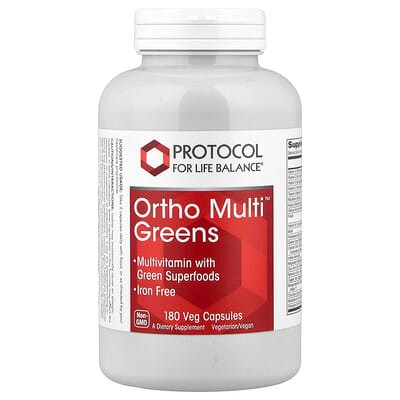
Ortho Multi Greens

Goals
$43.50 $0.48 per serving


Product analysis
Ortho Multi Greens may help fill dietary gaps that affect everyday energy use and general nutrition. Its extensive mix of vitamins, minerals, plants and enzymes makes it less targeted for a single need.
AI assessment of the formula, label and price. How scoring works
Nutrient Quality47
Ingredient quality is mixed, with favorable vitamin E and some mineral forms alongside less favored vitamin D2 and folic acid. The quality of several other ingredients remains uncertain.
Ingredient Transparency69
All ingredient amounts and most forms are stated, making much of the formula easy to compare. The proportions of the different calcium and magnesium forms are omitted, leaving their mixtures less clear.
Value For Money42
Value is uneven: some nutrients are reasonably priced, while several vitamins and extras offer limited value. Uncertainty about other ingredients prevents a firm judgment on the whole mix.
Customer Satisfaction71
Customer ratings are very positive, but the review base is relatively small. Satisfaction therefore reflects fewer experiences than for more widely reviewed products.
Product Focus29
The formula is broad, with its clearest role being everyday nutrition when dietary intake falls short. Its many extra ingredients make it less targeted without establishing a separate benefit for every addition.
- Format
Capsule - Container
- 180 Capsule(s)
- Per serving
- $0.48
- Customer rating
- 4.7 · 78 ratings
Goals

Impact
Moderate effect
Zinc · 7.5 mgVitamin C · 250 mgCopper · 0.25 mgSelenium · 25 mcgGreen Tea · 25 mgVitamin E · 100 IU
Vitamin C and zinc support normal collagen-related functions and skin repair, with B vitamins contributing to skin nutrition. Green tea provides an antioxidant-related ingredient, although the supplied oral skin findings are mixed and do not establish routine UV protection.
How this product is rated for Skin Health
Ingredient fit38
Skin-related ingredients are part of a broader formula with other purposes. Smaller or unresolved amounts limit the contribution in the saved dose assessment.
Goal fit
Skin-related ingredients are part of a broader formula with other purposes.
Dose adequacy
Smaller or unresolved amounts limit the contribution in the saved dose assessment.
Pathways6
The strongest saved contribution relates to uv antioxidant defence.
Depth
The strongest saved contribution relates to uv antioxidant defence.
Breadth
The saved findings show limited coverage across the different skin-related mechanisms.
Evidence100
Vitamin C provides the strongest evidence contribution among the assessed ingredients; this does not guarantee a visible skin benefit.
Evidence strength
Vitamin C provides the strongest evidence contribution among the assessed ingredients; this does not guarantee a visible skin benefit.
Studied preparation
The ingredients assessed at relevant amounts match preparations recognized in the saved findings.
Formulation logic94
The assessed ingredients can contribute independently or have their required partner.
Partner coverage
The assessed ingredients can contribute independently or have their required partner.
Conflicts
No configured ingredient conflicts were identified in the saved findings.
Effective doses
Some assessed ingredients fall below the saved minimum amount threshold: Vitamin A, Vitamin E.

Impact
Moderate effect
Folate · 400 mcgVitamin B12 · 100 mcgVitamin B6 · 25 mgMolybdenum · 25 mcgSelenium · 25 mcgMagnesium · 50 mgVitamin E · 100 IUZinc · 7.5 mgVitamin C · 250 mgCholine · 25 mgRiboflavin · 25 mg
Choline supports normal liver function, while folate and selenium help meet nutritional needs linked to handling specific toxic metals in people with low status or relevant exposure. Vitamins C and E contribute antioxidant functions; these roles do not imply broadly improved toxin clearance.
How this product is rated for Liver & Detox
Ingredient fit40
The ingredients span several purposes, with only part of the selection focused on liver support. The assessed amounts provide partial alignment with the saved ingredient comparisons.
Goal fit
The ingredients span several purposes, with only part of the selection focused on liver support.
Dose adequacy
The assessed amounts provide partial alignment with the saved ingredient comparisons.
Pathways44
The strongest saved coverage relates to methyl-group supply. One reviewed mechanism reaches the saved coverage threshold.
Depth
The strongest saved coverage relates to methyl-group supply.
Breadth
One reviewed mechanism reaches the saved coverage threshold.
Evidence96
Vitamin B9 (Folate) provides the strongest saved ingredient finding; the evidence remains specific to its reviewed context. Only part of the assessed ingredient selection matches the preparations in the saved comparisons.
Evidence strength
Vitamin B9 (Folate) provides the strongest saved ingredient finding; the evidence remains specific to its reviewed context.
Studied preparation
Only part of the assessed ingredient selection matches the preparations in the saved comparisons.
Formulation logic97
No missing required ingredient partner was identified. No configured conflict was identified in the saved findings. Some assessed ingredients fall below the saved minimum amount comparison level.
Partner coverage
No missing required ingredient partner was identified.
Conflicts
No configured conflict was identified in the saved findings.
Effective doses
Some assessed ingredients fall below the saved minimum amount comparison level.
Riboflavin Not classified
No linked studies yet.
Vitamin B6 Not classified
No linked studies yet.

Impact
Moderate effect
Iodine · 75 mcgVitamin D · 100 IUVitamin B5 · 25 mgMagnesium · 50 mgRiboflavin · 25 mgThiamin · 25 mgVitamin B12 · 100 mcgPotassium · 12.5 mg
B vitamins, including thiamin, riboflavin, folate, niacin and B6, support normal energy metabolism. Vitamin C and iodine add nutritional support, while magnesium, potassium, B12 and vitamin D make smaller contributions at their serving amounts. The botanical mass provides no quantified caffeine contribution, so the saved support is mainly nutritional.
How this product is rated for Energy
Ingredient fit61
The formula mainly addresses broader nutritional needs, with a limited focus on energy. The counted amounts provide substantial support, with some smaller contributions.
Goal fit
The formula mainly addresses broader nutritional needs, with a limited focus on energy.
Dose adequacy
The counted amounts provide substantial support, with some smaller contributions.
Pathways0
The saved contribution is nutritional, without meaningful coverage of the specific alertness or performance mechanisms assessed. No specific energy mechanism reaches the saved coverage threshold.
Depth
The saved contribution is nutritional, without meaningful coverage of the specific alertness or performance mechanisms assessed.
Breadth
No specific energy mechanism reaches the saved coverage threshold.
Evidence77
Vitamin B2 (Riboflavin) supplies the strongest relevant evidence at a counted amount, with benefits limited to the particular contexts and outcomes assessed. Most counted preparations match trial materials, while some retain preparation uncertainty.
Evidence strength
Vitamin B2 (Riboflavin) supplies the strongest relevant evidence at a counted amount, with benefits limited to the particular contexts and outcomes assessed.
Studied preparation
Most counted preparations match trial materials, while some retain preparation uncertainty.
Formulation logic100
The counted ingredients can contribute independently or have their needed partner. No configured ingredient conflict was identified. All ingredients counted here reach a meaningful amount in the saved comparison.
Partner coverage
The counted ingredients can contribute independently or have their needed partner.
Conflicts
No configured ingredient conflict was identified.
Effective doses
All ingredients counted here reach a meaningful amount in the saved comparison.
Vitamin B5 Not classified
No linked studies yet.

Impact
Moderate effect
Biotin · 50 mcgNiacin · 25 mgVitamin B12 · 100 mcgRiboflavin · 25 mgThiamin · 25 mgVitamin B5 · 25 mgVitamin B6 · 25 mgVitamin D · 100 IUZinc · 7.5 mgMagnesium · 50 mgGreen Tea · 25 mg
B vitamins help your body use energy from food, while iodine is needed to make the thyroid hormones that regulate metabolic rate. Iodine can help when a shortage has slowed thyroid function, but extra iodine doesn't routinely stimulate an already normal thyroid. These normal nutrient roles don't mean that taking the combination will make you burn more calories when you already get enough.
How this product is rated for Metabolism Support
Ingredient fit55
Thiamin connects the serving to metabolism, although normal energy processes are distinct from a faster metabolic rate.
Goal fit
Several nutrients have roles in normal metabolism, alongside ingredients with other purposes.
Dose adequacy
Vitamin B12 100 mcg, Vitamin B3 (Niacin) 25 mg, Zinc 7.5 mg per serving. These amounts do not themselves prove a metabolic-rate increase.
Pathways0
Thiamin is needed for normal carbohydrate metabolism, but extra intake does not imply faster calorie burning.
Depth
Thiamin is needed for normal carbohydrate metabolism, but extra intake does not imply faster calorie burning.
Breadth
The ingredients do not provide a demonstrated broad increase in whole-body energy expenditure.
Evidence100
Thiamin is needed for normal carbohydrate metabolism, but extra intake does not imply faster calorie burning.
Evidence strength
Thiamin is needed for normal carbohydrate metabolism, but extra intake does not imply faster calorie burning.
Studied preparation
The available ingredient forms have relevant background information, but their presence does not predict a routine increase in calorie burning.
Formulation logic100
The individual ingredients do not require an added partner for the roles described. No particular conflict is identified.
Partner coverage
No additional ingredient partner is required for the individual nutrient roles described here.
Conflicts
No particular ingredient conflict is identified for this goal.
Effective doses
Vitamin B12 100 mcg, Vitamin B3 (Niacin) 25 mg, Zinc 7.5 mg per serving. Declared amounts alone do not show how much calorie burning will change.
Ingredients
| Ingredient | Amount per serving | Score |
|---|---|---|
Vitamin A (Beta-Carotene) | 12500 IU | |
Vitamin C (Calcium Ascorbate) | 250 mg | |
Vitamin D (Ergocalciferol) | 100 IU | |
Vitamin E (D-Alpha-Tocopheryl Succinate) | 100 IU | |
Thiamine (Thiamine Hydrochloride) | 25 mg | |
Riboflavin | 25 mg | |
Niacin (Niacinamide) | 25 mg | |
Vitamin B6 (Pyridoxine Hydrochloride) | 25 mg | |
Folate (Folic Acid) | 400 mcg | |
Vitamin B12 (Cyanocobalamin) | 100 mcg | |
Biotin | 50 mcg | |
Pantothenic Acid (Calcium Pantothenate) | 25 mg | |
Calcium (Calcium Ascorbate, Calcium Carbonate, Calcium Citrate) | 50 mg | |
Iodine (Kelp) | 75 mcg | |
Magnesium (Mag. Oxide, Magnesium Citrate) | 50 mg | |
Zinc (Zinc Picolinate) | 7.5 mg | |
Selenium (L-Selenomethionine) | 25 mcg | |
Copper (Copper Bisglycinate) | 0.25 mg | |
Manganese (Manganese Bisglycinate) | 2.5 mg | |
Chromium (Chromium Picolinate) | 50 mcg | |
Molybdenum (Sodium Molybdate) | 25 mcg | |
Potassium (Potassium Chloride) | 12.5 mg | |
organic Spirulina | 125 mg | |
organic Chlorella | 50 mg | |
Alfalfa juice concentrate | 50 mg | |
Green Tea extract | 25 mg | |
Choline (Choline Bitartrate) | 25 mg | |
Inositol | 25 mg | |
PABA | 15 mg | |
Panax ginseng | 50 mg | |
Citrus Bioflavonoid Complex | 25 mg | |
Rutin powder (Sophora japonica) | 12.5 mg | |
Bromelain (Pineapple) | 20 mg | |
Papain | 12.5 mg | |
Protease | 12.5 mg | |
Lipase | 12.5 mg | |
Amylase | 5 mg |
Manganese (Manganese Bisglycinate) · 2.5 mg OverallScore90
A serving provides 2.5 mg of manganese as manganese bisglycinate. The whole-product serving costs about $0.48.
How this ingredient is rated
Active Ingredient Quality & Bioavailability100
Manganese bisglycinate is an amino acid chelate that the evaluation associates with good absorption.
Manganese Chemical Form
Manganese bisglycinate is an amino acid chelate that the evaluation associates with good absorption.
Dose, Safety & Label Transparency86
The mineral amount is stated directly for each serving.
Manganese Dosage Efficacy & Safety
A serving contains 2.5 mg of manganese.
Elemental Weight Disclosure
The saved facts specify 2.5 mg of manganese itself per serving, alongside its source.
Value80
The whole-product serving costs about $0.48.
Price per Serving vs. Median
The whole-product price is about $0.48 per serving.
PABA · 15 mg OverallScore68
Each serving supplies 15 mg of PABA, a low amount in the evaluation. The whole-product price is about $3.22 per 100 mg of PABA, a high cost for the quantity.
How this ingredient is rated
Active Ingredient Quality & Bioavailability80
PABA is identified in the saved facts, with no specific source or grade recorded.
PABA Source & Grade
The ingredient is named as PABA; the saved facts do not specify a quality grade or establish purity.
Dose, Safety & Label Transparency70
The PABA amount is individually disclosed.
PABA Dosage Alignment
The 15 mg per serving is a low amount in the evaluation.
Label Disclosure Clarity
PABA is individually listed at 15 mg per serving.
Additive and Excipient Quality
No artificial dyes, titanium dioxide, or hydrogenated oils were identified in the recorded other ingredients.
Value40
The whole-product cost is high when compared by PABA quantity.
Price per 100mg PABA
The whole-product price works out to about $3.22 per 100 mg of PABA.
Niacin (Niacinamide) · 25 mg OverallScore65
A serving supplies 25 mg of niacin as niacinamide. Niacinamide is generally not associated with the flushing typical of nicotinic acid.
How this ingredient is rated
Active Ingredient Quality & Bioavailability86
Niacinamide is a standard form of vitamin B3 used here for general supplementation.
Niacin Form & Goal Alignment
Niacinamide is the named form of vitamin B3.
Precursor Source Quality
Niacinamide is a standard form of vitamin B3.
Dose, Safety & Label Transparency67
The serving provides 25 mg of niacin as niacinamide, a form generally not associated with the flushing typical of nicotinic acid.
Clarity of Chemical Form
The label identifies niacinamide as the niacin form.
Form-Specific Dosage Efficacy
The serving provides 25 mg of niacin as niacinamide.
Flush Risk & Safety Labeling
Niacinamide is generally not associated with the flushing typical of nicotinic acid; no flush-free claim is recorded.
Value20
A whole-product serving costs about $0.48; that price covers all its ingredients.
Price Per Effective Serving
A whole-product serving costs about $0.48; that price covers all its ingredients.
Alternative products
Report alternatives
Sources
Published studies used for the product analysis and the top-ranked studies for each ingredient and goal.
- Effects of spirulina (Arthrospira) platensis supplementation on inflammation, physical and mental quality of life, and anthropometric measures in patients with relapsing-remitting multiple sclerosis (RRMS): a triple-blinded, randomized, placebo-controlled trial
- A randomized, double blind, placebo controlled study of spirulina supplementation on indices of mental and physical fatigue in men
- Ergogenic and antioxidant effects of spirulina supplementation in humans
- Association of radioactive iodine treatment with survivorship symptoms and primary care utilisation in women of reproductive age with thyroid cancer: a retrospective cohort study.
- Energy level and fatigue after surgery for thyroid cancer: A population-based study of patient-reported outcomes.
- Health-Related Quality of Life in Differentiated Thyroid Cancer Survivors: A Cross-Sectional Study From Turkey.
- Magnesium-L-threonate improves sleep quality and daytime functioning in adults with self-reported sleep problems: A randomized controlled trial.
- Total magnesium intake and risk of frailty in older women.
- Red blood cell magnesium and chronic fatigue syndrome.
- Exercise, magnesium and immune function.
- [Efficacy of potassium N-acetylaminosuccinate (Cogitum) in the treatment of asthenic syndrome: results of double-blind placebo-controlled trial].
- Human resting energy expenditure in relation to dietary potassium.
- Physicochemical properties of and volatile compounds in riboflavin fortified cloudy apple juice; study of its effect on job fatigue among Egyptian construction workers.
- Vitamin B status in patients with chronic fatigue syndrome.
- B-vitamins, related vitamers, and metabolites in patients with quiescent inflammatory bowel disease and chronic fatigue treated with high dose oral thiamine.
- Metabolic features of chronic fatigue syndrome.
- Effectiveness of Riboflavin in Inherited Metabolic Diseases: A Systematic Review
- Influence of thiamin supplementation on the health and general well-being of an elderly Irish population with marginal thiamin deficiency.
- Randomised clinical trial: high-dose oral thiamine versus placebo for chronic fatigue in patients with quiescent inflammatory bowel disease.
- Dietary reference values for thiamin.